Showing posts with label Grant applications. Show all posts

Thursday, February 02, 2017

Friendly Advice for Your First NSF Pre-proposal

It is going to be okay. Very okay.

Let's start with the important information that until last month I, like anyone who needs to read this post, had never applied for, let alone received, US National Science Foundation research funding. Having been out of the US for most of my time since earning my Ph.D., and other extenuating circumstances, kept me from applying to this extremely important source of funds. As with my posts on applying for NIH and ERC funding (which I didn't get), I'm writing this not as an expert, but because most people who write advice on applying for NSF funding are to varying degrees experts, and have been doing it for so long that they have no idea what us newbies might not know. I've never been on an NSF panel, I've never been to NSF, and all my attempts to talk to NSF employees have been unsuccessful. I am, like you, an outsider. So I learned a lot along the way, much of it later than I should have, and I'd like to share some key points. Before we begin, let's take a moment to contemplate this bodacious caterpillar I found in the University of Wisconsin Arboretum last summer:

Wow!

Alright, now that you remember that you love science, and brim with important and exciting questions about the world, let's delve.

1. NSF, we can agree, does not have the funds to support more than a small fraction of the grant applications they receive. Other huge governmental funders of science, like NIH, are in a similar situation. (I am assuming here, perhaps in vain, that the US government under El Presidentisimo continues to invest in funding basic research at some meaningful level.) This is a problem not only in terms of almost-everybody-doesn't-get-funded, but in terms of the phenomenal amount of time that scientists squander writing unsuccessful grant applications. In many cases, months of each year are spent applying for funding that is not available. On the flip side, NSF has to harness huge amounts of scientists' time to serve on committees, wading through the reams of applications finding reasons to reject as many of them as possible.

NSF has attempted a partial solution to this problem: the preliminary application. Basically, one starts by writing a short (four pages of text, plus many ancillary documents, including a one page Project Summary) version that has to be approved by a committee before one is invited to submit a full application. Most applicants (about 75%, in the program I'm applying to) only have to write the short version before being rejected, and the committees mostly have to read piles of short applications, with relatively few longer ones coming after that.

2. Writing the preliminary application was honestly not that bad. Several reasons: No budget is required, and many of the ancillary documents that NSF needs before they can fund anyone don't get submitted until your preliminary proposal is approved. More importantly, I have good collaborators, who are in practice writing these things. There is a huge amount to know about NSF specific 'grantsmanship.' When the committee gets to our application, after having already scanned scores of others, they will be both eager to find something really interesting that keeps them awake, and eager to find some reason that the thing can be rejected, so that they can get it over with. They will be looking for key phrases that everyone should have, and possible pitfalls indicated by things only people who have served on these committees (or maybe only that particular committee) know about. In short, it would be tremendously surprising if someone who just had phenomenal scientific ideas but no insider guidance as to the evaluation process ever got funding. I am lucky to have had that guidance; while it means I did a lot of rewriting to try to conform to a culture I've never encountered, it also, hopefully, means we have some chance of being invited to submit a full proposal. If so, that's what I'll be doing this summer, again with about a 20-25% chance of success.

3. As with any funding application, reading past successful applications to the same program is important. Notice not only the language used, the level of methodological detail given, and the structure of the proposal, but also the scope and scale of the proposed science.

4. Write, and revise, the one page Project Summary, and make sure everyone in the project agrees on it, before bothering with the longer Project Description. I made the mistake of drafting the Project Summary, receiving only minimal feedback on it from one of my collaborators, then writing the rest of the grant. By the time I got more extensive feedback from this collaborator, I had only a few days to reconsider the scope of the work being proposed and extensively rewrite. The proposal ended up much better for it, but I could have gotten a lot more sleep if I'd pushed for more feedback after writing just the summary.

5. The whole thing really isn't that much writing. Given that one knows what one is doing, and has good communication with collaborators, a good draft can be banged out in a couple of solid days.

6. In most cases, the one page Summary has to be uploaded as unformatted text, and it takes up more space the way NSF automatically formats it than it would if you or I formatted it according to their rules. I, and a few people I've talked to, ended up hacking down the one page summary very shortly before the deadline when we figured this out.

7. In order to apply, you need an "NSF ID." Looking on the NSF web page, you will find lots of information on retrieving your NSF ID, what to do if you have two NSF IDs, whether NSF ID is the same thing as various other identifiers NSF has used in the past, and so on. You will not find any information about how to get an NSF ID if you don't already have one. If you call NSF to ask how to get one, they will be so confused by you that they won't be able to help you, as if you had called to ask how to breath in before speaking. You just do it, and you must already know how. So I will tell you the secret: somewhere in your university or other approved research organization, there is some individual with the official power to communicate with NSF to get you your very own NSF ID. You will have to find out who that person is and request the NSF ID several days before the application deadline. My collaborator at another university didn't get a reply to his request until a few hours before we submitted, and we were actively discussing what would happen if we had to leave him off the PI list. Don't let that happen to you.

8. Which reminds me of another important point. I was advised to contact the NSF Program Officer for my application when I had a nearly final Project Summary worked up. As mentioned above, that didn't happen until less than a week before the grant deadline, at which point the Project Officers were all swamped by others trying to meet the same deadline. I emailed the Program Officer, and got back a very short email, but never got to talk with her. Finishing your Project Summary early will allow you to get input from your Project Officer.

9. Be smart, work very hard, and have extremely good luck.

Wednesday, February 20, 2013

A strange sort of consolation

Last year about this time I was working feverishly on a grant application to the National Institute on Aging (NIA), one of the National Institutes of Health. The specific grant I and my collaborators applied for is called an R21 (Exploratory/Developmental); it is sort of a starter grant for people who need money to do the background work to develop the proven methods and concepts you need to apply for their main type of grant, the R01. We submitted the application last winter, and got the fairly positive feedback from the scientific committee in the summer. They ranked it as being in the top 13% of applications in terms of scientific merit. Not wonderful, not terrible. By far the best (I am told) of the R21s reviewed by this particular scientific committee. This roughly means that if they funded 13% of the applications (all R##s combined), we would likely get funded.

In the fall we heard that our application had undergone final administrative review, but we didn't get any yea or nay answer until January, after the grant would have started, when they told us that we wouldn't get the grant this year but please improve a few things that the reviewers complained about and resubmit.

In preparing the application last year, I read a blog post saying that applications for R21s and R03s (another smaller grant) were pretty much a waste of time. The way the review process works, they are in direct competition with R01s, which are by their nature more mature projects, and are given 12 pages instead of 6 to make their case. Less money+less space+less mature project= very small chance of a small payoff was the argument. We decided the type of work we were proposing was exactly what the R21 was intended for, and was exploratory/developmental enough to have little chance at an R01, so we would go ahead and just try to beat the odds. (He may have run out on his last three wives, but surely he'll change for me!)


Even this rather fierce looking hawk wouldn't have gotten an R21

As of the beginning of this year, and as of now, all US federal agencies don't know what their budget for the current year is. What do you do when you don't know if you have money to spend? You don't spend it. So it turns out the NIA funding rate for R03s and R21s for this years is a whopping 0%. Yep, every single application for those types of grants was rejected. Some R01s were funded, but not so many. I try not to think of the absurd amount of time I put into writing my 0% chance of success application. We won't be resubmitting our R21 grant this year, and I don't plan to submit more applications to NIH in the near future. I do hope Congress gets their act together some time soon. There are an awful lot of American scientists in Europe these days.

Friday, November 02, 2012

Friendly advice for writing your first grant application, actually first edition

As a first year graduate student studying birds in a university natural history museum, I largely failed to learn how to make a decent specimen out of a dead bird. While there are many reasons for my failure, including a lack of aptitude and a lack of effort, at the time it felt impossible in part because the ornithology curator who was teaching a group of us how to do it was just too good at it. She would hold up the dead bird, make a tiny incision in its belly, and then her hands would spin around it and the entire carcass of the bird would be outside of its now inverted skin, which she would hold up to show us. Then she’d grab some bits of wood and cotton, and again her hands would whirl around the bird for a few seconds, after which the bird would be right-side out and restored to a life-like shape, its feathers unruffled, its head turned to the side just so and toes overlapping, as though it was patiently listening for something. I would try to repeat this process on my assigned dead bird, would screw it up somehow, and she would come over, sigh, take the bird for a few seconds and hand it back to me, several steps ahead from where I was. Then she would say, “See?”

I never did learn, or make it in ornithology. From this I learned that of the great challenges of good teaching is that you have to know the topic well, be interested in it and have a strong aptitude for it, but you also have to be able remember what it was like to not know it at all empathize with those with less inherent aptitude.

At the time, I was also learning to write grant applications. I wrote several that first year in grad school, none of which were funded. This was partly because the ideas behind the proposal weren’t well worked out, but partly because I didn’t really know what I was doing as a grant-writer. I have now written a lot of different grant applications, lets guess 40, almost every one to a different funding source. I don’t know that I can claim to know the topic well enough to teach it, or to have a particularly strong aptitude, but I can well remember what it feels like to not know where to begin, which is a very good place to start. So with that in mind, I’m going to offer some thoughts for those trying to write their first research grant applications. I’ve recently written what I learned about applying for grants from NIH and ERC. This is going to be a lot more basic.

First, consider this picture of the time my wife turned into a giant and flattened part of southern Denmark. Pretty cool, huh? Not even Photoshopped.


Okay, now down to business.

1. Don't panic. There is a good chance it seems to you at this point like you are somehow supposed to know how grant-writing is done, and that everyone around you magically knows how to do it, but there is a good chance that no one has ever provided you with any guidance on the subject. Or at least that is where I was at when I was in your shoes. Ask for help and advice frequently. Several times during the process, have people read what you are doing so they can point out your mistakes. There is a whole culture that you haven't been initiated to, and you need a guide. The basic formula for a grant application goes like this: there is a fundamentally important question that we don't know enough about. Here is what the question is and why it is so important. Here is the piece of that question I can address, how I would address it, why that is the right way to do it, why it is feasible and why it won't fail to answer the question. Here is why I am the right person to do it. I need these resources for this part of the plan, and can't do the work without them. Reiterate the importance of the question and your future results.

2. The place to start with a grant application is to have a question you need money to answer. While that may seem horrendously obvious, I have known a fair number of graduate students who were told to apply for a certain grant, or many grants, but didn’t have a clear conception of what they needed the money for. Either the question was ill-defined (as was mine that first year) or it wasn’t really clear what the money was needed for.

3. Writing grants is a pain in the ass, and there are very few academics who wouldn’t rather be spending their time on research. We do it because we need to. That said, writing grant applications is tremendously useful to your research planning, because it gives you a hard-deadline and strict format in which you have to clearly state your research plans in a succinct and clear way. My research plans have often improved dramatically through the process of writing them into an application. Some universities require graduate students to submit a detailed research proposal before starting work on their theses. This serves the same purpose.

4. The two most common types of funding you may be applying for are for research costs and for your own stipend or salary. Small grants available to students usually focus on research costs, fellowships usually fund only stipend or salary and related costs, although some do both or are for funding travel to conferences or other specific costs. Every granting agency has rules for what each grant can or can’t be used for, and so what you apply for depends on what you need to fund.

5. There are an effectively infinite number of organizations that at least occasionally give research grants, but the chance that any one of them is the one you need to apply for is almost infinitely small. This makes finding the grants you should be applying for very difficult. The way to go about this is to avoid doing what I did. I wasted a huge amount of time online looking at listing of things I could apply for, examining the websites of various foundations, etc. Instead, ask people at your university what other students have applied for successfully. Ask faculty, other students, and the administrative staff. Most every university has people whose job it is to shepherd grant applications.

6. Whenever possible, get a copy of someone's successful grant application. Get several if you can. The instructions for every grant are different, so it is best if the application you are reading is for the same grant you are applying for. That said, there is a certain grant-like style that you will find in most applications.

7. Know your audience. Most research grants are evaluated by a small group of very busy researchers who have to get through a big pile of applications and find just a few to fund. Find out as much as you can about who these people are, and design your grant to grab their interest, and tailor it to (or slightly below) their level of knowledge of your field.

8. You need to convince them that your ideas are compelling and sound, your goals achievable and the whole thing in line with the purpose for which the grant is given. You also need to convince them that you are the person to do it. Doing all of this is harder in less space than in more. When you only have a page or two, as is often the case with the grants available to students, you can't get bogged down in the details. Your writing needs to be crisp and to the point. I often write much more than I need and then edit it down repeatedly. No matter how much time you put into writing a section, if you find it isn't necessary, cut it.

9. Beware of giving too much methodological detail. The committee reviewing the grants generally won't care what concentration your solution will be at, where you will order the food pellets or what software package you will use to analyze your data. That said, if one of those details is key to understanding what you plan to do, of course you need to include it.

10. Try to write it long enough in advance that you can set it aside and come back to it a few days later, perhaps more than once. Once you've worked it over more than a few times, you need some time away from it before you can really see it again. Very good writers can produce very bad writing when they've lost their ability to take a step back and just read.

That's my ten cents (inflation). I'm sure there are things I've missed, but those are the main lessons that I can remember learning. Good luck. Now quit browsing the internet and get back to writing.

Tuesday, October 16, 2012

Friendly advice for your first grant application, ERC edition

Earlier this year I wrote a fairly long post about the experience and lessons of completing my first NIH grant application (nightmare). While I still haven't heard back if NIH are going to fund me, the good news is that my application has been deemed to at least have the scientific merit for funding (the scientific review board ranked it ahead of almost all of the other applications). Now they have to decide if it makes sense for them administratively to fund it. I should hear some time this month, I hope.

In the mean time I've been applying for more grants (three applications I'm involved in have been submitted in the last three weeks), because what else is there for scientists to do? I've just completed my first grant application to the European Research Council (ERC). I've heard from several people that my NIH post was helpful, so I'm going to offer a few of my thoughts on the ERC process.

Before we start, think about how cool nature is. For example, consider this American Dipper my wife and I saw in Lassen Volcanic National Park a few years ago.
Now, with that in mind:

1. Don't panic.  The ERC process is far less brutal and inhuman than NIH's. Where NIH's instruction booklet is 264 pages and requires numerous supplementary online documents, ERC's is 77 (really only one 40 page section of it was necessary for me, and it is well organized) and requires very little outside information. It took me far less time to complete the ERC Starting grant application than just to figure out how one in theory applies for an NIH grant, despite the fact that I was applying for eight times as much money from ERC, and the funding rate is somewhat better. The whole ERC process, including a lot of reading relevant literature I wasn't previously aware of, took me about three weeks of very hard work. There is a reason so many American academics are in Europe these days. There is no industry of writing ERC grantsmanship advice the way their is for NIH because it just isn't necessary. That said, I'll offer a few bits that may be helpful.

2. The type of grant I applied for, the ERC Starting Grant, is the one most people applying for the first time will apply for. "Starting" in this case means early in your career (at least two and no more than I think seven years since you got your PhD) rather than necessarily your first grant. They also have other grants for people later in their careers. The idea is that a promising early-career scientist applies for money to start a research group at a European university (or other academic host, like a Max Planck Institute). The host is named in the grant and has to provide a letter promising to employ the applicant for at least the duration of the grant (up to 5 years) if that application is funded. It has often been the case that applicants would apply with one host and then upon getting funded used that wad of cash an enticement to get hired somewhere else, but I hear that the ERC is trying to clamp down on that. They retain the right to tell you that you can't take it with you.

2. Try very hard to get a copy of a successful ERC application, the more recent and the closer to your field, the better. While the instructions are pretty clearly written, it is always helpful to look at how a successful application is organized. That said, make sure you follow the latest version of the instruction. A friend of mine who is also applying for an ERC this year thought he was supposed to use the 2012 instructions, because it is 2012. Silly friend! If you write your application in 2012, your application will be reviewed in 2013, so use the 2013 instructions. They don't seem to change too drastically from year to year, but they do change.

3. Be aware that when they say you have to have your PhD for at least 2 years, they mean the date physically written on your diploma has to be at least two years before they publish that year's call for applications. I wasn't eligible to apply last year because while I finished my PhD more than two years before the deadline, the somewhat later date written on my diploma was less than two years before the somewhat earlier date when the call for applications was published. They don't care about your citizenship or residency, but they do care what date is written on your diploma.

4. They review in two rounds. The first time they look at your CV and publications and a five page project description called an 'Extended Synopsis.' (Sort of like an unabridged compact edition). If you make it through the first round, they look instead at a 15 page scientific project description that includes more detail, a methods section and your proposed budget. The five pager really is a compact version of the 15 pager minus the budget, and there is no reason you can't copy and paste almost all of your text from the first into the second.

5. ERC has a list of 25 topic-specific evaluation panels that review these applications. Before you start writing, decide which panel you are aiming it at. When they publish the names of the panel chairs, be sure to look at the recent publications of your panel's chair so you know your audience.

6. You will need the help of an administrator at your proposed host. Find out who that person is and give her at least a month notice that you are applying. Chocolate is not a bad idea.

7. Oh yes, one last thing. The amount of money you can ask for doesn't depend on which country your host is in, but what you can do with that money does. My proposed host is in Denmark, which means I can hire about one third the number of people that I could in Germany with the same budget, and perhaps one tenth as many as in the least expensive EU countries. But apparently they are so focused on the scientific merit of the project and applicant (and to a lesser extent the host) that which country you propose to work in or how relatively expensive it is isn't a big concern for them.

That's about it. The three weeks I gave myself to get this done was clearly too little time, and I'm now exhausted and behind on everything else. My application probably could have used another couple of days of polishing and reading through by friends. But all in all I think the ERC process is quite reasonable.

Good luck and happy grant writing. I'm going to try to remember what papers I was working on before I started writing grants again.

Wednesday, March 14, 2012

Friendly advice for your first NIH grant application

I've just submitted my first National Institutes of Health grant application (or rather administrators at my collaborator's university have submitted an application that I wrote most of). In preparing to write it, I read a lot of online advice ranging from the general 'how to write an NIH grant' to the specific 'the clause-structure I use while writing my cover letter for maximizing the chances that it will be sent to my preferred review committee.' People who regularly apply for NIH money refer to NIH funded research as an industry, and like any industry, there is a lot to know to compete successfully. NIH pays or invites some people to write advice on 'good grantsmanship' and many others, for a variety of reasons (perhaps on their blogs) write advice essays. Most of this advice starts with a paragraph or two along the lines of, "I've been conducting NIH funded research since 1982, and am currently involved in seven NIH funded projects, four as PI (Primary Investigator). I've served on 12 review panels and helped to amend the rules on permissible administrative expenditures on research grants in 2002 and again in 2006." And so on. The message is, "I am an expert on NIH funding applications and therefore qualified to advise you." While these people certainly are qualified and anyone planning to apply should read as much of their advice as bearable, there are two points I would like to make about this that they may not have considered. The first is that the way they write their advice, including the way they lay out their qualifications, reads very much like an NIH application. It makes me wonder if becoming expert in these applications makes it hard to write a love letter that isn't in the form of a funding application."Specific Aim 2: Produce a rapid natural release of endorphins, aiding current pleasure, speeding forgetfulness of discomfort and fomenting pair-bonding."

Second, and more seriously, I have the impression that none of these people nor the people writing the instruction books or the FAQs on the NIH websites have any memory of what it is like to not already know how to apply for NIH funding. The instruction book is full of rules that are explained not in terms of what you have to do, but in terms of how what you have to do is different than what it was before the changes to regulation #SF5326BB777. They use all sorts of words that are normal English words but don't mean what they normally mean, without explaining, because however NIH usually uses a word is its normal meaning to them. (This, by the way, is very close to the technical definition of jargon).

So I'd like to offer a few pieces of advice to people considering applying for their first NIH grant. I am not an expert, have never served on (or been invited to serve on) a review panel and may or may not ever have any NIH funding, but when I was a kid my dad worked just a few blocks from NIH headquarters, and I once spilled an incredibly powerful neurotoxin on myself inside an NIH laboratory. Before I start, consider this unrelated photo (of a 2.5 inch long weevil I once found in my hair) that helps to break up the text:

Notice that its sharp mouth parts are at the end of its huge nose. Cool huh?

Okay, here goes:

1. Before doing anything else, ask yourself if you can spare the two or three hundred working hours your first NIH application is likely to take you. If you can't, don't. Subsequent applications may take an order of magnitude less time, but this is going to be a slog.

2. Before doing anything second else, find colleagues who know all about applying for NIH grants and buy them beer, chocolate, whatever it takes. Wash their cars, baby-sit their kids, fix their refrigerators, do their laundry. This will save you so much time. If you are very lucky your department/institute/whatever may even have someone whose job includes guiding you through the process. If so, flowers and a gift-certificate to a nearby spa are in order. If you can by any means obtain copies of past successful grants to use as Rosetta Stones in figuring out what the instructions mean, then you have some chance of retaining your sanity.

3. Next, find out who is your SO (Signing Officer, an administrator officially authorized to sign legal documents on behalf of your organization). You don't submit the grant, the SO does. She also has to do various other registration tasks, meaning that they need to know that you will apply several weeks before you actually do. If you just found out that the deadline is in three weeks, relax. There will be another deadline some months in the future, and by then you may have found some other way to fund your work. The SO will need all the forms you are to prepare at least a week before the official due date, as there are a whole bunch of other forms they have to fill out seperately.

4. Don't panic. Download the 264 page instruction book (a.k.a. "SF424 (R&R)
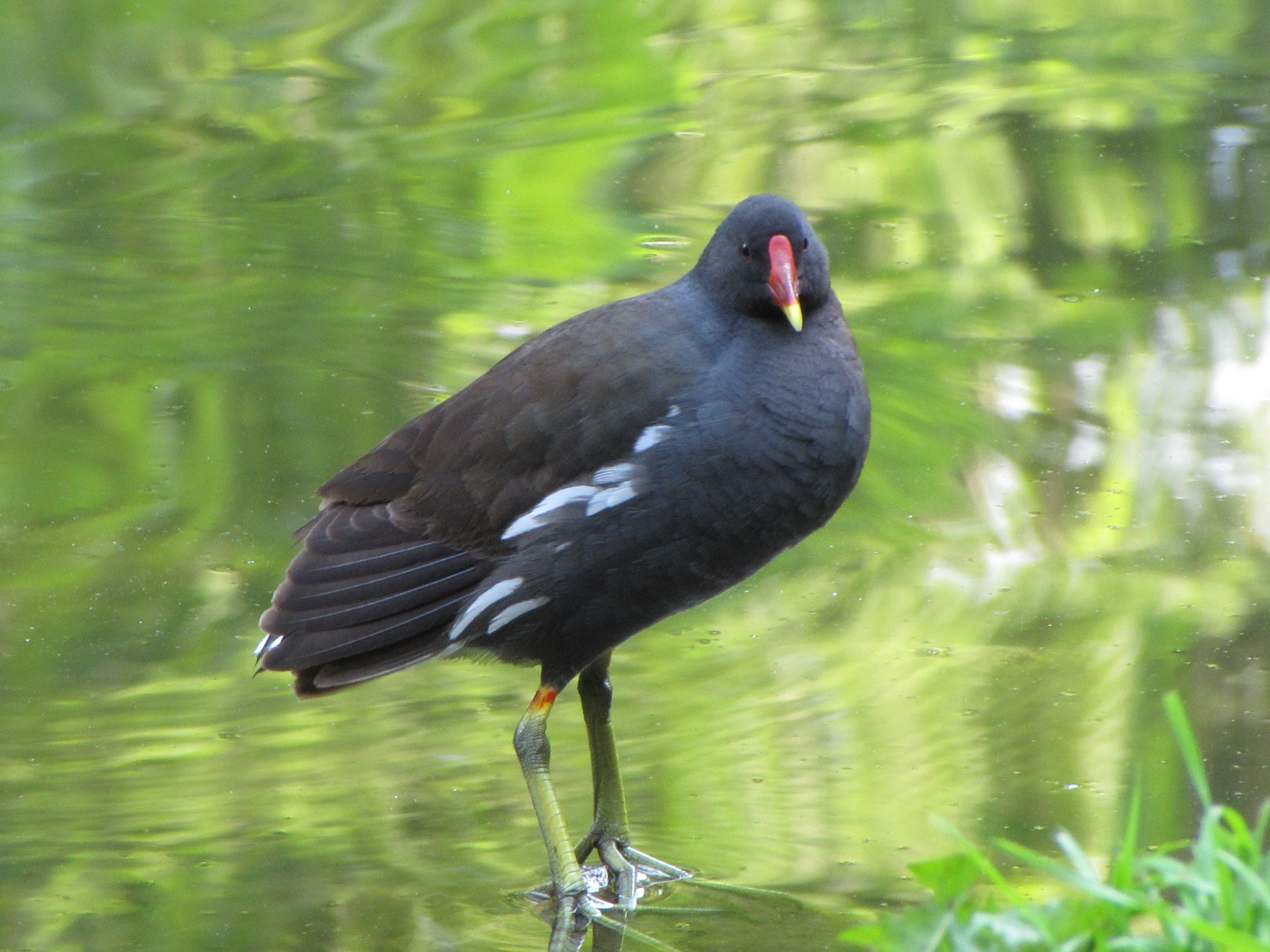
Application Guide for NIH and Other PHS Agencies"). Here is a picture of a moorhen to help you not panic as you download:

Can you see how long its toes are? Fricken' long. Imagine soaking your extra-long toes in a nice summer pond.

5. Do not print out the instruction book. It is 264 pages. You will need to constantly jump from section to section to hunt down the clues and riddles needed to fill out each of the approximately 30 forms you will complete. Keep it digital so you can search for relevant terms.

6. Do print out this glossary of NIH terms. Then read it. Then read it again to see if you understand it any better. Keep in mind that while necessary, this glossary is wildly incomplete, because NIH people can't guess what terms non-NIH people won't understand. Also keep in mind that when they use a term to define itself, they mean well.

7. The National Institutes of Health are called "Institutes" because they have quite a few different topic-specific Institutes, plus a bunch of Centers and several Divisions. You are supposed to know which of these is most likely to be interested in funding your work, contact the appropriate PO (program officer) and pitch it to them before then writing in your cover letter than you contacted that PO and she encouraged you to apply to that Institute, Center or Division. There are very detailed guidelines you should follow in writing to that PO. You are supposed to already know which PO within the appropriate branch is the appropriate PO. The only way I found of finding this out was to spend countless hours on the NIH web pages learning about the structure of NIH, then countless more hours reading those pages before making a wild (and wrong) guess. Luckily the person I wrote to (who wasn't even at the Institute I thought she was at) directed me to another person, who told me that I was heading the wrong way. Eventually I made a decision.

8. Go through the instruction book and make a list of all the forms and attachments you will need. Depending on the specifics, there could be anywhere from 15 to infinity of them. On your list, make notes as to the purpose of each form and what is an attachment to which extension to which sub-form. Also note which parts you have to do and which parts the SO has to do, and then confirm this with the SO. Then look at these pieces in the pile of example applications you've gathered.

9. Don't plan any vacations for before the due date. Plan a vacation for after the due date.

10. You may notice that I have not yet mentioned anything about science. At least once a week, think about the scientific goal of your application. It is very easy to lose track of the fact that there is some reason you are putting yourself through this.

Friday, February 03, 2012

11-hour

One of our laws in the U.S. requires that federal paperwork that people have to fill out be a bit longer than necessary in order to inform us that the federal government is mandated by law to reduce unnecessary paperwork, and to provide an estimate of how long it should take to deal with the particular piece of paperwork.


I'm preparing a grant application to the National Institutes of Health, and have spent the last month trying to figure out the rules, regulations and customs. They provide a helpful 264 page guide to filling out the application form, with links to more information online. This guide estimates it should take me 11 hours to prepare my application, not including the part where I design my research. It also advises me that I should read the whole guide, and the various additional information (including a very necessary glossary) before beginning to fill out the forms. A friend of mine, who recently looked at this instruction book and thereupon decided not to apply for NIH funds, suggested that anyone who could read and comprehend all 264+ pages in under 11 hours with enough time left to fill out the forms should probably just be acknowledged as a genius and given whatever money they need for their work.

I certainly don't blame NIH for having a lot of rules, or putting them in a book. They have a huge number of people asking them for money, the responsibility to make sure all the applications are dealt with fairly, and the need to comply with a very large number of laws on many topics. All sorts of special cases and exceptions arise, and they need to have guidance on everything (although I have already come across several places where one just has to know how it is done, generally by asking people who have done it before). So you can't really blame their helpful but understaffed staff. However the 11-hour estimate should probably be reexamined.

Anyway, I'm learning, and the next time I write an NIH application, it may take me only 11 hours to understand the rules, provided they haven't changed them too much. The sad part is that the proportion of applications funded continues to decline, even as the length of the application instructions increases. I'll distract myself from thinking about that by reading the 33 FAQs about the Modular Grant Application Concept.

Saturday, August 27, 2011

Writing while sleep deprived

I am about to submit another big funding application. This one has been a lot more work than the previous applications, as the required research statement, the largest of several sections, is 25 pages. I can't really complain. If I was going to give someone enough money to run a research group for five years, I too would want to know in some detail what they would do with the money. Further, sitting down and trying to put my plans into a single document makes me systematically consider how my various plans fit together, always a useful exercise. My only complaint really is that I should have done much more on this long before my daughter was born. It is hard to care too much about the details of the application while fighting to stay awake and get the baby to sleep.

Friday, February 18, 2011

news

First the bad news:
I will not get the grant. The interview went well, but the Human Sciences committee included no one with knowledge of my field (either of my fields, really), and my claims that no one else is focusing on this important topic, while true, were not entirely believed. Out of >60 applicants, I am told they interviewed 10 and will fund three.

Second, the good news:
I have been encouraged to apply for a nearly identical grant in the Biology section, deadline this Monday. If I don’t get that, I have been generously offered enough funds to recruit a couple of grad students and a post-doc, while keeping my current position. So one way or another I will have a research group, although not necessarily one as well funded or official as I would have had.

Friday, January 14, 2011

Two talks at once!

My task, apparently, is to give a talk to both audiences simultaneously. Those viewing my job talk will include “a specialist in your field” as well as committee member representing the breadth of backgrounds of the Human Sciences Section of the Max Planck Society. That Section consists of the following Institutes, which I have casually categorized:

Anthropology:
MPI for Evolutionary Anthropology, Leipzig
MPI for Social Anthropology, Halle/Saale

Psychology:
MPI for Human Development, Berlin
MPI for Human Cognitive and Brain Sciences, Leipzig
MPI for Psycholinguistics, Nijmegen, Netherlands

Economics:
MPI of Economics, Jena
MPI for Research on Collective Goods, Bonn

Law:
MPI for Foreign and International Social Law, München
MPI for Intellectual Property, München
MPI for Comparative and International Private Law, Hamburg
MPI for Foreign and International Criminal Law, Freiburg
MPI for Comparative Public Law and International Law, Heidelberg

Sociology:
MPI for the Study of Religious and Ethnic Diversity, Göttingen
MPI for the Study of Societies, Köln
MPI for Demographic Research, Rostock

History:
MPI for Art History, Florence, Italy
MPI for the History of Science, Berlin
MPI for European Legal History, Frankfurt/Main

You will note that I put my own institute, Demography, under the heading of sociology. Demography is in many way rooted in sociology, despite my belief that it should be a branch of biology. You will also note the preponderance of topics such as Law, Economics and Psychology, which have little theoretical overlap with evolutionary demography.
This is, in a way, a brilliant way of evaluating an applicant. Anyone who can describe their topic in a way which is simultaneously comprehensible and exciting to experts in one’s own field and experts in distant fields is at least a talented communicator. If they threw in some toddlers, who also had to like my talk, and maybe a few Tea Partiers, then it would be a real challenge.

Thursday, December 23, 2010

Passed round one

They said they would get back to me in December, but I was starting to doubt, as today is effectively the last working day of the year for those few Germans who aren't already on vacation. But I got the email this morning.

I've been invited to give a short talk on my research to the committee deciding which applicants will be invited to form Research Groups. The interview will be mid-February in Berlin, and I should know very shortly after that if my application was successful.

This means I have a month and a half to write a talk, make impressive figures and graphs, and so forth. The hardest part for me in writing the talk is figuring out who my audience is. The committee that wants to interview me is from the Human Sciences Section. This includes institutes focusing on anthropology, economics, art-history, law, religious and ethnic studies, linguistics, sociology, the history of science and the study of cognition. It also includes demography, evolutionary anthropology and a fair bit of other natural sciences. I can't simply give the same talk to a group of biologists and demographers that I would give to a committee of lawyers and ethnographers. I don't yet know if the committee as a whole will be judging my talk, in which case I have to assume a great diversity of background, or if they will have a smaller group of specialists assigned to each talk. I can give a good talk either way, but not both simultaneously. I've got some thinking to do.

Friday, October 15, 2010

The LPU

This big grant on applying for, to lead my own group, requires me to do all sorts of things beyond just completing the grant application. I need my CV to look as good as possible when I submit, and that doesn't just mean checking for typos. A lot of the work that I've done recently is not yet in the form that goes on a CV, so I need to get it in that form. A paper that is written but just sitting on my computer is not a publication. So last week I submitted a draft to a high-profile journal is very rapid turnaround time, hoping to have accepted before my application deadline. I am now working on what is called an LPU.

The Least Publishable Unit has a long and proud history in science. It is often the case that one can either toil for months over a very long paper, or chop that up into several smaller papers which will come out faster, often in lower profile journals. The quality of the work is not necessarily any lower, but the step is more incremental and the CV filled out faster. This particular LPU is a simple reanalysis of some data from my doctoral work. I started writing it today, and expects to have completed draft by sometime next week. I will submitted to a low-profile journal with rapid turnaround and hope to have an answer from them before I send in my CV.

I do not feel at all bad about this, my first LPU, for several reasons. First, looking through the CVs of most of the very successful scientists I know, there are quite a few little papers among their giant publications. Second, I can think of several papers which seem to me to have started out as LPUs but which turned out to be tremendously important and widely cited. Third, experience and mentors have told me people are more likely to read a short paper. Fourth and finally, writing short papers is a hell of a lot easier when one has to dictate everything.

There is one way in which this paper does not really meet the classical definition of an LPU: there are lots of data behind it. The true LPU should have just enough data to make a publishable paper. In this case, the sample being analyzed is fairly enormous, although not much bigger than is needed to answer the question.

All in all, writing a little paper seems a good change from the massive review article I've just submitted. I hope it turns out to be as easy as I think it will.

Friday, October 08, 2010

Big grant, small grant application

Applying for a grant is nothing new, but this one is big, at least by the standards of the grants have applied for previously. The Max Planck Society sponsors Independent Research Groups, headed by a promising young scientist to explore some innovative and important niche. My task is to convince them I am promising and young, and that my work is innovative and important. They don't actually say young, they say "early career," for which I qualify, as I just got my PhD last year. I'm also fairly confident that my work is innovative, as everyone I tell about my work tells me that nobody else has thought about the question. The problem is, "nobody else has thought about the question," can be taken to mean, "who could possibly be interested in that?" So I am young and innovative, and my challenge is to seem promising and important.

Assuming I can convince them of these things, more so than the many other applicants, it will be a pretty sweet deal. They will not only give me a significantly increased salary for five years and enough funding to get my experiments going, they will pay for me to hire a couple of graduate students and a postdoc or two. Frankly, this is more of a career advance than I think I am likely to receive at this point.

The nice part, other than the generosity of the award should I get it, is how little work they ask of me for the application. They want only a one-page statement of my Scientific Accomplishments (I'm not sure what these are yet) plus 2 pages of Research Plans. I could give them 20 pages of research plans with little difficulty if my hands worked well, but under the circumstances I'm much happier to give them 2.

How my health issues will work into this whole application is an interesting question. There is no doubt that I would have been more productive this year and in grad school had been healthy, but I doubt that they can or should take this into consideration. The best I can hope for is that one of my letter writers will mention something about dedication to science or gumption or the fact that I just keep coming back, like a bad case of poison ivy.

On a more philosophical level, I can ask this question: if someone has a disability which interferes with their productivity, and is likely to continue interfering with their productivity, should an employer consider how productive the worker would be without the disability, or should they simply asked of each candidate, "how productive is he/she likely to be?" I would like to say the former, but from the employer's point of view, it's hard to make the case against the latter.

On the other hand, my joint problems potentially make me better qualified to think of the questions and tell other people to gather the necessary data to answer them than I am for actual data gathering and analysis. The higher they promote me, the more qualified I may be.