Showing posts with label reptiles. Show all posts

Thursday, January 19, 2017

Large Alligators, explained.


I've now seen several reactions to this video shouting questions like, "Why aren't they all dead?!", "Why aren't they running for their lives!?"

Well, sit yerself down my friend, I'm going to be brief.

1. Telephoto lens makes that ol' gator look bigger and closer than it is.
2. Gators rarely attack people unless fed by people, or defending nests. Average is less than one fatal attack a year in the US.
3. Gators are aquatic ambush predators. They don't run down large prey on land.
4.  Florida has well over a million gators. Spend time there, you learn not to worry about them.
5. I stepped on a live, submerged gator while working in the Everglades. It moved away. So did I.
6. Florida, outside Miami Beach, is the deep South. Somebody, possibly everybody, in that crowd is armed.
7. If they had all run away there would be no video of it.

 "Video: Large Gator Spotted in Florida" isn't quite fake news, but it certainly isn't news.

Thursday, January 05, 2012

A, alligators all around


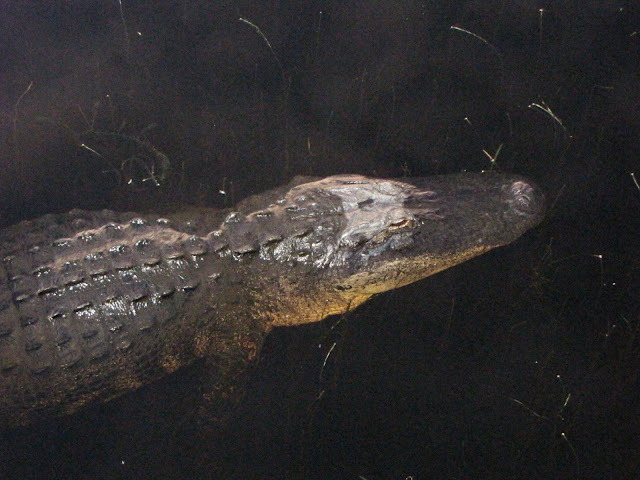
They say that the distance in inches between an alligator's eyes and its nostrils is equal to the length of the whole animal in feet. This behemoth hangs out by the fishing dock in Loxahatchee National Wildlife Refuge feeding on discarded bait fish and who knows what else. My best guess is 14 inches nose to eyes, which would make it not unheard-of big but certainly exciting-to-canoe-past big.

It is amazing to think such an invulnerable top predator (at least within the refuge) started out nearby as a scared little snack for herons like this:

Saturday, January 02, 2010

Thrice bitten

There is a class of "getting to know each other" games that organizers like to force upon groups of people meeting for the first time, in order to help them start talking to each other. One of these is called something like "Two truths and a lie" in which each person offers three autobiographical facts, and the group has to guess which one is false. My facts when faced with this game were:

1. I have been stung by a Portuguese Man o'War.

2. I have been poisoned by a black widow spider.

3. I have been bitten by a venomous snake.

The third was the one I intended to be false. I have just found out that all three of these are true. The only snakes I have ever been bitten by are those I have picked up, and the only snakes I have picked up are those which I knew to be non-venomous, primarily garter snakes. It turns out though, that garter snakes are venomous, and my knowledge (shared with most of the rest of the world) of their lack of venom was wrong. Mind you, they almost never actually get any venom into a human, and if they do it is not dangerous. But it turns out garter snakes do have venom glands, and of the dozens I've handled I've twice been bitten by them. Once picking up a tiny individual from under a rock, and once rescuing a larger individual from a road. They don't have fangs, or dental groves, or other efficient venom delivery systems, and their venom isn't strong enough to kill even small prey, but apparently if they chew on a prey item long enough some of the poison will work its way into the wound and perhaps help to subdue the food, easing swallowing. I once watched a small garter snake attempt (for about twenty minutes) to swallow a very large frog, and I must say the poison didn't do the snake much good, despite extensive chewing, because the frog escaped after giving the snake a good kicking about the head.

If I'm ever forced into that game again I will have to change my lie to, "I've been bitten by a venomous mammal." I'm not dumb enough to pick up a shrew.

Friday, January 01, 2010

Convergent crocodilians


This attractive individual lives in the Zoo Basel. It shares a large enclosure with these two:


As we gazed upon their toothy serenity, my wife asked me what species they were. I had to admit I didn't know. There may have been a placard somewhere, but in the crowd of humans I didn't notice it. Clearly crocodillians, and not alligators or caimans, but beyond that I couldn't say. Gharials have longer, skinnier snouts for catching fish, and most crocodiles have thicker, heavier snouts for pulling down large terrestrial animals. These seemed to be somewhere in between.

I've looked up what species of crocodilians have snouts like this, and was pleasantly surprised to find out that there are three candidates: the Slender Snouted Crocodile, the False Gharial and the Freshwater Crocodile. All three have similarly shaped snouts and eat a mixture of fish and terrestrial prey. All three are said to bite humans only when harassed, and all three live in fresh water. Each is found on a different continent and they are not closely related to each other. The African Slender Snouted Crocodile, the South Asian False Gharial and the Austrailan Freshwater Croc have apparently evolved into similar niches and therefore converged on similar morphology. Interestingly, despite its numerous crocodilians, the Western Hemisphere seems to lack a similar species.

I found out that these are Australian Freshwater crocs only by looking up which of these three species the Zoo in Basel keeps.

They also hold three of these, Nile Crocodiles:
That's what the above water part looks like. The below water part of the same individual in the same position looks like this:


Notice the much wider, more typical crocodilian snout.

Wednesday, July 16, 2008

Snake self defence

Iris and I were on our way up Blake St from the BART station to our house.
At the corner of Walnut St, I exclaimed, "Oh!"
"What! What!? What?" Iris responded.
"A garter snake!"
The sleek black ribbon, two feet long and no more than half an inch wide, with a bright yellow strip up its back, was frantically trying to wriggle out of the street and onto the curb. That corner has no curb-cut, and its movements were too disorganized to allow it to climb the 6-inch curb.
Three facts jumped to mind:
1. It was clearly overheated by being on the black pavement in the sun, and would cook to death or get run-over unless we rescued it.
2. Garter snakes are not poisonous, but can bite.
3. It probably came from El Cerrito Hillside Natural Area, 200m up the street.

So I handed my cane and groceries to Iris and grabbed the snake with both hands. But I had forgotten that the hotter a snake is, the faster it can move. Before I could get a finger on it, my thumb was bleeding from multiple tiny punctures. I grabbed the little snot anyway and held firmly, but without squeezing, on the back of its skull. Then it hit me with a garter-snake's last line of defense: musk. A garter snake's musk glands are in its vent (a.k.a. cloaca, a.k.a. butt) and can rapidly discharge a surprising quantity of a fluid that smells somewhere between a port-a-potty and old gym-socks.

With one hand bleeding and the other clamped on a snake and stinking, I looked up at Iris. She handed me my cane and retreated up the street.

Thamnophis elegans - Western Terrestrial Gartersnake


Saturday, February 23, 2008

Field Notes

FEB. 23 2008
D. Levitis
Hillside Natural Area (North Unit) El Cerrito, Contra Costa County, CA

Sijie Mao, Nichole Winters and I went out from 1300 to 1530. It was quite windy with very strong gusts, temp in the lower 50s and varying between slight drizzle and significant rain. Our fist stop was the detritus field around the storm drain at the lowest point in the park, just behind my house, under the Eucalyptus. A lot of good cover items, but nothing under there. From there we went just up the hill to the small pile of shipping pallets on the grass. Under the first one I lifted was an Aneides lugubris (Arboreal Salamander)! The first I'd seen here. We took this as a sign of good salamandering to come.

We followed a route approximated by that marked on this map, but with many side excursions to check under log, rocks and other cover objects:


Much of this part of the Nature Area has many of the cover objects removed for yearly mowing, so much of the available cover is in piles of cut log pieces or small rocks piled at the base of trees and in gullies.

Sijie and Nichole are extremely contentious about putting every cover item back exactly as it was, and are energetic and enthusiastic herpers. We found almost nothing under rocks, but the logs were very productive today. We checked under approximately 400 wood bits and 100 rocks/cement bits and found 71 Batrachoseps attenuatus (California Slender Salamanders) 3 Aneides and one Elgaria multicarinata (Southern Alligator Lizard).

The Aneides were all near oaks, as Dave Wake told me to expect, while the Batrachoseps were under logs and a few rocks in every habitat we checked. The Elgaria was under a pine log in grassy habitat.

In addition to the herps, invertebrates were extremely numerous under cover objects, including Jerusalem crickets, cave crickets, ants, termites, ground beetles, several kinds of spiders including a couple of Black Widows, copious pill-bugs, snails, slugs, worms and sundry.

Many fresh gopher diggings were evident in the soft wet earth, and many of the logs and rocks we lifted had smaller rodent tunnels, quite possibly vole. Deer prints and fox scat were in abundance.

One bird species to add to my list for the nature area, Wild Turkey. One was seen at the northwest corner of our route, just north of Snowdon Ave. and another was heard responding to its calls. Nichole took pictures of the turkey, which was tame enough to allow her to approach to within 6 meters.

Our explorations revealed no standing water in which frogs could breed, which may explain their absence from our observations.

Birding today wasn't great, due to wind and rain, but saw/heard following birds today:

Western Scrub-Jay (2)
American Crow (10)
Northern Raven (2)
Black Phoebe (1)
Yellow-rumped Warbler (25)
Chestnut-backed Chickadee (4)
House Sparrow (15)
Ruby-Crowned Kinglet (2)
American Robin (40)
California Towhee (3)
Dark-eyed Junco (4)
Wild Turkey (2)
Red-shouldered Hawk (1)
Anna's Hummingbird (3)
Mourning Dove (6)

Mammals:
Eastern Fox Squirrel (Sciurus niger) (2)
Mule Dear (Odocoileus hemionus) (tracks)
Voles (Microtus californicus? runways and burrows)
Pocket Gophers (burrows)
Fox (Grey fox? scat)

Herps:
Southern Alligator Lizard (Elgaria multicarinata) (1)
California Slender Salamander (Batrachoseps attenuatus) (71)
Arboreal Salamander (Aneides lugubris) (3)
Thursday, February 21, 2008

"Science" "Journalism"

Even taking into account how poor the state of science journalism is in this country, and what a sorry rag the San Fransisco Chronicle is, this piece on the danger posed to San Francisco by invasive pythons is well below the curve.
To summarize, there is an introduced population of Burmese pythons in the Everglades, 3100 miles away. A USGS lab used an off the shelf climate model to predict where in the US Burmese Pythons could deal with the climate, and San Francisco (along with pretty much the southern half of the US) showed up as one potential habitat.

The idiot who wrote the article then follows this train of thought to show that pythons will be eating pedestrians on Market Street by 2020:
•One python showed up at Lake Okeechobee, 100 miles north of the Everglades, and in the same direction it would travel if its single-minded goal was to reach Fisherman's Wharf.
•Pythons can travel up to 20 miles a month, and the road to SF is 3000 miles, so it will be here in 150 months, or about 12 years.
•Pythons eat mammals.
"Human beings - like rodents, beavers and deer - are mammals, government scientists confirmed."
•Giant snakes falling from office buildings and eating you.
•QED

The sad thing is, reading the article, I am not sure if he is joking, but I am sure there are some people who will think this is a real threat.

Sunday, December 16, 2007

El Cerrito Hillside Natural Area

Add:
American Coot
Sharp-shinned Hawk
Southern Alligator Lizard (Elgaria multicarinata)
Northern Mockingbird

Iris and I went for a very nice walk this morning. Iris found a couple of pellets (she thinks they are from an owl, I suspect they were regurgitated by a hawk) which contained the full skeleton of a pocket gopher and quite a lot of fur. We also found the partial skeleton, including the skull, of a dear. The highlight was when we came around a corner and a Red-Tailed Hawk Came running out from the bushes. It took off but circled low over us such that it was clear it did not want to leave the spot. I checked the bush it had come out from under and found a freshly killed and partly dismembered American Coot. Continuing a little way along the path we came to a swampy area and a free flowing creek that could easily be coot habitat. We left the coot for the hawk to finish off.
Iris is getting good at using binoculars, and we spent a while sitting and looking at Scrub-Jays, Spotted Towhees and hummingbirds to give her practice. Found a small (~10cm) Southern Alligator Lizard under a chunk of wood in a field. When I let it go it ran down a gopher hole. On our way back to the house, we passed a Northern Mockingbird on the edge of the park and I heard a Sharp-shinned Hawk calling.