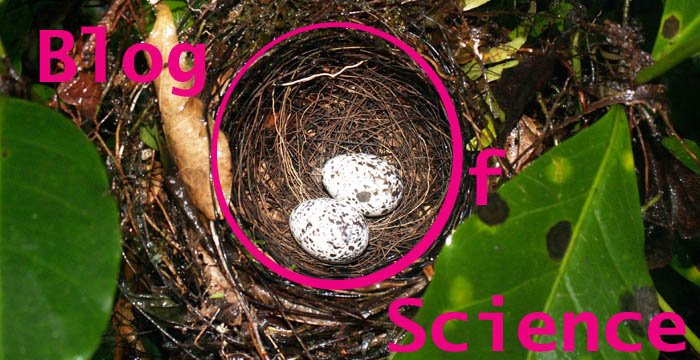
Notice that its sharp mouth parts are at the end of its huge nose. Cool huh?
Okay, here goes:
Oops. Since then, resistance to glyphosate has emerged in 20 different weed species.In case the holes in their logic haven't struck you, allow me to provide a quick lesson in how natural selection (or in this case semi-natural selection), as opposed to genetic engineering, works.
I called up several people who were at Monsanto at that time. Why didn't people there think resistance would happen? They all told a similar story.
First, the company had been selling Roundup for years without any problems. Second, and perhaps most important, the company's scientists had just spent more than a decade, and many millions of dollars, trying to create the Roundup-resistant plants that they desperately wanted — soybeans and cotton and corn. It had been incredibly difficult. When I interviewed former Monsanto scientists for my book on biotech crops, one of them called it the company's "Manhattan Project."
Considering how hard it had been to create those crops, "the thinking was, it would be really difficult for weeds to become tolerant" to Roundup, says Rick Cole, who is now responsible for Monsanto's efforts to deal with the problem of resistant weeds.
Some weeds, Cole says, appear to keep glyphosate from entering the plant at all; others sequester the herbicide in a spot where it can't do much damage. Monsanto's genetically engineered crops use a different technique entirely.So they didn't consider the possibility that some plants would simply shield their vital tissues from the toxin, the way many metal resistant plants do.
"We tried to find all possible explanations for this," the report's author Antonio Ereditato of the Opera collaboration told BBC News on Thursday evening.I now ask you to consider the opening of NPR's article reporting the news that the error has probably been found:
"We wanted to find a mistake - trivial mistakes, more complicated mistakes, or nasty effects - and we didn't.
"When you don't find anything, then you say 'well, now I'm forced to go out and ask the community to scrutinise this'."
Friday's meeting was designed to begin this process, with hopes that other scientists will find inconsistencies in the measurements and, hopefully, repeat the experiment elsewhere.
"Despite the large [statistical] significance of this measurement that you have seen and the stability of the analysis, since it has a potentially great impact on physics, this motivates the continuation of our studies in order to find still-unknown systematic effects," Dr Ereditato told the meeting.
"We look forward to independent measurement from other experiments."
Remember last year, when we reported that Italian scientists claimed to have broken the speed of light?
Remember CERN's claim that they found neutrinos traveling faster than the speed of light? Weeeeeell now they want to renege, blaming a faulty fiber-optic cable and timing gear for the erroneous results. Jesus -- and we're supposed to trust these people to NOT tear open a black hole and swallow earth?And this, linked to by another friend
Ridiculous: A Loose Cable Caused Those ‘Faster-Than-Light’ Particles
We know that Einstein always has the last laugh, but this is hilarious: the faster-than-light particles that could have wrecked his relativity theory are no more. It was a mistake in the test results caused by a loose cable.
Didn't anyone from the Genius Bar tell them about the first rule of tech support? Check your cables first! Oh, scientists!
One of our laws in the U.S. requires that federal paperwork that people have to fill out be a bit longer than necessary in order to inform us that the federal government is mandated by law to reduce unnecessary paperwork, and to provide an estimate of how long it should take to deal with the particular piece of paperwork.
I'm preparing a grant application to the National Institutes of Health, and have spent the last month trying to figure out the rules, regulations and customs. They provide a helpful 264 page guide to filling out the application form, with links to more information online. This guide estimates it should take me 11 hours to prepare my application, not including the part where I design my research. It also advises me that I should read the whole guide, and the various additional information (including a very necessary glossary) before beginning to fill out the forms. A friend of mine, who recently looked at this instruction book and thereupon decided not to apply for NIH funds, suggested that anyone who could read and comprehend all 264+ pages in under 11 hours with enough time left to fill out the forms should probably just be acknowledged as a genius and given whatever money they need for their work.
I certainly don't blame NIH for having a lot of rules, or putting them in a book. They have a huge number of people asking them for money, the responsibility to make sure all the applications are dealt with fairly, and the need to comply with a very large number of laws on many topics. All sorts of special cases and exceptions arise, and they need to have guidance on everything (although I have already come across several places where one just has to know how it is done, generally by asking people who have done it before). So you can't really blame their helpful but understaffed staff. However the 11-hour estimate should probably be reexamined.
Anyway, I'm learning, and the next time I write an NIH application, it may take me only 11 hours to understand the rules, provided they haven't changed them too much. The sad part is that the proportion of applications funded continues to decline, even as the length of the application instructions increases. I'll distract myself from thinking about that by reading the 33 FAQs about the Modular Grant Application Concept.
Arabadopsis
Bufo
Caenorhabditis
Drosophila
Escherichia
Felis
Gallus
Hydra
I
J
Klebsiella
Loligo
Mus
Neurospora
Oikopleura
Phodopus
Q
Rattus
Saccharomyces
Trichoplax
Ustilago
Vibrio
Wolbachia
Xenopus
Yersinia
Zea
I'm writing a paper with two of my students. Well, I'm writing it with one of them and another one did a lot of work on the statistics. But today we had to straighten out the order that the authors would be listed in on the paper. This can be a contentious issue, and I know of cases in which papers did not getting written at all because the authors couldn't agree on who got to be listed first. Some big multi-author papers simply list everyone in alphabetical order to avoid the fuss, but then Dr. Aardvark always gets to be first author. Some journals have a little section where each author's contribution is described, but they usually end up saying something uninformative and false like "all authors contributed equally."
I came up with most of the ideas in the current paper, put things together, decided who would do what, etc. My student did much of the lab work and is doing much of the actual writing. Given this, most biologists would propose what I did, and what my student objected to: She (as the person doing the writing) should come first, I (as the senior person on the paper) should come last, and everyone else (in this case meaning the statistics student) gets sandwiched in between. This was very counterintuitive for my student; she thought I was trying to minimize my own role by putting myself last. In fact, it is a step up for me to be writing papers in which I am in that last position. I remember this being counterintuitive for me the first time it was explained to me. I was a college student, and a boss said that he'd make me second author on a paper. I said something to the effect that I'd be glad to be even last author, which I thought was being humble, but he took it as me saying the paper had been my idea. We straightened out the miscommunication but I didn't end up being listed as author on the paper. That the last author spot (at least in biology) signifies the senior author is a code biologists internalize, and I had to think back a long way to figure out why my student objected to me being last author. I explained, she reluctantly believed, and now it is settled.
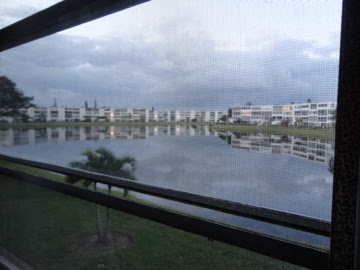
Retirement communities are, by design, fairly sterile places. Much of south Florida is covered in huge gated spreads of nearly identical buildings with neatly trimmed lawns leading down to pleasingly curving shallow canals so that every apartment can have water views. It is uniform, controlled, boring. But all those networks of shallow canals catching lawn fertilizer and Florida sun provide habitat and highways for rapidly growing aquatic plants, which feed aquatic invertebrates and fish. With relatively few retirement community residents catching their own fish, this leaves the fish to grow as big as want.
Or at least it used to. When I was a kid visiting my grandparents in Century Village, I rarely saw any wildlife around the wide place in the canal (referred to as a lagoon because it increases resale values) behind their apartment.
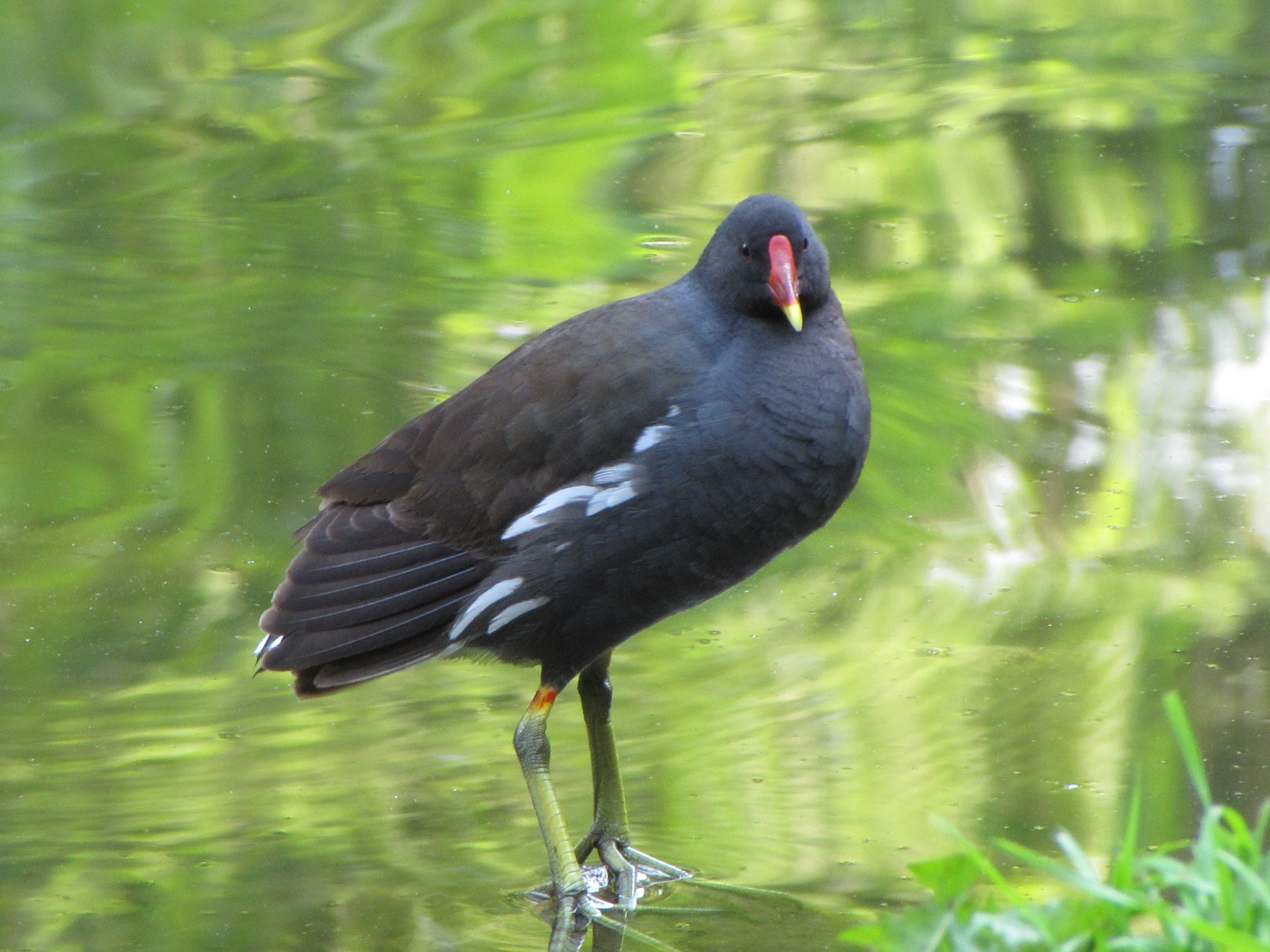
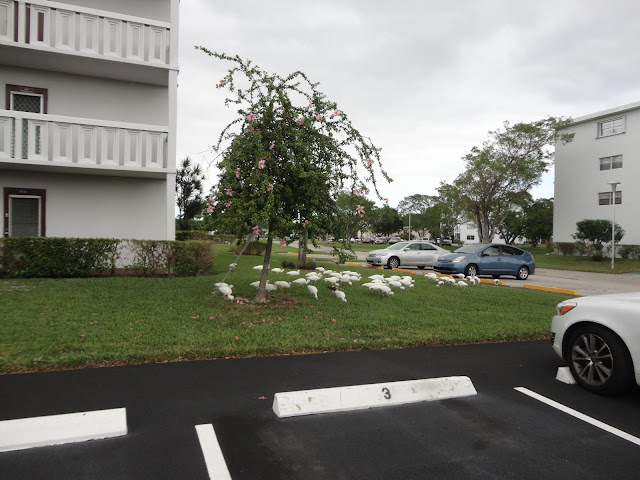
When I was a teenager and my grandmother was widowed, the lawn by the water was occupied by a flock of Muscovi Ducks (plant eaters), Cattle Egrets (which eat mostly insects picked from lawns) and the very occasional Great Blue Heron, which eat only small to medium fish. My aunt inherited the same apartment, and my wife and I brought our baby daughter to visit her this winter. Our first morning there, jetlag woke us early. Standing by the lagoon was a flock of Wood Storks. Walking past them in the water's edge was a flock of White Ibis, trailed by a Tricolor Heron.
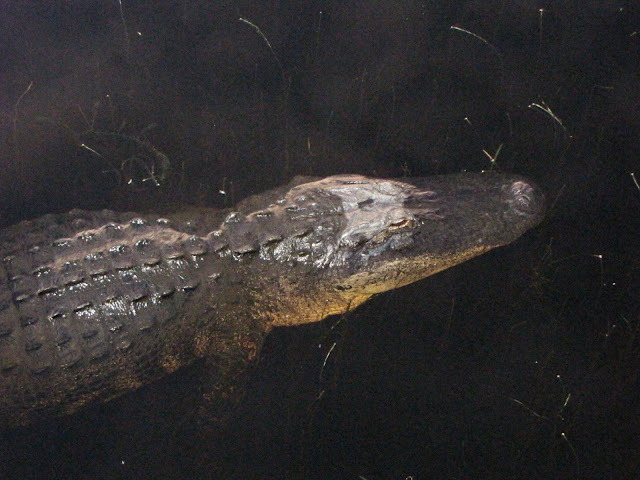
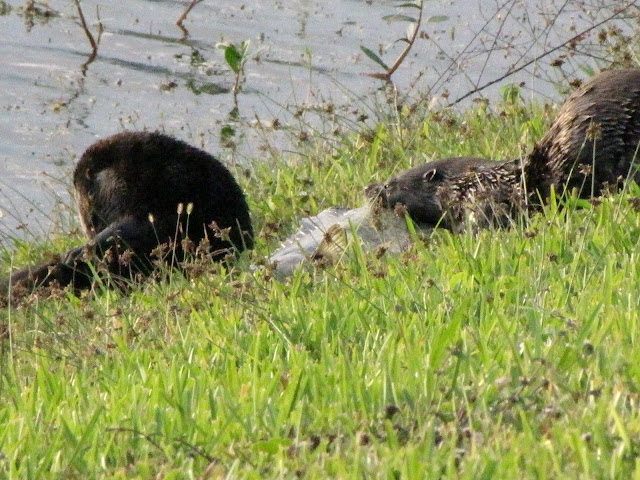
On the far bank an Anhinga spread its black wings to the sun. A few feet away lay a huge dead fish, heavily built and probably 80cm long, partly eaten by something. What could kill a fish that big, drag it up on the bank and eat only part of it? Walking the banks we found the shells of numerous Apple Snails, so named because they are as large as the fruit. Apple snails don't come up on land by themselves, so something must have carried them up, presumably to eat them. In back of the next building over, beyond the Great Egret and Little Blue Heron, I could just see something moving on the bank. I thought it might be a dog (not allowed in Century Village) but then I could see it was two long low animals chasing and wrestling with each other. They jumped in the water and swam as no dog could. River otters! A pair of very large river otters chased each other, making circles in the reflected condos. The remains of several large fish, each only partly eaten, attested to the successful hunting they had been having in the canal.
Four Turkey Vultures sat around one such plate of sushi as others circled and swooped, their wing tips almost brushing the screening of enclosed patios. We cajoled my aunt, her bad ankle throbbing, to come out onto the lawn with us for a closer look at the otters. We crept closer to them and the fish they were snacking on until they raised their heads and hissed at me, at which point we backed off.
All this wildlife, carrion, birds and their poo on cars, giant snails, etc. are pretty clearly not what the designers of Century Village, and south Florida's thousands of other retirement communities had in mind. Nevertheless, I think most of the residents are probably happy to have so much nature on their lawns. I doubt all those telescopes and binoculars sitting in the screened patios were for spying on the other retirees.
Is this all good for the wildlife populations? Clearly they would have been better off if the wetlands had not been made into retirement communities, but given that they were, I'd guess that learning to exploit those communities is to their advantage. The water in these canals surely has all sorts of runoff from lawns and parking lots, but if the birds feeding in it can still breed consistently, they are likely to have a feeding habitat that no one will drain, pave or burn. If things get too rough in the nearby Everglades, they will have a retirement home ready.
* Drying environments in the late Tertiary constricted African forests, making capacities to use alternative foods more advantageous among ancestral apes.
* Bipedalism was then favored because it freed hands for tool use, which
increased success at hunting big animals, and this put a premium
on larger brains.
* But the mechanics of bipedal locomotion limited pelvic width, so brain expansion created an ‘‘obstetrical dilemma’’ requiring most brain growth to be postnatal.
Consequently, children with developing brains were immature longer and were more dependent, for a longer time, on maternal care.
* The care requirements interfered with maternal hunting, so mothers relied on
provisioning from hunting mates. This help from fathers allowed mothers to produce more surviving offspring.
* Thus, parents formed lasting bonds and nuclear families became the fundamental
units of cooperation in which a sexual division of labor served familial goals of production and reproduction.
Note that this fish has its gonads above and in front of its pelvic fin. That is a common trait among fish, including the lobe-finned fish from which all terrestiral vertebrates are descended. The lobe-finned fishes had bony feet with which they could support themselves on the sea floor, and the bones in their pelvic fins would eventually be modified by evolution into the legs and pelvis.
Now the first terrestrial vertebrates were amphibians, and like most frogs and salamanders, laid small soft eggs, so it was probably no problem for them to continue having the gonads in front and running a tube through the pelvis to the cloaca. This system only became problematic when the eggs got large and hard, as they are in reptiles like turtles. Turtle people like to talk about "pelvic consraint" when they discuss why turtles don't make bigger eggs.
The only non-fish vertebrates to escape the need to run the babies through the pelvis are those that no longer have ana full pelvis, like whales and most snakes. To my knowledge nobody has managed to invent an alternative outlet, so everybody, including us, has to find one way or another to get through the pelvis. In fact, the only alternative is a human invention, the cesarian section.
This obstetric dillema is a very obvious contraint of the 'no alternative' type. Whenever I get a chance to write another longish post, I'll give an example of a constraint where the lack of alternatives is less obvious because it is genetic rather than anatomical.
It took 34 minutes from the time we arrived at Hamburg Hbf until I was sitting in my gate at the Hamburg airport waiting for my flight to Manchester. This without any running, pushing or hurrying, and the airport is not particularly near the Hbf. A single S-Bahn trip stops directly under the security check, so up two escalators I got on one of the many very short lines, and didn't have to remove my shoes or belt, nor get molested. I like to complain about the fact that you can't get a flight from Rostock's small airport to anywhere, but if door to gate takes only two and half hours, this is still better than many trips to JFK I've made. It is frankly slightly disorienting for an American for a transit system to work this smoothly.
As I sat in the gate, two English gentlemen sitting just behind me recognized each other and began to make small talk. The one is the occasional patient of the other, and has an appointment to see him in late December. They kept up a lively conversation about not much of anything, without a single pause, for about 45 minutes. I have heard the English talent for small talk described before, but I must say this was really impressive. They moved purposefully from one genial topic to the next, always with a smooth transition. Football, Christmas Markets, vacation destinations, and so forth. I felt like congratulating them.
As the bus took us from our gate to the plane, we passed a taxiing airplane from Air Tunis. It wonder if flights to Tunis are cheep these days? I've heard they have trouble filling their hotels since the revolution.
As we pass up then down through layers of clouds, I notice how closely defined their surfaces are. The top of my window can be mostly in the cloud, and the bottom mostly out. I wonder vaguely what sort of fluid dynamics allow for such a sharp transition to be stable.
I hope I have the right ticket for this train.
An hour and a half into wandering around Sheffield looking for my accommodation, I'm standing on a corner with three young guys with tattoos on their massive biceps as one of them looks up Edgecliffe Crescent on his iPhone. The guy resting in front of the closed Pakistani restaurant next door says go to the roundabout, take a right, and straight to the top.
Breakfast in the cafeteria is much what you would expect from breakfast in an English University's dormitory cafeteria. The orange juice and eggs are from concentrate, but the sausage is fresh squeezed. I sit across from a young woman who has never been to a conference before. I briefly consider teasing her about the fact that she is nervous despite not having to do anything but listen to other people's presentations. She gives me good directions to the conference hall.
"You can't really understand anything in ecology without thinking about soil biodiversity," says the plenary speaker. I guess what I do isn't ecology.
A couple of people come up to question me further after my talk. One of them is a guy I once emailed for advice on keeping rotifers. I can't remember what the question was, but thank him for how quickly he responded.
There is no way I am going to stay awake through the whole poster session. I get slightly lost on my way back to my room and end up in an OxFam thrift store. I get lost again carrying some used books. I spot an expidition of ecologists and follow them home.
Waking up cold I pass by the Greek place and have peas panner with garlic nann. I happily chew the hard chunks of spices in the sauce. "I'm a womanizer!" announces the old, obese, bald and drunk puddle of English gentleman at the corner table with the off duty waiters. "Yes, Sir, you are!" one of them reassures him.
I consider rehearsing my poster spiel for tomorrow, but instead prepare by sleeping more.
We are joined at breakfast by a conference of dentists (there may be a better term of venery for dentists, but I don't know it). They are easily distinguished by their unecologist-like formalwear.
Lost of people ask questions about my poster, and most of them tell me that while interesting, it has nothing to do with anything they will ever work on. This interesting but not directly relevant feeling is largely mutual.
I am not generally given to violence, but do currently have the urge to break something.
I am working on another big funding application. This one is a lot more work than the previous applications, as the required research statement, the largest of several sections, is 25 pages. I can't really complain. If I was going to give someone enough money to run a research group for five years, I too would want to know in some detail what they would do with the money. Further, sitting down and trying to put my plans into a single document makes me systematically consider how my various plans fit together, always a useful exercise. My only complaint really is that I should have done much more on this much earlier. Trying to finish everything up at the same time that my wife is preparing to deliver a baby and my family is visiting is an less than an optimal solution.