Tuesday, October 06, 2009

Something's doing at the zoo

I can think of nothing that divides the opinions of animal lovers more than zoos. To some they are horrid spectacles where wild animals are locked in little cement boxes for the public to gawk at. To others they are a way to educate the public about wildlife while adding to our knowledge of each species and contributing meaningfully to conservation efforts. Some view zoo animals as living short boring lives of confinement, while others view zoos as predator, poacher and disease free shelters for species rapidly declining in the wild. Both groups are passionate in their support of animal welfare, and both are partly right about zoos. Zoos for a very long time were, and to some extent and in some places still are, places where animals are kept in very unnatural conditions for the gawking pleasure of humans. Zoological gardens originally cared little about the welfare of the animals, beyond the expense of replacing them. When most modern zoos were opened, animals usually were kept in small hard cages with no natural elements and nothing to do. It is still possible to find many zoos like this, and many cages like this even in the more modernized zoos. But many zoos, including most I have been to in the US, are actively and intentionally reforming themselves, and have been gradually improving for some decades. Rapid improvement is difficult while one has a large group of animals to keep. You can't simply bull-doze the whole place and start anew. Rather you must find what open space you have and build a new tiger habitat, then move the tigers there and rip up their old cages to build a large outdoor space (with winter quarters underneath) for the baboons. When that is done, and the baboons are safely outside, the monkey house can be rebuilt, and so on. In a few decades when all the old cages are gone, you will realize that the tiger habitat you built really isn't big enough for tigers, and you can start the cycle again. So changing from a bad old zoological garden to a new fancy new wildlife conservation and education center takes decades.

I recently had the pleasure of visiting one of the most advanced and impressive zoo I've been to, the Copenhagen Zoo. In overall appearance and plan it reminded me very much of the Bronx Zoo, where I worked for a short time. In fact it was so similar I have no doubt many of the same people were involved in planning the individual habitats in the two zoos. The two are so similar that I could say to my wife, "this looks just like the place in the Bronx Zoo where they have the crocodiles and river turtles," only to turn the corner and find the crocodiles and river turtles in nearly identical enclosures.

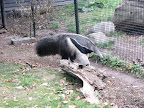
Almost all of the enclosures were state of the art, made to look and feel as much as possible like habitat, with places the animals can go to get out of the weather, and out of the view of tourists, or where they lay in the sun if they so choose. They had a large display (in Danish, so I couldn't read any of it) on the bad old way of doing thing, set up so that the viewers actually walk through a series of cold cement cages with giant steel bars where rhinos and hippos used to be kept. But what impressed me most was the attention paid to making sure the animals had something to do. The anteater ate not from a trough, but from a rotten log with numerous holes drilled in it and food stuffed into each hole. This gave it something to do with its improbably long tongue and impressive curved claws. Rather than laying around looking bored, it spent its time ripping open logs and licking food out from inside them.


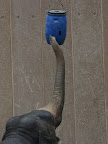
Inside the impressive new elephant house the elephant also has to work for its food. I spent half an hour watching an elephant attempting to extract its food from a large barrel hung 5 meters off the ground. The barrel hangs from a rope, such that the elephant can barely reach it with its trunk. By repeatedly whacking the barrel with the tip of its trunk it can make it swing enough that eventually some of the food inside spills out on the ground. The elephant then eats this and goes back to whacking the barrel. By the time the meal was over, the elephant looked honestly tired, a rare and precious thing for a zoo animal.


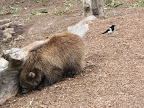
The bears spent enough time digging in their enclosures (with enough magpies and starlings closely following them) that I can only assume there was food buried somewhere in there, with the location changing from day to day. Over and over throughout the zoo we saw animals doing something.


The term in the zoo community for this is behavioral enrichment, and it turns out to be incredibly important not only for the animal's mental state, but for their overall health, their longevity and the satisfaction and education of the viewing public. Crowds these days don't just want to see an elephant standing there, they want the elephant to be happy, and they want it to be doing something. In the Copenhagen Zoo, the animals are doing something, and usually it is something similar to an actual behavior observed from the wild. Wild elephants really do whack and grab overhead food with their trunks. Anteaters really do tear open rotten logs. Behavioral enrichment takes a lot more thought, and a lot more work, than dumping food in a trough, but it makes for a wonderful zoo. (A recent episode of the NPR show Radio Lab focuses on Zoos, and talks a lot about the importance of behavioral enrichment.)

We spent about eight hours walking around the Copenhagen Zoo, and saw most but not all of it. I strongly recommend it to anyone who loves animals, whether or not you love zoos. I took about 500 pictures that day, 60 of the better ones are linked to below.

Copenhagen Zoo

Demographic Decline

There are no national rankings for departments of Demography in the US. If there were, UC Berkeley would certainly be near the top, and would likely rank first. Four of the five core faculty members have been elected to the National Academy of Sciences, and the last is relatively young. (The entire Academy has about 2100 members, out of perhaps a million PhDs who could potentially have qualified). I had the good luck to stumble into association with this department, benefited greatly, and was tremendously impressed.

This department contributes tremendously not only to Berkeley, and the field of Demography, but to our civilization's progress in understanding how populations function, how populations are likely to change in the future, and what effects these changes have on our economy, society and environment. Methods developed at Berkeley are at the core of the United Nations' understanding of population trends and their importance. Alumnae of Berkeley's rather small program in Demography can be found in almost every important institution making use of demographics, from the US Census Bureau to every major branch of the UN, to departments of Economics, Sociology, Anthropology and Epidemiology at most major universities, to think tanks, research organizations, and major corporations. The people that come out of this program are predictably smart, creative, quantitatively talented and know how to ask important questions and answer them convincingly. It is everything that graduate education should be. There are not many rooms full of people in which I feel slow, but discussing research with a bunch of Berkeley demographers required me to manufacture a fair bit of bravado. Among Berkeley's graduate programs, so many of which are at the top of their field, Demography stood out to me as a bastions of professionalism and brilliance.

Unfortunately, like so many of Berkeley's programs, Demography is in clear and present danger from the current fiscal crisis, and several of its students have hinted to me that it could easily cease to exist in a relatively few years. This happened once before. The following is an excerpt from a 1991 interview with Albert H. Bowker, Berkeley's sixth chancellor (1971-1980):

Q: I don't want to skip over some of your other activities with various departments, if you'd care to pick up on that again. Let's see, we had Department of Demography.

Bowker: Demography was a small group, and it had a lot of trouble recruiting faculty, largely because it was dominated by Judith Blake. I just decided to abolish it, largely because it was just one person, really, on permanent position. It's just something you can have or have not, not an important subject. There are some subjects that every university must have-- mathematics, physics, chemistry, biology, history, English, philosophy, some of the languages, and others. Demography is not one of them, and criminology is not one of them. If you have it, it ought to be good and large. They kept bringing it back, and apparently that was not so much on intellectual grounds. It's a silly subject and the group there couldn't be very effective. Then Judith left, and somebody revived it, not in my day.

Q: Do you remember the Department of Design?

Bowker: Vaguely. Yes, we abolished that for the same reason, I guess. I've forgotten now what design was.

Demography was brought back by a group of faculty who are themselves now of an age where even many dedicated academics retire. The Demography department is, as a professor in another department put it "highly age structured." Beyond this older group, they brought in a few younger faculty, shared with the Department of Sociology. One of these recently left for a better offer in Texas. The department is unable to replace her because of the budget crisis. Another scheduled faculty search was cancelled. If recruitment remains frozen for longer than the faculty's more senior members care to continue teaching, (which is quite possible) the department could easily be back to one or two professors. One of these has already said that if this were to happen he could simply join another department. The current administration, may or may not remember what Demography is, or care whether it is important, and is unlikely to make any particular effort to save the department from attrition.

This department is of course just one casualty of the budget cuts to the University, which is in turn only one portion of the destitution of California's public education system, which is in turn only one piece of the general collapse of governance in California. To me, of course it means more than that. I wasn't actually a student in the department, but I spent enough time there to know I was surrounded by the best humanity can produce finding out things that humanity desperately needs to understand. This department is one of the best pieces of the best school in what was once the most ambitious public education system in the world, and it hurts to see it left to atrophy. This abandonment of greatness symbolizes for me what ails California, and America.

Monday, October 05, 2009

The Jellyfish of Copenhagen


Unlike French toast, Danish pastry is actually a specialty of the country it is named for. So while visiting friends in Copenhagen, we had little choice but to make frequent visits to the "Lagkagehuset," pronounced "La-Kay-Who-set" and meaning "The Layer Cake House." Our friend Nisha assured us that this was the best bakery in Copenhagen, and judging by their pastry this seems likely. (Broader sampling may be necessary at some point.) Lagkagehuset is next to one of the many canals that crisscross Copenhagen, and one morning as we sat eating our pastry, I noticed something floating by, maybe a plastic bag. The way it moved caught my eye because it didn't seem entirely passive. I went to take a closer look, but it was gone, moving quickly downward in the water. Too quickly to be a plastic bag, unless there was a sudden and sharp down current. Watching for a moment more, another floated into view, and it was a jellyfish! A big one, as big around as a dinner plate, but with tentacles only a hand long. As we stood and watched dozens more gradually floated by, apparently feeding on the numerous small silver fish moving in schools through the canals. I was surprised to find so much active, apparently healthy sea life in the middle of a major metropolis. Over the next few days every time I glanced into the canals there were jellyfish. Copenhagen's water seems to support lots of little fish, and the jellyfish seem to be their main predators. I've heard that in at least some cases (e.g. where the Mississippi's nutrients spill into the Gulf of Mexico) jellyfish thrive in polluted waters. The water in the canals of Copenhagen look pretty clear, but it is a major metropolis, so I'm not sure if the jellyfish in this case indicate dirty water or a healthy ecosystem. Either way, it is cool to see them floating by.

Friday, October 02, 2009

Wadden Sea

Imagine if you will a big flat muddy seabed. Various rivers and ocean currents deposit mud, silt, and sand onto it for ages. Currents may dig a slightly deeper part here, cause a raised area to form there, but basically its flat. Next, suppose global sea level drops. The top of the water is about equal with the top of the accumulated sediment at the bottom of our flat sea. Where the sediment is piled high, it might stick a meter or two above the water. Where the sediment is low water will remain, but not be very deep. And everywhere there will be mud.

Something very much like this has, over the eons, repeatedly occurred in what is currently the Wadden Sea area. Wadden Sea is the Anglicization of the Danish 'Vadehavet' which means mud-flat sea. In southwestern Jutland (the part of Denmark on mainland Europe), down through northwestern Germany and west across the northern Netherlands, simple daily tides still move the shoreline in and out by some miles. In between are extensive mudflats. As was done in Holland, the people of southwest Denmark gradually, over centuries, drained much of this tidal area with dikes, building walls over which the tide cannot climb (except during large storm floods, which throughout the middle ages would occasionally overcome the dikes and drown thousands of people). Despite the dikes, and the normally small tides of ~1.5m, the inter-tidal zone is many km wide in this area.

Iris and I spent a day on Mandø, an island in the Wadden Sea. The Danes long ago surrounded the island, which is only a few kilometers across, with dikes, and most of the interior is grazing land for cows and sheep. There is also a village of about 50 people, and an environmental education center/hotel, where we stayed. Outside the dikes, which are basically just 3-5m high slope-sides earthen walls grazed by sheep, there are wetlands surrounded by huge areas which daily alternate between being land and sea. At low tide one can drive to Mandø, or go for long walks on the mud-flats. At high tide it is water on every side for miles.

100m or so outside the dikes most of Mandø's shoreline (if it can be called that when it is often miles from the water) is ringed by fences that are about knee high. Each fence is made of two rows of sticks driven vertically into the mud, with thinner sticks, bits of brush and whatever else tied into bundles and wedged into the space between the two lines. Iris and I were mystified as to what function this short fence could perform, other than giving homes to billions of barnacles and perches to the preening shorebirds. It turns out these funny little fences, over generations, wrest land from the sea. At high tide water with sand and mud in it pours through, over and around the fence. As the tide recedes, much of its sediment gets caught in the bundled brush, like krill in the baleen of a whale. The area within the fence eventually fills with soil up to the top of the fence, and another fence is built further out. Repeat for 1000 years and add sheep.

Danish policy, now that they finally have the technology to seize the entire mud flats in years rather than centuries, is to let the boundary stand where it is. Let the shellfish, the shorebirds, the mud worms and the crabs keep what they have, and let the farmers keep their hard-won dry land. This summer Nationalpark Vadehavet became the largest national park in Demark. (Germany has also made large portions of its piece of the Wadden Sea into national parks.) It is bizarre, mysterious and wonderful to visit, and a glorious piece of wildness on the edge of all too tamed northern Europe. Global climate change may well doom the Wadden Sea to return to just being a flat seabed, so I suggest a visit sooner rather than later.

Here are a few photos:
Iris on the mud flats


Disintegrating coastal fence encrusted by shellfish

Oystercatchers like this one are extremely numerous in the Wadden Sea. Their long stout bills are perfect for wrestling invertebrates out of the mud.

Tuesday, September 08, 2009

And it's off to Germany with us

I spent last week in Berkeley. My finishing talk was the first joint demography and biology seminar at Berkeley in at least 30 years, possibly ever. I closed with an appeal for the demographers and the biologists to talk to each other more. Evolution is the source of many ultimate explanations in demography, and demography has extremely important methods and insights for understanding evolution in age-structured populations. There was a good discussion, with the demographers and biologists both asking questions, and even talking to each other. Then I spent a couple of days fighting my way through the bureaucracy surrounding the filing of dissertations. I filed, cleaned out my office, packed up my stuff and missed my plane east. I went standby, got to my parents' house at 5AM the next day, spent a day with the family. Then we rushed to the airport only to find that our flight to Germany was canceled because the flight attendants are on strike. Air Berlin assures us we will get to fly today, but in the mean time we are in the JFK Holiday Inn. Being stuck here has given me my first chance to stop and reflect on the fact that:

1. I am now Dr. Daniel Levitis, Ph.D.
2. I am moving to Germany.
3. After nursery school, kindergarten, elementary school, junior high, high school, college and grad school, 22.5 years of schooling in all, I am no longer a student. Being a student was getting pretty old anyway.
4. I am starting a new job very soon, and don't know exactly what I will be doing.
5. I am on vacation for the next few weeks.

Time to go see if our flight will happen today. Posting may be sporadic until I am ensconced somewhere.

Friday, August 28, 2009

My terrible paper

Three days ago I spent the entire day putting the finishing touches on my terrible, unpublishable fourth chapter. The next morning Iris copy-edited it for me, and I sent it to a professor who sent it back to me six hours later. I would hug him if he wasn't 3000 miles away and if one went around hugging members of the National Academy of Sciences. I spent several hours implementing his enormously helpful comments, and sent it to a second professor very late that night. He sent it back 1PM yesterday. He had it for 12 hours, but I'm guessing he was asleep for at least six of those, so that is pretty fast turn-around also. His comments were also majorly helpful. I spent until 1AM this morning implementing his suggestions. Now I have to update my tables and figures, and I'll send it to my third faculty person. At that point the rapid turnover is likely to stop, as she takes her time in editing and produces masses of highly detailed incisive comments.

This seems like an awful lot of work by some incredibly smart, busy people to vastly improve my paper that is still unlikely to be publishable.

That said, it now seems at least plausible that I will have my degree by the time I leave California a week from now.

Thursday, August 27, 2009

Intro to Chapter 1

University rules say I have to have transitions between my chapters. They don't say what they have to be, and my professors don't care, so I'm writing little essays.

Here is the intro to Chapter 1:

Demographers and evolutionary biologists have a great deal to learn from each other. That there is no Demographic Evolution Society or Journal of Evolutionary Biodemography attests to the fact that most biologists, even those strongly interested in population processes and the interactions of individuals of different ages don't fully incorporate the insights and methods of demography. Similarly, most demographers give little thought to why such basic variables as mortality risk and fertility vary with age as they do. Any demographer can tell you that the qx curve is shaped like a U or a J or a bathtub, but precious few seem interested in ultimate explanations of how that came to be. Only evolutionary biology can provide such ultimate explanations. Demography is a social science; questions are expected to have some relevance to humans, and the vast majority are solely about humans. In evolutionary biology the assumption that humans must be interesting is quickly labeled as anthropocentrism.

Human demography offers the evolutionary biologist fascinating questions, tremendous stores of readily available data, and the quantitative tools to analyze them to. Evolutionary biology offers demographers the concepts to understand why humans are as we are, how we came to be this way, and how we differ from other organism. A uniquely human, cultural explanation is not needed to explain a trait humans share with all primates. Where humans are unique, this could be because of evolution, or culture, or more likely feedback between the two. Judging whether a trait of human demography is unique requires the methods and concepts of both demography and evolutionary biology.

Chapter 1 asks how unusual women's post-fertile survival is among primates, and what role culture plays. It combines the tools of demography (in developing appropriate measures of post-fertile survival) with those of evolutionary biology (in the comparative method). The result, it is my hope, clarifies a debate in which people have been talking past each other for some time.

Wednesday, August 26, 2009

Draft of thesis Abstract

While my committee is happy for my thesis to be a pile of loosely connected papers, the university still expects it to be a single unified document with a single topic, a single Abstract, and transitions. This is a bit of a stretch, considering how far afield some of my chapters are (chapters 2 and 4 for example have almost nothing in common). Here is my first attempt at an Abstract that ties it all together:


Abstract:
Humans are a demographically unusual species in many ways, but perhaps the most unusual thing about our demography is the huge portion of our adult females who are post-fertile. This thesis, in four chapters, explores the evolution of post-fertile survival, attempting to understand, from four different angles, how unusual women are in this respect and how they come to be that way.

Chapter 1 is a methodological and comparative study of post-fertile survival in primates. Post-fertile survival is most frequently measured as post-reproductive lifespan, the length of time between reproductive cessation and death. I show that post-reproductive lifespan is not a useful measure for comparative studies and use demographic life-table methods to create more useful measures of post-fertile survival. I then calculate these measures for several human populations and a large group of primate species. These results indicate that women in all populations experience post-fertile survival which greatly exceeds that in other primates under all circumstances. Non-human primates under natural conditions do not experience significant post-fertile survival, while human hunter-gatherers do.

Chapter 2 arises from the question of whether selective pressures associated with being a care-giver tend to increase longevity, potentially partly explaining women's longevity and therefore their post-fertile survival. The chapter focuses on the tradeoff between providing care to existing offspring and competing for matings so as to produce additional offspring. Data on male primates, in which variation in care provided is much greater than in females, are used in a comparative study. I ask whether these data support the assumption of a tradeoff between male care and male mating competition, and if so if one strategy or the other is associated with greater longevity. I find strong support that such a trade-off exists (males in most primate families invest significantly in one or the other, but not both, and care and competition coevolve in a phylogenetically robust pattern). However these data do not support the prediction that level of male care and degree of sex-bias in longevity coevlove meaningfully.

Chapter 3 is an allometric study of brain size, body size, age at reproductive cessation and longevity in primates, in which I ask if human post-fertile survival is predictable based on primate patterns. Again using life-table methods to create parameters more appropriate for comparative study than those used in the literature, I show that while women's age at reproductive cessation can be fairly accurately predicted based on primate scaling patterns, their longevity cannot. This result indicates that the selective forces which regulate these scaling patterns in primates have been altered or amended in humans.

Finally, Chapter 4 is an experimental evolution study. Using rotifers, a short lived microscopic metazoan, I experimentally make the survival of young depend on the continued survival of their mothers and grandmothers in a species which has no natural care of juveniles. I show that under this regime those familial lines which are longer lived, and which bear a larger portion of their young before mother and grandmother die, increase while others die out. However because of low heritability of demographic traits in this population, the experiment does not demonstrate adaptive change, but rather differential success based on stochastic variation.

Taken together these four papers serve primarily to underscore the uniqueness of post-fertile survival in women. Some have argued that human post-fertile survival is either an artifact of social rather than biological evolution, or a widespread trait in female primates simply exaggerated in human females. These studies make clear that human post-fertile survival must be considered as a novel trait, and its evolution explained as such.

Tuesday, August 25, 2009

10 days

My thesis is fully written, in the sense that I have a complete, but not final draft of each of the four chapters. This does not mean I can relax. My last chance to file it in person (as opposed to having a friend print it out for me and file it for me after I've left for Europe, which is much less desirable in several ways) is ten days from today. This is little enough time and there is enough to do that I am almost certain I will be filing via friend.

Chapter 1 is all done.
Chapter 2 is being edited, and three more professors have to edit it after that.
Chapter 3 has been edited by three of four professors, and is very close to done.
Chapter 4 I have just finished writing, and will send to its first professor in the morning.

Assuming that the suggested edits to Chapter 2 are small enough to be dealt with in a day, and assuming a lot of other things go quickly and correctly (a large set of assumptions), I can have all the edits from three of my four professors done by Sept 1st, when the fourth gets back from oversees. I then have until September 4th to have him look at and edit three chapters, and implement all his edits, and print it all out and put it all together, before I leave California for the east coast and then Europe. In that time I also have to plan my final talk, make the powerpoint, practice the talk, fly to California and give the talk. It will be a busy ten days, but as my wife says, "at least now you can see the light at the end of the tunnel, or at least know exactly how deep a hole you've dug.

Sunday, August 23, 2009

One week

I have one week in which to finish writing my thesis. I don't expect to be blogging much until after Sept. 2nd. Happy Labor Day.

Science and religion

There is a piece in the NYTimes by Robert Wright, trying to reconcile evolutionary biology. He proposes, in effect that if creationists would just accept that evolution happens as it does, and evolutionary biologists would just accept that the universe could have been set up the way it is by a creator who chose natural laws that would lead to organic evolution, we could all just get along. He makes the theistic evolution argument as well as I've seen it made, and I still think it is lousy both in its internal illogic and in its total lack of realpolitik.
The religious aren't about to accept a greatly diminished (or at least distanced) role of God in the universe, and secular scientists aren't going to accept that the fact that there could possibly be some space for God to slip into the cracks that science can't explain yet means that God is a scientifically viable option. Wright's proposed "bargain" wouldn't satisfy anyone, and wouldn't even be more satisfying than the status quo to many people. Wright questions why most people on both sides of this divide seem more inclined to leave it alone than to either argue over it or try to bridge the two views. The answer seems obvious to me: it is not particularly likely that one will either convince someone on the other side, or come to a common understanding, and people have other things to do with their time.

Saturday, August 22, 2009

Conversation

"Are you working?"

"Sorta. Writing a negative result I can't publish is hard."

"What are you looking at?"

"My blog."

"That's not your blog."

"No?"

"You changed the formatting. It doesn't even look like your blog."

"You also do not look like my blog."

"Why would I look like your blog? I don't know where you get your notions."

"I get them from Science!"

Publication bias

Much of the culture and methodology of science has been specifically designed to help combat bias. The human brain takes sensory inputs, filters them through our biases before we even perceive them, assigns them whatever interpretation seems most reasonable given what we already think, stores them (or not) depending on how they fit into our preconceived notions, and then retrieves them when they seem to support the view we already have on the topic at hand. We are like perfect bias machines, and we have to bend ourselves into all sorts of intellectual contortions to achieve any measure of impartiality on almost anything. Most of the statistics scientists employ, rather than testing for support for our preferred hypotheses, are designed to test for support of the opposite of our hypothesis. Only if someone tries really hard to prove the opposite of their point and utterly fails to do so are we convinced that their data significantly support their point. The scientific review process, the sometimes painfully stilted manner in which science is written and even the reluctance of many scientists to have any polling based system of evaluating scientific consensus are all designed to help us keep our biases in check. The Spockian view that one should act as though emotions and unreason don't exist is clearly illogical.
Despite all this anti-bias fervor, scientists are still human, and still have biases. One such bias is that we want, as individuals, to be successful. We would rather study a topic that is going to win us praise, jobs and funding than something else that will take a long time to reach any conclusion, even if the payoff for society is much greater for the long term project. We are also far more likely to publish results that are going to advance our careers than those that won't. This leads to the title of a 2006 paper called, "Publication Bias: The Problem That Won't Go Away." To be clear, I am not referring to a reluctance to publish papers that challenge the dominant viewpoint. Name any truly successful scientist, and I will bet you that his or her career was built on a paper that challenged the dominant viewpoint. Scientists know this, and we are pretty much obsessed with finding holes in the dominant view. Publication bias rather is most commonly a tendency to publish clear positive results ("our data strongly support hypothesis X over hypothesis Y") over the less clear cut cases ("our data do not allow us to confidently support or refute the hypothesis we set out to test"). This kind of thing happens a lot.

Publication bias on the part of others, and by me, has been on my mind recently. In writing a paper on the evolution of paternal care in primates, I ran into the problem that almost nobody makes the statement, "in 72,000 hours of behavioral observation we did not observe males caring for their young." But if after 120,000 hours of observation they see a male pick a couple of burrs out of a juvenile's fur, they might well write a paper titled, "first observation of paternal care in species X." This results not only from the logical impossibility of proving the complete absence of a behavior, but because in many species where males don't care the assumption is that males don't care, and a failure to see counterexamples isn't that interesting to the people studying the species or the editors reviewing their papers. The result of this is that we have lots of publications stating the presence of care, even when that result is rare, but almost nobody stating the likelihood of its absence. I ended up having to make the rule that if multiple papers describe patterns of care in a species, and none of them say anything about male care, that counted as too little care to qualify. In my own studies of rotifers, I absolutely would have written a paper on parental care if I had observed any, but absolutely could not get a paper published in which I state that I didn't see any.
But my publication bias when it comes to the rotifers is much more profound than that. The results of one of my major experiments were negative, and as such not particularly interesting. I am writing it up anyway, because my dissertation committee wants me to, but I and they think it unlikely any journal will publish it. Of course if 20 different labs did similar experiments, and only one got a positive result, only the positive result would be published, creating a very false impression. I recognize this as a source of bias, I don't like it, and I don't see any way around it. The best I might be able to do is post the whole damn paper on my blog and hope that anyone interested in the topic stumbles upon it.

The other option, which I won't take but is far more common than you might think, is to simply analyze my data until I do find something interesting in there, then write up the paper as though that was my main question all along. This is something that advisers have specifically told me to do in the past, although not on this project. It is grudgingly accepted that this happens, and like publication bias, isn't going away.

Wednesday, August 19, 2009

Why don't males care?

The defining difference between males and females biologically is that males produce smaller gametes than females do. Sperm are much smaller than eggs. This difference is the starting point for most arguments describing how the sexes have evolved divergent traits. In mammal further apparently inescapable differences arise because only females harbor internal development of young, and only females lactate (while male lactation is not unknown, there are no document cases of male lactation providing meaningful nutrition to the young of a species). These three apparently fixed differences underlie most arguments describing the evolution of sexual dimorphisms found in mammals, including the tendency among mammals for females to be the sole caretakers of dependent young.
Paternal care is rarer in mammals than in most other taxa where parental care is the norm. Post-birth maternal care is found in all mammals (most fundamentally in the form of lactation), and females care alone in ~90% of mammal species. This contrasts sharply with birds, where female-only care is found in fewer than ~10% of species. Primates are unusual among mammals in that approximately 40% of genera display at least some male care, according to an older and therefore probably low estimate (Kleiman et al. 1981). Primates provide the opportunity to examine what factors lead to evolution of paternal care, even when sex specific structural factors (internal development and lactation) require maternal care.
Why do so few mammalian males engage in care? Mated individuals face the choice to continue investing in caring of current offspring (bearing fitness costs in the form of time, individual quality and mortality risk), produce new offspring with the same mate, or abandoning mate and young to seek new mating opportunities. In all mammals lack of post-zygotic and post-pregnancy investment from mothers is fatal to the offspring. Males therefore have earlier opportunities to abandon, leaving females to bear these costs for both of them, than females do. Depending upon timing and the particulars of a species' natural history, mothers may also be more likely to successfully raise the young of the abandoning male than a male could be in raising the young of his absent mate.
Males not only have greater opportunity to desert, but also greater potential payoffs. A male's reproductive success increases more rapidly with multiple matings than a female's would (although females may gain social and genetic benefits from multiple matings), and males therefore experience higher variance in reproductive success than females. This variance is often non-random, relying on traits which influence female choice or the outcome of male-male competition. These traits are necessarily expensive in order to serve as honest signals, and potentially reduce males' ability as care-givers (and longevity, reducing their reliability as care givers) as they increase their ability as competitors. Therefore males who have already mated, and therefore have the opportunity to care for their own young, are likely to also be those who could most successfully remate, and have invested heavily in the capacity to do so. A female who has mated may not be of unusually high fitness, and may not gain fitness from remating, particularly given the cost in future grandchildren associated with abandoning current dependent young. Males, lacking internal incubation, are also less certain of parentage of social young (both probabilistically and in terms of lack of individual information) than are females, further reducing the value of social offspring (measured in number of genetic grandchildren). Mated males in this standard case, have more opportunity to desert, lower risk of losing future grandchildren by deserting and higher potential for remating than do mated females. Given these conditions, it is reasonable to turn the question around, and ask not why so few mammalian males care, but why do those mammalian males who care do so?
The clear answer to this question is that these conditions, or at least the fitness inequalities they imply, are not universal. Under certain conditions, males may gain more by continuing to invest in existing offspring than by attempting to produce additional offspring. Where biparental care is necessary for production of successful young, the opportunity cost associated with abandonment and competitive risk taking increases. Under the same condition, male reproductive success is likely to increase less sharply with multiple matings, at least in cases where certainty of paternity is fairly high. If this results in a decrease in non-random variance in male reproductive success, it is likely to also decrease the potential benefit to competing for new matings, and in investing in the weaponry necessary for that competition.

This by the way, was another start to an intro that didn't quite work out. The problem isn't that the analysis is internally flawed, but that it raises issues I don't have the data to address, and doesn't really lead to the question I can answer.

Tuesday, August 18, 2009

Rejected

The draft I am currently writing is about the fifth attempt to write this particular paper. The initial idea yielded a basically uninteresting paper, but I had all these compiled data and lots of carefully crafted paragraphs, so I rewrote it with the same concept, but a different focus. That didn't work either, so I changed my question, did a bunch of new analyses, got some interesting results and wrote a really mushy, mealy mouthed paper (because I hadn't done enough background research no my new topic to know exactly what my point was). I sent that to one of my advisers to ask him what I should do to make it less ugly. He sent some comments, which required rewriting. I sent that to another adviser who totally eviscerated my introduction and discussion (her list of comments, suggestions and objections was as long as the paper itself), and had some problems with my methods. Her feedback is tremendously useful, and appreciated, despite being painful. So I spent this weekend doing more background reading and yesterday rewrote my introduction. Today I'm fixing the methods and results, and hopefully will get a start on discussion.

For anyone who is interested, here is the deeply flawed and poorly written introduction I just threw out:

Trivers (1972) set the direction of much of the modern study of sexual selection by stating that, "what governs the operation of sexual selection is the relative parental investment of the sexes in their offspring. Competition for mates usually characterizes males because males usually invest almost nothing in their offspring (pg 141)." In this view, female parental investment is a resource for which males are expected to compete, and the less investment males make in offspring, the more valuable the investment of females becomes. The relative lack of paternal investment drives male-male competition, which in turn influences a wide range of other morphological and life history variables.
Trivers' statement then implies that interspecies variation in paternal investment is a key to understanding the evolution of life histories, socioecology and sexually selected traits. While a large and fruitful comparative literature on primate life-histories has matured over the last few decades (e.g. Gage 1998; Lee 1999; Nunn 1999; Ravosa and Dagosto 2007), few of these studies have considered paternal investment as a variable (but see Geary 2000; Mitchell and Brandt 1972; Smuts and Gubernick 1992; Wright 1990). Those that have done so have incorporated data on relatively few species or not coded paternal care in a way that allows for quantitative analysis.
One need not subscribe to Trivers' (1972) view to see paternal care as an important life history variable. Interspecific variation in paternal care may be caused by, rather than causing, male-male competition: because males compete for mates, male variance in reproductive success is relatively high, increasing the opportunity cost to males who provide care (Queller 1997). In this model, male-male competition is predicted to determine both paternal investment and sexual dimorphism. The prediction that intensity of sexual selection on males should be correlated with paternal care is common to both mechanisms. This prediction has been addressed using data from cichlid fishes (Gonzalez-Voyer et al. 2008) and shorebirds (Thomas and Székely 2005). These papers attempt to establish the direction of causality through a series of phylogenetic analyses (Maddison 1990; Pagel 1994) that attempt to describe the coevolution of traits. This type of analysis requires two types of assumptions, each of which is questionable. First, each trait is treated as binary (paternal care or none, sexual selection or none). Second, one must assume that the details of the inferred pattern of past change (or the probability distributions thereof, (Maddison 1990) are correct. There is reason to doubt the validity of these assumptions when studying a group of inter-correlated, continuously varying traits. Furthermore, while these mechanisms are positioned as alternatives, it is also plausible that sexual selection and level of paternal care may influence each other reciprocally.
Sexually dimorphic traits are useful exemplars of sexually selected traits. Observations of sexual dimorphisms were the impetus that caused Charles Darwin to introduce (Darwin 1872), and explore (Darwin 1882) the concept of sexual selection. Where natural selection is expected to act similarly on the two sexes so long as they differ only in gametes, sexual selection may apply quite distinct pressures to each, causing them to diverge. Indeed, primates, particularly Haplorhines (apes and monkeys) are known to display greater dimorphism in species with more intense male-male competition (Mitani et al. 1996; Plavcan and van Schaik 1992; Plavcan and van Schaik 1997; Thoren et al. 2006). The present study presents a comparative dataset, with each species assigned to one of four levels based on intensity of paternal investment. We use these data to test the prediction that paternal care is closely correlated with male-male competition, and to examine the utility of paternal care as a variable in models explaining sexual dimorphism. We specifically predict that if the linkage between dimorphism and paternal care is through male-male competition, models containing both paternal care and male-male competition should have little more explanatory power in describing patterns of dimorphism than do models excluding paternal care. A further prediction is that measures of dimorphism should be more closely correlated with male-male competition than with paternal care, and that this inequality should be robust to phylogenetically controlled analyses.
Primates are an ideal taxon in which to make this type of comparison, as their breeding systems are highly varied and they are well studied. The large number of studies of individual primate species allows a rich field of comparative studies compiling single variables for many primate species (Lee 1999). From this literature we draw comparative data on intersexual canine tooth dimorphism, mass dimorphism, and sex-differential longevity (longevity dimorphism). Primates employ their canine teeth in threat displays, and as weapons, and as such males are expected to invest in disproportionately larger canines when fighting between males is common (Plavcan and van Schaik 1992). Canine dimorphism incorporates information on both mass dimorphism (assuming allometric scaling) and disproportionate investment in canines by one sex. Mass dimorphism, has also been suggested to reflect intensity of intrasexual conflict, but to a lesser extent than canine dimorphism (Plavcan and van Schaik 1997).
Our final measure is sex-differential longevity, which by analogy we refer to as longevity dimorphism. The sex experiencing more intense sexual selection is predicted to live less long (Promislow 1992). This prediction arises both because of direct mortality associated with intrasexual conflict, and because of physiological and developmental tradeoffs between competitive ability and longevity. Allman et al. (1998) compared longevity dimorphism and paternal care in a group of ape species and New World monkeys (Platyrrhini), and suggested that the correlation they found was attributable to sexual selection. However their analysis was not phylogenetically controlled. New World monkeys are unusual among primates in several life history variables (Ross 1991; Wright 1990), including their tendency to have caring and long-lived males. In this light, the correlation between paternal care and longevity dimorphism observed by Allman et al may be attributable to a phylogenetic correlation. As most life history variables are correlated with each other, most are also correlated with phylogeny (Leigh and Blomquist 2007); we examine their correlations in this light.
A more direct link between longevity dimorphism and differential care by the two sexes is proposed based on the value of caregivers. As the selective disadvantage caused by death before a particular age is related to the residual expectation of reproduction at that age (Charlesworth 2000; Hamilton 1966), and as care is a form of reproduction which on the average is expected to occur later in life than fertility, a population that provides care to descendents may experience selection for greater longevity (Chu and Lee 2006). Males who provide care may tend to live as long or longer than conspecific females because of this selective pressure. This hypothesis does not depend upon male-male competition, and therefore predicts that paternal care is an directly important in the evolution of longevity dimorphism.

Short note on writing

Frequently I will think of something I should have said in a paper. I'll be reading a related paper, or writing another section of the same paper, and think, "Damn, I really should have clarified X in paragraph Y." It is always heartening when I go to paragraph Y and find that it does in fact already contain point X. It helps me to believe that I am able to keep track of what my argument is and how I intend to make it for more than a single day.

Monday, August 17, 2009

Speaking of New Scientist:

They have an article about methane plumes found bubbling up from from methane hydrates in the Arctic Ocean near Svalbard, where warming water seems to be releasing (and then redissolving) large quantities of the greenhouse gas. First talking polar bears and now potentially catastrophic climate changing gasses.

Science News that isn't

Google news has a science/tech section which I occasionally glance at to see if there is any interesting science news. Of the 20 some stories on their main page at any given time somewhere between 0 and 2 are usually science. The rest are Tech, including video game reviews, prospects for the newest iPhone app, and other useless hogwash.

The New York Times online Science section is better, but they lump in technology, health and the environment, including stories with no science news involved.

BBC science news is still better, focusing on science (although they always have a few non-science environment stories mixed in). They also tend to get less of the science wrong than the American press.

The source I am starting to like more is New Scientist.

Friday, August 14, 2009

Your biggest misconception about science

Among the frantic madness of trying to finish a thesis, I've been thinking a lot about how we evaluate scientific evidence. This has brought me to realize what I see as the single greatest, most damaging, and potentially most widespread misconception held about science. I'm not talking about disbelief in evolution, or climate change, or the moon landing, or any of the other usual loony bin stories. The misconception I have in mind is at the root of, or at least facilitates, many of these more discussed fallacies.

Imagine if you will that you are an electrician. I ask you to install a solar power system, in which you have specific training, and then to run the power to batteries, outlets and appliances in various parts of a house I am building for my grandmother. You carefully chose the type, size and placement of the photovoltaic panels, figure out how to attach them securely to my roof, how to run the wires, how to ensure safety and consistency of power. You comply with various and sundry codes I've never heard of, use materials whose properties I'm not knowledgeable enough to appreciate, and otherwise exercise your expertise and skill.

I, as an intelligent well-educated person with some layman's knowledge of wiring should be able to ask you questions about your work, and if you know what you are doing, you should be able to explain your choices in ways that make sense to me. Why are you using the more expensive panels instead of these cheap ones my cousin bought? Why does the wire go through there instead of through here? But you would rightly think I was an idiot if I thought I could evaluate the soundness of the plan in all its intricacies. Other than getting independent opinions from other experts, assessing your reputation, or spotting huge obvious flaws like a lack of power to the kitchen, I would have no way of telling if you were really planning an ideal system, or screwing me because you secretly own stock in the company that sells that brand of battery. And if three electricians gave me three divergent opinions on the same design, I would not presume to know which was right without asking a fourth. The same would be true of work by almost any expert in almost any technical field. Non-experts should be able to understand, should be able to spot obvious flaws, should be able to ask multiple opinions, but should not assume they are qualified to assess the finest points. No one without training as an electrician can say if a complex wiring diagram is perfect or adjudicate a disagreement between master electricians.

You've probably spotted where the long analogy is headed. It is often said, quite rightly that any scientist who can't explain his work to an intelligent layman is a fraud (or at least very bad at explaining). I forget the original quote. This, and the general (and correct) view that scientists should feel obligated to explain our work to the public reinforce the view that any thinking person should be able to evaluate the correctness of a scientific conclusion. But if I, having worked as a carpenter and done some wiring, can't evaluate the optimality of a complex circuit diagram, why should I, as a biologist, expect to be able to assess whether the uncertainty is understated in a climate prediction model which took hundreds of person years to design and build, went through multiple iterations, been evaluated by independent experts and are so complex it would take me months of reading just to understand what all of the variables are? I shouldn't and neither should you, unless you have years of intense training in that sub-field. I can read the papers, get a sense of what the question and conclusion is, understand an outline of the methodology. But I have no hope of just stumbling upon a conceptual or methodological error. I have no hope of finding the climatologist's errors if what I read is not the primary paper, but an article written by a journalist who also has no training in climatology. This is the blind leading the blind in trying to find flaws in the color scheme of a digital drawing. If two climatologists with opposing viewpoints were to write a trade book in which they lay out their disagreements, present evidence for their views and question each other's evidence, I would understand the science much better than I do, but I would still not be qualified to say which one of them was right and why.

It is unfortunate that non-experts generally can't evaluate science. It leads to the view that science is esoteric, made up, snobbish, arbitrary, undemocratic, religious and most of the other negative things people believe about science. It is also unfortunate that people don't know, or won't admit, that they can't just sit down and by thinking hard decide whether a scientist's work is useful, novel and correct. But they can't. You can't. I can't either, except in fields where I have reviewed the literature, thought deeply about the issues for weeks or months, read more literature in tangentially related fields, discussed the issues with other scientists and then sat down and written out my objections and concerns. This is why PhDs take more than five years on average. Science is hard and requires masochistic attention to detail, not only for those making statements, but also for those evaluating it. If you could sit down read a few papers on a subject and make a novel, well reasoned and convincing argument showing that previous papers are substantially wrong, you could have a PhD in a few weeks. No one has ever done it (or if they did their was fraud involved.)

This misperception, that anyone can evaluate science is widespread. I know scientists who openly contradict conclusions which are long since the consensus in fields in which they have no particular expertise. I've talked to several extremely well educated non-scientists who claim to have evaluated the evidence for human-caused global warming and come to firm conclusions. My conclusion that humans are causing climate change is based not on my personal review of the arguments pro and con, but on the fact that the vast majority of people who are qualified to judge, including many who were originally skeptics, say that it is no longer reasonable to doubt. But many, perhaps most Americans feel qualified to personally cast judgment based on the evidence. I have seen no polling on this, but expect that a larger number of Americans would tell you they are capable of offering informed opinions of scientific controversies than on disagreements between electricians.

As an evolutionary biologist, I feel qualified to read a book by an "Intelligent Design" proponent and say exactly what is wrong with their argument. I can map the circular logic, find the flaws in their interpretation of the Second Law of Thermodynamics, and point out which references are being misquoted. I can describe exactly how their evidence fails to support their argument, and explain exactly why the argument fails to qualify as a science. A nonscientist, reading these books, and armed with the delusion that if there are flaws she will see them, is likely to believe or disbelieve based on religion, politics and predilection. The scientific soundness of the argument is tertiary. Before I was versed in evolutionary biology, I could see logical flaws in Intelligent Design. But had I been raised with as little knowledge of evolution as I have of climatology, I could have only trusted to expert opinion. Similarly, while conspiracy theories about the moon landing are grossly implausible, I am not qualified to judge the claim that the physics of the landing wouldn't work as NASA says they do. The fact that physicist say it works just as explained is good enough for me.

It is not the moral of this story that you shouldn't ask questions, be skeptical and challenge authority. It is not my intention to claim that laymen should never question the competence and motives of experts. Rather, I urge that we try to be realistic in judging our ability to evaluate complex arguments in fields we don't know much about. I am not an expert in whatever it is you studied, and I am not hubristic enough to think that I am.
Wednesday, August 05, 2009

Plagaism, homicide and Wyeth

In trying to understand why America's healthcare system is so much more expensive and so much less effective than in other rich nations, I usually blame the insurance companies. But as is common with problems of this magnitude, there is more than enough blame to go around. The New York Times today highlights another major problem: distortion of the scientific literature by moneyed interests, particularly the pharmaceutical companies. Corporate culture, and corporate law, effectively require officers of publicly owned companies to do everything they legally can to maximize profit. A pharmaceutical company, faced with the option of doing something that boosts profits but decreases health, has every incentive to do so, and predictably will do so in many cases. Americans end up spending money to decrease our own health.

The case described in today's article should be shocking, but due to a long standing pattern of this type of thing, is only disgusting and outragous. Pharma giant Wyeth, maker of among many of things, synthetic hormones for hormone replacement therapy, has been paying ghostwriters to write review articles highlighting the benefits and minimizing the dangers of hormone replacement for post-menopausal women. These review articles were then passed to respected medical researchers who published them in their own names (whether for money, or just to boost their publication records, I'm not sure). The ghostwriters are not mentioned. Wyeth used these articles to paint a false consensus that its product was safe, and thereby boost sales and stave of regulation.

"But the seeming consensus fell apart in 2002 when a huge federal study on hormone therapy was stopped after researchers found that menopausal women who took certain hormones had an increased risk of invasive breast cancer, heart disease and stroke. A later study found that hormones increased the risk of dementia in older patients."

Wyeth's behavior is certainly harmful and reprehensible, and may or may not be illegal; they are currently being sued by several thousand former patients or their survivors. What is absolutely clear is that the researchers who went along with this are some seriously sleazy people who should not be allowed anywhere near medicine, or research. One of the first things we tell students in freshman science classes is that you never ever ever put your name on something that someone else wrote. It is fine to quote people, it is fine to collaborate and have everyone involved in the collaboration listed as authors, but we have a name for taking something someone else wrote and claiming it as your own, even with the blessing of the true author: plagiarism.

One of the many reasons plagiarism is illegal, and specifically forbidden in the ethics codes of universities and publishers, is to avoid exactly this kind of nonsense. We are trained to always question the motivation and bias of the author of anything we read. Why does this person take such a sunny view of the medicine? Why isn't that other study that showed increased risk of strokes mentioned? If the author is a well respected medical researcher with no apparent ties to the manufacturer, maybe the medicine really is that good, and the stroke study wasn't done well enough to be worth mentioning. But if the real author is an employee of Wyeth, with the specific goal of boosting sales, our interpretation might be different. This applies as much to the peer reviewers who were tricked into approving these fake reviews as to the average reader. Peer reviewers are supposed to evaluate conflicts of interest which cold make the article less valuable to the reader. Plagiarism makes it impossible to know the interests of the real author, which was undoubtedly the goal of Wyeth's scheme.

All researcher shown to be publishing articles written in part or whole by ghost-writers (a.k.a. plagiarists) should be publicly discredited by both their employer and their publisher. Furthermore, they should be held legally responsible for the harm and deaths caused by their unethical practices. Such sleazebags are bad for science, bad for medicine, bad for patients and bad for America. Although Wyeth is the most identifiable villain in this particular debacle, the "researchers" who shilled for them should lose the reputations they let Wyeth borrow. Laws should be enacted to make it clear that pharmaceutical companies may not produce deceptive scientific literature to boost sales, and are legally and financially liable both for the deception and for any harm that arises from it. Governments and insurers tricked in buying medicines through deceptive practices should be able to collect recompense and penalties from those perpetrating the fraud. If other pharmaceutical companies have been engaging in similar practices, they and their mouthpieces should also be exposed. It took decades and hundreds of thousands of lives lost to kill the Tobacco Institute. I hope that it will take less time to rid Pharma, which uses largely the same playbook, of their homicidal tendencies.