
Thursday, January 27, 2011
Hydra bud

Wednesday, January 26, 2011
Blame the vehicle
Monday, January 24, 2011
Science picture of the month: Hydra hatchling
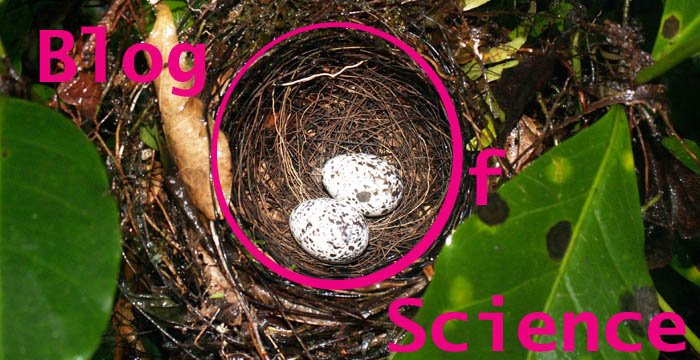
I've talked her before about hydra and their reproduction, so I thought I should post a few out of the thousands of pictures I have of them. I particularly like this one, and have a copy o up on the wall in the lab. It is a hydra hatchling, right out of the shell. The three bumps at the lower end of the picture are it's stubby little baby tentacles. The diameter of that shell is a bit under half a millimeter.
Innervation
There is perhaps good reason for concern. The other applicants I’m competing against are likely to be an extraordinary group. I have no indication of what fraction of us they're likely to hire. I have the bare minimum professional experience necessary to apply. I'm a biologist interviewing in the Humanities Section. What to an American seems an appropriate level of self recognition can strike many Germans as immodest boasting. My slides are currently a bit too wordy and dense.
All that said, I don't feel nervous yet; they don't expect me to describe my work in German. Just the idea makes me sweat.
Sunday, January 16, 2011
Linguistic injustice; it's good to be a native Anglophone
All this came to mind when I saw this letter
“Awkward wording. Rephrase”: linguistic injustice in ecological journals
and this response
‘Linguistic injustice’ is not black and white
in the journal Trends in Ecology and Evolution (TREE).
TREE is a high profile journal, publishing mostly excellent review articles, but unfortunately most of its content is not free to the public.
I will quote; the letter’s author, Miguel Clavero, begins,
International scientific communication is monolithically dominated by English, particularly within natural sciences. The professional career of individual scientists relies on their ability to publish in internationally relevant journals, and writing in English is the only way to achieve this. Non-native English speakers (NoNES) seem to be clearly disadvantaged with respect to native English speakers (NES) when trying to get their work published. In fact, English language proficiency has been shown to be a strong predictor of scientific output...
This argument makes sense to me. I have colleagues who are both smarter and harder working than I, who are quite fluent in conversational English, who take much longer to write a paper than I do. Writing crisp, clear, precise, flowing science while staying within word limits is hard, and frankly I’ll never learn a second language well enough to pull it off in anything but English. If Greek, Latin, French, Chinese, Arabic or German were the dominant language of science, I would be in deep trouble.
The response published in TREE points out that other disadvantages (e.g., being from a developing country) are vastly harder to overcome than being NoNES. A Swede has a much better chance to succeed in international science than an Anglophone African. A Swede may even come to speak and write English which is better than that of some Anglophones. It also points out that most English language journals won’t reject a paper because of language problems, so long as the science is sound and the writing is comprehensible and reparable. Both of these things are surely true, but don’t negate Clavero’s point. Bad English may not be a huge disadvantage, but skilled beautiful English is, it seems to me, a big advantage, and native speakers are much more likely to speak a language beautifully. This is particularly true, I think, when it comes to job applications. When one is being evaluated not only on the quality of one’s work, but also on one’s presentation skills, ability to answer complex questions clearly and leadership potential, language skills are important. I have seen application talks at the Institute given in such poor English that I had trouble following them; these people were not hired. The graduate students and post-docs I work with are mostly NoNES; a larger portion of the Research Scientist and lab heads are NES or have lived for extended periods in English speaking countries. This is not because of hiring decisions beeing made inappropriately. Rather, those fluent in English tend to be more successful in those tasks on which hiring decisions are legitimately based.
I doubt that English will cease to be the dominant language of science in my lifetime, and for this I am glad. That said, I take Clavero’s point, and I suppose we should add NoNES to the list of groups disadvantaged in scientific careers (females, underrepresented minorities, the disabled, citizens of developing nations, etc.). I am not sure what is to be done about it. Clavero argues that journals should cover the costs of language editing by charging a fee to all authors, whether they need language editing or not, spreading the costs. They would have to waive this fee for those without sufficient funding to cover them. Some journals in fact already do this, paying in-house language editors from author fees. This has not obviated the linguistic injustice. I am not sure what will, short of sci-fi quality automatic simultanious translation technology. I would love to have this technology, if for no other reason than because then I could stop struggling to learn German.
Friday, January 14, 2011
Weasel words
After reading the Wikipedia article on this, I happened to sit down to edit an application essay by a brilliant, but very shy, student of mine. I found it full of phrases like, "I wanted to," "Although I was," "I believe," "I began to," "I had the opportunity to," and "I helped to." These aren't weasel words mostly, but they serve a similar function. They allow her to say what she accomplished without it seeming like she is saying that she accomplished things. "I designed and carried out the research" reads a lot better than, "I was offered the chance to gain experience in designing research and gathering data," and takes up a lot less space.
The really successful scientists I know not only can say a great deal in very little space, they can squeeze in praise of their own work. I have several times seen, in scientific publications, people describe their own work as startling, revolutionary or subtle. For purely professional reasons, I aspire to this level of unabashidness. For the truly shy, classes in hubris might be in order.
Two talks at once!
Anthropology:
MPI for Evolutionary Anthropology, Leipzig
MPI for Social Anthropology, Halle/Saale
Psychology:
MPI for Human Development, Berlin
MPI for Human Cognitive and Brain Sciences, Leipzig
MPI for Psycholinguistics, Nijmegen, Netherlands
Economics:
MPI of Economics, Jena
MPI for Research on Collective Goods, Bonn
Law:
MPI for Foreign and International Social Law, München
MPI for Intellectual Property, München
MPI for Comparative and International Private Law, Hamburg
MPI for Foreign and International Criminal Law, Freiburg
MPI for Comparative Public Law and International Law, Heidelberg
Sociology:
MPI for the Study of Religious and Ethnic Diversity, Göttingen
MPI for the Study of Societies, Köln
MPI for Demographic Research, Rostock
History:
MPI for Art History, Florence, Italy
MPI for the History of Science, Berlin
MPI for European Legal History, Frankfurt/Main
You will note that I put my own institute, Demography, under the heading of sociology. Demography is in many way rooted in sociology, despite my belief that it should be a branch of biology. You will also note the preponderance of topics such as Law, Economics and Psychology, which have little theoretical overlap with evolutionary demography.
This is, in a way, a brilliant way of evaluating an applicant. Anyone who can describe their topic in a way which is simultaneously comprehensible and exciting to experts in one’s own field and experts in distant fields is at least a talented communicator. If they threw in some toddlers, who also had to like my talk, and maybe a few Tea Partiers, then it would be a real challenge.
Wednesday, January 05, 2011
The dead blackbird thing.
Much has been made of the news that 5000 dead blackbirds fell from the sky onto a small Arkansas town at the turning of the year. ~11:30PM on New Year's Eve. Conspiracy theories and omens abound, but I will propose my own theory: a conspiracy between fireworks and the migratory behavior of blackbirds.
There are several species of blackbirds in North America (e.g. Red-winged Blackbirds, Grackles, Starlings), that tend to migrate in large mix-species flocks. And when I say large, I mean blot out the sun, river in the sky, ornithophobe's nightmare large. Frequently in the hundreds of thousands, not rarely in the millions of birds. I was working at the Long Point Bird Observatory (in southern Ontario) one day in late November when one of these blackbird flocks went by, too thickly to count, for an hour and a half. As soon as we saw them we rushed out and closed the mist-nets we had put up to catch birds. While these nets work well for catching a flock of a dozen chickadees (which we would then measure, band and release), a thousand blackbirds hitting the nets all at once will collapse them, potentially killing large numbers of the birds. Many of the nets had several dozen blackbirds in them within the first minute, and it was a struggle to free them faster than new birds got caught. We couldn't close the nets until they were empty, and we couldn't stop catching them without closing the nets, so thick and fast they came, despite the fact that the main stream of birds was far above our heads, and despite each bird tending to avoid places where humans were standing. We put brightly colored cloths in the nets to make them more visible, but still we couldn't keep up. The nets began to sag under the weight of birds, each of which weighed only a few ounces. Only when the course of the avian river shifted significantly to one side were we able to empty and close the nets, and then stand and gape at the immensity of the flock. That night they all settled in a nearby wetland, densely and within a surprisingly small area.
Now by New Years Eve, these flocks would not be in Ontario, but in places more like Arkansas. It is reported that a wooded area in Beebe was being used as a nighttime roost for several hundred thousand blackbirds. My guess is that somebody was setting off fireworks near that wood, and scared the bejesus out of at least half a million blackbirds. Fireworks are used in agriculture to scare blackbirds out of fields, and to uninitiated birds, they are quite terrifying. So this river of blackbirds leaps into the air whirl around and around as the rockets and fountains go up. Now blackbirds, like most songbirds, have very poor night vision, and frequently smack into things if startled up at night. So maybe one in a thousand in the whirling disoriented mass smacked into a lamp, a sign, a building, each other. They go quite fast enough to kill themselves crashing headlong into hard objects, and can rebound several feet. The birds seemed to have died of blunt trauma, as from a crash.
Or it could be a sign of the end times.
Friday, December 31, 2010
A Frigorific New Year!
The temperature of course can't get much above freezing with all this ice all over everything. Looks like a frigorific new year.
Thursday, December 23, 2010
Passed round one
I've been invited to give a short talk on my research to the committee deciding which applicants will be invited to form Research Groups. The interview will be mid-February in Berlin, and I should know very shortly after that if my application was successful.
This means I have a month and a half to write a talk, make impressive figures and graphs, and so forth. The hardest part for me in writing the talk is figuring out who my audience is. The committee that wants to interview me is from the Human Sciences Section. This includes institutes focusing on anthropology, economics, art-history, law, religious and ethnic studies, linguistics, sociology, the history of science and the study of cognition. It also includes demography, evolutionary anthropology and a fair bit of other natural sciences. I can't simply give the same talk to a group of biologists and demographers that I would give to a committee of lawyers and ethnographers. I don't yet know if the committee as a whole will be judging my talk, in which case I have to assume a great diversity of background, or if they will have a smaller group of specialists assigned to each talk. I can give a good talk either way, but not both simultaneously. I've got some thinking to do.
Friday, December 17, 2010
Christmas Party of Science
My favorite part of the party was the Powerpoint Karaoke. This is a game which could be popular only with academics. Each player gets up to give a talk with power-point slides, which sounds boring, until you consider that he has never seen these slides before, and they are on a topic he likely knows nothing about. There were three contestants, including Santa, and each of us prepared a set of slides another one of us had to speak on. We were not kind to each other. My friend Jon spoke first, on a set of slides I had made, on sesquipedalianisms. I had the longest and most complicated words in several languages under the bright red heading “SAY THESE WITH ME!!.” He made a valiant attempt. Next I got up, in costume, and my slides were entirely in Greek. I recognized the alphabet, but had no idea what any of the words said, and there were no pictures. Lucky for me, most of my audience also didn’t read Greek, so I pretended that I knew exactly what the slides said, and that they were designed to correct common misconceptions about Santa (e.g., Santa does not in fact employ any reindeer, as their odor offends his sensitive nose.) The talk went quite well, and only afterwards did I find out that it was a presentation in Greek on numerical modeling. Finally, my friend Mikko got up and gave a talk on obscure economic phenomena he knew nothing about. He did a creditable job of pretending he knew what he was saying, or rather of being so precise in his vagaries that it was a believable if entirely uninformative talk. It was the first time I’d played this game, but I think it will not be the last.
Frohe Weinachten! Ho Ho ho!!!
Saturday, November 27, 2010
Could be good
If he ends up writing about my work it will bring my mother great bragging points with her cousins whether he gets it right or not, but I would be greatly annoyed if he slaughters it.
Competing by not competing
Despite this, I am setting out to write a human demography paper, with little if any evolution in it. I can do this with some confidence because, as far as I know, I am working in an area that has been almost completely overlooked, and therefore I have no competition. Most anyone with a solid demography background could do a better job of what I want to do than I can, and I really couldn't compete. But because they haven't bothered, I don't have to compete. I can do a decent job and hopefully publish in a good journal without worrying about the competition, because I believe there to be none.
In my recent grant application, I wrote, "My work falls between demography and evolution, outside the well explored territory of either. Work within evolutionary demography tends to focus on senescence and reproduction; I have intentionally eschewed these to seek the question others have avoided. This is a high risk strategy; my work does not fit neatly into any one topic-specific journal or discipline. However this unconventional approach has the opportunity to found a new direction of study and investigate the most important questions therein." This is a polite way of saying that I intentionally avoid competition by seeking out the questions others have ignored, or deemed less interesting. Most successful scientists are successful because they look for opportunities to do what others aren't doing. I don't know to what extent other seek out whole areas that others haven't bothered with. I also don't know how successful or sustainable a strategy this is likely to be in the long run. After all, the success of the work will ultimately be measured by how many other people get interested in it, and try to improve upon it. Successful work, by definition, must therefore attract competition. So if I want to be successful, but continue not having competitors, I’ll need to move on to some other under-appreciated topic fairly quickly. As I rather like the topic I’m currently seeding, I may just have to put up with some competition, and try to stay ahead of them. having my own research group would be a great help in this. Not being an expert demographer is less of a problem if you have an expert demographer on staff.
Sunday, November 21, 2010
More Tardigrades
Anyway, here, by popular demand, are a couple more pictures.
Note the long curved claws at the ends of the toes, much like a bear has.
Saturday, November 20, 2010
Fussy Hydra babies
I find myself looking forward to having rotifers in the lab again. They are just so familiar at this point.
Friday, November 19, 2010
The Royal Society has informed me
Focus
Science, like most complex tasks, is much easier to make progress on if you know exactly what you are doing, and you have everything you need to do it ready. Over the last couple of months, I got a lot done because I focused on finishing my grant application, and on getting out the two papers I needed to finish to go with my application. Now the application is in, the review paper is accepted, and the methods paper is submitted, and I must find a new focus to guide me. Over the last couple of days I have been scattering my time and thoughts between a dozen projects, and not really making any progress on any of them. I am giving myself until Monday to decide what the new plan is.
Thursday, November 18, 2010
Tardigrades!
What is so cool about tardigrades? They can survive total dehydration, exposure to vacuum, radiation, freezing, extreme heat, conservative radio personalities, you name it. They can persist for a decade dried out with no signs of life, then just add water and they reanimate themselves. They are rolly and round and shaped kind of like six-legged teddy bears with two more legs growing out of their tails. This appearance has earned them the nickname ‘water bears.’
This afternoon I wanted to see if the hydra I am keeping in the lab would eat rotifers, because the Artemia I am giving them now are a bit too big for them, and rotifers a tiny. I found some in a puddle outside the institute, and in the same puddle, I found tardigrades. I had never knowingly seen a live tardigrade before, so I took a good long look at them under the microscope. These ones were well under a millimeter long, but I tried to get pictures.
They are small enough that really good photos would require a different microscope, but here are two.
This is a tardigrade from above. You can't really see how cute they are from above.
This is the shed skin of a tardigrade.
Just as snakes have to shed their stiff skins occasionally, many animals with exoskeletons molt that shell occasionally. All the arthropods (insects, spiders, crustaceans, crabs etc) will shed their skins, and so will tardigrades. Tardigrades are not arthropods, but are their closest realtive except for the velvet worms. This skin is head-end down. You can clearly see the six legs on the left side, and the two-legged tail at the top-left. I will try to get better pictures of a live critter tomorrow.
Sunday, November 14, 2010
Jon Asks: 2
In the Laura Ingalls Wilder book The Long Winter, Laura's father says that you can predict the severity of a winter by observing the thickness of muskrat nests in the summer. Muskrats, he says, will build thicker nests during the summer if the following winter is going to be relatively colder, and vice versa with thinner nests and relatively warmer winters. Has this folk wisdom been investigated? Is it true? And if so, where can I get my own muskrat colony?
I can't find anything on Google Scholar or Web of Science indicating that anyone has published anything about muskrats and weather prediction, other than this:
Man's natural craving for advance knowledge of coming weather extends thousands of years back of any attempts at scientific weather forecasting. Realizing that he has not the necessary foresight himself, he has imagined animals to be endowed with some peculiar sense which enables them to know, weeks or months ahead, what the weather will be. Thus a large group of animal weather proverbs has come into existence. Millions of people believe that the thickness of fur on a muskrat, or the number of nuts stored by a squirrel, or a supposedly early migration of certain birds, indicates a severe winter. Yet it is certain that animals have no such foresight.
from: Robert DeC. Ward. 1926. The Present Status of Long-Range Weather Forecasting
Proceedings of the American Philosophical Society,Vol. 65, No. 1, pp. 1-14
He provides no evidence to show that they don't, he is just certain. Note that the version you mention has to do with the thickness of the wall of the house, while the version Ward mentions has to do with the thicknesss of their fur. The fur hypothesis would be easier to test, if you were a muskrat hunter. I am frankly doubtful whether he or anyone else has done the work that would be needed to convincingly either story. You would have to measure the wall thickness of bunches of muskrat houses (or the pelt of many muskrats) in the summer. You would have to do this every year for quite a few years in order to make a convincing analysis of the relationship between wall thickness and hardness of winter. You would probably also want to measure various features of the microclimate, the muskrats behavior and physiology, and the local ecology, in order to get some sense of what the mechanism was. You probably would want to measure the pelts and the houses, just to make sure you were measuring the right thing. This is one limitation to testing folk-wisdom. There are often several versions, and it is hard to know if you are testing the right one unless you test all of them, and then you increase your chances of finding a strong correlation just by chance. My best guess is that there is some, but not a lot of, truth to either version of the story. Certainly they could pick up on whatever cues are available that the winter is going to be hard. But like most weather prediction, they probably aren't very accurate, at least not months in advance.
Jon Asks: 1
I've read that fungi are the only organisms that can degrade the longer-chain fibers in wood, such as lignin, and that without saprobic fungi the world would be blanketed in dead, undecayed trees. I see on Wikipedia that it is not literally true that no bacteria can degrade lignins, however, by Wiki's account, it does seem that no known bacteria are very good at it. (http://en.wikipedia.org/wiki/Ligninase) So why would that be the evolutionary case? Bacteria have evolved to break down pretty much everything else on the planet (roughly speaking), and wood has been around for something like 350+ million years. Why would they be such second-rate degraders when it comes to lignin?
This is an interesting question, but not one I can give a very satisfying answer to. Explanations of why something didn't evolve are always fairly speculative. Why no six legged tigers? Why no live-birthing birds? Why no Ents?
So why no lignin devouring bacteria? If they can do it poorly, why not well? Maybe it isn't worth their while to invest in that capacity, as they are always outcompeted by the fungi who can already do it? Maybe they can rely on the fungi to make the enzymes, and then they can just mooch. Perhaps the process of making the necessary enzymes requires separate cellular compartments, which bacteria lack. Maybe the necessary mutations just never occurred, and so couldn't be selected for. Certainly I don't know.

