Thursday, August 04, 2011

Taxonomically not what you eat

One should be cautious in naming a taxonomic group for their ecological habits.

I offer you these examples:

1. Most turtles are amphibious; all are reptiles, not amphibians. Turtles have scales, lay hard leathery eggs, have the physiological and genetic makeup of reptiles. I often see phrases such as, "turtles and other Amphibians" in writing about biology by non-scientists. The taxonomic term 'amphibians' is not helpful in getting across to people that turtles are reptiles.

2. Consider the Carnivora. Most Carnivora are carnivores, but some, such as the giant panda, eat largely plants. Further, many carnivorous mammals are not Carnivora in the taxonomic sense. Unnecessarily confusing.

3. Pity the poor Insectivora. It turns out things are worse than just dietary nonconformity (not all the Insectivora ate insects, and not all insectivorous mammals were called Insectivora). The group called Insectivora no longer exists! Biologists had assumed that similarities in diet and morphology among the moles, shrews, tree shrews, golden moles, hedgehogs, moonrats, solenodons, tenrecs, elephant shrews and colugos were the result of common descent (they all had these traits because they were all closely related to each other). It is now clear that Insectivora was an ecological rather than taxonomic grouping. This is because modern molecular genetic and phylogenetic methods make clear that most of these Insectivores are not any more closely related to each other than they are to you, or to an elephant. Specifically, the moles, shrews, solodons, hedgehogs and moonrats form one group, whose closest relatives include the carnivores and hoofed mammals. The tree shrews and culogos (of southeast Asia) are more closely related to the primates. The golden moles, tenrecs and elephant shrews (all African groups) are related to larger mammals found in Africa such as the aardvarks and elephants.

4. The Caprimulgidae (Latin for goat suckers), do not suck goats. They were named for a feeding behavior falsely attributed to them. They are in fact insectivores.

Wednesday, August 03, 2011

Who's a demographer?

I tend to find religious fundamentalists, whatever the religion, hard to listen to. One of the habits I find objectionable is the tendency for fundamentalists of a religion to argue that others who practice the same religion differently aren't really practitioners of that religion at all. This tendency has recently been popping up in the news as Christian fundamentalists in the US argue that because Mitt Romney is a Mormon, he isn't really a Christian. I have no fondness for Mitt Romney, and frankly suspect he would claim to be a Pastafarian if he thought it would get him elected. That said, the Mormons declare themselves to be Christians (they do talk about Christ a lot), and I can't see as anyone has the authority to tell them they aren't. It is just hubris to go around telling people that you can describe their religious beliefs better than they can.

This is all a roundabout way of getting to the question of who is a demographer. Ask a demographer what is the largest annual scientific meeting for demographers, and she will probably say The Population Association of America (PAA). I consider myself a demographer as well as a biologist, but I think most PAA members would say the stuff I do isn't demography. This is for the simple reason that I mostly study non-human populations, and the PAA defines demography as the study of human population processes. Studying the same processes in non-humans is, by this definition, not demography. Last year they had a session on evolutionary demography, but all the accepted papers were on humans. This year they don't even have such a session. I think that inserting the word 'human' into the definition of demography is roughly akin to saying that anyone who doesn't follow the teachings of a particular Rabii isn't really Jewish, so I call myself a demographer.

I was recently surprised to find myself in a conversation in which the tables were turned. A colleague was arguing that most PAA members are not really demographers, but sociologists. His argument was that many human-focused hard-core demographers feel out of place at the PAA. After their meetings this spring several colleagues complained that most talks at PAA meetings are really quantitative sociology rather than demography. The distinction is a fine one, but basically classical demography has a core set of questions and methods, and these have certainly been supplanted to a considerable degree by questions coming out of sociology, mostly approached with methods that don't require the quantitative machinery of formal demography. My colleague told me, "All the talks are full of regression tables, and most of the regressions aren't even done well."

So is it fair to say that my colleagues and I, who apply classical demographic methods to non-humans are more demographery than the quantitative sociologists at the PAA? I'm afraid not. We can no more revoke their demographer label than they can revoke ours. However, since the social demographers who control the PAA aren't interested in evolutionary demography, and most of their presentations frankly aren't that interesting to us (there really are a ridiculous number of regression tables, mostly demonstrating the relationship between fertility and female education for yet another population), I'm going to let my membership lapse. I'm thinking I'll join the British Ecological Society instead. They have lots of evolutionary demography at their meetings. I don't even feel the need to call myself an ecologist.

Monday, August 01, 2011

Why there are no whale-like birds.

For my birthday, my parents sent DVDs of the Life series with David Attenborough, nature films from the BBC. These are wonderfully made, with amazing photography, and you will likely never hear me say that about any other films. One aspect of the photography that is amazing are the underwater shots. This has got me thinking about marine mammals and seabirds, and the differences between them.

There are five independent lineages of extant (extant is the opposite of extinct) marine mammals:
1. The Cetaceans (whales, porpoises and dolphins), relatives of pigs and hippos.
2. The Sirenians (manatees and dugongs), mildly related to elephants and hyraxes.
3/4. The Pinnepeds (walrus, seals and sea lions), descended from a dog-like carnivore.
3/4. The sea otter, an otter, which is an aquatic weasel.
5. The polar bear, bear.

I have ordered these in the degree to which they have become fully aquatic. The Cetaceans neither need to, nor safely can, leave the water. This is true of Sirenians also, but they tend to feed and birth in shallow water near shorelines, where whales wander the open oceans and dive to amazing depths. The Pinnepeds aren't so good on land, but they do haul up to breed and pup. The sea otter is in some ways more fully marine than the Pinnepeds, mating and usually giving birth at sea. But again, otters are more tied to the land than are Pinnepeds the rest of the year, living and feeding in coastal kelp forests and being capable of fast and efficient movement on land. The polar bear is marine in that it swims long distances, hunts at sea, and has structures that specifically help it do these things. But it still prefers to walk rather than swim, brings its food onto solid ground to feed, breeds and pups out of the water and so forth.

There are more independent groups of sea birds, even if you don't consider each transition from freshwater to saltwater. Penguins are perhaps the most fully marine, flying only in water, feeding entirely on seafood, having special mechanisms for dealing with high levels of salt. The Procellariiformes (albatrosses and petrels) are not far behind, spending about as much time at sea (although over rather than in) as penguins do. The Phaethontiformes (tropicbirds) spend most of their lives at sea, as do many of the Pelicaniformes (pelicans, frigatebirds, boobies, gannets, cormorants and shags). While many gulls live far from the sea, many Charadriiformes (gulls, terns, skuas, plovers, puffins, auks etc.) are extremely marine. Many Anseriformes (ducks, swans and geese), particularly the Merginae (sea ducks) are, well, sea ducks. It was recently discovered that gyrfalcons spend long periods hunting on and around sea-ice, although they probably don't actually swim. I'm sure I've forgotten other examples.

Why so many birds moving out to sea, but so few mammals?

The obvious first hypothesis is that the ability to fly is very useful at sea, while the ability to walk/run/hop etc. is not. The falcons are a pretty terrestrial group, but with few changes beyond the behavioral, gyrfalcons can spend extended periods at sea. Ospreys and eagles, relatives of falcons, use talons that evolved grabbing terrestrial prey to scoop fish. Even hummingbirds and warblers that can't forage or land at sea regularly spend long periods migrating over open ocean. Birds may have an easier entree than do mammals.

Given this, it may be surprising that the most fully marine descendent of terrestrial vertebrates are not birds. All birds lay eggs, and none have figured out how to make that work at sea, so all need to maintain the ability to be land animals. Almost all mammals give live birth, and three groups (Cetaceans, Sirineans and sea otters) can do that without ever leaving the water. The birds may have an easier time getting started down evolutionary paths that lead to a marine life, but they seem to have an inescapable constraint that keeps them from finishing that path: shelled eggs.

The marine reptiles show an interesting parallel to this. Marine iguanas, saltwater crocs and sea turtles all lay eggs, and all do so on land. Sea snakes, excepting one genus, birth live young, and do so at sea. That one genus lays eggs on land.

If some snakes have evolved the ability to have their eggs hatch internally and their hatchlings ready to swim the moment they emerge from the mother, why can't some bird do the same? Imagine how much better off an emperor penguin would be if instead of spending the Antarctic winter fasting in the cold, it could spend that time feasting in the ocean with it's chick developing internally.

Any answer I could offer would be pure speculation. One class of question that evolutionary biology is very bad at answering is "why didn't X evolve." Why hasn't any bird evolved live birth? Maybe it is something about their egg shells. Maybe they are in a habitat where that just doesn't work. Probably it just never happened.
Friday, July 22, 2011

37 weeks

It is an obvious yet remarkable fact that a fetus, near the end of pregnancy, could as easily be a newborn baby. Whether through natural birth or c-section, removing the full term fetus from the mother is all that is necessary to transform it into a baby. One remarkable thing about this is that a baby is an air-breathing animal much like any other, and a fetus does all its gas exchange through a tube attached to its circulatory system through its belly button. I can’t easily imagine keeping a tortoise alive by sticking a tube into its belly, nor do I imagine one would have much luck doing so with an adult human, or even a child. But somehow it works for the fetus.

Another thing that is striking about the fetus being a nearly complete baby is that it is a nearly complete baby entirely inside the belly of the mother, upside-down, often with its head inside her pelvis. I don’t know about you, but I could not function for very long with a nearly full sized baby inside me and a skull in the middle of my pelvis. I think I wouldn’t last five minutes, but apparently this situation can go for weeks with little danger, and bearable discomfort, to possessor of either pelvis or skull.

A tremendous amount is now known about ontogenesis, the process by which a single egg grows and develops into a whole person. We have studied it on the scale of molecules, cells, tissues, organs and whole individuals and from the perspectives of physiology, genetics and evolution. There are still vast areas we know almost nothing about, but we can largely reject the hypothesis that there is magic involved. Never the less, things can feel like magic even when reason rejects it. This whole process, of self-directed growth of a single cell into a person, makes it easy to understand why spirits, gods and humunculi are so often invoked.

Friday, July 01, 2011

Hyphum

I know a bit about a lot of organisms, but don't really qualify as an expert on any species. It is great fun planning experiments with people who know a lot about a particular organism. I can say, "if a hypha that is only 300 microns breaks in half, do you get two living 150 micron individuals, or two dead hyphae?" and get the immediate response, "The singular of hyphae is hyphum," followed by, "you would get two dead halves, so we don't have to worry about it." This way I can concentrate on designing the experiment and learn good Scrabble words.

EDIT: May 2nd 2017.
 The singular of hyphae is actually hypha. I just stumbled upon my own old blog post and said, "Whoa! That's wrong." I must have misheard that six years ago.

Friday, June 24, 2011

33 weeks LMP

There is a certain irony to being to a researcher who studies mortality risk early in life, and also a soon-to-be father. Sometimes I feel I know way too much about certain topics.

Thursday, June 23, 2011

Decreasing population, increasing density

The Institute where I work is built on land that used to be part of huge East German ship building facility. The facility folded shortly after the German Democratic Republic did. The buildings were, for the most part, left derelict. One of the former factory buildings has been converted into an indoor shopping center. Each store is its own single story box built into the bottom of the cavernous factory building, with walkways and cranes still hanging overhead. Most of the other buildings have been torn down, and ~15 waterfront apartment buildings have been built (or are being built) on the land, most just within the two years I have been here. Apartments in these new buildings are on the expensive side for Rostock, but are filling up fast. One or two huge windowless cement monstrosities (one holds a dance club called The Bunker) remain, as well as a couple of older brick warehouses that have been refurbished. One is being used as a temporary home for the Rostock Volkstheater (community theater) while their main hall is closed for fire-code violations. It feels as though a new, fairly fancy, neighborhood is simply sprouting from the root-system of the old shipyards, among the remaining shells, foundations and train tracks to nowhere.

The demand for housing that fuels all this building is a story of migration. Rostock is Mecklenberg-Vorpomern, the least densely populated state in Germany, and a state that has steadily lost population since reunification. Many of the outylying villages are dominated by abandoned buildings. Apartment complexes on the outer edges of Rostock, plunked down in the middle of fields by the communist planners, now offer multiple months of free rent to anyone who will move in and still are emptying out. Rostock is full of college students, who don’t want to be on the outskirts in half empty buildings, and an aging population of long-term residents, who don’t either. The more abandoned the outskirts get, the strong the incentive to move toward the city center. So the center of Rostock is becoming denser even as the state loses population.

Monday, June 20, 2011

A name but no face

The first time I saw one? I was out in the rowboat, only a couple of hundred feet from our dock, and had, for whatever reason, dropped an oar over the side. I was probably 11, so there is a good chance I had dropped it on purpose, so as to be able to retrieve it. As I was reaching for the oar, I noticed a little white circle, mostly translucent, maybe the size of a dime, floating just under the oar. My hand retracted as the word 'jellyfish' formed in my brain. But I had swum in this lake many hundreds of times and never been stung, or heard that anyone else had. It wafted back and forth in the wavelets I created as I wiggled down in the boat to get a closer look. I held still and eventually so did it. Definitely a jellyfish, or something very similar to one. I watched it until it sank down into the dark silky water and out of view. I imagined it going back down to its secret world and hidden life. I imagined following it and learning.

The oar by this time was far enough away that I had to jump in and get it. I did this with some reluctance, having been stung too many times before, by jellyfish at summer camp on the Chesapeake Bay, and the previous winter in Florida by a Portuguese Man-o-War. Like every swim in the lake before and since, no stings.

My mother afterwards told me that there were freshwater jellyfish in the lake, but only occasionally, and not as many as my grandfather described from when he was a boy. I’ve seen them occasionally since, usually only on really hot days, one or two at a time. I only recently learned their name, Craspedacusta sowerbyi, when they were suggested to me as a possible study organism. Looking them up, finding that they had been studied down to the molecular, I realized I already knew this organism, but only as scattered phantasms floating by on summer days.

Sunday, June 05, 2011

name for a principle?

There is a principle that I want to refer to in an upcoming talk, but I can't find a name for it. Someone must have named it after themselves by now. It is related to Ockham's razor, and to parsimony, but is distinct.

The principle is that an explanation for a pattern should preferably be applicable as broadly as the pattern is observed, but not more broadly. For example, an evolutionary explanation for group living that can be applied to all the group-living insects is preferable to an explanation that works only for one species of ant. The explanation should preferably not explain the pattern more broadly than it occurs. For example, an explanation for the fusion reaction of the sun merely in terms of the presence of hydrogen would also tend to predict fusion in many other contexts where it does not generally occur, making this explanation less desirable than a more complex one which also specifies the need for the physical conditions which encourage the hydrogen to fuse.

This is the sort of logical statement that is so obvious as to rarely need to be said, yet I need to say it for this talk. If you know what I should call it, please let me know.

Monday, May 30, 2011

Reproduction

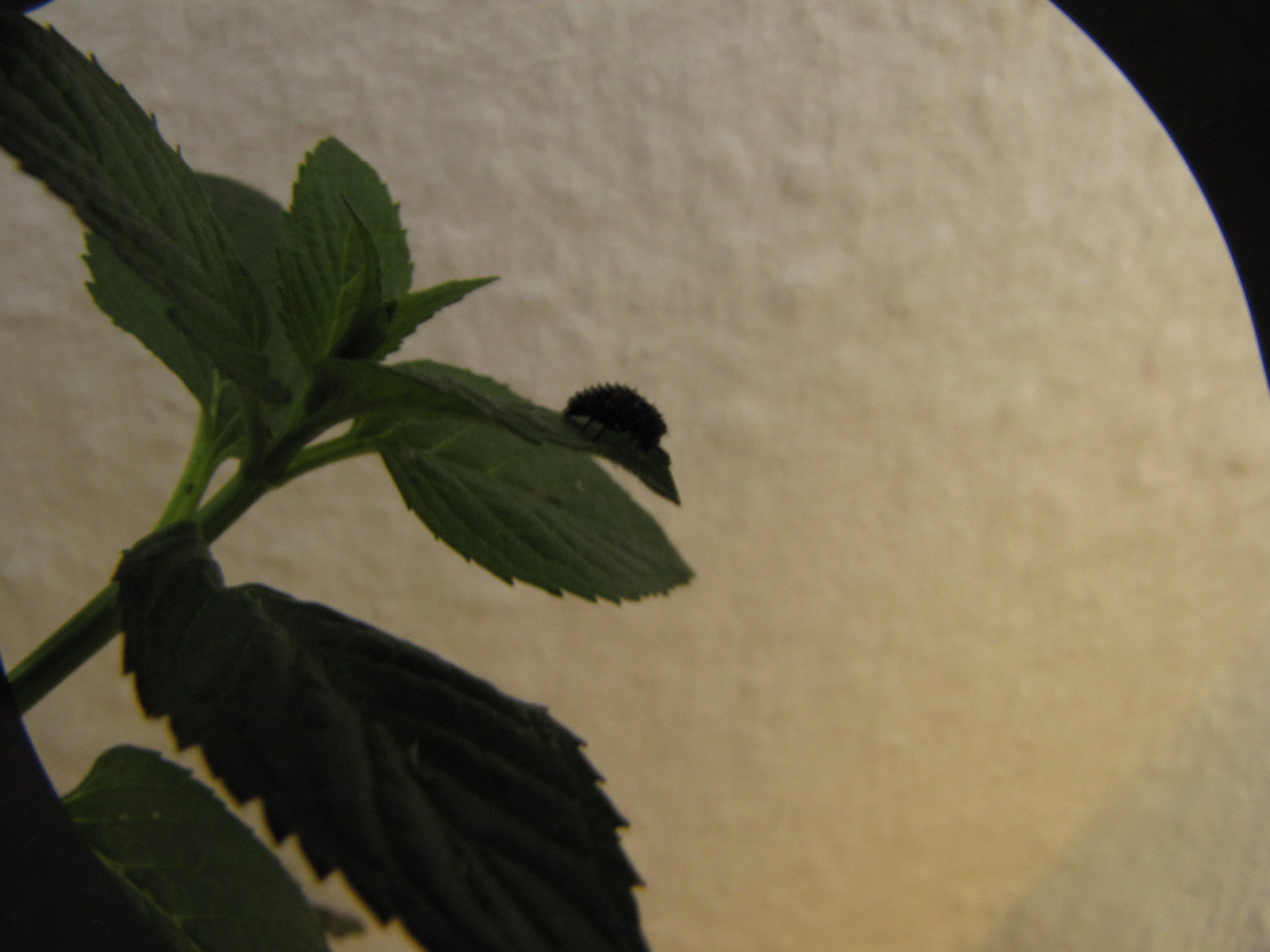
The ladybugs are successfully reproducing on our mint plant. Oh frabjous day! The larvae are crawling all over the plant scarfing down aphids like mad, and the adults are laying more eggs. It is exciting to see them doing so well.


Friday, May 20, 2011

Two offers out

We have now interviewed two post-doc applicants. Both are extremely well qualified for their respective prospective positions. Both seem very easy to get along with, and both have been offered the positions. Neither, unfortunately, has yet accepted. The first because she is scheduled for a competing interview today, the other because she needs to make sure her partner can also get a job in Rostock. If we hire both of them, I will have a wonderful research team. With either one we could make real progress.

We still have one more candidate coming, next week, and if my bosses like him we could offer a position to him also. If we end up successfully hiring all three, I will be very happy.

Thursday, May 19, 2011

Bedside ecosystem


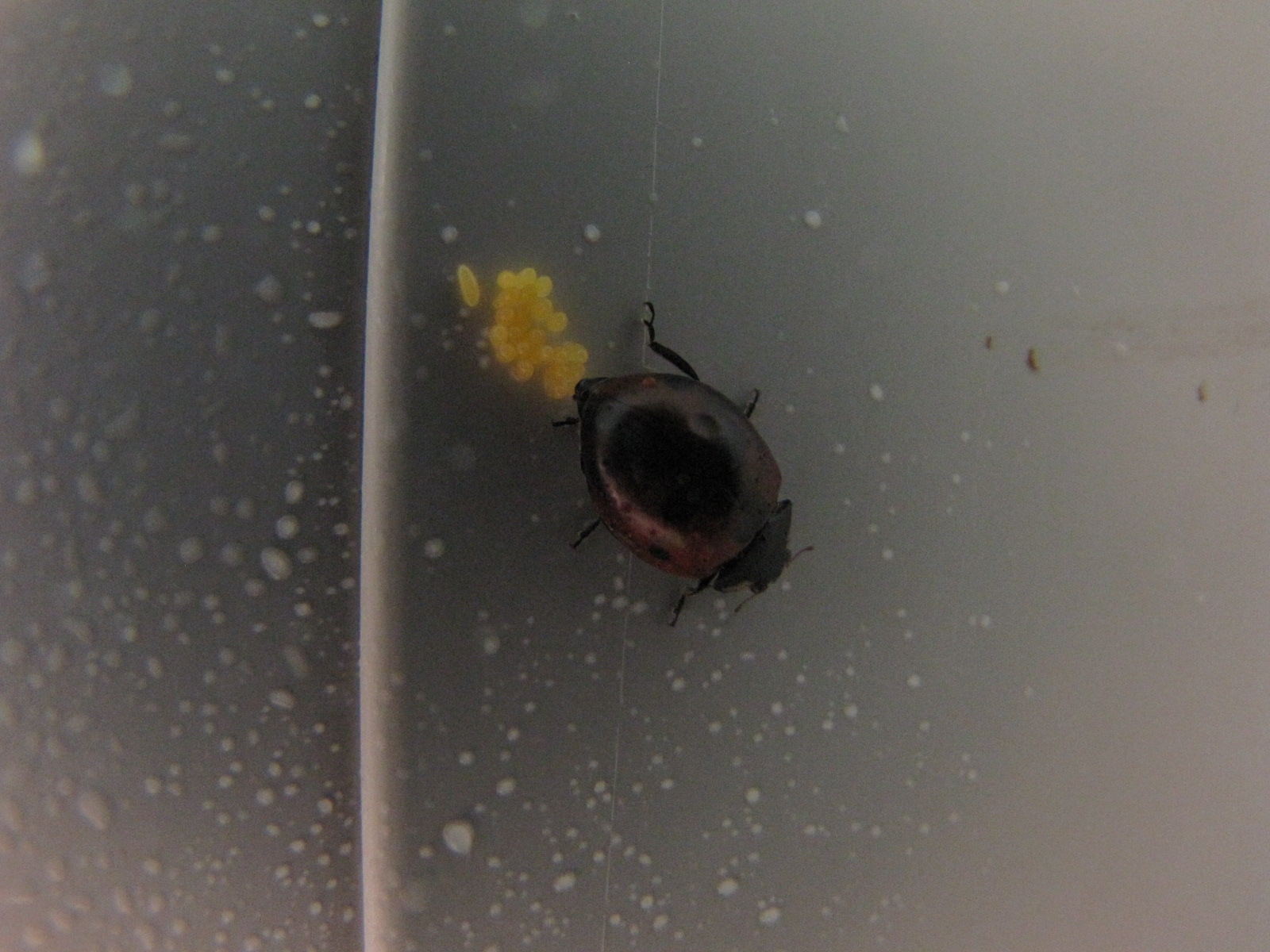
Most mornings I spritz the chocolate peppermint plant on our bedroom windowsill from a spray bottle of water. It loves to be damp. It is growing so well these days, is so juicy and luscious, that the aphids are maintaining a healthy population on it despite my best efforts to squish them and the depredations of the ladybugs. This of course leads the ladybugs to congregate on the mint, as the aphids, thrips and whiteflies have been picked clean off our other plants. And you know what happens when beetles congregate in the spring. This morning as I was spraying, I noticed one of the ladybugs laying eggs on the window frame!

There are about 30 eggs so far and she is still laying. The great thing about this is that labybug larvae are wonderful aphid predators, and don't fly away the way the adults do. So I'm going to transfer the eggs onto a leaf and hope they hatch.

Tuesday, May 17, 2011

Walking desk

I'm one of those people who have trouble sitting still and working for any great period of time. I frequently find excuses to get up and walk to the other side of the building to talk to someone or check on something. I've occasionally seen articles like this one on NPR touting the health and productivity benefits of treadmill desks.

When I was in grad school I read such an article, then saw a treadmill for sale in a thrift store near campus. I stopped by the office of the acting director of the museum where my office was and asked if I could install myself a treadmill desk. She looked confused and busy but said yes. The next day maybe half an hour after I had moved the mill in, as I was just figuring out how to build a desk over it, she apologetically called me to her office and asked me to remove it from the museum. My wife kindly let me keep the machine in our tiny tiny Berkeley studio apartment until we sold it to a friend.

Now that I have a real job and we have a decent sized apartment, we are reorganizing that apartment to fit a baby and all the stuff that goes with modern babyhood. And it just so happens that I have both another used treadmill and a broken desk. Below are pictures of the result. It is not the world's prettiest construction (built while recovering from a tooth extraction using only materials I had in the room and without taking any measurements) but now I can walk and type at the same time. It will take a little bit of getting used to typing while rocking from foot to foot, but I think I am going to like this, and maybe it will help me remember to use the treadmill.

Here is my wife's shot of me typing this post:


And here's a view from the treadmill. We are in the tallest building in the state, so I have a nice view of Rostock from my desk.

List of materials:
Treadmill from thrift store
Broken desk
Various screws and bolts I had around the house
An old curtain rod

Total cost €90 spent last year

Thursday, May 12, 2011

Spring is the season of interviews

Spring has sprung and is sprinting toward summer here in Rostock. The horse-chestnut trees that line many of the parks and roads are covered in big spikes of flowers. There are fledglings all over the place, running around on the ground until their wings are developed enough to let them fly. (Many of them don’t make it and the curious eye will spot the occasional bit of carnage under a bush). In the shallow western end of the old city moat, newts are breeding among the sunken leaves and floating catkins. From one day to the next, the skies above the city have filled with squadrons of swifts, whistling incessantly as they outmaneuver any insect that dares take flight.

The days are rapidly getting longer. The sun might officially go down at 9:02 today, but the twilight stretches to well after 10 as the sun skims just below the northwestern horizon. Early this morning there was light streaming in our north-facing kitchen window.

The spring here brings more than just a physical thaw. Come to Rostock in the winter and you will think the population generally has forgotten how to smile. You will see few people on the streets, and often the only parts of them that are visible are scowling. Now the streets are full of summer dresses and shorts, and their occupants are reveling in sunshine.

This, frankly, is the perfect time to be bringing post-doc candidates to Rostock. Flowers, birds, smiling faces, warm breezes, so much sun. These interviews are as much about convincing people they want to come here as they are deciding which people we want to hire. Having the place at its best certainly helps in that regard. We won’t do any interviewing in February.

Thursday, April 14, 2011

My very first robot

We've just gotten a Roomba. For those of you who don't know, this is one of those vacuum-cleaner robots. It has some obvious advantages (and disadvantages) as compared to just using a normal vacuum. First, I can turn it on and then go back to my sickbed while it cleans the floors. Push a button on the top and it vacuums the whole room. It is low enough to get under and behind the couches and beds, picking up huge amounts of dust and hair in the process. It is fun to watch when one has a fever.
On the downside, the thing is an idiot. In theory it has various "robot behaviors" that help it to efficiently clean the whole room, but in practice it seems to pretty much bounce around the room at random, occasionally following a wall successfully. I should specify that the version we have (440) is probably not as good at navigating as the latest versions (610). It does eventually find its way to most corners of the room, although it took about 45 minutes of bouncing around to have covered our living room fairly well, even after I put up the chairs, trash-can, etc. It doesn't see, and doesn't seem to make a map of where it has and hasn't gone, so it will repeatedly miss clumps of dust sitting in the middle of the floor. Some of these it never got. It has a very small dirt compartment, so after one room it was completely full, although I admit most of that dirt came from under couches where I don't usually get.
On a single charge it did our living room, hallway, office and most of our bedroom, although it needed to be emptied after each room. I left it doing the bedroom while I took a shower. Half way through the shower it started making a rather pathetic beeping. It was under the middle of the bed and had picked up so much lint and hair that its brushes and wheels could not longer turn. I pulled it out with a broom and had to take the thing half apart to clean all the hair wrapped around everything. Oh the plus side, it hasn't looked so clean under our bed in months I suppose with regular Roomba-ing the dust won't accumulate to the point that it becomes a navigational hazard.

With time these things and their competitors will become more advanced and less clueless. In movies and books we always go straight to humanoid sentient robots, without the intermediate step of a self-propelled vacuum cleaner taking two minutes to find its way out from under the desk. This is like the Precambrian ancestor of R2D2.

Tuesday, April 12, 2011

Dunno

I have called a lot of references for post-doctoral candidates over the last weeks. I always go into it wanting the reference to tell me how wonderful the candidate is. You would think the alternative would be for the reference to reluctantly express some concerns about the candidate’s appropriateness for the position, or something such. But I’ve now a few times had the experience of a third answer I didn’t really expect.

This answer is effectively, “Not qualified to answer.” The reference can’t really answer my questions, either because he didn’t work so closely with the applicant, or because she worked with him several years ago, before a great deal of professional development.

I can sympathize with the situation these references are in. Imagine that a student you like but don’t know extremely well asks you to be a reference for a job application. It can be hard to say, “Well, I don’t know you so well, isn’t there anyone else you can ask?” So you agree and then kind of hope not to wind up on the phone with some guy in Germany asking for insight into the applicant. Then I call. Doh!

Thursday, April 07, 2011

Despair not!

My prediction for hiring success has improved significantly over the past few days, for reasons both rational and irrational.

Rationally, I’ve started to receive more good applications, if not fewer spamly ones. I suspect that this is because the people who are preparing position-specific applications are taking their time to do it, as our deadline is not until April 30th. Also, it being spring, many graduate students are just finishing their thesis defenses and looking for positions.

Irrationally, I have been speaking to people’s references, and the references are of course enthusiastic about the applicants. I knew this was going to be so. I am well aware that the applicants wouldn’t have listed these references if they were going to say terrible things about them, and that the references feel a sense of obligation to say good things, but hearing great things about an applicant from a basically rational and honest colleague inevitably improves my view somewhat. It makes the applicant seem more like a person, and less like a CV. I don’t have any basic predilection to like CVs, but I like most people.

Thursday, March 31, 2011

Skipping that hard middle part

The part of science I like best is the coming up with questions part. The part where I ask something someone else has never asked before (or at least I don't yet know that they did) and brainstorm together a plan about how the question could be answered. But my second favorite part is writing rough drafts. I like the rough drafts in particular because I can let the ideas flow, without getting hung up on making sure I have exactly the right reference or my font is just the one the journal prefers. In other words, it is writing without the impeding mechanical details.

I can do lab work, I can program a simulation, I can edit bibliography formats in citation management software, and all those other jobs that require extensive attention to details beyond the scientific concepts. But by preference I'm really a concept guy. If I had collaborators who wanted to do every part of the process between the planning and writing the rough draft, I'd be thrilled.

This is why I'm writing a Forum piece, to submit to a journal that responded positively to my pre-submission inquiry. (A positive response means they are willing to look at it, not that they promise to publish it.) Their Forum section is designed for short papers of about a 1000 words, in which the author makes a relatively simple point or poses a question without a lot of new data. I've finished a rough draft of 1100 words in the last two days. Now comes the less fun part of editing it for clarity, making sure all the papers I cite actually say what I claim they say, getting feedback from colleagues and editing it again. A more adulterated and repetitive form of creativity. Still, I think I would be inclined to write more papers in this format, as it makes a nice compact project.

Tuesday, March 29, 2011

Fun with Photoshop: Hoofstock

The pun is my wife's, the Photoshopping my own:


This, for the record, took 36 minutes, starting with a giraffe clipart.

Sunday, March 27, 2011

What to do?

I have an ethical situation here. I've received a fraudulent post-doctoral application. This applicant has, on his CV, listed quite a few publications in peer reviewed journals. Some of them are real. Others simply don't exist. There are no papers by this author in the listed journals. There are no publications with the listed titles in any journal. One of the imaginary papers is supposed to be in Nature, but the listed volume number doesn't even correspond to the listed year, and so on. I am very confident that the CV is fraudulent.

The question then is what, if anything, should I do about this? I don't really want to waste a lot of my time, but this is fairly serious misconduct. I could write to him and request copies of the papers, or an explanation of Figure 2 in the Nature paper. I could tell his boss on him, assuming he actually works where he says he does. I could simply reject the application. I'm not certain what, if anything, is the standard response to this situation. There are confidentiality rules that apply to job applications, even fraudulent ones, so public humiliation is out of the question.

Etymological challange: Evolutionary Demography

I have a bit of a stomach bug this weekend, so I am thinking about things that don't require so much concentration. A colleague had raised the question of when the term "evolutionary demography" was first used in print, and said that the oldest example he could find was:

Caswell, H. 1985. The evolutionary demography of clonal reproduction. pp. 187-224. In: J. B. C. Jackson, L. W. Buss and R. E. Cook (eds.) Population Biology and Evolution of Clonal Organisms. Yale Univ. Press.

I, currently having more time than brain power, did a little bit of searching, and found this:

Wilbur, H.M. 1975. The Evolutionary and Mathematical Demography of the Turtle Chrysemys picta. Ecology, Vol. 56, No. 1 (Winter), pp. 64-77.

which uses the phrase "evolutionary demography," explicitly in the acknowledgements and implicitly in the title.

Can anyone find an older explicit recorded use of the phrase? If so, the commenter presenting the oldest confirmable example will win a prize: I will personally make a sculpture representing a species of your choosing (excepting diatoms) and send it to you in recognition of your etymological achievement. Comments will be accepted for one month from today, or until I get the first winning example, whichever comes last.

Friday, March 25, 2011

lebenslauf

I'm a bit uncomfortable with some of these German CVs. The lebenslauf (life run) is the rough equivlent to a curriculum vitae, but it is a lot more personal. Many of the lebenslaufen I have seen contain not only educational and employment infomation, skills and other things relevant to qualifications, but also things that from my frame of reference simply don't belong. What legitmate reason would a potential employer have for wanting to know the applicant's religion, the name and employment of her parents and siblings, what primary school she went to and her photograph?

Will the culture shock ne'er end?

Tuesday, March 22, 2011

What is EvoDemo?

The question has arisen how we should define Evolutionary Demography, such that we can decide if someone's work qualifies. I have offered 2 short definitions, into which I haven't yet put a lot of thought.

Short definition 1 : Scientific study which combines evolutionary biology and demography.

Short definition 2: The study of the evolutionary history, function, variation and relevance of demographic traits.

These are both broadly phrased. I don't like constraining definitions to the traditional terrain. A zebra found outside Africa is, in my opinion, still a zebra. As such, I haven't included anything about what traits, methods, etc. evolutionary demographers usually consider.

My question to you, dear readers, is: Can you think of anything that should be considered evolutionary demography that doesn't qualify under these definitions, or anything that shouldn't qualify that these definitions let in?

Propositioning journals

I’m a great fan of the pre-submission inquiry. The way this usually works is I write an email to the editor of a journal saying, “Here’s this great idea for a paper, and I’d like to know whether I should write this up for your fine journal.” Usually within a few days the editor writes back and says yes or no. Some journals require this, but I’ve started doing it even for some that don’t. It is useful for everyone involved. The editor gets to spend a couple of minutes reviewing my email and telling me that my paper doesn’t fit that journal, or inviting me to submit, rather than dealing with a full submission. I get to not waste time preparing a submission to a journal that is entirely uninterested in my topic, or I get the encouragement to submit to a journal that I have been told is likely to be receptive. Writing the email also forces me to think about what I want to say, and at what length, which aids my thought process. Finally, while rewriting and reformatting a paper to send to another journal takes some days, redoing the pre-submission inquiry takes only minutes. This is very useful for an interdisciplinary researcher like me who often has to hunt around for an appropriate journal for each paper.

Monday, March 21, 2011

The demographics of evolutionary demographers

A group of us considering organizing a new scientific society have been compiling a list of those we would like to invite to the initial meeting of the society, to be held here in Rostock, probably next year. We are up to 125 people (excluding people who work here, as everyone who works here will be invited). The group making this list is about half male, half female. The list is 100 males and 25 females.

Why this skew? We each listed people whose names came to mind, and in some of the subfields we are drawing from (e.g., mathematical ecology) almost all of the well known people are male. Higher level academics in general still skew strongly male, and the higher the level the stronger the skew, in most cases. This is both a cohort effect (older cohorts of scientists are both more well known and more male) and a selection effect (males find it easier to advance up the ladder). Being demographers, we are very much aware of this, and are very much interested in having a diverse society, but it is not clear what we can do about it. There is also a preponderance of Europeans, North Americans and East Asians; again this is unintentional and difficult to reasonably address.

Despite these skews, it is a wonderful list of researchers, and I hope we can get most of them to attend.

High r strategy in a high k regime

I have thus far received 39 post-doctoral applications. Of these 29 were immediately rejectable on the criteria that the application did not include the documents requested. Most of the 29 I couldn’t even tell which position the applicant was applying for, or that they had read the ad. About half of these also contain a similar mix of muddled excessive politeness and jumbled frilly clauses, as though they are cut and pasted at random from the same absurdist form letter. I have no doubt that these are smart, competent people, and perhaps this broadcast spawning strategy of application works in some fields or some countries, but my experience suggests no circumstance under which it would be effective.

Whenever I am hiring, or reviewing applications, I ask myself if I am expressing any unintended biases. I was warned by a friend to expect a large number of irrelevant applications out of India and China (where indeed most of the applications have come from) and so now I force myself to consider in detail whether each of these applications may be more relevant than it at first appears. So far if there is any doubt I have refrained from putting them in my reject folder, meaning that the 10 applications I haven’t yet rejected outright contain a few that I probably should. They also contain a few well worth consideration.

We listed April 30th as the application deadline, so I hope most of the people particularly interested in our positions here are simply taking their time to prepare a high quality application.

Tuesday, March 15, 2011

keen but generic interest

The cover letters of the post-doc applications I have received have included statements along the lines of, "I have been following the exciting publications from your lab with great interest." Which is generally hard to believe, as I don't yet have a lab. I have recently receiveced one that makes a statement like this, which begins, "Dear Dr. ," with a space left for the insertion of a name. I can't help but suspect...

Note to those applying for jobs: it is more efective to have and demonstrate interest than to claim it.

Monday, March 14, 2011

Computer bugs

We now have enough ladybugs in our window plants that the aphids and white-flies won't last long. However keeping the predators concentrated in the little ecosystem for that long requires some doing. We find these little red happy pills wandering all over the apartment, and occasionally find them congregating in some warm dark niche. They like to be in groups, as their defensive chemicals and colors work better that way. This morning I found them assembling a conclave on and in the wireless router. Warm. Dark. Dry. Connected. Perhaps it is time to supply some hidey-holes in the planters under the plants.


P.S. Yes, I know that they are actually beetles, not bugs, but who has ever heard of computer beetles?

Friday, March 11, 2011

March of the Beetles

I like to have edible plants in the house. We have mint, basil and a Thai chili plant at the moment. We had oregano, but it didn't make it through the long sunless months. One of the drawbacks to having edible plants year round is that it means we also have aphids year round. All winter long I have been keeping them in check by spending a few minutes each morning squishing them or wiping them off the plants, but it is impossible to eradicate them this way.

So you can imagine my excitement and disappointment when on my way to work this morning I saw that wonderful eater of aphids, a ladybug, squished on the sidewalk. This is practically the first outdoor insect I have seen this spring, and just the one I wanted to catch and put on my plants, but it had been stepped upon.

Knowing that the ladybugs were waking from hibernation, I kept an eye out for them on the rest of my walk, and at lunch time. I collected a dozen, and am prepared to offer advice on the finding of ladybugs on cold spring days. Look for them climbing out of dense vegetation (evergreen shrubs, tall dead grass) upon which the sun is shining in places sheltered from the cold wind. If you see one, look closely for more nearby, as they tend to overwinter in groups. Ladybugs are poisonous to most things that might want to eat them, and will come out of cover into the sun even when they are too cold and slow to fly or escape, and are therefore easy to catch. Generally a slightly moist finger touched to the wing covers will adhere enough to lift the beetle into a jar without risk of squishing them. Once you have handled them they will arouse quickly, and attempt to climb to the top of whatever container you have but them in. Apply them liberally to plants infested with aphids, whiteflies or other pests, and expect to find them crawling around your apartment.

Tuesday, March 08, 2011

Acronymic Challenge

As a grad student, I operated independently enough, and had a large enough group of undergraduate assistants, that I decided to pretend I had my own institute. I named it the Dissertational Institute for Evolutionary Demography, and believe me, I worked for that acronym.

Some colleagues and I are now discussing starting an actual scientific society for evolutionary demography, and it needs a good acronym. I suggested Society for Ecological and Evolutionary Demography (SEED) but was shot down on the grounds that I had added Ecology to the society just for the acronym. So I'm still thinking here, and wonder if you have any good ideas.

It has to have the words "Evolutionary Demography" in it and some word that means society or association. It can have the word "International" if the I helps. Keep in mind that this is going to be an actual scientific society, so nothing ridiculous, scatological or overtly jocular will do.

Now, I should clarify I'm not actually in charge here, so I don't necessarily get to pick the name, but if you propose something sufficiently clever, appropriate and memorable, I'll propose it, and you may have the honor of naming a scientific society.

Thursday, March 03, 2011

Excited to teach again

Summer Semester 2011

IMPRSD 189
Introduction to Evolutionary Demography


Start: 4 July 2011
End: 9 July 2011
Location:Max Planck Institute for Demographic Research (MPIDR), Rostock, Germany

Instructors:

  • Daniel Levitis, MPIDR
  • Hal Caswell, Woods Hole Oceanographic Institution
  • David Thomson, University of Hong Kong
  • Annette Baudisch, MPIDR
  • Alexander Scheuerlein, MPIDR
  • Oskar Burger, MPIDR
  • Maren Rebke, MPIDR

Course description:

Understanding survival, reproduction and other life-history events is central to the study of both demography and evolutionary biology, and each field has developed methods and concepts to observe patterns and elucidate principles. The growing field of evolutionary demography treats demographic variables (patterns of survival, reproduction, and development) as properties of organisms that reflect evolutionary processes, just as morphology, behavior, and physiology do. It draws on both disciplines to search for evolutionary explanations of demographic patterns in terms of adaptation, genetics, phylogeny, and the environment. Further, it applies demographic methods and reasoning to answering evolutionary questions. Demography and evolutionary biology are conceptually unified and inextricably linked, so the questions we want to answer can best be tackled by traversing traditional disciplinary boundaries. This course is intended to introduce early career researchers from both fields to the concepts, methods, challenges and questions of evolutionary demography.

Course structure:

We will begin with an introduction to classical evolutionary demography and the motivations for combing evolution and demography, incorporating enough basic evolutionary theory and demographic theory to get everyone on the same page. We will then focus on current topics in evolutionary demography, including:

  • Aging across the Tree of Life: Measures and Patterns
  • Sex-specific differences in mortality patterns: Evolution in action
  • Modes of adaptive explanation of demographic patterns: a survey
  • The pace and shape of aging
  • The evolution of mortality of the young
  • Age specific reproduction in the wild
  • Life-history allometry and Charnovian invariants

Finally, pairs of students will be asked to spend the afternoons of the 7th and 8th preparing short presentations, to be presented on July 9th. Each pair will discuss the evolutionary basis of a different demographic trait or phenomenon, what is known about it and how it can be investigated.

Organization:

For July 4-8, each morning will consist of two lectures (one hour each) and each afternoon will have a one hour lab. Then the afternoon of July 9th will be occupied with short presentations by pairs of students.

Prerequisites:

Students should be familiar either with the basics of demographic life-table methods, or with evolutionary theory. Familiarity with Stata or R software will be very helpful.

Examination:

Students will be evaluated on participation in class and on short presentations.

Financial support:

There is no tuition fee for this course. Students are expected to pay their own transportation and living costs. However, a limited number of scholarships are available on a competitive basis for outstanding candidates.

Recruitment of students:

  • Applicants should either be enrolled in a PhD program or have received their PhD.
  • A maximum of 16 students will be admitted.
  • The selection will be made by the MPIDR based on the applicants’ scientific qualifications.

How to apply:

Applications should be sent by email to the MPIDR. Please begin your email message with a statement saying that you apply for course IMPRSD 189 - Introduction to Evolutionary Demography.

  • You also need to include the following three documents, either in the text of the email or as attached documents. (1) A two-page curriculum vitae, including a list of your scholarly publications. (2) A one-page letter from your supervisor at your home institution supporting your application. (3) A one-page statement of your research and how it relates to course IMPRSD 189. Please indicate whether you would like to be considered for financial support.
  • Send your email to Heiner Maier (office@imprs-demogr.mpg.de).
  • Application deadline is 31 March 2011.
  • Applicants will be informed whether they will be admitted by 15 April 2011.

Readings:

The course will make use of readings from:

  • Baudisch, A. 2011. The pace and shape of ageing. Methods in Ecology and Evolution. DOI: 10.1111/j.2041-210X.2010.00087.x
  • Caswell, H. 2001. Chapter 11, Matrix population models. Sinauer.
  • Jones, O. R., Gaillard, J. M., Tuljapurkar, S., Alho, J. S., Armitage, K. B., Becker, P. H., Bize, P., Brommer, J., Charmantier, A. & Charpentier, M. 2008 Senescence rates are determined by ranking on the fast-slow life history continuum. Ecology Letters 11, 664-673.
  • Levitis, D. A. 2011 Before senescence: the evolutionary demography of ontogenesis. Proceedings of the Royal Society B: Biological Sciences 278, 801-809.
  • Metcalf, C. J. E. & Pavard, S. 2007 Why evolutionary biologists should be demographers. Trends in Ecology & Evolution 22, 205-212.
  • Rebke, M., Coulson, T., Becker, P. H. & Vaupel, J. W. 2010 Reproductive improvement and senescence in a long-lived bird. Proceedings of the National Academy of Sciences 107, 7841-7846.
  • Vaupel, J. W., Baudisch, A., Dolling, M., Roach, D. A. & Gampe, J. 2004 The case for negative senescence. Theoretical Population Biology 65, 339-351.

Additional reading material will be provided at the beginning of the course.

A reviewer's lot is not an'appy one

Suppose you are a scientist, and suppose you get an email asking you to peer-review a paper. This email contains the abstract of the paper, so that you can assess whether you are qualified to review the paper. Reading the abstract, you find that you are qualified, as the topic is one you know well. You also notice that you are deeply skeptical of the argument being made, and that you are very likely to recommend that the article not be published. What is your professional duty? Should you try to read the article with an open mind, despite your misgivings, or should you simply decline to review it out of fear of being biased?

In this situation, I did the former, reasoning that if we only review article we are sympathetic to, many terrible articles will be published simply because skeptical reviewers eliminated themselves, and some good articles with unpopular claims will be rejected for lack of qualified reviewers. I read the article, found it irreparably flawed in several major respects, and suggested that the journal reject it. I looked hard for nice things to say about it and didn't find much. While I'm confident my review was accurate, I'm glad these things are anonymous.

Finally out

This is the first of my dissertation chapters to be published. It is good to have it out. It is in a new Journal called Methods in Ecology and Evolution. It seems like it will be a very good journal, but it is too soon to know for sure.

A measure for describing and comparing postreproductive life span as a population trait

Summary:
While classical life-history theory does not predict postreproductive life span (PRLS), it has been detected in a great number of taxa, leading to the view that it is a broadly conserved trait and attempts to reconcile theory with these observations. We suggest an alternative: the apparently wide distribution of significant PRLS is an artefact of insufficient methods.

2. PRLS is traditionally measured in units of time between each individual’s last parturition and death, after excluding those individuals for whom this interval is short. A mean of this measure is then calculated as a population value. We show this traditional population measure (which we denote PrT) to be inconsistently calculated, inherently biased, strongly correlated with overall longevity, uninformative on the importance of PRLS in a population’s life history, unable to use the most commonly available form of relevant data and without a realistic null hypothesis. Using data altered to ensure that the null hypothesis is true, we find a false-positive rate of 0·47 for PrT.

3.  We propose an alternative population measure, using life-table methods. Postreproductive representation (PrR) is the proportion of adult years lived which are postreproductive. We briefly derive PrR and discuss its properties. We employ a demographic simulation, based on the null hypothesis of simultaneous and proportional decline in survivorship and fecundity, to produce a null distribution for PrR based on the age-specific rates of a population.

4.  In an example analysis, using data on 84 populations of human and nonhuman primates, we demonstrate the ability of PrR to represent the effects of artificial protection from mortality and of humanness on PRLS. PrR is found to be higher for all human populations under a wide range of conditions than for any nonhuman primate in our sample. A strong effect of artificial protection is found, but humans under the most adverse conditions still achieve PrR of >0·3.

5.  PrT should not be used as a population measure and should be used as an individual measure only with great caution. The use of PrR as an intuitive, statistically valid and intercomparable population life-history measure is encouraged.

One of my goals in this paper was to show how badly some evolutionary questions need demographic methods. I think we accomplished that.

Wednesday, March 02, 2011

Places where I may post postdoc ads

As a public service, here is the list I have assembled so far of places where post-doc ads may be placed (given of course the particular types of specialists I am looking for):

http://www.evolutionsociety.org/jobs.asp
http://www.sdbonline.org/archive/SDBNews/JobsIndexPostdoc.html
http://www.newscientistjobs.com/jobs/browse/biology.htm
http://www.sicb.org/jobs.php3
http://www.benthos.org/Classified-Ads/Jobs-offered.aspx
http://www.eseb2011.de/sponsoring.htm
http://www.evolution2011.ou.edu/sponsor_exhibition.html
http://www.thesciencejobs.com/category/fellowships
https://careers.chronicle.com/webbase/index.jsp
http://www.smb.org/jobs/index.shtml
http://www.math-jobs.com/?nav=employers&nav_sub=post_a_job
http://botany.org/newsite/employment/index.asp
http://www.postdocjobs.com/jobs/jobs2.php?subcatid=37&catid=2
http://evol.mcmaster.ca/cgi-bin/my_wrap/brian/evoldir/PostDocs/
https://listserv.umd.edu/archives/ecolog-l.html

Advertising

While I am sure there are Americans who consume fewer advertisements than I do, I'm sure there aren't too many. I don't watch TV or listen to commercial radio, I don't get the print versions of any magazines or newspapers and when I use the internet I use AdBlock, which pretty much means I see no online ads. I walk past a couple of billboards on my way to work, but they are in German, and generally for products or services I don't recognize, so I'm not sure I could be said to have consumed. Further, my opinion of the advertising industry hovers between my opinions of the fashion industry (inherently ridiculous and basically harmful) and the tobacco industry (murder for profit).

It therefore strikes me as somewhat ironic that most of my time this week seems to be consumed with advertising. I am advertising positions available and a summer course in evolutionary demography we will teach here at the Institute. So I write ads, consider how best to appeal to my target audiences, edit them, figure out where to place them, and so forth. Granted, these are very different kinds of ads than the one calibrated to make young women feel bad about wearing any shoes that don't draw blood, but it is still somewhat outside my core competency.

Sunday, February 27, 2011

Recruiting

I need to recruit some post-doctoral fellows. This sounds fairly simple at first glance, given the general state of the economy and the good reputation of the Institute, but there are a few complicating factors.

First, there is the possibility (depending upon my application) that I, and therefore these positions, will be moving to a different institute in a different part of Germany. I should know by mid-April, but until then I need to be somewhat vague as to the location.

Second, my boss is also recruiting, and effectively has first dibs on any of the candidates except those I independently recruit. So there are a couple of interesting candidates coming through the Institute's training courses, but he plans to offer them positions. In so far as there is a pool of local talent, I can't readily draw on it.

Third, although quite a few people have now seen my review article, I am still not widely known. This means no one is going to be just looking me up to see if I have positions available.

Fourth, I need to recruit some people with fairly specific and distinct skill sets and interests. A statistical demographer, a experimentalist to work with small aquatic invertebrates, and a developmental geneticist to start with. Good candidates for these three positions are likely to be reading three different sets of journals, going to three different types of meetings, and so on. Further, what I will ask them to work on is a bit outside the purview of each field, meaning candidates with specific plans for what research they want to do would have to change those plans considerably to fit within the bounds of the project.

Fifth, Rostock as a location is not a big draw. While not a bad lace to live for a few years, the place doesn't add anything to the appeal of the job for most potential applicants.

Finally, while my Institute is very well known to Demographers internationally, most biologists don't know of it and the biology that goes on here, and may be turned off by applying to a demographic institute.

Post-finally, I've not recruited anyone more senior than an undergrad before, and so I'm learning as I go.

Which all goes to say I am going to have to put some time and work into getting the word out. I frankly doubt I will fill each position in the near future, but I sure will try.

Friday, February 18, 2011

news

First the bad news:
I will not get the grant. The interview went well, but the Human Sciences committee included no one with knowledge of my field (either of my fields, really), and my claims that no one else is focusing on this important topic, while true, were not entirely believed. Out of >60 applicants, I am told they interviewed 10 and will fund three.

Second, the good news:
I have been encouraged to apply for a nearly identical grant in the Biology section, deadline this Monday. If I don’t get that, I have been generously offered enough funds to recruit a couple of grad students and a post-doc, while keeping my current position. So one way or another I will have a research group, although not necessarily one as well funded or official as I would have had.

Friday, February 11, 2011

Focus

We turned the living room into a seminar room for the night, all the couches and chairs facing the blank white west wall, onto which we projected my PowerPoint slides. The audience was diverse: in addition to a dozen adults from several professions, I spoke to two little girls (neither of which understand English), an eight month old baby and a big old shaggy dog who curled up by my feet. Before I had gotten through my introductory slide the dog was snoring loudly under the table I was using as a podium, one of the little girls was raising her hand wanting to go to the bathroom, and the baby was waving at me with both hands and saying, "bob bob bob bob bob bob bob bob." As I described the success of my laboratory experiments to date, the dog woke up and began snuffling in the trashcan next to me, and at some point one of the little girls came and tried to sit behind the podium. Despite these disruptions (or perhaps because of them?) the presentation went well, the assembled nonexperts seemed to think the presentation clear and convincing, and their comments, while helpful, require only minor changes to the talk.

I hope that the distinguished scientists I am to present to on Wednesday will be somewhat more decorous. If they are not, it may give me an unfair advantage over the other applicants.

Wednesday, February 09, 2011

My morning walk

Most mornings as I am walking to work I try to think through what I have to do that day, what was left undone the previous day, and other science related things. Today, instead, I made up this song:

No you can’t make a soup for your belly from your head,
No you can’t make head soup, for you’d surely wind up dead,
No you can’t make a soup from your head.

No you can’t make a soup for your mommy from your head,
Tell your mom you want soup, she’ll see that you’re well fed,
No you can’t make a soup from your head.

No you can’t make a soup for your wedding from your head,
If you served self-head soup, then you probably would not wed,
No you can’t make a soup from your head.

No you can’t make a soup for your belly from your head,
No you can’t make head soup, for you’d surely wind up dead,
No you can’t make a soup from your head.
It may be a sign of stress, or just plain silliness.

Tuesday, February 08, 2011

All I have to do in 15 minutes...

according to my boss, is convince the committee that I am brilliant, that my work is revolutionary, and that I am a natural leader.

I have now completely reworked my talk, put the phrase "path breaking" in there, redone all my figures to make them more non-specialist friendly, and made all the font real big in case anyone of the ≤ seven audience members is sitting way at the back of the room. My next task is to run through it several times before my next practice talk this Thursday.

Friday, February 04, 2011

This is why we give practice talks.

I gave my practice talk yesterday. About 25 people came, including my bosses, my students, and most of the people I collaborate with in the Institute. The talk went well, I presented lots of cool results, I answered all the questions comfortably, and then asked for suggestions on how to fix/improve the talk. The audience gave me so many helpful comments that I pretty much have to start from scratch. It was a great talk for presenting my work to others in my field, but not so much for communicating with an audience of non-biologist non-demographers. So the beautiful Lexis Diagram has to go. The bar graph has to be chopped down. The definitions have to be less precise in order to be more clear. I need to have less detail on my research process and more on why the question is original. The slides should be prettier. And so on. It is sort of exhausting.

I am giving another practice talk next Thursday, this time to complete non-experts. By then I hope to make it comprehensible to that audience.

Thursday, January 27, 2011

Hydra bud


To reproduce asexually, hydra bud. A bump grows on the lower stem of the adult, elongates, grows tenticles, develops a seperated body cavity, and finally releases from the mother to be a perfect little clone. This particular bud needs another few days of growing before it can detach, but its tenticles are already armed with poison stingers, and it can catch prey, or eat plankton passed to it by the tenticles of the mother. I've only seen this food-passing a couple of time, and it could even be coincidental, but it is nice to think that even cnidarians get tasty treats from their mommies.

Wednesday, January 26, 2011

Blame the vehicle

I'm on a medicine that helps tremendously with the neuropathic pain associated with Levitis Syndrome. It is often prescribed for neuropathies associated with diabetes, and while there apparently no similarity between the two disorders other than the peripheral neuropathies they cause, this stuff seems to help with both. I recently went to my doctor for a refill, and she prescribed the tablet form, where I had been taking the slow-release capsule in the same dosage. Two days after switching to the tablets, I suddenly started getting these sharp distinctive pains in my hands and wrist again, and the surgical scars on my palms are looking angry. So this morning I went back to my doctor, and this being Germany got to see her within 20 minutes. I am back on the capsules, and I hope the problem is solved. I really would love to understand what is going on with my neurophysiology that the difference between a tablet and a capsule makes such a difference. I don't think it is even understood why neuropathic pain happens, or why some compounds interfere with it, so I don't have much hope of understanding the pharmacokinetics. I just hope the stuff keeps working.

Monday, January 24, 2011

Science picture of the month: Hydra hatchling


I've talked her before about hydra and their reproduction, so I thought I should post a few out of the thousands of pictures I have of them. I particularly like this one, and have a copy o up on the wall in the lab. It is a hydra hatchling, right out of the shell. The three bumps at the lower end of the picture are it's stubby little baby tentacles. The diameter of that shell is a bit under half a millimeter.

Innervation

I have an almost complete first draft of the PowerPoint slides for my job talk. I have a week and a half until my practice talk, and two more weeks after that before the interview. It has just occurred to me that I’ve never actually given a job talk before. I’ve heard lots of other people’s job talks, and practice job talks, and I’ve given lots of non-job talks. I am not generally nervous about public speaking, and I don’t find myself too nervous about this. I wonder if I should be more nervous than I am, and if thinking of this as my first job-talk, instead of my hundredth talk, is a good way to accomplish that.

There is perhaps good reason for concern. The other applicants I’m competing against are likely to be an extraordinary group. I have no indication of what fraction of us they're likely to hire. I have the bare minimum professional experience necessary to apply. I'm a biologist interviewing in the Humanities Section. What to an American seems an appropriate level of self recognition can strike many Germans as immodest boasting. My slides are currently a bit too wordy and dense.

All that said, I don't feel nervous yet; they don't expect me to describe my work in German. Just the idea makes me sweat.

Sunday, January 16, 2011

Linguistic injustice; it's good to be a native Anglophone

The English language is good to me. Much of my success in science to date can be attributed to my English skills. The quality of my writing and my speaking attract the praise of my peers at least as frequently as the originality or soundness of my ideas. (I am not such a good speller, but at this point that has very little effect on me.) Further, my wife’s work is very much based on her English skills; she teaches English as a second language and edits scientific articles to improve their English.

All this came to mind when I saw this letter
“Awkward wording. Rephrase”: linguistic injustice in ecological journals

and this response
‘Linguistic injustice’ is not black and white

in the journal Trends in Ecology and Evolution (TREE).

TREE is a high profile journal, publishing mostly excellent review articles, but unfortunately most of its content is not free to the public.

I will quote; the letter’s author, Miguel Clavero, begins,

International scientific communication is monolithically dominated by English, particularly within natural sciences. The professional career of individual scientists relies on their ability to publish in internationally relevant journals, and writing in English is the only way to achieve this. Non-native English speakers (NoNES) seem to be clearly disadvantaged with respect to native English speakers (NES) when trying to get their work published. In fact, English language proficiency has been shown to be a strong predictor of scientific output...


This argument makes sense to me. I have colleagues who are both smarter and harder working than I, who are quite fluent in conversational English, who take much longer to write a paper than I do. Writing crisp, clear, precise, flowing science while staying within word limits is hard, and frankly I’ll never learn a second language well enough to pull it off in anything but English. If Greek, Latin, French, Chinese, Arabic or German were the dominant language of science, I would be in deep trouble.

The response published in TREE points out that other disadvantages (e.g., being from a developing country) are vastly harder to overcome than being NoNES. A Swede has a much better chance to succeed in international science than an Anglophone African. A Swede may even come to speak and write English which is better than that of some Anglophones. It also points out that most English language journals won’t reject a paper because of language problems, so long as the science is sound and the writing is comprehensible and reparable. Both of these things are surely true, but don’t negate Clavero’s point. Bad English may not be a huge disadvantage, but skilled beautiful English is, it seems to me, a big advantage, and native speakers are much more likely to speak a language beautifully. This is particularly true, I think, when it comes to job applications. When one is being evaluated not only on the quality of one’s work, but also on one’s presentation skills, ability to answer complex questions clearly and leadership potential, language skills are important. I have seen application talks at the Institute given in such poor English that I had trouble following them; these people were not hired. The graduate students and post-docs I work with are mostly NoNES; a larger portion of the Research Scientist and lab heads are NES or have lived for extended periods in English speaking countries. This is not because of hiring decisions beeing made inappropriately. Rather, those fluent in English tend to be more successful in those tasks on which hiring decisions are legitimately based.

I doubt that English will cease to be the dominant language of science in my lifetime, and for this I am glad. That said, I take Clavero’s point, and I suppose we should add NoNES to the list of groups disadvantaged in scientific careers (females, underrepresented minorities, the disabled, citizens of developing nations, etc.). I am not sure what is to be done about it. Clavero argues that journals should cover the costs of language editing by charging a fee to all authors, whether they need language editing or not, spreading the costs. They would have to waive this fee for those without sufficient funding to cover them. Some journals in fact already do this, paying in-house language editors from author fees. This has not obviated the linguistic injustice. I am not sure what will, short of sci-fi quality automatic simultanious translation technology. I would love to have this technology, if for no other reason than because then I could stop struggling to learn German.

Friday, January 14, 2011

Weasel words

I always thought the term "weasel words" derived from the idea that some words are inserted into speech or writing to allow the speaker to weasel out of saying something directly. It turns out it comes from the false belief that weasels suck the insides out of eggs, but leave the shell almost intact, so they appear to have more substance than they do. So in the statement, "I've heard it said that maybe half of your ancestors were kangaroos, just sayin'," the weasel words "I've heard it said," "maybe half," and "just sayin'" suck the hard meaning out of the actual statement "Your ancestors were kangaroos." The speaker, if challenged, can disavow responsibility for the statement, but has still said it.
After reading the Wikipedia article on this, I happened to sit down to edit an application essay by a brilliant, but very shy, student of mine. I found it full of phrases like, "I wanted to," "Although I was," "I believe," "I began to," "I had the opportunity to," and "I helped to." These aren't weasel words mostly, but they serve a similar function. They allow her to say what she accomplished without it seeming like she is saying that she accomplished things. "I designed and carried out the research" reads a lot better than, "I was offered the chance to gain experience in designing research and gathering data," and takes up a lot less space.
The really successful scientists I know not only can say a great deal in very little space, they can squeeze in praise of their own work. I have several times seen, in scientific publications, people describe their own work as startling, revolutionary or subtle. For purely professional reasons, I aspire to this level of unabashidness. For the truly shy, classes in hubris might be in order.

Two talks at once!

My task, apparently, is to give a talk to both audiences simultaneously. Those viewing my job talk will include “a specialist in your field” as well as committee member representing the breadth of backgrounds of the Human Sciences Section of the Max Planck Society. That Section consists of the following Institutes, which I have casually categorized:

Anthropology:
MPI for Evolutionary Anthropology, Leipzig
MPI for Social Anthropology, Halle/Saale

Psychology:
MPI for Human Development, Berlin
MPI for Human Cognitive and Brain Sciences, Leipzig
MPI for Psycholinguistics, Nijmegen, Netherlands

Economics:
MPI of Economics, Jena
MPI for Research on Collective Goods, Bonn

Law:
MPI for Foreign and International Social Law, München
MPI for Intellectual Property, München
MPI for Comparative and International Private Law, Hamburg
MPI for Foreign and International Criminal Law, Freiburg
MPI for Comparative Public Law and International Law, Heidelberg

Sociology:
MPI for the Study of Religious and Ethnic Diversity, Göttingen
MPI for the Study of Societies, Köln
MPI for Demographic Research, Rostock

History:
MPI for Art History, Florence, Italy
MPI for the History of Science, Berlin
MPI for European Legal History, Frankfurt/Main

You will note that I put my own institute, Demography, under the heading of sociology. Demography is in many way rooted in sociology, despite my belief that it should be a branch of biology. You will also note the preponderance of topics such as Law, Economics and Psychology, which have little theoretical overlap with evolutionary demography.
This is, in a way, a brilliant way of evaluating an applicant. Anyone who can describe their topic in a way which is simultaneously comprehensible and exciting to experts in one’s own field and experts in distant fields is at least a talented communicator. If they threw in some toddlers, who also had to like my talk, and maybe a few Tea Partiers, then it would be a real challenge.

Wednesday, January 05, 2011

The dead blackbird thing.

Much has been made of the news that 5000 dead blackbirds fell from the sky onto a small Arkansas town at the turning of the year. ~11:30PM on New Year's Eve. Conspiracy theories and omens abound, but I will propose my own theory: a conspiracy between fireworks and the migratory behavior of blackbirds.

There are several species of blackbirds in North America (e.g. Red-winged Blackbirds, Grackles, Starlings), that tend to migrate in large mix-species flocks. And when I say large, I mean blot out the sun, river in the sky, ornithophobe's nightmare large. Frequently in the hundreds of thousands, not rarely in the millions of birds. I was working at the Long Point Bird Observatory (in southern Ontario) one day in late November when one of these blackbird flocks went by, too thickly to count, for an hour and a half. As soon as we saw them we rushed out and closed the mist-nets we had put up to catch birds. While these nets work well for catching a flock of a dozen chickadees (which we would then measure, band and release), a thousand blackbirds hitting the nets all at once will collapse them, potentially killing large numbers of the birds. Many of the nets had several dozen blackbirds in them within the first minute, and it was a struggle to free them faster than new birds got caught. We couldn't close the nets until they were empty, and we couldn't stop catching them without closing the nets, so thick and fast they came, despite the fact that the main stream of birds was far above our heads, and despite each bird tending to avoid places where humans were standing. We put brightly colored cloths in the nets to make them more visible, but still we couldn't keep up. The nets began to sag under the weight of birds, each of which weighed only a few ounces. Only when the course of the avian river shifted significantly to one side were we able to empty and close the nets, and then stand and gape at the immensity of the flock. That night they all settled in a nearby wetland, densely and within a surprisingly small area.

Now by New Years Eve, these flocks would not be in Ontario, but in places more like Arkansas. It is reported that a wooded area in Beebe was being used as a nighttime roost for several hundred thousand blackbirds. My guess is that somebody was setting off fireworks near that wood, and scared the bejesus out of at least half a million blackbirds. Fireworks are used in agriculture to scare blackbirds out of fields, and to uninitiated birds, they are quite terrifying. So this river of blackbirds leaps into the air whirl around and around as the rockets and fountains go up. Now blackbirds, like most songbirds, have very poor night vision, and frequently smack into things if startled up at night. So maybe one in a thousand in the whirling disoriented mass smacked into a lamp, a sign, a building, each other. They go quite fast enough to kill themselves crashing headlong into hard objects, and can rebound several feet. The birds seemed to have died of blunt trauma, as from a crash.

Or it could be a sign of the end times.


Friday, December 31, 2010

A Frigorific New Year!

For the first time in about a month, there is not a cold wind blowing through Rostock. The temperature started going up late last night, as announced by the sound our chunks of ice and snow falling 24 stories off the of our building onto the street below.

The temperature of course can't get much above freezing with all this ice all over everything. Looks like a frigorific new year.

Thursday, December 23, 2010

Passed round one

They said they would get back to me in December, but I was starting to doubt, as today is effectively the last working day of the year for those few Germans who aren't already on vacation. But I got the email this morning.

I've been invited to give a short talk on my research to the committee deciding which applicants will be invited to form Research Groups. The interview will be mid-February in Berlin, and I should know very shortly after that if my application was successful.

This means I have a month and a half to write a talk, make impressive figures and graphs, and so forth. The hardest part for me in writing the talk is figuring out who my audience is. The committee that wants to interview me is from the Human Sciences Section. This includes institutes focusing on anthropology, economics, art-history, law, religious and ethnic studies, linguistics, sociology, the history of science and the study of cognition. It also includes demography, evolutionary anthropology and a fair bit of other natural sciences. I can't simply give the same talk to a group of biologists and demographers that I would give to a committee of lawyers and ethnographers. I don't yet know if the committee as a whole will be judging my talk, in which case I have to assume a great diversity of background, or if they will have a smaller group of specialists assigned to each talk. I can give a good talk either way, but not both simultaneously. I've got some thinking to do.

Friday, December 17, 2010

Christmas Party of Science

I was Santa Clause at the Institute’s X-mas party this year. I asked everyone if they had been good, and handed out presents and chocolate. I made small children cry. I got chocolate in my long white beard. It was great. I think it speaks to how far Germany has come that no one thought it odd to have a Jewish Santa.

My favorite part of the party was the Powerpoint Karaoke. This is a game which could be popular only with academics. Each player gets up to give a talk with power-point slides, which sounds boring, until you consider that he has never seen these slides before, and they are on a topic he likely knows nothing about. There were three contestants, including Santa, and each of us prepared a set of slides another one of us had to speak on. We were not kind to each other. My friend Jon spoke first, on a set of slides I had made, on sesquipedalianisms. I had the longest and most complicated words in several languages under the bright red heading “SAY THESE WITH ME!!.” He made a valiant attempt. Next I got up, in costume, and my slides were entirely in Greek. I recognized the alphabet, but had no idea what any of the words said, and there were no pictures. Lucky for me, most of my audience also didn’t read Greek, so I pretended that I knew exactly what the slides said, and that they were designed to correct common misconceptions about Santa (e.g., Santa does not in fact employ any reindeer, as their odor offends his sensitive nose.) The talk went quite well, and only afterwards did I find out that it was a presentation in Greek on numerical modeling. Finally, my friend Mikko got up and gave a talk on obscure economic phenomena he knew nothing about. He did a creditable job of pretending he knew what he was saying, or rather of being so precise in his vagaries that it was a believable if entirely uninformative talk. It was the first time I’d played this game, but I think it will not be the last.

Frohe Weinachten! Ho Ho ho!!!