Wednesday, January 22, 2020

Bow Hunter's Syndrome Part 2: What, with a dab of why


Bow Hunter's Syndrome is named for people who shoot arrows at wildlife. In order to do so, they have to turn their heads hard to one side and hold that position until they are ready to shoot. Attempting this with Bow Hunter's Syndrome lands them in the emergency room, and sometimes gets the actual attention of a doctor, who will occasionally figure out what is going on, possibly provide treatment, and if they've gone to that much bother, almost certainly publish a report mentioning said venery.

That case study might refer to this condition as Rotational Vertebral Artery Compression Syndrome. The vertebral arteries are the main blood supply to the brain stem, one of those body parts humans can't do without, not even for a few seconds. There is one vertebral artery on each side of your spine, running up through tunnels in your cervical vertebrae, the spine bones in your neck. When a healthy person moves their head, each artery has enough space to wiggle in these tunnel, so that it doesn't get compressed, kinked, stretched, or otherwise lose flow. Rotational Vertebral Artery Compression Syndrome means that rotating your head pinches your vertebral arteries, usually at the joint between the two uppermost vertebrae, reducing or eliminating flow of blood to your brain stem. The various other names this condition goes by mostly include the word "insufficiency" referring to the shortage of oxygen in your brain stem, which is what causes the actual symptoms.

About those symptoms: tinnitus (a buzzing sometimes in both ears, sometimes just in my left), vertigo, dizziness, mental fatigue, and faintness, increased gradually over several years during which I did not notice that head position had anything to do with it. I would consistently feel dizzy while shopping in the grocery store, not noticing any connection to turning my head from side to side trying to find unsweetened pickles. Long after others had recovered from some cold, I would have lingering vertigo and a sense of mental fog. I gave up my habit of sleeping on my belly, which allowed me to fall asleep very quickly, but from which I eventually decided I was waking feeling tired and unwell. My first autumn in Wisconsin I wondered if I was wrapping my scarf too tight because I would start to feel like I was going to faint every time I tried to back my car out of the driveway. Attempts to discuss all of this with doctors were frequent but unproductive.

The symptoms became debilitating only after an accidental blow to the top of my spine that winter. I was diagnosed with a concussion, and because most of the symptoms of Bow Hunter's Syndrome are consistent with a concussion, I looked no further. Most of a year later, having recovered only slightly, I was a passenger in my moving van (on the way to California) when it turned over on the highway, flexing my neck too far forward. After that, the observation that the position of my neck had both immediate and lingering effects on my symptoms became unavoidable.

The blaring clue to my addled brain came from my new neighbors' fig tree. Having permission to pick, I was straining to reach a fig well above my head. I looked up, turned my head to the side, stretched my arm, and collapsed. My eyeballs were shaking, my vision went black, and the tinnitus became unimaginably loud, louder than the human ear could withstand if real sound was involved. I was breathing, but felt the urgent need to come up for air. I brought my head back to neutral and the screeching tsunami gradually receded, light started to return, the spinning slowed. I had survived my first "Bow Hunter's Stroke." I put that phrase in quotes because unlike a real stroke, no tissue damage showed on scans afterwards. My brain stem hadn't lost living tissue, just power. The medical jargon for such an event is a transient ischemic attack. My doctors were no more than puzzled.

In the fifteen months since then, I went through thousands of abstracts, scores of full scientific papers, two insurance companies, four primary care providers,  three neurologists and a wide variety of other specialists, countless imaging studies, three interventions including a poorly planned major surgery that nearly killed me right there on the table, and months of recovery before I could considered myself past Bow Hunter's Syndrome. All worth it. I'll dig around in the key pieces of that in Bow Hunter's Syndrome Part 3: Wresting diagnosis and treatment from the jaws of modern medicine.

Tuesday, January 21, 2020

Bow Hunter's Syndrome Part 1: A Survivors' Support Group of One


My doctor looked like I had just puked in his shoes, but eventually took the papers I was holding out to him. This was a better response than I had expected, but still I could tell he would not look at them. I switched doctors, and with the next one emailed him the papers after our appointment. He wrote the referral I needed but declined to see me for months thereafter, going so far as to change an in-person appointment for a possible broken wrist to a phone appointment, after I was already in his parking lot.

The only thing a doctor likes less than a patient walking in with an obscure self-diagnosis they found on the internet is when the patient brings the medical literature about that diagnosis for the doctor to read. I knew this, but also that my doctors had not heard of Rotational Vertebral Artery Compression Syndrome, and that I needed treatment for it. Adding insult to injury, my obscure self-diagnosis would eventually be unquestionably confirmed and successfully treated.

This same condition goes by multiple names in the medical literature including Rotational Vertebral Artery Compression Syndrome, Positional VertebrobasilarIschemia, Positional Vertebrobasilar Insufficiency, and Bow Hunter's Syndrome. This last name is the least descriptive, but also the shortest and least jargony, so I tend to use it.

Bow Hunter's Syndrome is quite rarely diagnosed. There are perhaps a few hundred cases documented in the medical literature, total, globally. This could mean that it is a rarely occurring condition, but given the lengths I had to go to get it diagnosed, the severity of those cases that are documented, and the peculiar circumstances that allowed me to reach diagnosis, I suspect rather that it is an only slight uncommon condition which generally goes undiagnosed. As a neurological condition not caused by any neurological defect, Bow Hunter's Syndrome tends to fall through the cracks.

I was able to diagnose my own case because I have a Ph.D. in biology, loquacious physicians as parents, and extensive experience finding obscure scientific literature outside my field of expertise. I knew I had something, as most patients do, but I also knew how to search the scientific literature for conditions associated with terms like "cervical vertigo," "rotational stenosis," "positional tinnitus," and "nystagmus,"  then skim through the results, read those papers that seemed most relevant, follow citations back and forth, improve my search terms, and so on to a diagnosis. What I had to figure out was how to then navigate Earth's most wasteful medical system (USA! USA!) to arrive at an official diagnosis and ultimately treatment, and I had to do all of this while suffering the symptoms of Bow Hunter's Syndrome (including vertigo, ringing in my ears, dizziness, intermittently blurred vision, and faintness).

The good news is that I am largely recovered from it, and from the surgery that resolved it.

The bad news is that I will be posting here a series of short essays with the hope of making this process slightly easier for other sufferers of Bow Hunter's Syndrome, a purpose which I do hereby gleefully acknowledge will horrify all medical professionals that happen upon this. There are, so far as I can tell, no popular accounts, no support groups, no blog posts written for the uninitiated, describing what Bow Hunter's Syndrome is, what it feels like, how to approach being a patient with it. Perhaps soon more patients will be wobbling into their doctors' offices mumbling about the blood supply to their brain stem and a condition the doctor has never heard of. One can hope.

Next: Bow Hunter's Syndrome Part 2: What, with a dab of why
Then: Bow Hunter's Syndrome Part 3: Wresting diagnosis and treatment from the jaws of modern medicine

Thursday, January 03, 2019

Condor games

In elementary school they made boys play my least-favorite-except-dodgeball game. It consisted of everyone chasing after whoever had the ball, trying to mug them so that everyone could then violate the new ball-carrier. I was mortified by the aggression of it more than afraid of the assaults, as I made only transparently symbolic attempts to even catch the riot.

Over a decade later (December 2011) on a California mountain, I stepped out of a US government SUV to watch the world's largest flock of North America's biggest land birds playing this same game. The US Fish and Wildlife Service releases captive bred California Condors at Hopper Mountain Wildlife Refuge. Huge, ugly, smelly, fascinating, beautiful, precious birds, they are highly endangered and carefully managed. I was an intern on the Condor Recovery Program, and first thing every morning my assignment was to make sure we knew where they were. This morning I found them up Hopper Mountain with a Coke can. Condors, carrion eaters, are drawn to red, and prone to swallowing (and dying from) garbage. The Refuge is closed to the public, but trucks heading to oil wells in the mountains have to pass though, and we often found litter along those roads.

I radioed Mike Stockton, the flamboyant hippy cowboy biologist in charge. "Morning Mike, I'm looking at the whole flock standing on the road. They found a Coke can, and they all want it."

"You'd better just take it," was his only reply. "Roger that," I said, girding up.

This particular crumbling road, like many of those on the Refuge, had steep slopes up and down on either side. The condors, each four feet tall and armed with a beak that could disembowel a mastodon, were gathered at a bend in the road, a peninsula that ended in a cliff. Condors are too heavy to fly with anything in their beaks or feet, so R7, the dominant male, was cornered. Normally the whole flock was scared of him, but now his armament was full of Coke can. Several other condors charged him. He dropped it, jumped off, spread his ten foot wings and lifted skyward. He flew so close over my head I could almost taste his foulness, and could feel the heavy flapping of his wings. While I concentrated for a moment on not wetting myself, another condor grabbed the can and ran straight toward me. Fifteen birds, each incredibly important for this species' survival, each reeking of carrion and looking every bit like carnivorous dinosaur zombies prone to projectile vomiting, came running after the can and thereby towards me.

I took a step towards them and they stopped. I took a few more steps, and the lead bird, the one with the can, turned, ran right through the thicket of snapping beaks, and was back at the cliff's end, surrounded. I continued slowly forward.  A few more steps forward and most of the condors had jumped. Two more steps, the air filled with giant birds and their aroma, and it was just me and the condor with the can, still on the cliff's edge.

He hissed and flushed his face purple, trying to scare me off. "Boo!," I replied in kind, and he fled. Lunging after the can, I lay on my belly and examined my prize, a beat-up Coke can with one beak-tip-shaped bite snipped from its middle. I got to my feet, realizing I was now the one surrounded at cliff's end. I stuffed the can inside my jacket and tried to look fierce. We all stood there for a while. One condor after another stepped off the edge and floated into the morning sky. I finally won that god-awful game.

Friday, September 28, 2018

Mountain Lion

Sugarloaf Ridge State Park, Sonoma County, CA

Sept 28, 2018 

Hiking a bit over six miles this morning I saw no other human on the trails save an AT&T worker in his truck. It was foggy and cool (in the 50s when I set out about 8:40, but clear on the hilltops and ridges I was walking on by 10:00). There was no notable wind, and the forest was largely quiet except for jays disputing territories and a weed-wacker buzzing in the valley below.
At 11:21 AM, walking east along the Grey Pine Trail roughly .3 miles from Bald Mountain, I came around a bend in the trail and simultaneously heard two loud noises from a low pile of logs and brush on the left (north) side of the trail about 40-50 feet from me. These were crashing and a scream, both from the same animal. The scream was a deep loud snarl or growl that instantly struck me as feline and made my heart jump in my chest. The crashing was that of a large animal emerging from the pile and plunging downhill into brush. I saw only the rear end of the animal (and for only an instant). It struck me as quite large (roughly the size and height of a large German Shepard's) with a long thickly furred tail. In the full mid-day sun, during the single bound that took it from the wood pile and into the thick vegetation, the fur on its rear looked rufous, almost brick red, while what I saw of the tail was black. After it disappeared into the brush (which just there looked like it had not been burned last year) I heard crashing moving down the northward slope for only a few seconds. It moved quite fast. I looked in the loosely organized wood pile but could not see any kill, den, fur, scat, etc. Listening, I could hear nothing else of it, but did hear a woman’s voice in the distance, back towards Bald Mt. On the road there were numerous deer tracks, tire tracks, and shoe tracks, but nothing else I could locate.

Without having ever seen a wild big cat before (I've seen plenty of bobcats, but they don't count as BIG) I can't be sure this was a mountain lion, but I can't think of anything else it could have been, and lions are relatively common on these mountains.

Friday, October 20, 2017

After


The hills will look lifeless when you return, the char infinitely deep, like death on a cracker but the cracker has burned and so has the plate. But before the ravens, getting soot on their jet, remove the last body of evidence of life that was, the hills' funerary garb will be sullied, pimpled, with brown. The refugees are returning from the underworld. Gophers, their digging fanatical, already are turning the ash down into the soil that insulated them, churning the living earth to the surface, and making withdrawals from the seed bank. All the dungeon dwellers of their domain, moles and voles, snakes and salamanders, beetles and bugs, are filing out of Hades' unguarded gates, hunting water, and each other. Plants whose ancestors have persisted through every fire for ages are doing it again, resurrecting themselves according to each family's tradition. Deer who fled to the valley are hoofing it back to the unburned patches, nibbling everything that isn't too crispy, and trying to catch the scent of mountain lion through the dissipating olfactory roar of fire. Seeds will ride up the hill on pelts, and wind, and in cheek-pouches and colons, joining the feast of uncontested soil and light. Ashen mountain mourning garb will give way to a new morning's green and the united kingdom of death to rebellious, fractious life. As surely as the gophers make the soil boil in slow motion, the forest will return, and forget, and repeat its mistakes.

Tuesday, September 12, 2017

Current sea surface temperatures

Seeing this, it seems somehow unsurprising that we got three simultaneous Atlantic Hurricanes, including two that repeatedly made landfall as Major hurricanes. That many millions of square miles of high-energy water are not natural, and not good news.

Friday, August 04, 2017

Meiosis kills! (Now in print, and video)


Scientists are rarely dispassionate about their research. Why spend years trying to figure out the fine details of something you have no interest in? Before my wife and I lost two pregnancies, I had thought abstractly about the question of why developmental failure is so common across plants and animals, but it wasn't personal. I was interested in the fact that dying before reproductive age means an individual does not get to pass on whatever traits caused it to die. In other words, natural selection should quickly remove any heritable trait that commonly causes developmental failure. At the same time, pretty much any organism loses some of its offspring, implying some broad based mechanism WAS commonly causing developmental failure. I even went so far as to publish a review article focusing on what this mechanism might be.

But once developmental failure became personal, I wasn't just interested, I needed to know.  

The result of that impulse was just published by Proceedings B, one of my favorite scientific journals. 


In addition, I worked with Sarah Friedrich, the extremely talented Graphics Specialist in my department, to make this video explaining the science in public-friendly ways:

Wednesday, July 26, 2017

I, lichen.

This fungal individual makes lots of complex structures, on which microbes live. So do you.
A lichen is an ecosystem. It consists of a multicellular fungus that provides the gross structure of the lichen, and a community of microbes that live in and on that structure, including photosynthesizers.

A human is an ecosystem. It consists of a multicellular animal that that provides the gross structure of the human, and a community of microbes that live in and on that structure. A human, unlike a lichen, generally cannot photosynthesize. 

We usually see humans as individuals, but lichens as ecosystems. In the last few years some scientists have advocating deep thought about humans as ecosystems. There has been very little deep thought about lichens as individuals.

Friday, May 19, 2017

Me as a peer reviwer

I find it painful to read a very critical peer review, even if it clearly intended to be constructive. This is somehow especially true when I am the reviewer. That I've just written a rejection-worthy critical review, and seem to do so fairly often (always accompanied by specific suggestions for improvements) is part of my job, but not one I relish.

Friday, March 24, 2017

My brother and the failure of TrumpCare


Why, please ask yourself, do the Republicans, after years of wishing to replace the Affordable Care Act, have no replacement even they can support? One clear answer is illustrated by my brother, Jason Levitis, an unsung American hero. I've mostly kept quiet about this, because he has, but the cat is out of the bag, Jason is out of government, and the time has come. In his recent article in Vox, his byline reads, "Jason A. Levitis is a senior fellow at the Solomon Center for Health Law and Policy at Yale Law School. He led ACA implementation at the Treasury Department during the Obama administration." That's all true, but Jason was on this long before the ACA was law. He was the single most frequent visitor to the White House throughout the entire Obama administration, and he wasn't there for the tour. I feel safe in saying that no one in the world knows the Affordable Care Act better than my brother, or has thought more deeply about why each part of it functions as it does. When President Trump said, "Nobody knew health care could be so complicated," my response was, "actually, my brother knows exactly how complicated."

I can clearly remember Jason telling me that he was going to reform the U.S. healthcare system in the year 2000. He and I were both recovering from injuries, limping through the newly reopened Hayden Planetarium at the American Museum of Natural History. Both of us, as patients, had been screwed by the healthcare system. Our parents, both physicians, had recently retired early because they just couldn't stand being part of that system anymore. As we crept along, two very similar looking young men on canes, to an evening planetarium show, he explained matter-of-factly that he had decide that the most important thing he could do was fix American Healthcare. This, he explained, would require years of work to understand the system, probably a law degree, the building of connections in the policy world, and an activist White House brave enough to succeed where "HillaryCare" had failed. His younger brother, I had to admit he was talented enough to carry out each step, and still found it improbable.  As we watched billions of years of galactic evolution whiz around us, I wondered how long my always swirling brother could focus on this very long-term plan.

Seventeen years later, he is still following his plan. He built his detailed understanding of the system as a Senior Analyst in the health economics department at the Greater New York Hospital Association. Then he got his law degree at Yale. Then he built connections and expertise in health law at Connecticut Voices for Children. He moved from there to being a Senior Analyst and Counsel at the Center on Budget and Policy Priorities, a DC think tank that is just as wonkish and unflashy as its name implies. He testified before various state legislatures about earned income tax credits and other stuff that I only understand because he explains it well, and I thought his singular focus on health policy had melted. I was wrong. He had become a respected part of DC health policy wonkdom, and with his co-wonks was working up a national policy resembling Massachusetts’s health reforms, aka RomneyCare. By 2008, when Obama ran for president, their framework was far better developed than the final TrumpCare bill that failed today.

President Obama appointed Jason as Senior Advisor to the Assistant Secretary for Tax Policy, Department of the Treasury. In practice, Jason worked day and night, often over 100 hours a week, writing the text of the bill that would come to be known as the Affordable Care Act. He would come to an important family event and would pull out two Blackberries, communicating on both simultaneously with the half dozen other people writing the bill with him. He would go into the bathroom and be arguing with somebody about the wording and punctuation of some sentence that was likely to be challenged in court.  He fought for fine policy details that his training in both law and economics told him would actually help the American people, not just make good TV. He sat next to Obama's people as they testified before Congress, feeding them the details they needed to give full answers. He undertook endless last-minute rewrites to try to meet the demands of that one last wavering Democratic Senator. Once the bill became law, he spent years writing the regulations needed to implement it. He, with a few close colleagues, is the policy brain of the Affordable Care Act.

I tell you all of this not only to praise my brother, although he clearly deserves it. The Affordable Care Act has brought health coverage to millions of Americans, slowed the increase in healthcare costs, spurred needed innovation and raised standards across the American healthcare system, and in the process saved countless lives. My purpose here is not to litigate the merits of the law, but to point out the intellectual rigor at the heart of the Affordable Care Act, and contrast it with the mushy sloganeering and flailing demagoguery that is the Republican approach to health legislation. The entire Republican machine spent years scheming to replace the ACA, made that their mantra, and have utterly failed to find any solution that isn't demonstrably, disastrously worse. There is no Republican reflection of my brother, no Nosaj Sitivel, because one can't take the details and ramifications as seriously as Jason does without rejecting conservative "principles." There is no health policy wonk taken seriously by Republican leaders who saw these problems  two decades ago and resolved, without ideological baggage, to learn how to increase healthcare access and quality. There is no one in the Republican establishment willing to fight for effective policy that is hard to explain and harder to sell. So as many years as they spent railing against Obamacare's imagined failings, and promising to replace it with bottled heaven, they remain incapable of offering any substance. TrumpCare failed because nobody involved in writing it actually cares.

You want to know how to improve on the ACA? Ask my brother. He, of course, has detailed, well researched, carefully considered lists of fixes. Will our current all facade, no building, leaders implement any of that? Of course not, they want the ACA to fail so they can blame Democrats. But with the defeat of the American Health Care Act of 2017, it seems much more likely that government with an honest interest in good policy will be back. Facts matter, logic matters, policy matters, even in politics. And that is reason for hope.

Thursday, February 02, 2017

Friendly Advice for Your First NSF Pre-proposal

It is going to be okay. Very okay.

Let's start with the important information that until last month I, like anyone who needs to read this post, had never applied for, let alone received, US National Science Foundation research funding. Having been out of the US for most of my time since earning my Ph.D., and other extenuating circumstances, kept me from applying to this extremely important source of funds. As with my posts on applying for NIH and ERC funding (which I didn't get), I'm writing this not as an expert, but because most people who write advice on applying for NSF funding are to varying degrees experts, and have been doing it for so long that they have no idea what us newbies might not know. I've never been on an NSF panel, I've never been to NSF, and all my attempts to talk to NSF employees have been unsuccessful. I am, like you, an outsider. So I learned a lot along the way, much of it later than I should have, and I'd like to share some key points. Before we begin, let's take a moment to contemplate this bodacious caterpillar I found in the University of Wisconsin Arboretum last summer:

Wow!

Alright, now that you remember that you love science, and brim with important and exciting questions about the world, let's delve.

1. NSF, we can agree, does not have the funds to support more than a small fraction of the grant applications they receive. Other huge governmental funders of science, like NIH, are in a similar situation. (I am assuming here, perhaps in vain, that the US government under El Presidentisimo continues to invest in funding basic research at some meaningful level.) This is a problem not only in terms of almost-everybody-doesn't-get-funded, but in terms of the phenomenal amount of time that scientists squander writing unsuccessful grant applications. In many cases, months of each year are spent applying for funding that is not available. On the flip side, NSF has to harness huge amounts of scientists' time to serve on committees, wading through the reams of applications finding reasons to reject as many of them as possible.

NSF has attempted a partial solution to this problem: the preliminary application. Basically, one starts by writing a short (four pages of text, plus many ancillary documents, including a one page Project Summary) version that has to be approved by a committee before one is invited to submit a full application. Most applicants (about 75%, in the program I'm applying to) only have to write the short version before being rejected, and the committees mostly have to read piles of short applications, with relatively few longer ones coming after that.

2. Writing the preliminary application was honestly not that bad. Several reasons: No budget is required, and many of the ancillary documents that NSF needs before they can fund anyone don't get submitted until your preliminary proposal is approved. More importantly, I have good collaborators, who are in practice writing these things. There is a huge amount to know about NSF specific 'grantsmanship.' When the committee gets to our application, after having already scanned scores of others, they will be both eager to find something really interesting that keeps them awake, and eager to find some reason that the thing can be rejected, so that they can get it over with. They will be looking for key phrases that everyone should have, and possible pitfalls indicated by things only people who have served on these committees (or maybe only that particular committee) know about. In short, it would be tremendously surprising if someone who just had phenomenal scientific ideas but no insider guidance as to the evaluation process ever got funding. I am lucky to have had that guidance; while it means I did a lot of rewriting to try to conform to a culture I've never encountered, it also, hopefully, means we have some chance of being invited to submit a full proposal. If so, that's what I'll be doing this summer, again with about a 20-25% chance of success.

3. As with any funding application, reading past successful applications to the same program is important. Notice not only the language used, the level of methodological detail given, and the structure of the proposal, but also the scope and scale of the proposed science.

4. Write, and revise, the one page Project Summary, and make sure everyone in the project agrees on it, before bothering with the longer Project Description. I made the mistake of drafting the Project Summary, receiving only minimal feedback on it from one of my collaborators, then writing the rest of the grant. By the time I got more extensive feedback from this collaborator, I had only a few days to reconsider the scope of the work being proposed and extensively rewrite. The proposal ended up much better for it, but I could have gotten a lot more sleep if I'd pushed for more feedback after writing just the summary.

5. The whole thing really isn't that much writing. Given that one knows what one is doing, and has good communication with collaborators, a good draft can be banged out in a couple of solid days.

6. In most cases, the one page Summary has to be uploaded as unformatted text, and it takes up more space the way NSF automatically formats it than it would if you or I formatted it according to their rules. I, and a few people I've talked to, ended up hacking down the one page summary very shortly before the deadline when we figured this out.

7. In order to apply, you need an "NSF ID." Looking on the NSF web page, you will find lots of information on retrieving your NSF ID, what to do if you have two NSF IDs, whether NSF ID is the same thing as various other identifiers NSF has used in the past, and so on. You will not find any information about how to get an NSF ID if you don't already have one. If you call NSF to ask how to get one, they will be so confused by you that they won't be able to help you, as if you had called to ask how to breath in before speaking. You just do it, and you must already know how. So I will tell you the secret: somewhere in your university or other approved research organization, there is some individual with the official power to communicate with NSF to get you your very own NSF ID. You will have to find out who that person is and request the NSF ID several days before the application deadline. My collaborator at another university didn't get a reply to his request until a few hours before we submitted, and we were actively discussing what would happen if we had to leave him off the PI list. Don't let that happen to you.

8. Which reminds me of another important point. I was advised to contact the NSF Program Officer for my application when I had a nearly final Project Summary worked up. As mentioned above, that didn't happen until less than a week before the grant deadline, at which point the Project Officers were all swamped by others trying to meet the same deadline. I emailed the Program Officer, and got back a very short email, but never got to talk with her. Finishing your Project Summary early will allow you to get input from your Project Officer.

9. Be smart, work very hard, and have extremely good luck.

Thursday, January 19, 2017

Large Alligators, explained.


I've now seen several reactions to this video shouting questions like, "Why aren't they all dead?!", "Why aren't they running for their lives!?"

Well, sit yerself down my friend, I'm going to be brief.

1. Telephoto lens makes that ol' gator look bigger and closer than it is.
2. Gators rarely attack people unless fed by people, or defending nests. Average is less than one fatal attack a year in the US.
3. Gators are aquatic ambush predators. They don't run down large prey on land.
4.  Florida has well over a million gators. Spend time there, you learn not to worry about them.
5. I stepped on a live, submerged gator while working in the Everglades. It moved away. So did I.
6. Florida, outside Miami Beach, is the deep South. Somebody, possibly everybody, in that crowd is armed.
7. If they had all run away there would be no video of it.

 "Video: Large Gator Spotted in Florida" isn't quite fake news, but it certainly isn't news.

Friday, January 13, 2017

Adventitious knowledge

Joseph Grinnell, eminent ecologist and zoologist of the early 20th century, and founding Director of the Museum of Vertebrate Zoology, where I was a graduate student, wrote some hilarious stuff. Google Scholar lists 376 publications in his name, most of which are actually by him, including foundational papers in niche ecology, bio-geography, museum science, and so forth. He took so many thousands of pages of detailed, elegant, highly legible, informative, rigorous, lyrical, systematic field notes that if I told you how many, I'd have to look it up again, and it is getting late here. And he is rightly revered as a founder and role model in the MVZ. But perhaps my favorite thing of all about Joseph Grinnell is his nearly forgotten, mildly disturbing, profoundly droll paper, "A Striking Case of Adventitious Coloration." I have no memory of how I first encountered this paper, other than that it was in my former life as an ornithologist at the MVZ. I have never come across another paper that cited it, and Google Scholar lists none. It is, at core, a mystery.

The whole story is available here. The first two sentences:
On February 8, 1920, I spent the afternoon with my family at a point in Moraga Valley, Contra Costa County, California, some five miles, airline, northeast of Berkeley. My son Willard undertook to exercise the shotgun for the purpose of securing some specimens of local birds such as happened to be needed at the Museum.
So ornately informal, so precisely vague, so informatively not-to-the-point, I am in love with this opening. No reputable journal would publish it these days, and that is a shame. He's storytelling, and quite well. The story strides on: Willard blasts a mated pair of Oak Titmice, both of whom have bright yellow breasts. Why bright yellow? Oak Titmice are grey, never yellow.  Grinnell rushes the five airline miles back to Berkeley, marches into the botany department with his dead birds, and tells them to figure out what kind of yellow pollen these birds have got on them. Not pollen, say the botanists. Grinnell marches into a mycology lab and tells them to figure out what kind of yellow spores his birds have on their breasts. Maybe slime molds, hard to tell, say the mycologists. Grinnell concludes that possibly bird feathers could be an important means of dispersal in slime molds! He finishes by pointedly mentioning that if anyone is interested, these two birds "and their loads of spores, constitute Nos. 40,391 and 40,392 in the bird collection of the Museum of Vertebrate Zoology." He publishes the whole thing in The Auk, and that is the end of that, for almost a century. A century, by the way, is how long Grinnell said some of the MVZ's specimens might have to wait before they would be put to some as yet un-imagined use. It has been 97 years.

Which brings me to that wonderful word in Grinnell's title, "adventitious." It means something on the order of "acquired by chance" which is how those titmice presumably got their yellow, and how I came to the knowledge that in a drawer in Berkeley two spore laden titmice waited.  What did I intend to do with this knowledge? Keep it in a drawer, until, perhaps after one hundred years, it proved valuable.

Now, I unexpectedly find myself with colleagues interested in spore dispersal ecology, and somebody mentioned spore dispersal via bird feathers. Which started me rummaging around in my dusty rusty musty gusty fusty drawers of ornithology, hunting for memory of birds with spores on them. All I remembered clearly was Willard undertaking to exercise the shotgun, but eventually (this morning) I found first memory, then paper, and shared both. And by afternoon my new mycology colleagues had requested access to Nos. 40,391 and 40,392 from my old ornithology colleagues at the MVZ, so that we can collect some of the long faded yellow dust. A little bit of molecular genetics wizardry (our lab is set up for sequencing DNA from dried fungal museum specimens) and we may finally be able to discover what made Grinnell's birds so yellow. If it is a new species of anything, we must surely name it after Willard.

Thursday, November 17, 2016

How to tell if your aphid is done reproducing.

If you want to know if a parthenogenetic pea aphid is all done reproducing, look at her abdomen. If there are eyespots, she still has embryos in her. If not, she's done. If she is post-reproductive, she's likely to move to the edge of the colony, where risk of predator attack is highest. Details are here, in a paper written with some very talented undergraduates at Bates College.

How not to respond to unhelpful peer reviewers

For as long as I've been a scientist, and longer, there has been extensive discussion on the many ways that peer review is broken. Peer review is how, in theory, science gets evaluated and hopefully improved, before publication, and therefore hard to dispense with, despite being widely seen as inefficient, biased, and corrupt. It goes like this: Author submits manuscript to journal, journal sends it out to independent experts for feedback, these experts (the scientific peers of the author) decide whether they are expert and independent enough to give appropriate feedback carefully read it, think about it, identify its flaws, make constructive detailed suggestions, and finally recommend to the journal whether it should be published as is, fixed and then reevaluated, or just rejected. That is, at least ideally, how is supposed to work.

There are a great many ways in which that ideal can fail. I draw a great deal of schadenfreude from reading Retraction Watch, which is effectively a blog about cases where peer review failed in one of many ways, something was published, and mistakes or misdeed were later found out. I, like most scientists, know a few people whose work may show up all over Retraction Watch some day.

Which brings me to the fact that I am currently figuring out how to respond to a review that has failed with regards to independence, expertise, detail, fact, specificity and constructiveness. I would have suggested to the journal that this person could not be an independent reviewer, except that it never occurred to me that anyone would consider him to know anything about the topic of the paper. Explaining the long history of this interaction to the journal, we have now been assured that our re-submission would be sent out to different reviewers. Even so, in resubmitting, I have to respond to all the reviewer's comments, even those that are wildly counterfactual, have nothing to do with the current manuscript, or are just complaints about the reviewer's own work not being cited more extensively. And it has to be done politely and factually. So one must never include responses like these:
  • This highlights a fundamental difference in approach to science. Reviewer's comment, and publications, suggest that scientific papers should be fishing expeditions in which everything that can be gotten out of a data set is analyzed and those results that test significant published breathlessly. We started with one, a priori original question, gathered all of the available data to address it, and got a clear result, which we state concisely. While some authors would stretch the results section out to numerous exploratory paragraphs, expounding upon questions that were tailored to fit the results of the numerous analyses, that would surely be a disservice to science.
  • It is not clear what this means. Perhaps the reviewer did not find our Methods section. It is in there between the Introduction and the Results.
  • It does not seem that the Reviewer has any idea what kind of data we are using, despite the six paragraphs on the topic.
  • Furthermore, a reading of the manuscript would have revealed that no matrix models are employed. Reviewer's comments would seem to be hastily copied and pasted from review of an unrelated paper.
  • The Reviewer's publications are not relevant or useful here. Perhaps they were relevant to the paper for which most of this review was written?
  • This is counterfactual and the Reviewer has excellent reason to know that.
  • These quotes of the journal's rules are from an entirely different journal that the Reviewer often reviews for.
  • Not only can we find no mention of this statistical rule anywhere, we note that Reviewer's own papers don't follow it. We asked an expert in these methods about this 'rule.' She called it, "hilariously made up." 
I need some empenadas.


Wednesday, November 16, 2016

Ghosts of papers that may some day be


The world is full of science that only half exists: Experiments done but not written up, manuscripts waiting for revision, results too unimpressive to prioritize for publication. Where fetuses are gestated for months but born in hours, data sets often take longer to put out into the world than they took to create. Until it is published, academic research is only a nascent fluffy squishy wispy gelatinous downy larval effervescent ephemeral eufloccinaucinihilipilificatable translucent apparition, neither seen nor heard nor here nor there. Once published, research gains visibility, permanence, and perhaps even value.

While most scientists have things they would like to get around to publishing,  I feel like I've accumulated a particularly long list of research projects I need to push out. This summer and fall I've actually had some time to dedicated to that. I've made a goodly dent, but the list is still long, and new tasks and projects emerge like mosquitoes from an abandoned hot tub.

I've published four good papers this year, another is ready to go as soon as my coauthor has time to look at it, and a sixth just needs a few final touches, and should be submitted in a week or two. Both of those 'full term' papers will, hopefully, come out next year. I think that's pretty good considering I spent most of the last year on intensive teaching, had a months-long battle with epidemic keratoconjunctivitis, have moved my family four times in the last year and a half, and have three children five and under. There are days I wonder why I am so tired, and then there are days I remember why I am so tired. And on those days, I don't feel the least bit bad about keeping all those manuscripts, and coauthors, waiting.

Monday, October 24, 2016

Why we cosleep with our infant and you (perhaps) should too

The feeling of a soft little one gradually melting into my arms is lovely, and I wouldn't soon give up rocking my baby to sleep. That said, shifting from foot to foot in the dark several hundred times night after night can get repetitive. So tonight, as I was rocking little Peregrine, I set myself an intellectual challenge. I was going to simultaneously count how many times I shifted from foot to foot and plan out this blog post. It turned out that after only 564 rocks he woke up and demanded to be nursed, but I will write what I planned anyway.

Peregrine is now almost two months old, and we've slept with him in our bed with us from the very beginning, as we did with both his older sisters. I can hear the million voices crying out in horror, but hold on and let me explain why. The benefits, I hope are obvious (snuggles, not needing to wake up to nurse the baby, baby sleeping better, family bonding, etc.) but most people (in the US anyway) don't sleep in the same bed as their baby, don't feel allowed to, because the public health advice is that it can cause the infant to strangle or suffocate.
Zero day old Peregrine cosleeping (don't tell the nurses)
Our three children were born in Germany, Denmark and Wisconsin, respectively, and we have learned to be quite skeptical of official advice and cultural mandates that vary wildly from place to place. Advice regarding infant suffocation risk certainly depends on where one lives. When we told our Japanese friends how strongly Americans are cautioned against cosleeping, they were surprised and amused. In Japan, apparently, the official advice and common practice is for the baby to sleep between the mother and father, like Lancelot's sword (misplaced cultural reference, I know.) Our German friend warned us strongly against letting our cat near our baby, as a smothering would surely ensue.
Tigerlily and Flopper, dressed for Halloween
As an American scientist with a professional interest in early mortality, and with kids, I of course looked up the science upon which the American advice is based. The most common reference regarding the risks of cosleeping is:
Blair et al. (1999). Babies sleeping with parents: case-control study of factors influencing the risk of the sudden infant death syndrome. British Medical Journal. 319, 1457-1462.
There are more recent papers on this conducted in several countries, and as far as I can see none of them have basically contradicted Blair et al.'s clearly stated "Key messsages" (sic):

Key messsages

  • Cosleeping with an infant on a sofa was associated with a particularly high risk of sudden infant death syndrome
  • Sharing a room with the parents was associated with a lower risk
  • There was no increased risk associated with bed sharing when the infant was placed back in his or her cot
  • Among parents who do not smoke or infants older than 14 weeks there was no association between infants being found in the parental bed and an increased risk of sudden infant death syndrome
  • The risk linked with bed sharing among younger infants seems to be associated with recent parental consumption of alcohol, overcrowded housing conditions, extreme parental tiredness, and the infant being under a duvet
Now, my wife and I do not smoke, do not drink, are not sleeping on a sofa, do not put the baby under a duvet, do not have overcrowded housing conditions and are merely very, rather than extremely, tired. As this 2016 study makes clear, cosleeping is often associated with overcrowding because people in poverty don't have the money for an extra room or an extra bed. Poverty increases the risk of almost all causes of death, especially infant deaths, and much of the risk from cosleeping may actually be risk from poverty. Our baby is under 14 weeks, but according to Blair et al.'s findings, without these other risk factors (particularly smoking), there is no increased risk associated with cosleeping, even for neonates.

Not child endangerment (with Tigerlily)
Other studies have added parental obesity and extreme youth as risk factors. I am certainly overweight by the standard definition, but not obese. We are not particularly young parents. But still, if there is any risk at all of rolling over onto the baby, wouldn't it be safer to have him in a crib in another room? Emphatically, disastrously, not. Blair et al. write, "There was an increased risk for ... infants who slept in a separate room from their parents." Their estimate, that having the baby sleep in another room increases risk by about ten times, has been revised by more recent research to increasing risk by about half. Long story short, having the baby in a separate room is dangerous, while having him in our bed with us presents no documented risk compared to a good modern crib.

This presents two obvious questions: How should parents who aren't trained in interpreting regression tables make this decision? And, why is the official US advice (which resembles that in several other countries) what it is?
My interpretation, based on Blair et al., and the studies that have followed from their work: Always sleep in the same room as the baby. (Shockingly, this has only now become the advice from the American Academy of Pediatrics)  Never sleep on the couch with the baby (they tend to roll into the cracks, and this is truly dangerous). Don't cosleep with a baby under 14 weeks old if you are a smoker, are under the influence, are obese, are overcrowded (which is associated with poverty and all its ills), or are otherwise difficult to wake. If those risk factors don't apply to you, there are hundreds of hours of baby snuggling available to you, and you can decide to take them or leave the baby in a proper crib in your room. Quitting smoking is astoundingly good for your children's survival, even if you don't smoke inside the home.

Now why is the official advice a simple, "Never cosleep," or starker versions thereof? Because official advice has to be short and simple to be effective. My paragraph of advice, above, is 150 words. "Never cosleep" is two. "Don't live in poverty," would be great, if people were given the opportunity of escaping. People are, on the whole, really bad at following complex advice, and really good at finding reasons why things don't apply to them. Have my wife and I really never used a duvet with a baby? Questionable. Am I really overweight rather than obese? I haven't weighed myself in over a year. How tired is "extremely?" Have I ever fallen asleep on the couch with a baby? Certainly. You see, it gets messy, and it is easier for officialdom to just say, "No."
Baby Kestrel sleeping on the couch with Big Sister. Closely supervised.
So my message to you, should you be in the position of choosing where to sleep your baby is to make an informed decision. Good slogans are rarely good advice, and extensive snuggles are one of the things babies need most.
This baby (Kestrel) is not asleep. A desk drawer is not a proper crib.


Sunday, October 02, 2016

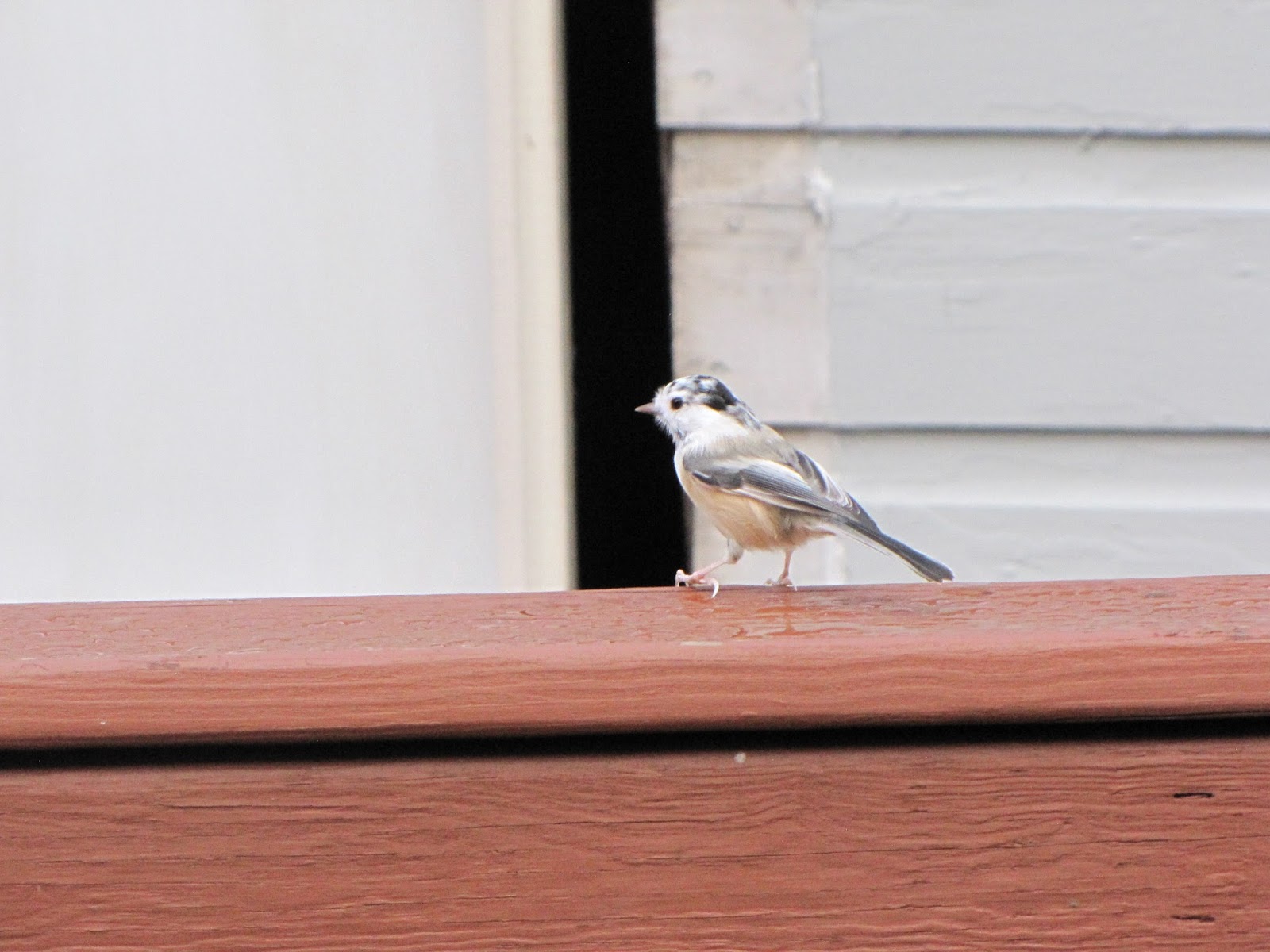
Leucistic Chickadee

We've intentionally left some dead wood and tangled sticks in the cedars at the back of our yard. This morning during breakfast a very light colored bird caught my eye. It didn't strike me as any bird I know. I ran to find my binoculars and camera.


It helpfully had come to the railing of our deck. It moved like a chickadee, but the coloration was weird.

White bill, pink legs, white patches all over the feathers, especially on the head.

A leucistic chickadee, repeatedly visiting our backyard feeder in Madison, WI.
Leucistic birds (those lacking some or all of their pigment) are not particularly rare, but still fun to spot.

Wednesday, September 21, 2016

Not for the sake of the species

I frequently come across statements implying that a particular trait evolved because it increases the fitness of the species or that a behavior observed in some animal exists because it helps the species. I hear this from not only members of the general public, but also from biology students and even biologists whose work does not directly address evolutionary questions. Please be aware that this is almost entirely wrong.

In most circumstances, natural selection favors traits that increase the fitness of those individuals that have those traits. If a heritable traits is good for the species but bad for the fitness of those organisms that have it, then those that have it will tend to survive or reproduce less well than those that don't, such that in subsequent generations, the trait will be repeatedly rarer in the population. Even if it is good for the species but has no effect on the fitness of the individual, there is no strong reason to expect that it will increase in frequency.

In some special situations, selection can favor a trait that increases the frequency of a gene in the population, even if that gene causes the individuals that carry it to live less long or reproduce less well than individuals that don't have it. And there are indeed some cases where some biologists reasonably argue that selection occurs at the group level, with traits of the population or group determining which groups survive and which die out. But in almost any popular science context, if you imply that something is for the good of the species, you have gotten it wrong.

Note: this is something I started writing about a year ago, and never finished, until now. I had some particular example in mind, but don't know what it was.

Decleration of intent to start blogging again, I hope.

In some weird way things have settled down enough that I can consider blogging (briefly) again. I do miss it. So much to say, so little time. Much of my blogging will likely be done late in the evening while holding my tiny baby and listening to my sleeping girls. But I'll try.

Let's start with this: I don't have to move my family anywhere in the near future. We are in Madison, Wisconsin, and I have a great job here: Associate Scientist in the Department of Botany at UW-Madison. Being a scientist who doesn't have to currently think about moving to another country or continent is kind of lovely.

Okay, more soon, I hope, about science, I hope.