Showing posts with label Conservation. Show all posts

Tuesday, October 06, 2009

Something's doing at the zoo

I can think of nothing that divides the opinions of animal lovers more than zoos. To some they are horrid spectacles where wild animals are locked in little cement boxes for the public to gawk at. To others they are a way to educate the public about wildlife while adding to our knowledge of each species and contributing meaningfully to conservation efforts. Some view zoo animals as living short boring lives of confinement, while others view zoos as predator, poacher and disease free shelters for species rapidly declining in the wild. Both groups are passionate in their support of animal welfare, and both are partly right about zoos. Zoos for a very long time were, and to some extent and in some places still are, places where animals are kept in very unnatural conditions for the gawking pleasure of humans. Zoological gardens originally cared little about the welfare of the animals, beyond the expense of replacing them. When most modern zoos were opened, animals usually were kept in small hard cages with no natural elements and nothing to do. It is still possible to find many zoos like this, and many cages like this even in the more modernized zoos. But many zoos, including most I have been to in the US, are actively and intentionally reforming themselves, and have been gradually improving for some decades. Rapid improvement is difficult while one has a large group of animals to keep. You can't simply bull-doze the whole place and start anew. Rather you must find what open space you have and build a new tiger habitat, then move the tigers there and rip up their old cages to build a large outdoor space (with winter quarters underneath) for the baboons. When that is done, and the baboons are safely outside, the monkey house can be rebuilt, and so on. In a few decades when all the old cages are gone, you will realize that the tiger habitat you built really isn't big enough for tigers, and you can start the cycle again. So changing from a bad old zoological garden to a new fancy new wildlife conservation and education center takes decades.

I recently had the pleasure of visiting one of the most advanced and impressive zoo I've been to, the Copenhagen Zoo. In overall appearance and plan it reminded me very much of the Bronx Zoo, where I worked for a short time. In fact it was so similar I have no doubt many of the same people were involved in planning the individual habitats in the two zoos. The two are so similar that I could say to my wife, "this looks just like the place in the Bronx Zoo where they have the crocodiles and river turtles," only to turn the corner and find the crocodiles and river turtles in nearly identical enclosures.
Almost all of the enclosures were state of the art, made to look and feel as much as possible like habitat, with places the animals can go to get out of the weather, and out of the view of tourists, or where they lay in the sun if they so choose. They had a large display (in Danish, so I couldn't read any of it) on the bad old way of doing thing, set up so that the viewers actually walk through a series of cold cement cages with giant steel bars where rhinos and hippos used to be kept. But what impressed me most was the attention paid to making sure the animals had something to do. The anteater ate not from a trough, but from a rotten log with numerous holes drilled in it and food stuffed into each hole. This gave it something to do with its improbably long tongue and impressive curved claws. Rather than laying around looking bored, it spent its time ripping open logs and licking food out from inside them.

Inside the impressive new elephant house the elephant also has to work for its food. I spent half an hour watching an elephant attempting to extract its food from a large barrel hung 5 meters off the ground. The barrel hangs from a rope, such that the elephant can barely reach it with its trunk. By repeatedly whacking the barrel with the tip of its trunk it can make it swing enough that eventually some of the food inside spills out on the ground. The elephant then eats this and goes back to whacking the barrel. By the time the meal was over, the elephant looked honestly tired, a rare and precious thing for a zoo animal.

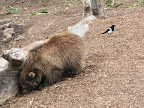
The bears spent enough time digging in their enclosures (with enough magpies and starlings closely following them) that I can only assume there was food buried somewhere in there, with the location changing from day to day. Over and over throughout the zoo we saw animals doing something.


The term in the zoo community for this is behavioral enrichment, and it turns out to be incredibly important not only for the animal's mental state, but for their overall health, their longevity and the satisfaction and education of the viewing public. Crowds these days don't just want to see an elephant standing there, they want the elephant to be happy, and they want it to be doing something. In the Copenhagen Zoo, the animals are doing something, and usually it is something similar to an actual behavior observed from the wild. Wild elephants really do whack and grab overhead food with their trunks. Anteaters really do tear open rotten logs. Behavioral enrichment takes a lot more thought, and a lot more work, than dumping food in a trough, but it makes for a wonderful zoo. (A recent episode of the NPR show Radio Lab focuses on Zoos, and talks a lot about the importance of behavioral enrichment.)

We spent about eight hours walking around the Copenhagen Zoo, and saw most but not all of it. I strongly recommend it to anyone who loves animals, whether or not you love zoos. I took about 500 pictures that day, 60 of the better ones are linked to below.

Copenhagen Zoo

Friday, October 02, 2009

Wadden Sea

Imagine if you will a big flat muddy seabed. Various rivers and ocean currents deposit mud, silt, and sand onto it for ages. Currents may dig a slightly deeper part here, cause a raised area to form there, but basically its flat. Next, suppose global sea level drops. The top of the water is about equal with the top of the accumulated sediment at the bottom of our flat sea. Where the sediment is piled high, it might stick a meter or two above the water. Where the sediment is low water will remain, but not be very deep. And everywhere there will be mud.

Something very much like this has, over the eons, repeatedly occurred in what is currently the Wadden Sea area. Wadden Sea is the Anglicization of the Danish 'Vadehavet' which means mud-flat sea. In southwestern Jutland (the part of Denmark on mainland Europe), down through northwestern Germany and west across the northern Netherlands, simple daily tides still move the shoreline in and out by some miles. In between are extensive mudflats. As was done in Holland, the people of southwest Denmark gradually, over centuries, drained much of this tidal area with dikes, building walls over which the tide cannot climb (except during large storm floods, which throughout the middle ages would occasionally overcome the dikes and drown thousands of people). Despite the dikes, and the normally small tides of ~1.5m, the inter-tidal zone is many km wide in this area.

Iris and I spent a day on Mandø, an island in the Wadden Sea. The Danes long ago surrounded the island, which is only a few kilometers across, with dikes, and most of the interior is grazing land for cows and sheep. There is also a village of about 50 people, and an environmental education center/hotel, where we stayed. Outside the dikes, which are basically just 3-5m high slope-sides earthen walls grazed by sheep, there are wetlands surrounded by huge areas which daily alternate between being land and sea. At low tide one can drive to Mandø, or go for long walks on the mud-flats. At high tide it is water on every side for miles.

100m or so outside the dikes most of Mandø's shoreline (if it can be called that when it is often miles from the water) is ringed by fences that are about knee high. Each fence is made of two rows of sticks driven vertically into the mud, with thinner sticks, bits of brush and whatever else tied into bundles and wedged into the space between the two lines. Iris and I were mystified as to what function this short fence could perform, other than giving homes to billions of barnacles and perches to the preening shorebirds. It turns out these funny little fences, over generations, wrest land from the sea. At high tide water with sand and mud in it pours through, over and around the fence. As the tide recedes, much of its sediment gets caught in the bundled brush, like krill in the baleen of a whale. The area within the fence eventually fills with soil up to the top of the fence, and another fence is built further out. Repeat for 1000 years and add sheep.

Danish policy, now that they finally have the technology to seize the entire mud flats in years rather than centuries, is to let the boundary stand where it is. Let the shellfish, the shorebirds, the mud worms and the crabs keep what they have, and let the farmers keep their hard-won dry land. This summer Nationalpark Vadehavet became the largest national park in Demark. (Germany has also made large portions of its piece of the Wadden Sea into national parks.) It is bizarre, mysterious and wonderful to visit, and a glorious piece of wildness on the edge of all too tamed northern Europe. Global climate change may well doom the Wadden Sea to return to just being a flat seabed, so I suggest a visit sooner rather than later.

Here are a few photos:
Iris on the mud flats


Disintegrating coastal fence encrusted by shellfish

Oystercatchers like this one are extremely numerous in the Wadden Sea. Their long stout bills are perfect for wrestling invertebrates out of the mud.

Friday, February 06, 2009

Carnival of Science!

The lead story on the BBC New's Science and Environment page is on the research of one of the post-doctoral researchers in my professor's lab. The idea is rather simple, the process was complex.
We know that climate changes over time, and that where one can find a particular type of habitat changes with the climate. Recently, using a wide range of data sources, scientists have been constructing both a detailed history of how climate has changed over time and what climate parameters limit the extent of particular habitats, such as South America's Atlantic Rainforest. My lab-mate, Ana Carnival (along with several collaborators) combined the climate history data with the climate requirement data to make maps of how the extent of the Atlantic forest has changed over the last 20,000 years. She found that there were a few relatively small areas that had been rainforest the whole time, even when climate shifts caused the rest of it to change to other habitat types, such as grassland. She identified these as 'rainforest refugia,' areas where rainforest species could survive through the millenia when the climate was inhospitable elsewhere. She then predicted that these refugia should be the centers from which genetic diversity spread to the rest of the forest once its borders once again grew. To test these predictions, she gathered genetic samples from three species of frogs which can survive only in the rainforest. Sure enough, the frog's DNA told the story she had predicted, confirming the refugia she had identified based on climate models. This is not only cool science, it has significant conservation implications. These refugia should house a large portion of the diversity found in the rainforest, because at some points in the last 20K years, all the rainforest species lived there. This suggests that if we are forced to make choices about which land to preserve (which we are) we might do well to preserve these refugia. And both the methods and the conclusions are potentially generalizable to other thretened habitats around the world.

One final thought: This is very cool work, and very much in line with what most people in my adviser's lab study, but it is so far from my own work that I barely understand the details. This may be why I don't notice any glaring errors in the BBC article, or maybe the UK press are not as bad at writing about science as the American press.

Wednesday, January 14, 2009

Can't live with'em can't live without 'em.

Biologists and Ecologists have (mostly) learned to give at least some forethought to the consequences of introducing non-native species. The problems invasive species cause are often most sever on islands, where the native species often have limited evolutionary experience dealing with the relative of the invaders. For example, many island endemic bird species were flightless, as there were no land based predators to need to fly away from, so why bother building all that expensive escape equipment when there is nobody to escape from. Other island nesting birds, like those on Macquarie Island can fly (except the penguins) but don't seem to have the right tricks in their behavioral repertoires to escape from introduced predators.

A recent attempt to help these birds is making ecologists aware that one has to be very careful not only about introducing invasive species, but also about removing them. A commentary in Nature describes the story:

Cats were introduced to the Macquarie Island in 1818; sealers introduced rabbits 60 years later.

The rabbits tore through the island's vegetation. In 1968, the rabbit flea was introduced. Once that had established the lethal myxomatosis virus — which the flea spreads — was introduced in 1978.

Rabbit numbers crashed, but then the cats, which had previously eaten rabbits, switched their attentions to the island's birds.

But once the cats were gone, the few hardy rabbits that had survived both the cats and the myxomatosis emerged and began doing what rabbits do best — breeding and eating.

So the island has cats, rabbits, rabbit fleas, rabbit viruses as well as rats and mice, all introduced. The cats were bad for the birds because they ate them. The rabbits were introduced and were bad for the birds because they destroyed the vegetation, but good in that they distracted the cats. And the cats were at least partly good for the birds, because they ate the rabbits. Some kind of unstable plateau was reached. And then disease was introduced to reduce the rabbit population, leaving a whole bunch of hungry cats, which were bad for the birds. But then the cats were killed off, which was bad for the birds and everything else (except the rabbits, rats and mice) because for the first time there were rabbits without cats on the island. The rabbits, unchecked, ate through most of the island's plants. And this, of course, is a vast over simplification.

The Australian authorities who run Macquarie Island are now trying to figure out how to exterminate the rabbits, rats and mice without harming other native populations, such as the seals and sea lions that breed on the island. They estimate it will take tens of millions of dollars, and that may be optimistic. Few efforts to irradicate rodents from any land mass of decent size have succeeded. Macquarie Island, at 128 km², offers a lot of hiding places big enough for a rat. Miss one pregnant rat and in just few years you are back to square one. And who knows what effect the rats would have without rabbits around harboring disease and eating potential cover? Rats eat bird eggs, and have been known to finish off large bird colonies in just a few years.

The lesson learned is that just because introducing species is generally bad, removing those introduced species from an ecosystem that has started to adjust to their input isn't always good. At least it has to be done very carefuly.

Tuesday, July 22, 2008

Conservation inaction

A friend who runs a conservation organization in Papua New Guinea is visiting. She and I have been discussing whether, in the long run, there would be any meaningful change in long-term conservation outcomes if every western conservation organization in PNG were to up and leave. We are not convinced that there would be.

Sad.