Friday, January 22, 2010
I really didn't want to get into discussing testis size.


Sunday, January 03, 2010
Picking sources
I and my assistants at Berkeley classified a significant number of primate species based on how much care fathers give to their offspring. For each species we would search the primary literature for sources documenting if fathers in that species provided care to their offspring, and if so how much. We gathered papers, sometimes dozen for a single species, read the relevant pieces and decided that fathers of that species provided no care, little or incidental care, significant care or were, for at least some part of their offspring's lives, the primary caregivers. This compilation allows me to compare the evolution of paternal care with that of other traits, such as the degree to which males fight for access to females in each species (the prediction being that males will tend to either invest heavily in their offspring or fight intensively for mates, but not both).
But what I have to do now is decide, for each species individually, which paper or papers to say I based my decision on when I publish this compilation. I've not actually studied any live primates myself. The many people who have dedicated years of their lives to documenting the behavior of each species, may disagree with my conclusion on their species (some inevitably will, I hope not too many). Those that do will be prone to dismiss the paper as a whole unless I at least give appropriate references to show I wasn't just making my data up. I feel like somehow I've made it this far without really knowing what rules to follow in documenting my sources. One can't just list every paper one consulted, or pick one at random. Should I reference the first paper to suggest that this species had that trait? Or the one with the strongest evidence, or the review article that states that the evidence for that conclusion is overwhelming? Should I include a reference to the dissenting papers, to show that I am aware of them, even if I disagree? Should I try to include references from the journal I plan to submit to?
What I'm actually doing, which may be the wrong approach, is referencing the papers I find most convincing and relevant, regardless of precedence, author or journal. As long as the reviewers don't object, I'll consider this strategy a success.
Saturday, October 17, 2009
Rostock Zoo
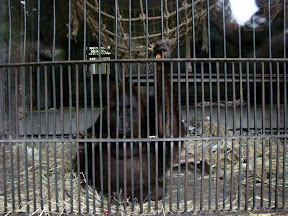 |
| From Rostock Zoo 10/17/09 |
Many of the animals were tremendously obese. We saw almost no zoo employees except at the cafe, the entrances and the store. There was a lot of the feeling of bad old zoo here.
At the same time, like much of Rostock, it was obvious that the Rostock Zoo is very actively trying to replace the run-down vestiges of GDR with new, modern and elegant. The otter habitat, clearly recently built, had the otter racing every which way through trees, ponds and tunnels searching for cleverly hidden bits of food. We watched from a small bridge over the enclosure or from a sunken room below water level, aquarium style. The otter's enclosure was beautifully thought through and built.
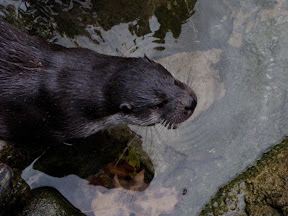 |
| From Rostock Zoo 10/17/09 |
The depressing concrete and iron boxes that house the great apes have been retrofitted with glass fronts for warmth as well as branches and nets for climbing on, and big signs requesting donations to build a new ape house. I emptied my coins into the collection box. A large counter showed that they had raised most of the million Euros in donations they need for the new ape house. The old-world monkeys were in a new (although still somewhat cramped) exhibition hall that doubles as a gallery of large prints of the winners of a wildlife photography contest.
The most striking (and to me most disturbing) enclosure is the crocodile house. About the size of a two car garage, it has a couple of small crocs, some large soft-shelled turtles, brightly colored freshwater fish (all the fish at the zoo are freshwater, presumably because they lack the facilities for salt-water aquaria) and four free-roaming Black-mantled Tamarins. These little South American monkeys had the complete run of the place. They jumped over the crocodile tank, ran between the zoo visitors' feet, jumped on the visitors and scurried up and down the walls. They showed no fear of people, and while we were there were fed by hand by more than one young guest. One young lady took turns with a tamarin licking her ice cream.
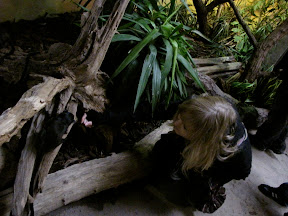 |
| From Rostock Zoo 10/17/09 |
All this with no zoo employee or volunteer in the building, and both doors to the house frequently open. It was thrilling to see these tiny (~1Lb) primates up so close, have them jump onto my shoulder, stick their noses against my camera lens to see what was inside, etc. But it also struck me as really quite irresponsible. It may be that the zoo simply has no other warm space to keep the tamarins, but my mind was filled with all the things that could go wrong here. Someone could step on a tamarin. One of the teenagers attempting to grab a tamarin's tail could succeed and get a nasty bite, or injure the animal. People could transmit diseases to our fellow primates. The monkeys could transmit diseases to people. Someone could stuff a tamarin in a backpack and take it home (this sort of thing has happened at other zoos). The tamarins could run out the door and wander into the nearby lion enclosure, or just die of cold. The crocs could get them. Petting zoos are supervised, and never contain primates or species of conservation concern. This broke every rule, and I can only hope it is a very temporary arrangement. That said, the tamarins were probably the most memorable and exciting part of the visit.
One other thing that struck me about this zoo is how much space they have for expansion. Many of their newer exhibits, and large fields for the ungulates, are in an area across a road from the main zoo, accessible through a separate entrance or via an underpass. Most of that added-on section is still just woods, waiting to be made into wooded homes for animals. They also have lots of old cages that are simply empty, ripe for replacement or creative reuse. What they seem to lack is not the will to improve, or the space, but funding. With the exception of the tamarins (which I think should be moved at once, even if it has to be to somewhere the public can't see them, or to another zoo) all of the animals are situated as well as they can be given the current enclosures available. If asked, I would probably advise replacing or significantly modifying 75% of the enclosures. I suspect the people who work there feel the same way. I very much hope that they find the funding and the will to make the type of transformation they need.
Due to poor weather and bad batteries I only took 150 pictures today. 20 of the better or more relevant ones are here.
 |
| Rostock Zoo 10/17/09 |
Saturday, August 22, 2009
Publication bias
Despite all this anti-bias fervor, scientists are still human, and still have biases. One such bias is that we want, as individuals, to be successful. We would rather study a topic that is going to win us praise, jobs and funding than something else that will take a long time to reach any conclusion, even if the payoff for society is much greater for the long term project. We are also far more likely to publish results that are going to advance our careers than those that won't. This leads to the title of a 2006 paper called, "Publication Bias: The Problem That Won't Go Away." To be clear, I am not referring to a reluctance to publish papers that challenge the dominant viewpoint. Name any truly successful scientist, and I will bet you that his or her career was built on a paper that challenged the dominant viewpoint. Scientists know this, and we are pretty much obsessed with finding holes in the dominant view. Publication bias rather is most commonly a tendency to publish clear positive results ("our data strongly support hypothesis X over hypothesis Y") over the less clear cut cases ("our data do not allow us to confidently support or refute the hypothesis we set out to test"). This kind of thing happens a lot.
Publication bias on the part of others, and by me, has been on my mind recently. In writing a paper on the evolution of paternal care in primates, I ran into the problem that almost nobody makes the statement, "in 72,000 hours of behavioral observation we did not observe males caring for their young." But if after 120,000 hours of observation they see a male pick a couple of burrs out of a juvenile's fur, they might well write a paper titled, "first observation of paternal care in species X." This results not only from the logical impossibility of proving the complete absence of a behavior, but because in many species where males don't care the assumption is that males don't care, and a failure to see counterexamples isn't that interesting to the people studying the species or the editors reviewing their papers. The result of this is that we have lots of publications stating the presence of care, even when that result is rare, but almost nobody stating the likelihood of its absence. I ended up having to make the rule that if multiple papers describe patterns of care in a species, and none of them say anything about male care, that counted as too little care to qualify. In my own studies of rotifers, I absolutely would have written a paper on parental care if I had observed any, but absolutely could not get a paper published in which I state that I didn't see any.
But my publication bias when it comes to the rotifers is much more profound than that. The results of one of my major experiments were negative, and as such not particularly interesting. I am writing it up anyway, because my dissertation committee wants me to, but I and they think it unlikely any journal will publish it. Of course if 20 different labs did similar experiments, and only one got a positive result, only the positive result would be published, creating a very false impression. I recognize this as a source of bias, I don't like it, and I don't see any way around it. The best I might be able to do is post the whole damn paper on my blog and hope that anyone interested in the topic stumbles upon it.
The other option, which I won't take but is far more common than you might think, is to simply analyze my data until I do find something interesting in there, then write up the paper as though that was my main question all along. This is something that advisers have specifically told me to do in the past, although not on this project. It is grudgingly accepted that this happens, and like publication bias, isn't going away.
Wednesday, August 19, 2009
Why don't males care?
Paternal care is rarer in mammals than in most other taxa where parental care is the norm. Post-birth maternal care is found in all mammals (most fundamentally in the form of lactation), and females care alone in ~90% of mammal species. This contrasts sharply with birds, where female-only care is found in fewer than ~10% of species. Primates are unusual among mammals in that approximately 40% of genera display at least some male care, according to an older and therefore probably low estimate (Kleiman et al. 1981). Primates provide the opportunity to examine what factors lead to evolution of paternal care, even when sex specific structural factors (internal development and lactation) require maternal care.
Why do so few mammalian males engage in care? Mated individuals face the choice to continue investing in caring of current offspring (bearing fitness costs in the form of time, individual quality and mortality risk), produce new offspring with the same mate, or abandoning mate and young to seek new mating opportunities. In all mammals lack of post-zygotic and post-pregnancy investment from mothers is fatal to the offspring. Males therefore have earlier opportunities to abandon, leaving females to bear these costs for both of them, than females do. Depending upon timing and the particulars of a species' natural history, mothers may also be more likely to successfully raise the young of the abandoning male than a male could be in raising the young of his absent mate.
Males not only have greater opportunity to desert, but also greater potential payoffs. A male's reproductive success increases more rapidly with multiple matings than a female's would (although females may gain social and genetic benefits from multiple matings), and males therefore experience higher variance in reproductive success than females. This variance is often non-random, relying on traits which influence female choice or the outcome of male-male competition. These traits are necessarily expensive in order to serve as honest signals, and potentially reduce males' ability as care-givers (and longevity, reducing their reliability as care givers) as they increase their ability as competitors. Therefore males who have already mated, and therefore have the opportunity to care for their own young, are likely to also be those who could most successfully remate, and have invested heavily in the capacity to do so. A female who has mated may not be of unusually high fitness, and may not gain fitness from remating, particularly given the cost in future grandchildren associated with abandoning current dependent young. Males, lacking internal incubation, are also less certain of parentage of social young (both probabilistically and in terms of lack of individual information) than are females, further reducing the value of social offspring (measured in number of genetic grandchildren). Mated males in this standard case, have more opportunity to desert, lower risk of losing future grandchildren by deserting and higher potential for remating than do mated females. Given these conditions, it is reasonable to turn the question around, and ask not why so few mammalian males care, but why do those mammalian males who care do so?
The clear answer to this question is that these conditions, or at least the fitness inequalities they imply, are not universal. Under certain conditions, males may gain more by continuing to invest in existing offspring than by attempting to produce additional offspring. Where biparental care is necessary for production of successful young, the opportunity cost associated with abandonment and competitive risk taking increases. Under the same condition, male reproductive success is likely to increase less sharply with multiple matings, at least in cases where certainty of paternity is fairly high. If this results in a decrease in non-random variance in male reproductive success, it is likely to also decrease the potential benefit to competing for new matings, and in investing in the weaponry necessary for that competition.
This by the way, was another start to an intro that didn't quite work out. The problem isn't that the analysis is internally flawed, but that it raises issues I don't have the data to address, and doesn't really lead to the question I can answer.
Wednesday, July 15, 2009
A bit humbling
Kaplan H, Gangestad S, Gurven M, Lancaster J, Mueller T, and Robson A. 2007. The evolution of diet, brain and life history among primates and humans. In: Roebroeks JWM, editor. Guts and brains: An integrative approach to the hominin record: Leiden University Press. p 47-81.
The various authors of this paper have each been working on a set of related questions for decades, and they bring together this acquired knowledge into a devastatingly clear and cogent argument. Where I have vague intentions to explore an idea, they have specific arguments and evidence to back them up. I can't help but feel a bit like a child building a pile of sand on top of the great pyramid, thinking I am making it taller when I'm just making a mess. Or maybe it is just past my bedtime.
Tuesday, April 21, 2009
The Free Encyclopedia and 'Hairless' Apes
I suppose one could argue that body hair would obscure some portion of our typically primate anatomy, or make the photos appear less clinical. That said, none of the other primates pictured are shaven, so why the humans? And honestly, human's body hair doesn't hide that much anyway. As humans are naturally the least hairy of any primate, the clean shaven models seem to me to unduly exaggerate our distinctness from other primates. I don't approve.
On further consideration of the nature of Wikipedia, the inclusion of these photos could be intended purely to annoy social conservatives who object on religious grounds to the placement of humans among the primates. In that case the hairlessness would presumably be intended to emphasize the nudity of the models.
Monday, April 20, 2009
Wherefore art thou, niche conseratism?
But why do species have this tendency, or more particularly, why do ecological traits not change more rapidly than they do as a lineage evolves? Wiens and Graham state that, "We refer to niche conservatism as a process, although it may be caused by more than one factor at the population level," but don't say what those factors may be, or provide a reference to someone who does.
So what causes niche conservatism:
Two basic mechanisms occur to me. The first is that new traits simply don't arise, and therefore can't be selected for or against. Why don't we have rats that can eat iron? There is lots of elemental iron around these days, and it is very high in energy. Surely a rat that could eat iron and extract all that energy would do very well, and make lots more iron-eating rats. But that trait has not occurred (and is not likely to do so) and as such there is no way for natural selection to favor the iron-eating rats. But for traits like sexual mass dimorphism, this type of constraint seems unlikely. We know that closely related species sometimes have very different mass dimorphisms (compare gorillas to humans). But closely related species usually don't have wildly different mass dimorphisms, so there is conservatism in the trait even though it is pliable.
The second possibility that occurs is that niche conservatism comes about simply because a trait works well with the way a population lives, and the other traits is has, and therefore some form of selection acts to keep the trait where it is. The trait is conserved because it is functional. Even if some other combination of traits would be more advantageous, that combination would require so many modifications that you can't get there from here. The population would have to go to far 'downhill' on the fitness landscape to get to that taller hill across the way. So selection, which tends to push the population 'uphill,' keeps it on the little local peak it is on. By keeping the population where it is, selection causes niche conservatism.
I'll call it a hypothesis. First I need to find out who has already said almost the same thing.
Sunday, April 19, 2009
A third way of seeing things
The largest investment in primates' offspring is in the form of care, not eggs or sperm or pregnancy. In species where females provide all of the care, males need not stay with a single mate, so the operational sex ratio is male biased (i.e. lots of males are out looking for a mate, while most of the females are pregnant or nursing and therefore not looking to mate), reproductive skew is high for males (some males will father lots of offspring, others none), and the fitness rewards to successful male competitors are great. Larger males are more likely to win these competitions, resulting in an increase in optimal male size. These large belligerent males risk increased mortality through conflict, and through diversion of physiological and developmental resources away from longevity and into competitiveness. Simultaneously, selection for longevity in females may be increased by the need to stay alive until their young become independent (and in the case of humans, to care for grandkids). This leads to males who, relative to females, are non-caring, short-lived, large and conflict prone.
I have data (gleaned from the literature) for a bunch of primate species on how long males and females live, how much care the fathers provide in each species, how big males and females are and how frequently and intensely males fight with each other. Depending on how I analyze these data, I get two very different answers. If I treat each species as an independent sample, and look at the correlations between these variables, the data completely support the story. The species range along a continuum having short-lived belligerent large, uncaring males at one end and long-lived caring low-conflict small males at the other.
But most evolutionary biologists would say that is not the right way to analyze the data. I need to take into account the relationships among the species. Two traits might seem to be correlated not because the one makes the other selectively advantageous, but because a group related species all have the one and all have the second. Take the example of feathers and laying eggs. All birds have feathers and all birds lay eggs. Is this because something about feathers requires egg-laying (probably not) or because all birds are descendents of some ancestral birds that laid eggs and had feathers, and ever since no bird has arisen that didn't do both those things. That all birds have eggs and feathers is an example of what biologists call evolutionary inertia.
The question this poses for me in writing my paper on primates is whether the correspondence between sex-biased longevity and these other variables is because of the adaptive story I told you, or because of evolutionary inertia. So I look at the data a second way, and see that there is a great deal of evolutionary inertia in these traits. Most primate species are somewhere near the middle of that continuum I described. Ever species at one end is from one group of related monkeys. Every species at the other end of the continuum is either a great ape or from a different family of monkeys. Plugging my data into software designed to test for evolutionary inertia, I find that closely related species are very likely to have similar values for all the traits I am measuring, and that inertia is fully sufficient to explain the correlations between these traits. It is like eggs and feathers in bird.
As I am trying to write the paper to present all of this in a scientifically rigorous way, I am struggling with what to say about it. The easiest, and least interesting, conclusion would be to simply say that the correlations are purely illusions conjured by evolutionary inertia. What I'm attempting to find a way to argue it that it could just be inertia, but that the inertia might be because of selective effects. In other words, that both the inertia story and the selective story could simultaneously be true, and closely related species are similar not because they can't change, but because what was adaptive for their common ancestor is still adaptive for them. If a male from a very belligerent species was to grow in a way that made him not a good competitor, but able to live a long time and provide care to his young, this wouldn't fit with the way his species lives, so he wouldn't pass on his novel trait, and his species would stay like their ancestors had been. It is evolutionary inertia caused by adaptive mechanisms. I think my next step is to find out who has already written about adaptive evolutionary inertia, and what they said.
Thursday, April 16, 2009
Poster-time
My title is, "Post-Reproductive Lifespan in Humans: Cultural Artifact, Widespread Primate Trait or Unique Adaptation?"
I've had fun making my poster, mostly because it is an excuse to play with Photoshop and Powerpoint instead of writing my thesis. For my poster I needed to find a compact easy way to display how the fertility and survival of a population changes with age, and simultaneously explain my methods. And I needed to be able to do that for several populations side by side in a small space. Now this is all tailored to make sense to the demographer, so it may not be that intuitive to anyone else, but I like what I've got. To clarify, in demographerese, lx means what portion of the individuals that survive to each age and mx means how fertile are individuals at that age.
 By plotting mx and lx on the same graph I make it visually clear (to a demographer) that the population nears an endpoint to fertility (age M) long before it nears an endpoint of survival (age Z). I then go on to use some math and demographic methods to define good ways to measure post-fertile survival in ways that allow for straightforward comparisons between species. I call the two measurements G and S. But the fun part comes in when I use the graphical format established in Figure 1 to compare populations in Figure 2:
My hope is that having labeled and explained the parts of the graph in Fig. 1, the meaning of these graphs in Fig. 2 will be quickly obvious to the demography crowd. I'll leave you to interpret what these graphs say about post-fertile survival in humans and chimps in different environments. I can't give away everything.
Friday, February 13, 2009
Progress!
Human females have the unusual life-history trait of frequently surviving well past their reproductively fertile period. While a variety of adaptive hypotheses have been proposed to explain this trait, some authors argue that post-reproductive lifespan (PRL) is a phylogenetically widespread trait, requiring no special adaptive explanation for humans. Still others have argued that PRL is the result of cultural and physiological traits, not adaptive evolution. We suggest that the continued confusion on this front arises from two primary sources, the treatment of non-alternative hypotheses as mutually exclusive, and the use of PRL, an inconsistently calculated and theoretically ill-suited parameter. Given the drawbacks of PRL as a comparative measure, a variety of more useful and comparable measures of post-reproductive survival (PRS) can be calculated using data in the form of standard demographic life tables. Using life tables from 20 human populations, 78 non-human primate populations and two non-primate species, we present a set of measures of PRS which allow for direct comparability between populations and to evolutionary null hypotheses. We find strong support for the uniqueness of the scale of human PRS, for the widespread presence of PRS in primates and for the influence of culture in extending PRS.
Tuesday, August 19, 2008
Chimp Politics
There are about 300 conference participants here, half of the usual ABS meeting. The reason, other than the scheduling conflict, seems to be that they are having it at the Snowbird Ski and Summer Resort. The problems with this are two. First, they had their meeting here in 2006, and a significant part of why many people decide to go to conferences is to have an excuse to visit a new and exciting place. The second problem is that the Resort is an industrial scale conspicuous consumption machine, meaning that it is overbuilt, overdone and overpriced. I have to admit that it is in a beautiful place, and I will be posting pictures of a moose and some marmots some time soon.
Looks like the projector is working, John Mitani is a well known expert on primate behavior, and has performed fieldwork on all five species of non-human apes. He is giving the Keynote Address, and I will try to convey in non-technical terms my understanding of his understanding of what he says (Or at least that part of it based on previously published work. I don't actually know, but I suspect it would be very rude to distribute the parts of his talk that he had not yet published.)
He has been studying the social behavior of the chimps of southwest Uganda for the last 14 years. Male chimps are more social than the females, form more lasting bonds, move more broadly over a group territory and more often cooperate in coalitions. Male coalitions seem to serve the function of supporting their members in conflicts with other males. The male with the most coalition support rises to the top of the social status, even if he is not the smartest, strongest etc. (A slide of Bush and Cheney somehow appeared in his talk.) The alpha male gets most of the mating opportunities, but in times of coalitional uncertainty, will cede those opportunities to other males whose coalitional support they need.
Chimps are also group hunters, especially of young monkeys. Most of the hunters are adult males. A large group of male chimps will surround a troop of monkeys, and are extremely frequently successful, even if the amount of food per hunter is very small. But group hunters are not necessarily cooperative hunters. If 50 guys all go for the same prey, they may successfully grab it, but that doesn't necessarily mean they are intentionally helping each other. Each individual may be trying to be the one who grabs the meat.
But the chimp who catches the monkey is likely to share it with others. Why? Males are the primary hunters, and hunt mostly when there are a bunch of other males around. It is suggested they may go hunting for male-bonding purposes. The meat seems to be used as a political tool. Males use meat to buy coalition support from other males.
Male coalitions will also make territorial patrols and raids into the territory of neighboring groups. They defend their own territories and grab more land, not infrequently resulting in serious injury or occasionally death. The larger the group patrolling together, the less the risk from any rival group encountered. Dr. Mitani's study group has killed 18 rival males in 10 years, because they are the largest group around. He wants to show us a video of chimps attacking each other, but is having technical difficulties. Now we see another video of a gang of male chimps beating another to death. The room is very still.
Female chimps disperse to other groups, males do not. So males are potentially living in groups of close relatives. And it turns out that males do preferentially help their maternally related brothers. It is easy to know if you have the same mother as another chimp. It is much harder in a non-monogamous species to know if you have the same father, and males don't preferentially help paternally related brothers.
He is finished telling us about the chimps in particular, and is going on to discuss the differences between those who study the behavior of primates and the broader animal behavior community. He says that primatologists can be overly focused on the primates, but that the broader behavioral biological community can be overly resistant to viewing the primates as relevant to their own work. This is apparently one shot in an arguement I was not aware of, and it seems odd to raise it here. One of the biologists sitting near me mutters that he regularly references primate papers, while he never sees primatologists reference the frog literature.
The address is over, time for bagels, juice and schmoozing. Then I'll try to take pictures of the marmot that hangs around on the hotel lawn, and find my name tag.
Sunday, August 17, 2008
On asking non-novel questions
I started looking into the [student project that we discussed], and I found that there are already papers published about [that topic]. ... Since it seems like this topic has already been done, should I try to find another topic to look into? I've had the impression that if someone has already studied it, it doesn't work very well for a research topic but I know that must not be the case, otherwise no one would be able to prove theories wrong and there'd be nothing left to study... I suppose what I'm asking is if it's possible to still look into this, but in a way that doesn't only cover a portion of what another paper has already said (a paper that I'll have to cite, too)?I responded as follows:
Hi DC-I wonder if my students know I make this stuff up as I go along?
An excellent question, and one that always needs to be asked. Very few people ever ask a truly novel question. Those who do are usually geniuses or lunatics or both. What we mostly do instead is try to ask the same question in a different context, or ask it better, or take a different and hopefully improved approach to answering it.
When LZ was hoping to design a project, she got interested in what caused mixis in rotifers, and I told her to go read the literature on that subject. She did, and came back upset because there were papers on the subject by respected rotifer experts, and they had already published answers to many of her questions. I told her to read those papers again with three questions in mind.
1. Which of her questions, or their own questions, had they failed to answer?
2. What areas of disagreement, apparent contradiction or uncertainty remained?
3. Where are the soft spots in the literature, meaning studies that could have been done better, analyses that are unconvincing or conclusions that aren't fully supported by the data they rest upon?
LZ, being both very hardworking and very clever, came back with answers to all these questions, and we used her answers, plus knowledge of our particular strengths, to design the study that became her senior honors thesis, and will become her first scientific publication.
Our strengths in terms of the primates, as compared to others who have written on this topic, are:
1. We have dispersal data on more species than they did.
2. We have longevity data for males and females of each species, where they did not.
3. We have their papers to use as references and examples of what to do (and what not to do) and they don't.
My suggestion to you is the same as what I suggested to LZ. I don't know if it is the best approach, but it worked for LZ.
Keep up the good work.
Best,
Dan
Wednesday, August 13, 2008
Phylogeny schmylogeny
1. The generating and using of increasingly complex guesses as to how organisms are related to each other.
2. Something you have to do these days to study evolution.
That time has come. For five years in a heavily phylogenocentric lab in a museum mostly focussed on phylogeny in a department deeply into phylogenetics at a time when phylogenetics is nearing (I hope) the zenith of its trendiness, I have avoided really learning how to do phylogenetics. I can talk at length and in detail about the philosophical underpinnings of phylogenetics, I have read books and papers and taken classes on the subject, but I have never actually sat down and applied that knowledge. This is partly because of my inherent and unreasonable dislike for everything trendy and partly because I find that the most boring research talks in the universe are the straight phylogeny talks ("And then we sequenced 4327 base pairs of CR32.5 and SLD19423 from these twelve hundred taxa. Notice that on this taxa here there is a deletion, and I'll spend ten minutes talking about how we dealt with that. Now I'll spend half an hour talking about how we generated the priors for our Baysian analysis. And look, this taxon you have never heard of is closely related to this other taxon you have never heard of. Who would have thunk it? Someone wake that guy with the funny hair").
But my phylogenetic inexperience is based on more than simple obstinacy. I don't think that way. My predilection is to think of evolution in terms of selection, mutation, drift and so on. Phylogenetics at its core doesn't care WHY there are differences between organisms, phylogenetics is focussed on the methods for gathering and analyzing data on HOW these taxa are different from each other, and on drawing trees of relationships. In many papers, the tree itself is the goal, and maybe they do an analysis or two showing how useful their tree is.
I, knowing I needed to learn some phylogenetic software packages eventually, but deeply not wanting to, have backed myself into it. So I have taken a taxon for which the tree already exists (primates) and gathered from the literature (or had my students gather) a bunch of variables for as many species on that tree as possible. We have data on sex biased dispersal, social system, who provides care to the young and so on for about 90 species, and data on sex-biased longevity for 119. A huge amount of work over some years has gone into this, and there is no way I can weasel out of writing papers based on it. But there is also no way I can publish this in a decent journal without controlling for the effect of phylogeny. What "controlling for the effect of phylogeny" means takes a little bit of explaining. There is a tendency for related species to have similar traits, whether or not there is any adaptive mechanism driving that similarity. The common ancestor had that trait and both the descended populations inherited that trait from that ancestor. Humans and chimps have similar genetic sequences, and our common ancestor was surely very similar to both of us. This is termed 'phylogenetic inertia.'
Anytime one does a comparative analysis these days, one has to explain how we know that the observed pattern isn't just an example of phylogenetic inertia. Imagine one thought there was a causal relationship between being large and having hooves. One could find ten big species, notice they all have hooves, and ten species, notice none of them have hooves. But if those ten hooved species were all in the cow family, and the ten small species were all in the vole family, one would not have proved anything about hooves and largeness except that Bovidae have both and Cricetidae neither. So one has to make sure one is not being fooled by similarities due to evolutionary relatedness, or in the parlance, 'control for phylogeny.'
I need to control for phylogeny, and therefore will learn a few phylogenetics programs. But I don't have to like it, and I am going to make my students learn it too.
Thursday, July 17, 2008
Fishy
So I emailed the author, asked for either the data table or the references on which it was based, and got an almost immediate reply. She stated that:
A. The data and sources had been cut out to save space. This is fishy, as the journal has no space limits on supplemental online materials, and many papers come out in this same journal with far more appendixes than this paper has.
B. It would be too much work to track down all the references and sources again. This is fishy, as the paper came out only this year, and it would be truly remarkable to lose track of one's data set and all of its sources so quickly and thoroughly.
C. If I wanted information on a particular species, she would be glad to see what she could find. This too is fishy, as it implies that she would have to go to the library looking for the data that her published paper is already based on.
I can't help but wonder if there ever were data and sources. I would like to think of some innocuous explanation, but have not done so yet. I told my student to take this as an example of what not to do.
Friday, April 18, 2008
Dying for Sex
There has been limited support for this hypothesis, and most of the others, because so many hypotheses make the same predictions that one can rarely conclude that a particular factor is at play unless one ignores all the other possibilities (which seems to be the standard practice.)
This paper from Proc.Roy.Soc.B. takes an interesting new tack, looking not at whether males that are shorter lived than their mates are taking more risks, but rather at whether their short-livedness can be explained by increased mortality during the season of risk taking.
Here is the abstract:
Abstract
Male excess mortality is widespread among mammals and frequently interpreted as a cost of sexually selected traits that enhance male reproductive success. Sex differences in the propensity to engage in risky behaviours are often invoked to explain the sex gap in survival. Here, we aim to isolate and quantify the survival consequences of two potentially risky male behavioural strategies in a small sexually monomorphic primate, the grey mouse lemur Microcebus murinus: (i) most females hibernate during a large part of the austral winter, whereas most males remain active and (ii) during the brief annual mating season males roam widely in search of receptive females. Using a 10-year capture–mark–recapture dataset from a population of M. murinus in Kirindy Forest, western Madagascar, we statistically modelled sex-specific seasonal survival probabilities. Surprisingly, we did not find any evidence for direct survival benefits of hibernation—winter survival did not differ between males and females. By contrast, during the breeding season males survived less well than females (sex gap: 16%). Consistent with the ‘risky male behaviour’ hypothesis, the period for lowered male survival was restricted to the short mating season. Thus, sex differences in survival in a promiscuous mammal can be substantial even in the absence of sexual dimorphism.
Thursday, March 20, 2008
Residual life
On Tuesday I was giving a talk on my research to Berkeley's Primate Research Group, including my experimental examination of the Grandmother Hypothesis. After the talk, I got a lot of good feedback, including an interesting question. How certain are we that females of other species of primates wouldn't live as long post-menopause as humans if they lived as cushy lives as we do?
The only answer I could give them is that I haven't seen any data suggesting otherwise. But then, on my way home, it occurred to me that I already have probably the world's best data set for answering exactly that question.
Primates in well run zoos tend to greatly outlive their wild cousins. Medical care, reliable food supplies, no predators and few pathogens. Not to say the life of a captive primate is perfect, or that there isn't significant variation in the quality of care, but for many species maximum longevity in captivity is much greater than in the wild. And it just so happens that I have life tables, including age specific reproductive rates and mortality rates, for 120 species of primates. These come from ISIS data, meaning data from relatively well run zoos, and I will need permission from ISIS to use them in this way, but I doubt they will have any major objections.
The idea of writing a paper based on data I already have is exciting to me. Usually I spend years between having an idea and having assembled the data to address it. I have almost all the data I need to address this question safely on several computers. I'll get the hang of this science thing yet.
Friday, February 29, 2008
phylogenetic inertia and cooperative breeding
My general conclusions are:
1. A species whose relatives are cooperative breeders are often cooperative breeders themselves.
2. It is not entirely clear if cooperative breeding itself is phylogenetically conserved in many groups, or if the traits that make it a useful strategy are conserved, leading to the impression of inertia in the evolution of cooperative breeding.
3. Phylogenetists spend a lot of time and ink poodling on about the flaws in each other's methods, but always end by saying that the conclusion about the trait is probably robust to minor variations in the shape of the tree.
4. Cooperative breeding is a blanket term for several different phenomena, and papers that deal with this explicitly are more convincing than those that only pay it lipservice.
5. The data I am already putting together on who provides how much care in 120 primate species could probably also be used for a very useful paper on phylogenetic inertia in cooperative breeding.
Sunday, February 17, 2008
Why no "grandfather effect"?
Evolutionarily, this makes sense. If one is no longer increasing one's lifetime reproductive success, staying alive offers no obvious selective advantage. No point in investing in physiologies and structures that will last 100 years if one is only going to reproduce for 50 years. Better to put those resources into having more kids now.
But under a certain set of circumstances, reproduction does not end with, or shortly after, childbirth. If your young aren't really able to take care of themselves for a decade or two, you aren't done reproducing until they don't need you any more. In most hunter gatherer societies, the survival rate of five year olds whose mothers die is quite low. So for human women, having a kid in the last several years of life was likely a waste of time.
Worse, the kid who didn't make it took time and resources that could have been put into other kids, and childbirth, particularly late in life, is dangerous. Plus, elder human females are important for helping their daughters raise their own young, and learn how to do so. It has been shown that young mothers in several societies have a higher success rate raising kids if their mothers are around. The women who stopped having kids and focussed on the kids and grandkids they already had, and avoided the risk of late life childbirth, are thought to have ended up getting more of their genes into future generations than women who kept giving birth as long as they lived. If so, and if this variation in life history was heritable, which seems likely, this differential reproductive success would inevitably lead to a population with more and more women stopping early and fewer and fewer giving birth late in life. This is, we think, why we ended up with this "grandmother effect" of women living well past reproductive age.
The benefit of having a grandmother around seems to be restricted to maternal grandmothers. And this observation, that paternal grandmothers don't seem to make as much of a difference (at least in the societies studied) to the survival of their grandkids, points to at least two possible reasons why we don't see a "grandfather effect" to go along with this "grandmother effect."
First, in most societies, at least those studied in this context, males are providing less in the way of vital care. So if a women has a son who has kids, perhaps she is less involved in care, or in teaching how to care, because her son is not as involved as his mate in that care, and the daughter-in-law is not nearly as likely to look for advice and help from her husband's mother than her own mother. And perhaps this same logic applies to grandfathers on both sides. If they are not who the primary caregiver can go to for help and advice, the advantage of having them around to help is smaller.
Second, paternal grandmothers are less certain of which is really their genetic grandchild. If a woman gives birth to a daughter, and watches that daughter give birth to babies, she can be very confident that those are her descendants. If a woman gives birth to a son, and then watches that husband's mate give birth, there is a significant chance (and we have the genetic data to substantiate this) that the baby was fathered by some other man, and those babies aren't her genetic kin. So investing in them heavily may not be doing her any good. This argument is doubly true for grandfathers. The daughter who is giving birth may not even be his. A couple of generations removed, and who can be sure?
A final reason males may not have evolved to have a post reproductive period comes back to that risk in late life childbirth. Men don't give birth, so the risk to late life survival posed by late life reproduction may be greatly reduced, or completely absent. Without that trade-off, why not keep on breeding as long as possible?
Thursday, September 27, 2007
Germ-line chimerism and paternal care in marmosets (Callithrix kuhlii)
Ross, C., J. French, and G. Ortí. 2007. Germ Line Chimerism and Paternal Care in Marmosets (Callithrix kuhlii). Proc. Natl. Acad. Sci. USA, 104 (15): 6278–6282.
Abstract:
The formation of viable genetic chimeras in mammals through the transfer of cells between siblings in utero is rare. Using microsatellite DNA markers, we show here that chimerism in marmoset (Callithrix kuhlii) twins is not limited to blood-derived hematopoietic tissues as was previously described. All somatic tissue types sampled were found to be chimeric. Notably, chimerism was demonstrated to be present in germ-line tissues, an event never before documented as naturally occurring in a primate. In fact, we found that chimeric marmosets often transmit sibling alleles acquired in utero to their own offspring. Thus, an individual that contributes gametes to an offspring is not necessarily the genetic parent of that offspring. The presence of somatic and germ-line chimerism may have influenced the evolution of the extensive paternal and alloparental care system of this taxon. Although the exact mechanisms of sociobiological change associated with chimerism have not been fully explored, we show here that chimerism alters relatedness between twins and may alter the perceived relatedness between family members, thus influencing the allocation of parental care. Consistent with this prediction, we found a significant correlation between paternal care effort and the presence of epithelial chimerism, with males carrying chimeric infants more often than nonchimeric infants. Therefore, we propose that the presence of placental chorionic fusion and the exchange of cell lines between embryos may represent a unique adaptation affecting the evolution of cooperative care in this group of primates.
Translation: According to the seminar I went to today, what this all means is that Marmosets and their relatives almost always produce fraternal twins, and the embryos grow in close proximity, with out the usual membranes separating them. The two developing embryos can actually have blood vessels in common, meaning that blood born cells can move from one embryo to the other. And stay there. And develop. So when the little monkeys are born and grow up, they can be riddled with cells that are genetically part of their sibling. This is what we call a chimera, when one individual has cells that are of different genetic lineages.
So then one of the chimeric monkeys mates. But some of his germ line cells (the ones that make sperm) are genetically his brother. So he's doing the mating, but the young could be genetically his nephews. Weird, I know. And one outcome of all this is that marmosets put a lot more energy into taking care of their nieces and nephews than would otherwise be expected. Ain't evolution weird and wonderful.
Cartoon explanation:

