Showing posts with label writing. Show all posts

Thursday, February 02, 2017

Friendly Advice for Your First NSF Pre-proposal

It is going to be okay. Very okay.

Let's start with the important information that until last month I, like anyone who needs to read this post, had never applied for, let alone received, US National Science Foundation research funding. Having been out of the US for most of my time since earning my Ph.D., and other extenuating circumstances, kept me from applying to this extremely important source of funds. As with my posts on applying for NIH and ERC funding (which I didn't get), I'm writing this not as an expert, but because most people who write advice on applying for NSF funding are to varying degrees experts, and have been doing it for so long that they have no idea what us newbies might not know. I've never been on an NSF panel, I've never been to NSF, and all my attempts to talk to NSF employees have been unsuccessful. I am, like you, an outsider. So I learned a lot along the way, much of it later than I should have, and I'd like to share some key points. Before we begin, let's take a moment to contemplate this bodacious caterpillar I found in the University of Wisconsin Arboretum last summer:

Wow!

Alright, now that you remember that you love science, and brim with important and exciting questions about the world, let's delve.

1. NSF, we can agree, does not have the funds to support more than a small fraction of the grant applications they receive. Other huge governmental funders of science, like NIH, are in a similar situation. (I am assuming here, perhaps in vain, that the US government under El Presidentisimo continues to invest in funding basic research at some meaningful level.) This is a problem not only in terms of almost-everybody-doesn't-get-funded, but in terms of the phenomenal amount of time that scientists squander writing unsuccessful grant applications. In many cases, months of each year are spent applying for funding that is not available. On the flip side, NSF has to harness huge amounts of scientists' time to serve on committees, wading through the reams of applications finding reasons to reject as many of them as possible.

NSF has attempted a partial solution to this problem: the preliminary application. Basically, one starts by writing a short (four pages of text, plus many ancillary documents, including a one page Project Summary) version that has to be approved by a committee before one is invited to submit a full application. Most applicants (about 75%, in the program I'm applying to) only have to write the short version before being rejected, and the committees mostly have to read piles of short applications, with relatively few longer ones coming after that.

2. Writing the preliminary application was honestly not that bad. Several reasons: No budget is required, and many of the ancillary documents that NSF needs before they can fund anyone don't get submitted until your preliminary proposal is approved. More importantly, I have good collaborators, who are in practice writing these things. There is a huge amount to know about NSF specific 'grantsmanship.' When the committee gets to our application, after having already scanned scores of others, they will be both eager to find something really interesting that keeps them awake, and eager to find some reason that the thing can be rejected, so that they can get it over with. They will be looking for key phrases that everyone should have, and possible pitfalls indicated by things only people who have served on these committees (or maybe only that particular committee) know about. In short, it would be tremendously surprising if someone who just had phenomenal scientific ideas but no insider guidance as to the evaluation process ever got funding. I am lucky to have had that guidance; while it means I did a lot of rewriting to try to conform to a culture I've never encountered, it also, hopefully, means we have some chance of being invited to submit a full proposal. If so, that's what I'll be doing this summer, again with about a 20-25% chance of success.

3. As with any funding application, reading past successful applications to the same program is important. Notice not only the language used, the level of methodological detail given, and the structure of the proposal, but also the scope and scale of the proposed science.

4. Write, and revise, the one page Project Summary, and make sure everyone in the project agrees on it, before bothering with the longer Project Description. I made the mistake of drafting the Project Summary, receiving only minimal feedback on it from one of my collaborators, then writing the rest of the grant. By the time I got more extensive feedback from this collaborator, I had only a few days to reconsider the scope of the work being proposed and extensively rewrite. The proposal ended up much better for it, but I could have gotten a lot more sleep if I'd pushed for more feedback after writing just the summary.

5. The whole thing really isn't that much writing. Given that one knows what one is doing, and has good communication with collaborators, a good draft can be banged out in a couple of solid days.

6. In most cases, the one page Summary has to be uploaded as unformatted text, and it takes up more space the way NSF automatically formats it than it would if you or I formatted it according to their rules. I, and a few people I've talked to, ended up hacking down the one page summary very shortly before the deadline when we figured this out.

7. In order to apply, you need an "NSF ID." Looking on the NSF web page, you will find lots of information on retrieving your NSF ID, what to do if you have two NSF IDs, whether NSF ID is the same thing as various other identifiers NSF has used in the past, and so on. You will not find any information about how to get an NSF ID if you don't already have one. If you call NSF to ask how to get one, they will be so confused by you that they won't be able to help you, as if you had called to ask how to breath in before speaking. You just do it, and you must already know how. So I will tell you the secret: somewhere in your university or other approved research organization, there is some individual with the official power to communicate with NSF to get you your very own NSF ID. You will have to find out who that person is and request the NSF ID several days before the application deadline. My collaborator at another university didn't get a reply to his request until a few hours before we submitted, and we were actively discussing what would happen if we had to leave him off the PI list. Don't let that happen to you.

8. Which reminds me of another important point. I was advised to contact the NSF Program Officer for my application when I had a nearly final Project Summary worked up. As mentioned above, that didn't happen until less than a week before the grant deadline, at which point the Project Officers were all swamped by others trying to meet the same deadline. I emailed the Program Officer, and got back a very short email, but never got to talk with her. Finishing your Project Summary early will allow you to get input from your Project Officer.

9. Be smart, work very hard, and have extremely good luck.

Friday, January 13, 2017

Adventitious knowledge

Joseph Grinnell, eminent ecologist and zoologist of the early 20th century, and founding Director of the Museum of Vertebrate Zoology, where I was a graduate student, wrote some hilarious stuff. Google Scholar lists 376 publications in his name, most of which are actually by him, including foundational papers in niche ecology, bio-geography, museum science, and so forth. He took so many thousands of pages of detailed, elegant, highly legible, informative, rigorous, lyrical, systematic field notes that if I told you how many, I'd have to look it up again, and it is getting late here. And he is rightly revered as a founder and role model in the MVZ. But perhaps my favorite thing of all about Joseph Grinnell is his nearly forgotten, mildly disturbing, profoundly droll paper, "A Striking Case of Adventitious Coloration." I have no memory of how I first encountered this paper, other than that it was in my former life as an ornithologist at the MVZ. I have never come across another paper that cited it, and Google Scholar lists none. It is, at core, a mystery.

The whole story is available here. The first two sentences:
On February 8, 1920, I spent the afternoon with my family at a point in Moraga Valley, Contra Costa County, California, some five miles, airline, northeast of Berkeley. My son Willard undertook to exercise the shotgun for the purpose of securing some specimens of local birds such as happened to be needed at the Museum.
So ornately informal, so precisely vague, so informatively not-to-the-point, I am in love with this opening. No reputable journal would publish it these days, and that is a shame. He's storytelling, and quite well. The story strides on: Willard blasts a mated pair of Oak Titmice, both of whom have bright yellow breasts. Why bright yellow? Oak Titmice are grey, never yellow.  Grinnell rushes the five airline miles back to Berkeley, marches into the botany department with his dead birds, and tells them to figure out what kind of yellow pollen these birds have got on them. Not pollen, say the botanists. Grinnell marches into a mycology lab and tells them to figure out what kind of yellow spores his birds have on their breasts. Maybe slime molds, hard to tell, say the mycologists. Grinnell concludes that possibly bird feathers could be an important means of dispersal in slime molds! He finishes by pointedly mentioning that if anyone is interested, these two birds "and their loads of spores, constitute Nos. 40,391 and 40,392 in the bird collection of the Museum of Vertebrate Zoology." He publishes the whole thing in The Auk, and that is the end of that, for almost a century. A century, by the way, is how long Grinnell said some of the MVZ's specimens might have to wait before they would be put to some as yet un-imagined use. It has been 97 years.

Which brings me to that wonderful word in Grinnell's title, "adventitious." It means something on the order of "acquired by chance" which is how those titmice presumably got their yellow, and how I came to the knowledge that in a drawer in Berkeley two spore laden titmice waited.  What did I intend to do with this knowledge? Keep it in a drawer, until, perhaps after one hundred years, it proved valuable.

Now, I unexpectedly find myself with colleagues interested in spore dispersal ecology, and somebody mentioned spore dispersal via bird feathers. Which started me rummaging around in my dusty rusty musty gusty fusty drawers of ornithology, hunting for memory of birds with spores on them. All I remembered clearly was Willard undertaking to exercise the shotgun, but eventually (this morning) I found first memory, then paper, and shared both. And by afternoon my new mycology colleagues had requested access to Nos. 40,391 and 40,392 from my old ornithology colleagues at the MVZ, so that we can collect some of the long faded yellow dust. A little bit of molecular genetics wizardry (our lab is set up for sequencing DNA from dried fungal museum specimens) and we may finally be able to discover what made Grinnell's birds so yellow. If it is a new species of anything, we must surely name it after Willard.

Wednesday, November 16, 2016

Ghosts of papers that may some day be


The world is full of science that only half exists: Experiments done but not written up, manuscripts waiting for revision, results too unimpressive to prioritize for publication. Where fetuses are gestated for months but born in hours, data sets often take longer to put out into the world than they took to create. Until it is published, academic research is only a nascent fluffy squishy wispy gelatinous downy larval effervescent ephemeral eufloccinaucinihilipilificatable translucent apparition, neither seen nor heard nor here nor there. Once published, research gains visibility, permanence, and perhaps even value.

While most scientists have things they would like to get around to publishing,  I feel like I've accumulated a particularly long list of research projects I need to push out. This summer and fall I've actually had some time to dedicated to that. I've made a goodly dent, but the list is still long, and new tasks and projects emerge like mosquitoes from an abandoned hot tub.

I've published four good papers this year, another is ready to go as soon as my coauthor has time to look at it, and a sixth just needs a few final touches, and should be submitted in a week or two. Both of those 'full term' papers will, hopefully, come out next year. I think that's pretty good considering I spent most of the last year on intensive teaching, had a months-long battle with epidemic keratoconjunctivitis, have moved my family four times in the last year and a half, and have three children five and under. There are days I wonder why I am so tired, and then there are days I remember why I am so tired. And on those days, I don't feel the least bit bad about keeping all those manuscripts, and coauthors, waiting.

Monday, March 16, 2015

Progress


For years, I've been worrying about about my chronic backlog of papers I should have written a long time ago and just haven't had time for. I'm very happy to report that my to-write list is getting a lot shorter. Three of the papers on that list will come out in the first half of this year. Number four is currently out for review, 5&6 need to be revised and resubmitted, a seventh is written and currently with colleagues awaiting their comments. The eighth has figures made and large chunks of text in their second or third drafts. If all goes well, all eight should be at least submitted by the end of the year, and I'm guessing that six will have come out. Of course there are several more that I need to get to, and new projects being planned, but it feels good to be clearing the backlog a bit. Especially nice is that after spending too long on methods papers, incidental discoveries and other tangents, the manuscripts I am working on now actually address the central points that motivated the research in the first place.

1. Levitis DA. (2015) Evolutionary Demography: a synthesis of two population sciences. In: International Encyclopedia of Social and Behavioral Sciences, 2nd Edition. ed.: J.D. Wright. (Coming out in May)
I am an evolutionary demographer, and while encyclopedia articles are not my bread and butter, this is very much on topic.

2. Olsen TB, Christensen FEG, Lundgreen K, Dunn PH, Levitis DA. (2015) Coelomic transport and clearance of foreign bodies by sea stars (Asterias rubens). Biological Bulletin. (Coming out in April)
This started as a student project to develop methods for studying the evolutionary demography of starfish, but when it became clear the animals wouldn't stay tagged, my students decided to investigate why. Their result was cool enough that we're publishing it.

3. Oravecz Z, Levitis DA, Faust K, Batchelder WH. (2015) Studying the existence and attributes of consensus on psychological concepts by a cognitive psychological model. American Journal of Psychology 128: 61-75.
My most cited paper (on the biological meaning of the word behavior) is one I started as a graduate student, even before it became clear I would be an evolutionary demographer. It got a nice write-up in the New York Times. Many of those citing it are in philosophy or psychology. A couple of years ago I was contacted by some psychologists who wanted to work with me to reanalyze those data. I never expected to publish in a psychology journal.

4. Zimmerman K, Levitis D, Addicott E, Pringle A. (2014) Maximizing the mean nearest neighbor distance of a trait to choose among potential crosses and design a fully crossed mating experiment.
This methods paper, currently out for review but with an earlier version already archived online and therefore available (journals are increasingly okay with this) grew out of a collaboration that is part of my ontogenescence project. In trying to answer my evolutionary question, my collaborator invented a new method for designing mating experiments, and we wrote it up. 

5. On raven populations in the Eastern US. One reviewer loved it just as it was, the other made numerous (and useful) comments on how to improve the analysis. Being worked on by my colleagues who are primarily responsible for the analysis.

6. Part of the same ontogenescence collaboration as #4, this was just rejected by a high impact journal on the basis that they rejected it (no reason or feedback given, as is common with such journals) and will be submitted to another in April.

7. Another ontogenescence paper, this time in a marine ecology context. Our plan is to submit in May. Between now and then the main order of business is to get feedback from colleagues and use it to improve the text.

8. Same project as #s 4 and 6.

9. On post-reproductive lifespan, building on the papers and methods that came out of my dissertation. We have cool results proving an interesting point, but it still needs a fair bit of work.

They probably won't be submitted in exactly this order, as a lot of it depends on factors beyond my control, but this is more or less the order I'm prioritizing them in. Beyond that it is hard to predict. Some older things I still do really need to write up, some fruitful student projects on post-reproductive lifespan that are looking good, some vague ideas. 

One thing I've decide is that at least for the moment, no papers that are outside the main foci of my research program (evolution of pre-reproductive mortality and post-reproductive survival) are going to make the list. Numbers 1-3 & 5 above don't directly address either of these topics, and 4 is tangential. That is a bad habit, and one I'm going to break.

Thursday, January 29, 2015

Insignificant figures

Before writing a paper I make lots of figures. Some will be improved upon and included in the paper. Others just help me understand what the data are telling me. Graphical data analysis.
Still others, like this one, end up being rather pointless exercises. This categorizes those barnacle larvae that died during our study, based on the stage during which they died, and whether they spent abnormally long in that stage and/or the previous stage before dying. The reason this is pointless, despite the nice colors and nested boxitude, is that all the same information can more compactly and clearly be displayed in a table. However, I now know how to use, and when not to use, the R package treemap.

Saturday, September 13, 2014

Student scientists study sea stars, produce plaudable publication

A good university science education should give students the opportunity to engage in scientific research. This is widely agreed upon, and most of the biology position announcements I consider state that the successful applicant's research should present opportunities for student participation. The general model is that the professor has the research program, and a question that needs answering, and a plan for answering it, and the student gets to see how research happens by carrying out, or at best refining, that plan. I'm all in favor of this, but I'd like to take it a step further.

My first publication, way back in 2003, was with one of my professors at Bennington College, based on work that she planned, and I, as an undergraduate, helped carry out. I made alterations to the experimental protocols, did a lot of lab work with minimal supervision, and chose to work on this project rather than others that were available, but I can take no credit for any of the ideas in the publication. In retrospect the one thing I would add to my own undergraduate education, if I was to be my own professor, was working through the entire process of generating a primary paper, from initial observations and idea generation to publication.

Implausible you say? Impracticable? If generating publishable science is so easy, why doesn't every professional scientist publish a paper a week? Well, I've just finished doing it with two of my students, and I'll tell you about it.

'Finished' is vague. We've submitted the paper, and I think it good, but we have to wait to hear if the reviewers agree. I'm not going to give you too much detail on what we found because you'll have to read the paper (or a future post) when it comes out.

It happened like this: At SDU, where I currently work, all natural science students in their second semester have to complete a group project. A group of students (four in my case) are assigned a faculty mentor who gives them a question to answer and guides them in answering it. In my case, the question was, "Can we use PIT-tags (like a vet puts in your cat) to mark starfish for a long-term demographic study?" We brought some starfish into the lab, talked about animal care and experimental design, showed them how to inject the tags and pretty much let them do their own thing.

They did great, but the tags just kept coming out. After a few weeks, all the tags were out. They answered my question with confidence: No, PIT-tags cannot be used to mark starfish long term. But the thing is, they didn't stop there. With no pay, no additional course credit, no requests for recommendation letters or such, two of the four students just decided to keep going. We met occasionally and I offered encouragement and comments, but little more.

They presented their results to the Evolutionary Demography Society, and long after the course was over they kept doing more experiments to figure out how the starfish were ejecting the tags. Notice that this is their own question. I asked, "Do the tags stay?" and my students answered this then asked, "How do they get rid of the tags?" And when we had an open house at the laboratory, they presented what they had learned to the public. Just by chance, one of the visitors they talked to had access to an ultrasound machine. This let them repeatedly image exactly where within the starfish the foreign body was moving. A year after they started, they convinced me that they had discovered, and had the data to back up, a previously unknown mechanism by which starfish can eliminate foreign objects from within their body cavities. "Okay," I said, "write it up for publication, and tell me now by what date you will have a finished draft." They missed their self-assigned deadline. They needed more help with data analysis than they expected. They put in all the wrong references in all the wrong places, and the flow of the article was terrible. English is not their first language. But not so long after they said they would, they sent me a draft that had most everything I needed to make it good. With the co-authorship of a couple of marine biologists (did I mention that I know next to nothing about starfish and have no other starfish research ongoing?) and with the continued input of these two students, we made a respectable manuscript out of it.

What lessons do I draw from this? Motivated undergraduates, with just enough guidance, can basically have their own successful research programs. The paper we produced still took a bit of my time to write up, and isn't the most important paper in the world, but they discovered something completely new (answering a question that someone who knew the literature would never think to ask), and they learned. They learned a lot. Refining questions. Starfish anatomy and function. Experimental design and practice. Ultrasound imaging. Cox regression in R. Scientific English. Literature searching and use. Collaboration. Communicating science to peers and the public. Preparing and submitting a manuscript for publication. Now they will get to see how peer review really works, or doesn't. These students, just starting their third year as undergraduates, have a fuller experience of what goes into making a scientific publication than I did when I started my third year as a doctoral student. Chew on that for a minute.

It is important here to think about these students' motivation. Judging by their grades, they are not academic stars. Neither of them has described a lifelong fascination with starfish. They did this, so far as I can tell, because it was their first chance to truly be scientists rather than just science students.

I told them early on that:
A) That they would have a strong say in the direction of the research and
B) that if they produced something publishable, I would help them submit it for publication.

These are not promises to be made lightly. Publishing things, especially things outside one's own central line of research, is time consuming. Giving first year undergraduates even this limited version of academic freedom in their research is, understandably, not common practice. But it seems to me to be damn good educational practice, and I plan to continue offering this type of opportunity to students when possible. Students will do much better, and more, work when they are exercising agency and following their own curiosity. Even if they don't choose careers in science, they know how science happens from start to finish, and that is surely something science students should be given the chance to learn.

Monday, August 04, 2014

To-write-list


I keep a running list of papers to write on my whiteboard.

This list currently has 15 entries.

Two of these have been accepted for publication this year but not yet taken off my list because it is nice to see them there.
 
Another was submitted, rejected, and is waiting rewriting.

Two have nearly complete manuscripts written and have been sent to colleagues for comments.

Five more are actively being worked on by me or co-authors and will hopefully be finished by the end of the year.

Four others are collaborations that are currently not moving. One of those is a project died for some specific reasons (like the data couldn't answer the question) and I just haven't entirely decided what to do about it. The others are things that neither I nor my collaborators are currently prioritizing that I hope we will get back to.

Finally, I have one project on my list that I want to write, but I don't even know exactly what data I need or the approach I want to take. I just know it is an important paper to write.

There are roughly a million other ideas I could put on my list, but I'm having a moratorium. I have decided I am not allowed to start on anything else until my list gets a lot shorter. As I have mentioned, I am applying for jobs, and I'd like to have most of this backlog cleared up before I go.

Thursday, July 17, 2014

Too consise?

I'm preparing a manuscript to submit to Nature. In addition to a low acceptance rate (8%), they have severe word limits. The 'main text' should be "about 1500 words" excluding introductory paragraph, references, methods, figure legends, etc. It is the intro, summary of results, and the discussion all in one. My main text, of which I now have a complete but not final draft, is 1138. It was not hard to make it this short. This is just how long I wrote it. This of course makes me think that there are all sorts of vital things that I should have said but left out. I will think about what these might be after my wife and daughter are asleep.

Friday, June 20, 2014

So many reference to choose from, may as well alliterate

"Many different processes are commonly referred to as asexual reproduction and numerous authorities have set out systems of terminology dividing these up and labeling them (e.g., Schön et al. 2009; Schulz-Schaeffer 1980; Suomalainen 1950)."

Thursday, January 09, 2014

The Evolutionary Demography Society has a website

I spent a lot of time figuring out that I could very quickly and easily make a website that would suit our needs. I used SeaMonkey but frankly for what I made I could have used anything, down to and including any text editor. Now that I know how simple it is, I could do it again in a day.

The logo I designed for the society probably won't last, as there are far better designers than I involved, but it does the job. 

At some point I will add some pretty pictures of animals and plants.

Oh yes, the url:
http://www.evodemos.org/

Wednesday, December 19, 2012

Unboiling letters of recommendation

Laboratory work, especially demographic laboratory work, is labor intensive. (Perhaps that is why it is called a laboratory?) I couldn't do the experiments I do without lots of reliable helpers. At the Institute where I work, and at most universities I've seen, much of this labor comes from eager young undergraduate students. They work hard (if carefully chosen), want to learn and don't cost a great deal.

This is the last week I will employ most of my wonderful mob of students, and so today I am writing letters of recommendation for almost all of them. I've gotten to know most of them quite well, and I like all of them, so it shouldn't be such a hard task. But of course I have found a way to make it hard. I feel I owe it to them to write a memorable individual letter for each person, not a formulaic boilerplate with a few details changed. And while their personalities are very different, many of the positive things I can say about them in these letters are all the same, leading to boilerplatedness. I suppose the need for creativity within constraints such as these should be taken as an artistic challenge.

Wednesday, November 21, 2012

Context

It is a real challenge to write papers that say, "here is what is wrong with this body of work I am reviewing" in a way that doesn't make the people who wrote that work feel like I am a nit-picky asshole. So I go back through my drafts multiple times, looking for things that are poorly stated or abrasive, and trying to fix them without losing the meaning. Then I send the draft to colleagues and ask them to look for anything I missed. I may still come across as a picker of nits, but I have minimized the insult as much as possible.

I am scheduled to give an interview to a radio reporter who wants comments from a not-involved scientist on a recent paper. I happen to know the senior author on that paper very slightly. In this situation I have none of the ability I would normally employ to go back and make sure the things I am saying aren't abrasive, overstated or unfounded. Rather the reporter has both the ability and the motive to find the most dramatic and controversial thing I say and put it in a context of her choosing.

Imagine that I say to the reporter, "This is really an excellent paper, that greatly increases our understanding of poodles and how fancy they are.  I'm not much of a poodle-fancier myself, and hadn't known there were so many kinds, let alone that they could do back flips so successfully. I would have worried that I would break their necks doing these experiments, but these guys clearly knew what they were doing. I may have to go out and get a couple of poodles."

The reporter could reorganize as follows: "A new study out of Paris has concluded that poodles are the fanciest dogs around. The authors compared the fanciness of a wide range of dog breeds on a variety of measures, and poodles took the cake, paws down. But not everyone in the field is fond of poodles. Dr. Daniel Levitis of Rostock, Germany is, 'not much of a poodle-fancier myself.' In fact, he says, 'I may have to go out and get a couple of poodles' What would he do with them? 'I would break their necks.'  So clearly there is still great scientific controversy regarding the worth of poodles."

I've been advised to avoid saying anything the least bit critical about the paper in question, myself, the authors or the weather, and instead to try to talk as much as possible about my own work. We'll see how that works out.


Friday, November 02, 2012

Friendly advice for writing your first grant application, actually first edition

As a first year graduate student studying birds in a university natural history museum, I largely failed to learn how to make a decent specimen out of a dead bird. While there are many reasons for my failure, including a lack of aptitude and a lack of effort, at the time it felt impossible in part because the ornithology curator who was teaching a group of us how to do it was just too good at it. She would hold up the dead bird, make a tiny incision in its belly, and then her hands would spin around it and the entire carcass of the bird would be outside of its now inverted skin, which she would hold up to show us. Then she’d grab some bits of wood and cotton, and again her hands would whirl around the bird for a few seconds, after which the bird would be right-side out and restored to a life-like shape, its feathers unruffled, its head turned to the side just so and toes overlapping, as though it was patiently listening for something. I would try to repeat this process on my assigned dead bird, would screw it up somehow, and she would come over, sigh, take the bird for a few seconds and hand it back to me, several steps ahead from where I was. Then she would say, “See?”

I never did learn, or make it in ornithology. From this I learned that of the great challenges of good teaching is that you have to know the topic well, be interested in it and have a strong aptitude for it, but you also have to be able remember what it was like to not know it at all empathize with those with less inherent aptitude.

At the time, I was also learning to write grant applications. I wrote several that first year in grad school, none of which were funded. This was partly because the ideas behind the proposal weren’t well worked out, but partly because I didn’t really know what I was doing as a grant-writer. I have now written a lot of different grant applications, lets guess 40, almost every one to a different funding source. I don’t know that I can claim to know the topic well enough to teach it, or to have a particularly strong aptitude, but I can well remember what it feels like to not know where to begin, which is a very good place to start. So with that in mind, I’m going to offer some thoughts for those trying to write their first research grant applications. I’ve recently written what I learned about applying for grants from NIH and ERC. This is going to be a lot more basic.

First, consider this picture of the time my wife turned into a giant and flattened part of southern Denmark. Pretty cool, huh? Not even Photoshopped.


Okay, now down to business.

1. Don't panic. There is a good chance it seems to you at this point like you are somehow supposed to know how grant-writing is done, and that everyone around you magically knows how to do it, but there is a good chance that no one has ever provided you with any guidance on the subject. Or at least that is where I was at when I was in your shoes. Ask for help and advice frequently. Several times during the process, have people read what you are doing so they can point out your mistakes. There is a whole culture that you haven't been initiated to, and you need a guide. The basic formula for a grant application goes like this: there is a fundamentally important question that we don't know enough about. Here is what the question is and why it is so important. Here is the piece of that question I can address, how I would address it, why that is the right way to do it, why it is feasible and why it won't fail to answer the question. Here is why I am the right person to do it. I need these resources for this part of the plan, and can't do the work without them. Reiterate the importance of the question and your future results.

2. The place to start with a grant application is to have a question you need money to answer. While that may seem horrendously obvious, I have known a fair number of graduate students who were told to apply for a certain grant, or many grants, but didn’t have a clear conception of what they needed the money for. Either the question was ill-defined (as was mine that first year) or it wasn’t really clear what the money was needed for.

3. Writing grants is a pain in the ass, and there are very few academics who wouldn’t rather be spending their time on research. We do it because we need to. That said, writing grant applications is tremendously useful to your research planning, because it gives you a hard-deadline and strict format in which you have to clearly state your research plans in a succinct and clear way. My research plans have often improved dramatically through the process of writing them into an application. Some universities require graduate students to submit a detailed research proposal before starting work on their theses. This serves the same purpose.

4. The two most common types of funding you may be applying for are for research costs and for your own stipend or salary. Small grants available to students usually focus on research costs, fellowships usually fund only stipend or salary and related costs, although some do both or are for funding travel to conferences or other specific costs. Every granting agency has rules for what each grant can or can’t be used for, and so what you apply for depends on what you need to fund.

5. There are an effectively infinite number of organizations that at least occasionally give research grants, but the chance that any one of them is the one you need to apply for is almost infinitely small. This makes finding the grants you should be applying for very difficult. The way to go about this is to avoid doing what I did. I wasted a huge amount of time online looking at listing of things I could apply for, examining the websites of various foundations, etc. Instead, ask people at your university what other students have applied for successfully. Ask faculty, other students, and the administrative staff. Most every university has people whose job it is to shepherd grant applications.

6. Whenever possible, get a copy of someone's successful grant application. Get several if you can. The instructions for every grant are different, so it is best if the application you are reading is for the same grant you are applying for. That said, there is a certain grant-like style that you will find in most applications.

7. Know your audience. Most research grants are evaluated by a small group of very busy researchers who have to get through a big pile of applications and find just a few to fund. Find out as much as you can about who these people are, and design your grant to grab their interest, and tailor it to (or slightly below) their level of knowledge of your field.

8. You need to convince them that your ideas are compelling and sound, your goals achievable and the whole thing in line with the purpose for which the grant is given. You also need to convince them that you are the person to do it. Doing all of this is harder in less space than in more. When you only have a page or two, as is often the case with the grants available to students, you can't get bogged down in the details. Your writing needs to be crisp and to the point. I often write much more than I need and then edit it down repeatedly. No matter how much time you put into writing a section, if you find it isn't necessary, cut it.

9. Beware of giving too much methodological detail. The committee reviewing the grants generally won't care what concentration your solution will be at, where you will order the food pellets or what software package you will use to analyze your data. That said, if one of those details is key to understanding what you plan to do, of course you need to include it.

10. Try to write it long enough in advance that you can set it aside and come back to it a few days later, perhaps more than once. Once you've worked it over more than a few times, you need some time away from it before you can really see it again. Very good writers can produce very bad writing when they've lost their ability to take a step back and just read.

That's my ten cents (inflation). I'm sure there are things I've missed, but those are the main lessons that I can remember learning. Good luck. Now quit browsing the internet and get back to writing.

Genus species

When writing the genus and species of an organism, the genus name is capitalized, but the species name is not. Also note that both are usually italicized to differentiate them from common names.

Right: Homo sapiens
Wrong: Homo Sapiens, homo sapiens, Homo sapiens

This is a long established rule that is consistently followed by scientists but generally ignored by many science reporters and other non-scientists. It becomes very useful when taxonomic level could be unclear.

For example, the extant members of Bison are bison (the American bison) and bonasus (the European bison, or wisent). While bison has been out of immediate risk of extinction for some decades, bonasus populations remain small and have started to rise only recently in captivity and intensely managed reserves. Commercially available bison meat is bison. It is more commonly sold as buffalo meat, although the term buffalo is more properly used for Syncerus and Bubalus, rather than Bison.

It is prefered, but not in all contexts, that in scientific writing one put the abbriviated genus name ahead of the species name. This is done in part because many genera have identically named species. For example, Dendrocopos major, Parus caeruleus and Parus major are all birds of Europe. While P. major is clearly in Parus, P. caeruleus is sometimes placed in Cyanistes.


Tuesday, October 16, 2012

Friendly advice for your first grant application, ERC edition

Earlier this year I wrote a fairly long post about the experience and lessons of completing my first NIH grant application (nightmare). While I still haven't heard back if NIH are going to fund me, the good news is that my application has been deemed to at least have the scientific merit for funding (the scientific review board ranked it ahead of almost all of the other applications). Now they have to decide if it makes sense for them administratively to fund it. I should hear some time this month, I hope.

In the mean time I've been applying for more grants (three applications I'm involved in have been submitted in the last three weeks), because what else is there for scientists to do? I've just completed my first grant application to the European Research Council (ERC). I've heard from several people that my NIH post was helpful, so I'm going to offer a few of my thoughts on the ERC process.

Before we start, think about how cool nature is. For example, consider this American Dipper my wife and I saw in Lassen Volcanic National Park a few years ago.
Now, with that in mind:

1. Don't panic.  The ERC process is far less brutal and inhuman than NIH's. Where NIH's instruction booklet is 264 pages and requires numerous supplementary online documents, ERC's is 77 (really only one 40 page section of it was necessary for me, and it is well organized) and requires very little outside information. It took me far less time to complete the ERC Starting grant application than just to figure out how one in theory applies for an NIH grant, despite the fact that I was applying for eight times as much money from ERC, and the funding rate is somewhat better. The whole ERC process, including a lot of reading relevant literature I wasn't previously aware of, took me about three weeks of very hard work. There is a reason so many American academics are in Europe these days. There is no industry of writing ERC grantsmanship advice the way their is for NIH because it just isn't necessary. That said, I'll offer a few bits that may be helpful.

2. The type of grant I applied for, the ERC Starting Grant, is the one most people applying for the first time will apply for. "Starting" in this case means early in your career (at least two and no more than I think seven years since you got your PhD) rather than necessarily your first grant. They also have other grants for people later in their careers. The idea is that a promising early-career scientist applies for money to start a research group at a European university (or other academic host, like a Max Planck Institute). The host is named in the grant and has to provide a letter promising to employ the applicant for at least the duration of the grant (up to 5 years) if that application is funded. It has often been the case that applicants would apply with one host and then upon getting funded used that wad of cash an enticement to get hired somewhere else, but I hear that the ERC is trying to clamp down on that. They retain the right to tell you that you can't take it with you.

2. Try very hard to get a copy of a successful ERC application, the more recent and the closer to your field, the better. While the instructions are pretty clearly written, it is always helpful to look at how a successful application is organized. That said, make sure you follow the latest version of the instruction. A friend of mine who is also applying for an ERC this year thought he was supposed to use the 2012 instructions, because it is 2012. Silly friend! If you write your application in 2012, your application will be reviewed in 2013, so use the 2013 instructions. They don't seem to change too drastically from year to year, but they do change.

3. Be aware that when they say you have to have your PhD for at least 2 years, they mean the date physically written on your diploma has to be at least two years before they publish that year's call for applications. I wasn't eligible to apply last year because while I finished my PhD more than two years before the deadline, the somewhat later date written on my diploma was less than two years before the somewhat earlier date when the call for applications was published. They don't care about your citizenship or residency, but they do care what date is written on your diploma.

4. They review in two rounds. The first time they look at your CV and publications and a five page project description called an 'Extended Synopsis.' (Sort of like an unabridged compact edition). If you make it through the first round, they look instead at a 15 page scientific project description that includes more detail, a methods section and your proposed budget. The five pager really is a compact version of the 15 pager minus the budget, and there is no reason you can't copy and paste almost all of your text from the first into the second.

5. ERC has a list of 25 topic-specific evaluation panels that review these applications. Before you start writing, decide which panel you are aiming it at. When they publish the names of the panel chairs, be sure to look at the recent publications of your panel's chair so you know your audience.

6. You will need the help of an administrator at your proposed host. Find out who that person is and give her at least a month notice that you are applying. Chocolate is not a bad idea.

7. Oh yes, one last thing. The amount of money you can ask for doesn't depend on which country your host is in, but what you can do with that money does. My proposed host is in Denmark, which means I can hire about one third the number of people that I could in Germany with the same budget, and perhaps one tenth as many as in the least expensive EU countries. But apparently they are so focused on the scientific merit of the project and applicant (and to a lesser extent the host) that which country you propose to work in or how relatively expensive it is isn't a big concern for them.

That's about it. The three weeks I gave myself to get this done was clearly too little time, and I'm now exhausted and behind on everything else. My application probably could have used another couple of days of polishing and reading through by friends. But all in all I think the ERC process is quite reasonable.

Good luck and happy grant writing. I'm going to try to remember what papers I was working on before I started writing grants again.

Tuesday, April 03, 2012

Accepted, but...

We have set ourselves a difficult task. Some months ago, my friends and I submitted a review article, clarifying some common (within the scientific literature) misconceptions, to a very good anthropology journal. Today we heard back from them. The editor explained that it took longer than usual because he had sent it out to "several" reviewers, and then "several more" and was waiting to get comments from all of them.

The good news is that all the reviewers seemed to like it, and the editor knows which issue of the journal he wants to put it in, which we take as the paper being accepted. The bad news (or at least time-consuming news) is that all of the several and several reviewers made long lists of things they would like to see changed, added, clarified or reorganized. I have not yet finished reading all these comments, but I don't see a lot of repetition, meaning that we have hundreds of distinct comments and criticisms to deal with. In the months we were waiting, we also showed the draft to a couple of colleagues, who gave us still different but also very useful comments. The good news is that the editor has given us permission to go well beyond the usual page limit for this journal in order to deal with all the reviewer comments. The bad news is that we now can't use space limitations as an excuse for not dealing with relevant points or citing relevant literature. So we have a great deal of rewriting to do.

Part of the problem with writing an article pointing out places where other people's thinking or language has been unclear is that one has to live up to very high standards for clarity in one's thinking and language. We've already extensively rewritten this paper a few times, and each time it has gotten clearer. Nevertheless, a large portion of the reviewers' comments are right on, and further clarification is needed. By the time this thing comes out it will either be brilliant or a total muddle. I'm not clear which.

Wednesday, March 14, 2012

Friendly advice for your first NIH grant application

I've just submitted my first National Institutes of Health grant application (or rather administrators at my collaborator's university have submitted an application that I wrote most of). In preparing to write it, I read a lot of online advice ranging from the general 'how to write an NIH grant' to the specific 'the clause-structure I use while writing my cover letter for maximizing the chances that it will be sent to my preferred review committee.' People who regularly apply for NIH money refer to NIH funded research as an industry, and like any industry, there is a lot to know to compete successfully. NIH pays or invites some people to write advice on 'good grantsmanship' and many others, for a variety of reasons (perhaps on their blogs) write advice essays. Most of this advice starts with a paragraph or two along the lines of, "I've been conducting NIH funded research since 1982, and am currently involved in seven NIH funded projects, four as PI (Primary Investigator). I've served on 12 review panels and helped to amend the rules on permissible administrative expenditures on research grants in 2002 and again in 2006." And so on. The message is, "I am an expert on NIH funding applications and therefore qualified to advise you." While these people certainly are qualified and anyone planning to apply should read as much of their advice as bearable, there are two points I would like to make about this that they may not have considered. The first is that the way they write their advice, including the way they lay out their qualifications, reads very much like an NIH application. It makes me wonder if becoming expert in these applications makes it hard to write a love letter that isn't in the form of a funding application."Specific Aim 2: Produce a rapid natural release of endorphins, aiding current pleasure, speeding forgetfulness of discomfort and fomenting pair-bonding."

Second, and more seriously, I have the impression that none of these people nor the people writing the instruction books or the FAQs on the NIH websites have any memory of what it is like to not already know how to apply for NIH funding. The instruction book is full of rules that are explained not in terms of what you have to do, but in terms of how what you have to do is different than what it was before the changes to regulation #SF5326BB777. They use all sorts of words that are normal English words but don't mean what they normally mean, without explaining, because however NIH usually uses a word is its normal meaning to them. (This, by the way, is very close to the technical definition of jargon).

So I'd like to offer a few pieces of advice to people considering applying for their first NIH grant. I am not an expert, have never served on (or been invited to serve on) a review panel and may or may not ever have any NIH funding, but when I was a kid my dad worked just a few blocks from NIH headquarters, and I once spilled an incredibly powerful neurotoxin on myself inside an NIH laboratory. Before I start, consider this unrelated photo (of a 2.5 inch long weevil I once found in my hair) that helps to break up the text:

Notice that its sharp mouth parts are at the end of its huge nose. Cool huh?

Okay, here goes:

1. Before doing anything else, ask yourself if you can spare the two or three hundred working hours your first NIH application is likely to take you. If you can't, don't. Subsequent applications may take an order of magnitude less time, but this is going to be a slog.

2. Before doing anything second else, find colleagues who know all about applying for NIH grants and buy them beer, chocolate, whatever it takes. Wash their cars, baby-sit their kids, fix their refrigerators, do their laundry. This will save you so much time. If you are very lucky your department/institute/whatever may even have someone whose job includes guiding you through the process. If so, flowers and a gift-certificate to a nearby spa are in order. If you can by any means obtain copies of past successful grants to use as Rosetta Stones in figuring out what the instructions mean, then you have some chance of retaining your sanity.

3. Next, find out who is your SO (Signing Officer, an administrator officially authorized to sign legal documents on behalf of your organization). You don't submit the grant, the SO does. She also has to do various other registration tasks, meaning that they need to know that you will apply several weeks before you actually do. If you just found out that the deadline is in three weeks, relax. There will be another deadline some months in the future, and by then you may have found some other way to fund your work. The SO will need all the forms you are to prepare at least a week before the official due date, as there are a whole bunch of other forms they have to fill out seperately.

4. Don't panic. Download the 264 page instruction book (a.k.a. "SF424 (R&R)
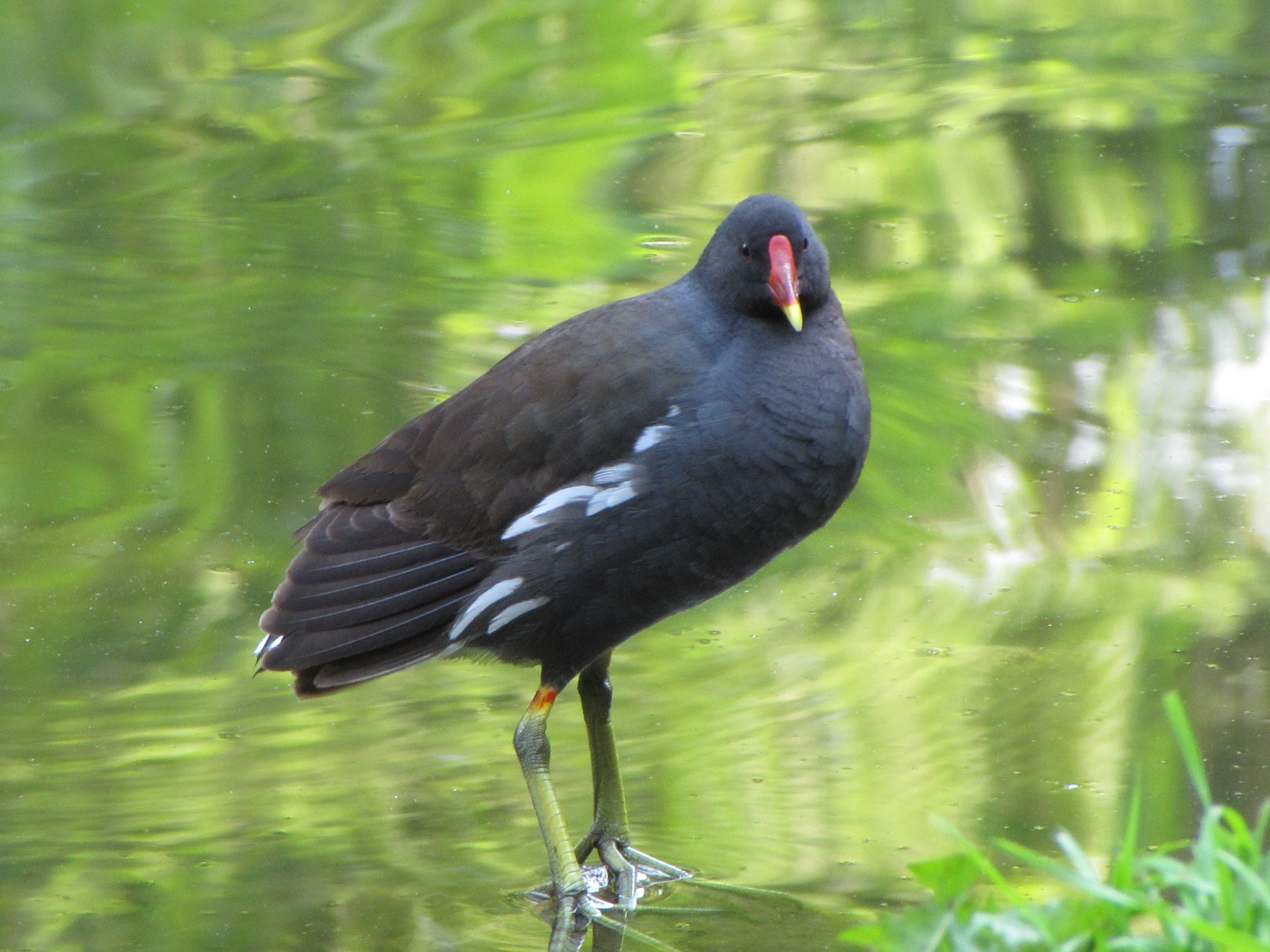
Application Guide for NIH and Other PHS Agencies"). Here is a picture of a moorhen to help you not panic as you download:

Can you see how long its toes are? Fricken' long. Imagine soaking your extra-long toes in a nice summer pond.

5. Do not print out the instruction book. It is 264 pages. You will need to constantly jump from section to section to hunt down the clues and riddles needed to fill out each of the approximately 30 forms you will complete. Keep it digital so you can search for relevant terms.

6. Do print out this glossary of NIH terms. Then read it. Then read it again to see if you understand it any better. Keep in mind that while necessary, this glossary is wildly incomplete, because NIH people can't guess what terms non-NIH people won't understand. Also keep in mind that when they use a term to define itself, they mean well.

7. The National Institutes of Health are called "Institutes" because they have quite a few different topic-specific Institutes, plus a bunch of Centers and several Divisions. You are supposed to know which of these is most likely to be interested in funding your work, contact the appropriate PO (program officer) and pitch it to them before then writing in your cover letter than you contacted that PO and she encouraged you to apply to that Institute, Center or Division. There are very detailed guidelines you should follow in writing to that PO. You are supposed to already know which PO within the appropriate branch is the appropriate PO. The only way I found of finding this out was to spend countless hours on the NIH web pages learning about the structure of NIH, then countless more hours reading those pages before making a wild (and wrong) guess. Luckily the person I wrote to (who wasn't even at the Institute I thought she was at) directed me to another person, who told me that I was heading the wrong way. Eventually I made a decision.

8. Go through the instruction book and make a list of all the forms and attachments you will need. Depending on the specifics, there could be anywhere from 15 to infinity of them. On your list, make notes as to the purpose of each form and what is an attachment to which extension to which sub-form. Also note which parts you have to do and which parts the SO has to do, and then confirm this with the SO. Then look at these pieces in the pile of example applications you've gathered.

9. Don't plan any vacations for before the due date. Plan a vacation for after the due date.

10. You may notice that I have not yet mentioned anything about science. At least once a week, think about the scientific goal of your application. It is very easy to lose track of the fact that there is some reason you are putting yourself through this.

Thursday, January 05, 2012

Authorship code

I'm writing a paper with two of my students. Well, I'm writing it with one of them and another one did a lot of work on the statistics. But today we had to straighten out the order that the authors would be listed in on the paper. This can be a contentious issue, and I know of cases in which papers did not getting written at all because the authors couldn't agree on who got to be listed first. Some big multi-author papers simply list everyone in alphabetical order to avoid the fuss, but then Dr. Aardvark always gets to be first author. Some journals have a little section where each author's contribution is described, but they usually end up saying something uninformative and false like "all authors contributed equally."

I came up with most of the ideas in the current paper, put things together, decided who would do what, etc. My student did much of the lab work and is doing much of the actual writing. Given this, most biologists would propose what I did, and what my student objected to: She (as the person doing the writing) should come first, I (as the senior person on the paper) should come last, and everyone else (in this case meaning the statistics student) gets sandwiched in between. This was very counterintuitive for my student; she thought I was trying to minimize my own role by putting myself last. In fact, it is a step up for me to be writing papers in which I am in that last position. I remember this being counterintuitive for me the first time it was explained to me. I was a college student, and a boss said that he'd make me second author on a paper. I said something to the effect that I'd be glad to be even last author, which I thought was being humble, but he took it as me saying the paper had been my idea. We straightened out the miscommunication but I didn't end up being listed as author on the paper. That the last author spot (at least in biology) signifies the senior author is a code biologists internalize, and I had to think back a long way to figure out why my student objected to me being last author. I explained, she reluctantly believed, and now it is settled.

Sunday, December 18, 2011

The end is neigh!

When I start working on a project, it is always interesting and exciting, otherwise I wouldn't start working on it. Developing ideas is fun, narrowing down the question to just the core issue is challenging, building an apparatus or simulation or whatever feels productive and creative. But I also have to actually write a paper which frame the whole thing in a useful way, which means reviewing and summarizing the relevant literature, which is boring unless I actually have something novel to say about that literature, other than what my new experiment or analysis or whatever shows. And I have to make my paper, which is always interdisciplinary in some way, fit into a particular journal, most of which are tightly disciplinary. So I'm much better at starting papers than finishing them, and I have a tremendous backlog of papers to get out. It is therefore a great relief to have just sent out what was originally (three years ago) a response to another paper in which I saw some methodological shortcomings, that turned into a broad comparative analysis of human and primate demography, and ended up as a review article submitted yesterday to an anthropology journal. One of my co-authors is a bone fide anthropologist, so I feel confident that we at least refer to most of the right papers. I'm also confident that our points are valid and important and the paper generally well written. But mostly I just feel happy that if all goes well I will soon no longer have to work on this paper.

Thursday, March 31, 2011

Skipping that hard middle part

The part of science I like best is the coming up with questions part. The part where I ask something someone else has never asked before (or at least I don't yet know that they did) and brainstorm together a plan about how the question could be answered. But my second favorite part is writing rough drafts. I like the rough drafts in particular because I can let the ideas flow, without getting hung up on making sure I have exactly the right reference or my font is just the one the journal prefers. In other words, it is writing without the impeding mechanical details.

I can do lab work, I can program a simulation, I can edit bibliography formats in citation management software, and all those other jobs that require extensive attention to details beyond the scientific concepts. But by preference I'm really a concept guy. If I had collaborators who wanted to do every part of the process between the planning and writing the rough draft, I'd be thrilled.

This is why I'm writing a Forum piece, to submit to a journal that responded positively to my pre-submission inquiry. (A positive response means they are willing to look at it, not that they promise to publish it.) Their Forum section is designed for short papers of about a 1000 words, in which the author makes a relatively simple point or poses a question without a lot of new data. I've finished a rough draft of 1100 words in the last two days. Now comes the less fun part of editing it for clarity, making sure all the papers I cite actually say what I claim they say, getting feedback from colleagues and editing it again. A more adulterated and repetitive form of creativity. Still, I think I would be inclined to write more papers in this format, as it makes a nice compact project.