We wanted to go for a longish walk today, and the
Rostock Zoo is walking distance from our house, so we headed on over. We walked through only a few city blocks and then a large city park with oak/maple/chestnut/beech forest and playing fields. The zoo was blissfully uncrowded due to the cold and wet weather. Unfortunately, this also meant that many of the animals were inside or inactive. Walking into this zoo the differences in funding and history from the
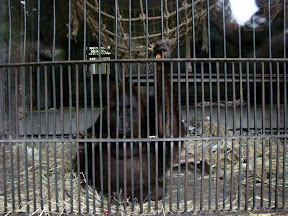
Copenhagen Zoo we so recently admired were painfully obvious. It is of course an unfair comparison, given the differences between the two cities, and the weather when we visited, but still striking. Many of the animals simply stood in small, relatively featureless enclosures. Iris commented that the people who designed some of the enclosures were following in the style of Soviet apartment blocks. The animals, with some notable exceptions, looked bored, and sat waiting to be fed. A couple of the fish tanks had dead fish at the bottoms. The lone elephant walked in a small circle, always clockwise. The orangutan clutched the bars of her cage.
Many of the animals were tremendously obese. We saw almost no zoo employees except at the cafe, the entrances and the store. There was a lot of the feeling of bad old zoo here.
At the same time, like much of Rostock, it was obvious that the Rostock Zoo is very actively trying to replace the run-down vestiges of
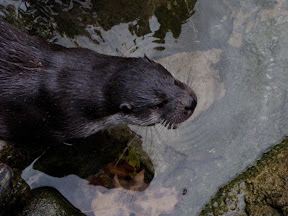
GDR with new, modern and elegant. The otter habitat, clearly recently built, had the otter racing every which way through trees, ponds and tunnels searching for cleverly hidden bits of food. We watched from a small bridge over the enclosure or from a sunken room below water level, aquarium style. The otter's enclosure was beautifully thought through and built.
The depressing concrete and iron boxes that house the great apes have been retrofitted with glass fronts for warmth as well as branches and nets for climbing on, and big signs requesting donations to build a new ape house. I emptied my coins into the collection box. A large counter showed that they had raised most of the million Euros in donations they need for the new ape house. The old-world monkeys were in a new (although still somewhat cramped) exhibition hall that doubles as a gallery of large prints of the winners of a wildlife photography contest.
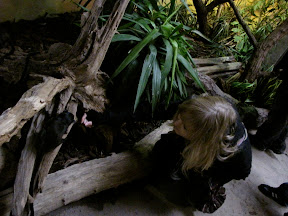
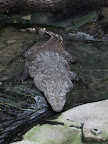
The most striking (and to me most disturbing) enclosure is the crocodile house. About the size of a two car garage, it has a couple of small crocs, some large soft-shelled turtles, brightly colored freshwater fish (all the fish at the zoo are freshwater, presumably because they lack the facilities for salt-water aquaria) and four free-roaming Black-mantled Tamarins. These little South American monkeys had the complete run of the place. They jumped over the crocodile tank, ran between the zoo visitors' feet, jumped on the visitors and scurried up and down the walls. They showed no fear of people, and while we were there were fed by hand by more than one young guest. One young lady took turns with a tamarin licking her ice cream.
All this with no zoo employee or volunteer in the building, and both doors to the house frequently open. It was thrilling to see these tiny (~1Lb) primates up so close, have them jump onto my shoulder, stick their noses against my camera lens to see what was inside, etc. But it also struck me as really quite irresponsible. It may be that the zoo simply has no other warm space to keep the tamarins, but my mind was filled with all the things that could go wrong here. Someone could step on a tamarin. One of the teenagers attempting to grab a tamarin's tail could succeed and get a nasty bite, or injure the animal. People could transmit diseases to our fellow primates. The monkeys could transmit diseases to people. Someone could stuff a tamarin in a backpack and take it home (this sort of thing has happened at other zoos). The tamarins could run out the door and wander into the nearby lion enclosure, or just die of cold. The crocs could get them. Petting zoos are supervised, and never contain primates or species of conservation concern. This broke every rule, and I can only hope it is a very temporary arrangement. That said, the tamarins were probably the most memorable and exciting part of the visit.
One other thing that struck me about this zoo is how much space they have for expansion. Many of their newer exhibits, and large fields for the ungulates, are in an area across a road from the main zoo, accessible through a separate entrance or via an underpass. Most of that added-on section is still just woods, waiting to be made into wooded homes for animals. They also have lots of old cages that are simply empty, ripe for replacement or creative reuse. What they seem to lack is not the will to improve, or the space, but funding. With the exception of the tamarins (which I think should be moved at once, even if it has to be to somewhere the public can't see them, or to another zoo) all of the animals are situated as well as they can be given the current enclosures available. If asked, I would probably advise replacing or significantly modifying 75% of the enclosures. I suspect the people who work there feel the same way. I very much hope that they find the funding and the will to make the type of transformation they need.
Due to poor weather and bad batteries I only took 150 pictures today. 20 of the better or more relevant ones are here.



 I've looked up what species of crocodilians have snouts like this, and was pleasantly surprised to find out that there are three candidates: the Slender Snouted Crocodile, the False Gharial and the Freshwater Crocodile. All three have similarly shaped snouts and eat a mixture of fish and terrestrial prey. All three are said to bite humans only when harassed, and all three live in fresh water. Each is found on a different continent and they are not closely related to each other. The African Slender Snouted Crocodile, the South Asian False Gharial and the Austrailan Freshwater Croc have apparently evolved into similar niches and therefore converged on similar morphology. Interestingly, despite its numerous crocodilians, the Western Hemisphere seems to lack a similar species.
 I found out that these are Australian Freshwater crocs only by looking up which of these three species the Zoo in Basel keeps.
 That's what the above water part looks like. The below water part of the same individual in the same position looks like this: