Saturday, August 27, 2011
Writing while sleep deprived


Tuesday, August 16, 2011
Busy
I am working on another big funding application. This one is a lot more work than the previous applications, as the required research statement, the largest of several sections, is 25 pages. I can't really complain. If I was going to give someone enough money to run a research group for five years, I too would want to know in some detail what they would do with the money. Further, sitting down and trying to put my plans into a single document makes me systematically consider how my various plans fit together, always a useful exercise. My only complaint really is that I should have done much more on this much earlier. Trying to finish everything up at the same time that my wife is preparing to deliver a baby and my family is visiting is an less than an optimal solution.
Thursday, August 04, 2011
Taxonomically not what you eat
One should be cautious in naming a taxonomic group for their ecological habits.
I offer you these examples:
1. Most turtles are amphibious; all are reptiles, not amphibians. Turtles have scales, lay hard leathery eggs, have the physiological and genetic makeup of reptiles. I often see phrases such as, "turtles and other Amphibians" in writing about biology by non-scientists. The taxonomic term 'amphibians' is not helpful in getting across to people that turtles are reptiles.
2. Consider the Carnivora. Most Carnivora are carnivores, but some, such as the giant panda, eat largely plants. Further, many carnivorous mammals are not Carnivora in the taxonomic sense. Unnecessarily confusing.
3. Pity the poor Insectivora. It turns out things are worse than just dietary nonconformity (not all the Insectivora ate insects, and not all insectivorous mammals were called Insectivora). The group called Insectivora no longer exists! Biologists had assumed that similarities in diet and morphology among the moles, shrews, tree shrews, golden moles, hedgehogs, moonrats, solenodons, tenrecs, elephant shrews and colugos were the result of common descent (they all had these traits because they were all closely related to each other). It is now clear that Insectivora was an ecological rather than taxonomic grouping. This is because modern molecular genetic and phylogenetic methods make clear that most of these Insectivores are not any more closely related to each other than they are to you, or to an elephant. Specifically, the moles, shrews, solodons, hedgehogs and moonrats form one group, whose closest relatives include the carnivores and hoofed mammals. The tree shrews and culogos (of southeast Asia) are more closely related to the primates. The golden moles, tenrecs and elephant shrews (all African groups) are related to larger mammals found in Africa such as the aardvarks and elephants.
4. The Caprimulgidae (Latin for goat suckers), do not suck goats. They were named for a feeding behavior falsely attributed to them. They are in fact insectivores.
Wednesday, August 03, 2011
Who's a demographer?
This is all a roundabout way of getting to the question of who is a demographer. Ask a demographer what is the largest annual scientific meeting for demographers, and she will probably say The Population Association of America (PAA). I consider myself a demographer as well as a biologist, but I think most PAA members would say the stuff I do isn't demography. This is for the simple reason that I mostly study non-human populations, and the PAA defines demography as the study of human population processes. Studying the same processes in non-humans is, by this definition, not demography. Last year they had a session on evolutionary demography, but all the accepted papers were on humans. This year they don't even have such a session. I think that inserting the word 'human' into the definition of demography is roughly akin to saying that anyone who doesn't follow the teachings of a particular Rabii isn't really Jewish, so I call myself a demographer.
I was recently surprised to find myself in a conversation in which the tables were turned. A colleague was arguing that most PAA members are not really demographers, but sociologists. His argument was that many human-focused hard-core demographers feel out of place at the PAA. After their meetings this spring several colleagues complained that most talks at PAA meetings are really quantitative sociology rather than demography. The distinction is a fine one, but basically classical demography has a core set of questions and methods, and these have certainly been supplanted to a considerable degree by questions coming out of sociology, mostly approached with methods that don't require the quantitative machinery of formal demography. My colleague told me, "All the talks are full of regression tables, and most of the regressions aren't even done well."
So is it fair to say that my colleagues and I, who apply classical demographic methods to non-humans are more demographery than the quantitative sociologists at the PAA? I'm afraid not. We can no more revoke their demographer label than they can revoke ours. However, since the social demographers who control the PAA aren't interested in evolutionary demography, and most of their presentations frankly aren't that interesting to us (there really are a ridiculous number of regression tables, mostly demonstrating the relationship between fertility and female education for yet another population), I'm going to let my membership lapse. I'm thinking I'll join the British Ecological Society instead. They have lots of evolutionary demography at their meetings. I don't even feel the need to call myself an ecologist.
Monday, August 01, 2011
Why there are no whale-like birds.
There are five independent lineages of extant (extant is the opposite of extinct) marine mammals:
1. The Cetaceans (whales, porpoises and dolphins), relatives of pigs and hippos.
2. The Sirenians (manatees and dugongs), mildly related to elephants and hyraxes.
3/4. The Pinnepeds (walrus, seals and sea lions), descended from a dog-like carnivore.
3/4. The sea otter, an otter, which is an aquatic weasel.
5. The polar bear, bear.
I have ordered these in the degree to which they have become fully aquatic. The Cetaceans neither need to, nor safely can, leave the water. This is true of Sirenians also, but they tend to feed and birth in shallow water near shorelines, where whales wander the open oceans and dive to amazing depths. The Pinnepeds aren't so good on land, but they do haul up to breed and pup. The sea otter is in some ways more fully marine than the Pinnepeds, mating and usually giving birth at sea. But again, otters are more tied to the land than are Pinnepeds the rest of the year, living and feeding in coastal kelp forests and being capable of fast and efficient movement on land. The polar bear is marine in that it swims long distances, hunts at sea, and has structures that specifically help it do these things. But it still prefers to walk rather than swim, brings its food onto solid ground to feed, breeds and pups out of the water and so forth.
There are more independent groups of sea birds, even if you don't consider each transition from freshwater to saltwater. Penguins are perhaps the most fully marine, flying only in water, feeding entirely on seafood, having special mechanisms for dealing with high levels of salt. The Procellariiformes (albatrosses and petrels) are not far behind, spending about as much time at sea (although over rather than in) as penguins do. The Phaethontiformes (tropicbirds) spend most of their lives at sea, as do many of the Pelicaniformes (pelicans, frigatebirds, boobies, gannets, cormorants and shags). While many gulls live far from the sea, many Charadriiformes (gulls, terns, skuas, plovers, puffins, auks etc.) are extremely marine. Many Anseriformes (ducks, swans and geese), particularly the Merginae (sea ducks) are, well, sea ducks. It was recently discovered that gyrfalcons spend long periods hunting on and around sea-ice, although they probably don't actually swim. I'm sure I've forgotten other examples.
Why so many birds moving out to sea, but so few mammals?
The obvious first hypothesis is that the ability to fly is very useful at sea, while the ability to walk/run/hop etc. is not. The falcons are a pretty terrestrial group, but with few changes beyond the behavioral, gyrfalcons can spend extended periods at sea. Ospreys and eagles, relatives of falcons, use talons that evolved grabbing terrestrial prey to scoop fish. Even hummingbirds and warblers that can't forage or land at sea regularly spend long periods migrating over open ocean. Birds may have an easier entree than do mammals.
Given this, it may be surprising that the most fully marine descendent of terrestrial vertebrates are not birds. All birds lay eggs, and none have figured out how to make that work at sea, so all need to maintain the ability to be land animals. Almost all mammals give live birth, and three groups (Cetaceans, Sirineans and sea otters) can do that without ever leaving the water. The birds may have an easier time getting started down evolutionary paths that lead to a marine life, but they seem to have an inescapable constraint that keeps them from finishing that path: shelled eggs.
The marine reptiles show an interesting parallel to this. Marine iguanas, saltwater crocs and sea turtles all lay eggs, and all do so on land. Sea snakes, excepting one genus, birth live young, and do so at sea. That one genus lays eggs on land.
If some snakes have evolved the ability to have their eggs hatch internally and their hatchlings ready to swim the moment they emerge from the mother, why can't some bird do the same? Imagine how much better off an emperor penguin would be if instead of spending the Antarctic winter fasting in the cold, it could spend that time feasting in the ocean with it's chick developing internally.
Any answer I could offer would be pure speculation. One class of question that evolutionary biology is very bad at answering is "why didn't X evolve." Why hasn't any bird evolved live birth? Maybe it is something about their egg shells. Maybe they are in a habitat where that just doesn't work. Probably it just never happened.
Friday, July 22, 2011
37 weeks
Another thing that is striking about the fetus being a nearly complete baby is that it is a nearly complete baby entirely inside the belly of the mother, upside-down, often with its head inside her pelvis. I don’t know about you, but I could not function for very long with a nearly full sized baby inside me and a skull in the middle of my pelvis. I think I wouldn’t last five minutes, but apparently this situation can go for weeks with little danger, and bearable discomfort, to possessor of either pelvis or skull.
A tremendous amount is now known about ontogenesis, the process by which a single egg grows and develops into a whole person. We have studied it on the scale of molecules, cells, tissues, organs and whole individuals and from the perspectives of physiology, genetics and evolution. There are still vast areas we know almost nothing about, but we can largely reject the hypothesis that there is magic involved. Never the less, things can feel like magic even when reason rejects it. This whole process, of self-directed growth of a single cell into a person, makes it easy to understand why spirits, gods and humunculi are so often invoked.
Friday, July 01, 2011
Hyphum
EDIT: May 2nd 2017.
The singular of hyphae is actually hypha. I just stumbled upon my own old blog post and said, "Whoa! That's wrong." I must have misheard that six years ago.
Friday, June 24, 2011
33 weeks LMP
Thursday, June 23, 2011
Decreasing population, increasing density
The demand for housing that fuels all this building is a story of migration. Rostock is Mecklenberg-Vorpomern, the least densely populated state in Germany, and a state that has steadily lost population since reunification. Many of the outylying villages are dominated by abandoned buildings. Apartment complexes on the outer edges of Rostock, plunked down in the middle of fields by the communist planners, now offer multiple months of free rent to anyone who will move in and still are emptying out. Rostock is full of college students, who don’t want to be on the outskirts in half empty buildings, and an aging population of long-term residents, who don’t either. The more abandoned the outskirts get, the strong the incentive to move toward the city center. So the center of Rostock is becoming denser even as the state loses population.
Monday, June 20, 2011
A name but no face
The oar by this time was far enough away that I had to jump in and get it. I did this with some reluctance, having been stung too many times before, by jellyfish at summer camp on the Chesapeake Bay, and the previous winter in Florida by a Portuguese Man-o-War. Like every swim in the lake before and since, no stings.
My mother afterwards told me that there were freshwater jellyfish in the lake, but only occasionally, and not as many as my grandfather described from when he was a boy. I’ve seen them occasionally since, usually only on really hot days, one or two at a time. I only recently learned their name, Craspedacusta sowerbyi, when they were suggested to me as a possible study organism. Looking them up, finding that they had been studied down to the molecular, I realized I already knew this organism, but only as scattered phantasms floating by on summer days.
Sunday, June 05, 2011
name for a principle?
The principle is that an explanation for a pattern should preferably be applicable as broadly as the pattern is observed, but not more broadly. For example, an evolutionary explanation for group living that can be applied to all the group-living insects is preferable to an explanation that works only for one species of ant. The explanation should preferably not explain the pattern more broadly than it occurs. For example, an explanation for the fusion reaction of the sun merely in terms of the presence of hydrogen would also tend to predict fusion in many other contexts where it does not generally occur, making this explanation less desirable than a more complex one which also specifies the need for the physical conditions which encourage the hydrogen to fuse.
This is the sort of logical statement that is so obvious as to rarely need to be said, yet I need to say it for this talk. If you know what I should call it, please let me know.
Monday, May 30, 2011
Reproduction



Friday, May 20, 2011
Two offers out
We still have one more candidate coming, next week, and if my bosses like him we could offer a position to him also. If we end up successfully hiring all three, I will be very happy.
Thursday, May 19, 2011
Bedside ecosystem

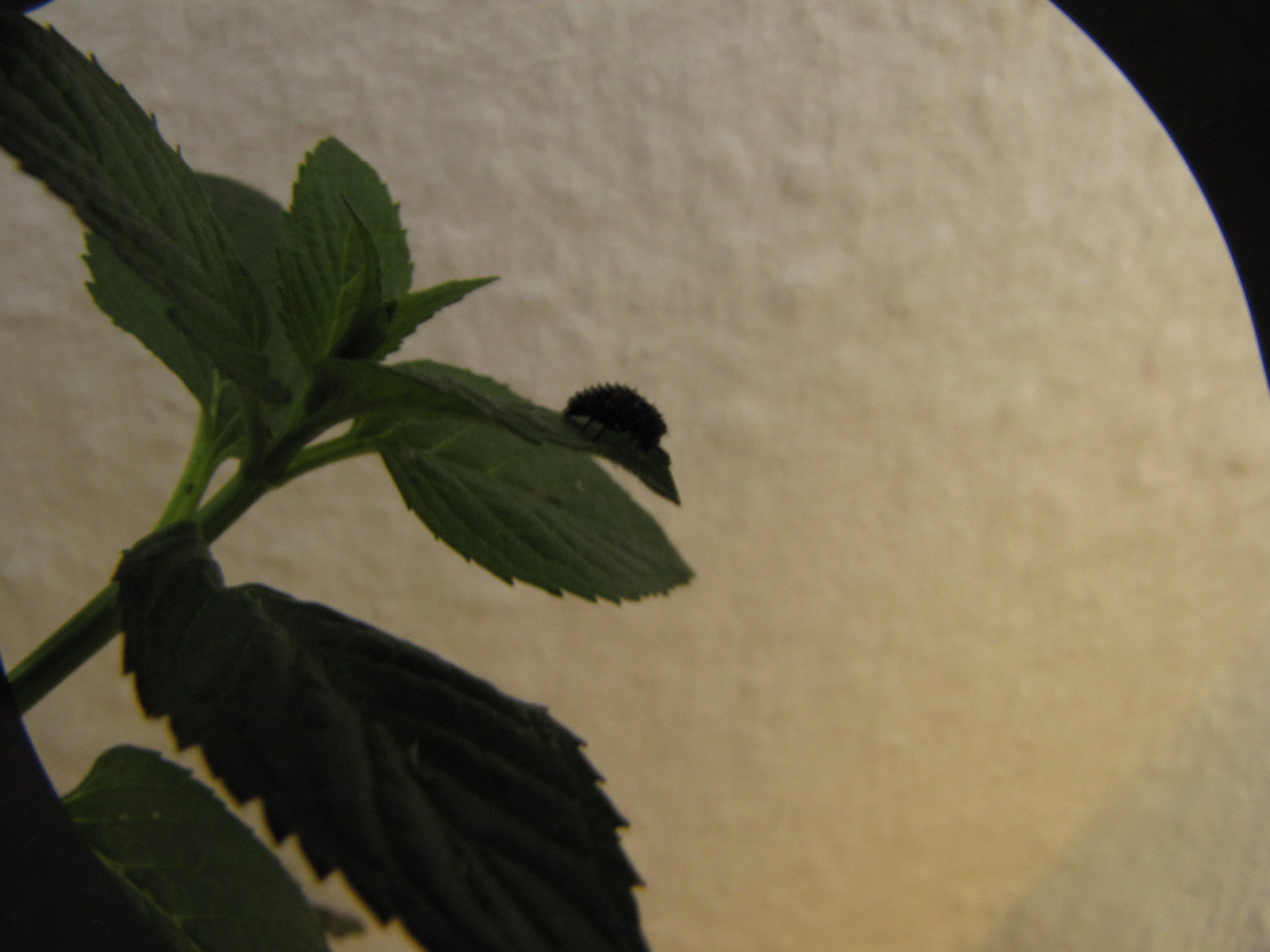
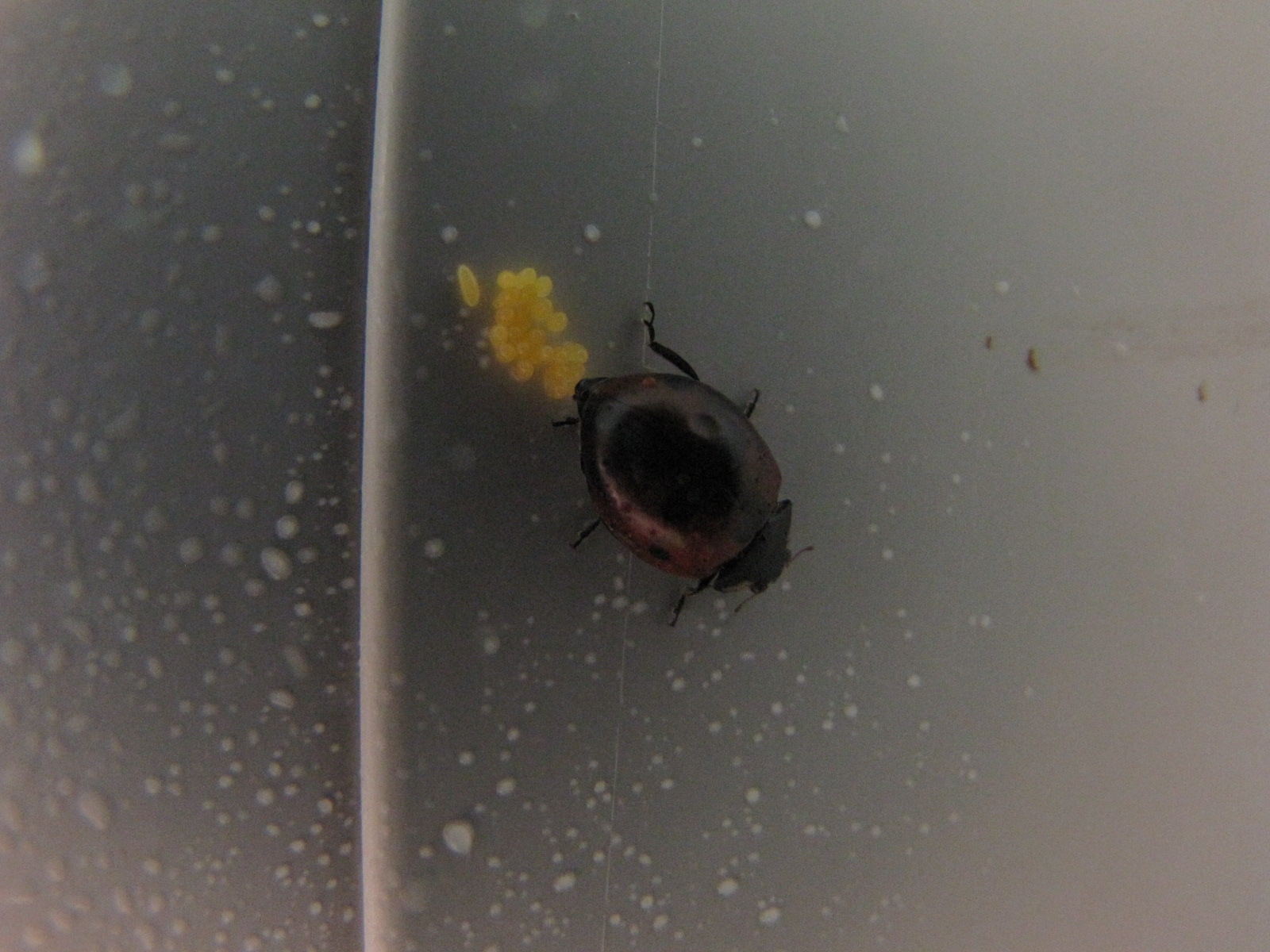
Most mornings I spritz the chocolate peppermint plant on our bedroom windowsill from a spray bottle of water. It loves to be damp. It is growing so well these days, is so juicy and luscious, that the aphids are maintaining a healthy population on it despite my best efforts to squish them and the depredations of the ladybugs. This of course leads the ladybugs to congregate on the mint, as the aphids, thrips and whiteflies have been picked clean off our other plants. And you know what happens when beetles congregate in the spring. This morning as I was spraying, I noticed one of the ladybugs laying eggs on the window frame!
There are about 30 eggs so far and she is still laying. The great thing about this is that labybug larvae are wonderful aphid predators, and don't fly away the way the adults do. So I'm going to transfer the eggs onto a leaf and hope they hatch.
Tuesday, May 17, 2011
Walking desk
When I was in grad school I read such an article, then saw a treadmill for sale in a thrift store near campus. I stopped by the office of the acting director of the museum where my office was and asked if I could install myself a treadmill desk. She looked confused and busy but said yes. The next day maybe half an hour after I had moved the mill in, as I was just figuring out how to build a desk over it, she apologetically called me to her office and asked me to remove it from the museum. My wife kindly let me keep the machine in our tiny tiny Berkeley studio apartment until we sold it to a friend.
Now that I have a real job and we have a decent sized apartment, we are reorganizing that apartment to fit a baby and all the stuff that goes with modern babyhood. And it just so happens that I have both another used treadmill and a broken desk. Below are pictures of the result. It is not the world's prettiest construction (built while recovering from a tooth extraction using only materials I had in the room and without taking any measurements) but now I can walk and type at the same time. It will take a little bit of getting used to typing while rocking from foot to foot, but I think I am going to like this, and maybe it will help me remember to use the treadmill.
Here is my wife's shot of me typing this post:

And here's a view from the treadmill. We are in the tallest building in the state, so I have a nice view of Rostock from my desk.

List of materials:
Treadmill from thrift store
Broken desk
Various screws and bolts I had around the house
An old curtain rod
Total cost €90 spent last year
Thursday, May 12, 2011
Spring is the season of interviews
The days are rapidly getting longer. The sun might officially go down at 9:02 today, but the twilight stretches to well after 10 as the sun skims just below the northwestern horizon. Early this morning there was light streaming in our north-facing kitchen window.
The spring here brings more than just a physical thaw. Come to Rostock in the winter and you will think the population generally has forgotten how to smile. You will see few people on the streets, and often the only parts of them that are visible are scowling. Now the streets are full of summer dresses and shorts, and their occupants are reveling in sunshine.
This, frankly, is the perfect time to be bringing post-doc candidates to Rostock. Flowers, birds, smiling faces, warm breezes, so much sun. These interviews are as much about convincing people they want to come here as they are deciding which people we want to hire. Having the place at its best certainly helps in that regard. We won’t do any interviewing in February.
Thursday, April 14, 2011
My very first robot
On the downside, the thing is an idiot. In theory it has various "robot behaviors" that help it to efficiently clean the whole room, but in practice it seems to pretty much bounce around the room at random, occasionally following a wall successfully. I should specify that the version we have (440) is probably not as good at navigating as the latest versions (610). It does eventually find its way to most corners of the room, although it took about 45 minutes of bouncing around to have covered our living room fairly well, even after I put up the chairs, trash-can, etc. It doesn't see, and doesn't seem to make a map of where it has and hasn't gone, so it will repeatedly miss clumps of dust sitting in the middle of the floor. Some of these it never got. It has a very small dirt compartment, so after one room it was completely full, although I admit most of that dirt came from under couches where I don't usually get.
On a single charge it did our living room, hallway, office and most of our bedroom, although it needed to be emptied after each room. I left it doing the bedroom while I took a shower. Half way through the shower it started making a rather pathetic beeping. It was under the middle of the bed and had picked up so much lint and hair that its brushes and wheels could not longer turn. I pulled it out with a broom and had to take the thing half apart to clean all the hair wrapped around everything. Oh the plus side, it hasn't looked so clean under our bed in months I suppose with regular Roomba-ing the dust won't accumulate to the point that it becomes a navigational hazard.
With time these things and their competitors will become more advanced and less clueless. In movies and books we always go straight to humanoid sentient robots, without the intermediate step of a self-propelled vacuum cleaner taking two minutes to find its way out from under the desk. This is like the Precambrian ancestor of R2D2.
Tuesday, April 12, 2011
Dunno
This answer is effectively, “Not qualified to answer.” The reference can’t really answer my questions, either because he didn’t work so closely with the applicant, or because she worked with him several years ago, before a great deal of professional development.
I can sympathize with the situation these references are in. Imagine that a student you like but don’t know extremely well asks you to be a reference for a job application. It can be hard to say, “Well, I don’t know you so well, isn’t there anyone else you can ask?” So you agree and then kind of hope not to wind up on the phone with some guy in Germany asking for insight into the applicant. Then I call. Doh!
Thursday, April 07, 2011
Despair not!
Rationally, I’ve started to receive more good applications, if not fewer spamly ones. I suspect that this is because the people who are preparing position-specific applications are taking their time to do it, as our deadline is not until April 30th. Also, it being spring, many graduate students are just finishing their thesis defenses and looking for positions.
Irrationally, I have been speaking to people’s references, and the references are of course enthusiastic about the applicants. I knew this was going to be so. I am well aware that the applicants wouldn’t have listed these references if they were going to say terrible things about them, and that the references feel a sense of obligation to say good things, but hearing great things about an applicant from a basically rational and honest colleague inevitably improves my view somewhat. It makes the applicant seem more like a person, and less like a CV. I don’t have any basic predilection to like CVs, but I like most people.
Thursday, March 31, 2011
Skipping that hard middle part
I can do lab work, I can program a simulation, I can edit bibliography formats in citation management software, and all those other jobs that require extensive attention to details beyond the scientific concepts. But by preference I'm really a concept guy. If I had collaborators who wanted to do every part of the process between the planning and writing the rough draft, I'd be thrilled.
This is why I'm writing a Forum piece, to submit to a journal that responded positively to my pre-submission inquiry. (A positive response means they are willing to look at it, not that they promise to publish it.) Their Forum section is designed for short papers of about a 1000 words, in which the author makes a relatively simple point or poses a question without a lot of new data. I've finished a rough draft of 1100 words in the last two days. Now comes the less fun part of editing it for clarity, making sure all the papers I cite actually say what I claim they say, getting feedback from colleagues and editing it again. A more adulterated and repetitive form of creativity. Still, I think I would be inclined to write more papers in this format, as it makes a nice compact project.

