Tuesday, February 21, 2012

The boundries of personhood

A group of academics (psychologists, ethicist, biologists etc.) have recently endorsed a statement arguing that dolphins and whales do deserve the rights of humans, based on their intelligence, self-awareness, individuality, sociality and so forth.

 A curmudgeonly old man, who was an environmentalist but hated that he was because he didn't like to be associated with hippies, once opined to me as follows on this topic, only in much more colorful language: We can't start treating whales as though they have the same rights as humans, because if we give those rights to whales, we have to give them to apes too, and if we give them to apes pretty soon we'll be extending them to monkeys, and pretty soon antibiotics will be outlawed because they violate the inalienable rights of infectious bacteria.

I have mixed feelings about slippery slope arguments generally. Letting even minor instances of objectionable predilections (sexism, racism, etc.) slide really does seem to be a problem, on the principle that once people are used to these sentiments going unchallenged, they will feel freer to get more egregious. But we can and frequently do make different rules about the treatment of different categories of animals, and there is little likelihood of the rules that now apply to the study of chimpanzees being extended to include studies of bacteria, let alone infections. My research with live animals legally requires no review by any ethics board because I am working with invertebrates. Back when I studied birds, I needed committee approval just to go out in the woods and watch birds for scientific purposes, and my friends who study humans have sometimes had to get such approval just to reuse preexisting published and publicly available data on long-dead populations.

The fact of the matter is that we can and do make arbitrary decisions, often influenced by scientific knowledge but also influenced by emotional predilections, about who and what deserve what rights and protections. Before the US Civil War, southerners quibbled with the evidence that slaves were fully human, but more fundamentally they didn't admit that this implied that they deserved the same rights as other people. These days, American conservatives tend to want to extend the full rights of personhood to fetuses, embryos and potentially fertilized eggs. American liberals often want to extend these same rights to smart charismatic non-humans. Each side sees the other as both ridiculous and morally bankrupt. The difference underlying these wants are philosophical, moral, ethical and political, sometimes economic, but not generally founded in disagreements on scientific fact. Those factual disagreements usually follow, as each side looks for ways to justify its conclusions. I don't expect cetaceans will ever be granted the same rights as humans, but as we learn more about their mental and emotional lives, I do think it will become harder to treat them little different from large endangered fish. In other words, I think we will go part way down the slope.

Monday, February 20, 2012

Culturing culture

I am supervising/mentoring/collaborating with two post-doctoral researchers (a.k.a. postdocs), and greatly enjoying the process. They are both smart, hardworking and enthusiastic, and, unlike me, talented experimentalists. I am good at proposing experimental designs, and at inventing or improving upon experimental apparatus, but I managed to get through all my years of training as a biologist without ever being taught the nitty-gritty of laboratory work. I like to make things up as I go along, and work on twelve projects at a time, paying sporadic attention to each, and you can't really do experiments that way. But these two post-docs actually know what they are doing in the lab. It is impressive to see how thoroughly they train the students, how carefully they document their doings, and how well they know their organisms. As a grad student I started working with rotifers with almost no prior knowledge of rotifers, and without any advisor who knew rotifers. I read the literature, but there is a deep cultural knowledge about how to care for aquatic lab animals, with lore and practice around each group, and I had none of that. These two know, and it is wonderful to watch and learn.

Friday, February 17, 2012

I, flotsam.

Certain relatives of mine cling to the fantasy that I will be able to decide where I get a job, so as to live within a few miles of them. While the sentiment is appreciated, and shared, the reality is that I have almost no say in where I end up.

Let's review a few facts. First, the US economy is still in the shitter, if slightly less deep in than a few years ago. Lots of people, regardless of their industry, are moving wherever for whatever job they can get. Maybe there is some profession where you can just up and move where you want and be confident of making a living there, but I'm not sure what profession that would be at this point.

Second, even in good times, academics can almost never pick a city and get a job there. For hundreds of years academics have been moving to whatever University has a position for them. I'm reading a book about Alexander von Humboldt, who was one of the greatest scientists of the late 1700s and early 1800s, and even he keeps going from country to country looking for a patron and encountering academics working far from their own countries. There are extraordinarily few academics who can simply contact a University of interest and based on their scientific reputation be confident of getting a job there. Once you've won a Nobel Prize your chances are good. Barring that, good luck.

Third, I have done what most of the academic establishment says scientists should do, but very few fully do, because it makes publishing and job-hunting that much harder. My work is so damn interdisciplinary and specific that I am unlikely to fit the particular job description a small disciplinary department at a college or university is likely to write. I am on an email list for an online bulletin board for evolutionary biologists called EvolDir, and every few days I get an email for some position somewhere in the world that they are trying to fill. Here are a few of the most recent entry-level faculty positions:
•"There are several openings for Bioinformaticians and Software Developers at the University of Glasgow (UK)."
•The City University of New York seeks candidates with expertise "in tropical ecology, biogeography, evolutionary ecology, and conservation biology."
•" Tel Aviv University (ISRAEL) invites ... applicants who apply modern approaches to investigate fundamental problems in the general area of Plant Ecology. "
•UC Riverside "invites applications for a faculty position in plant evolutionary developmental biology."

These are positions I would bother applying for. This is not to say that I won't find anything, but rather that even if Near My Relatives U does decide to advertise for a new professor, they are more likely to be looking for an expert in the genomic analysis of primate fecal samples than they are a developmental evolutionary demographer. When I am ready to apply for positions, the question will not be, "Is that biking distance from my relatives?" but rather, "am I plausibly qualified for that position and is it a place where my wife is willing to live?" If it is, I'll need to apply. It is most likely that positions I do apply for will be among the relatively few broadly defined positions in evolutionary biology, with no further disciplinary restrictions. I very much approve of such broad-net casting, but it tends to lead to many hundreds of applications, as everyone in the field qualifies, so my chances with any one such position are slim.

If the economy were to improve dramatically, I could plausibly limit my search to within 1000 miles of my family. As it is, that limit will be about 12000 miles.


Wednesday, February 15, 2012

How I got stapled to a live turkey, and other fond memories of California

Round about this time of year I usually start making a list in my head of all the reasons I should probably not live in northern Germany much longer than necessary. One of my complaints is my general lack of opportunity to observe and interact with wildlife. I spent the better part of a decade doing biological field work, spending most of my time in the general proximity of wild animals. Sometimes it was more proximate than "general proximity" would suggest.

One day early in grad school, I was on my way into research museum where I worked, when I was stopped by the museum's eccentric old preparator, who was on his way out and wanted my help on I knew not what. I ended up on the beach with him and an armed National Park ranger using a carving knife to remove the head and fins of a dead whale that had washed up, for reasons that were not entirely explained to me at the time. I think the skull may have wound up in our museum's collection, but the ranger kept saying something about things not ending up on the black market.

Another time, my friend Alan wanted help catching and marking the wild turkeys he was studying. He would set up big walk-in traps baited with grain on cold mornings, and trap a whole flock of turkeys at a time. Then he would pull them out one at a time, measure them and attach a patagial tag to their wings. My job was to hold the birds' wings still while he attached the tag. Well it was quite cold and wet and my fingers were numb, so I didn't immediately notice that the rivet had gone not only through the bird's wing (as it was supposed to) but also into my hand. It took perhaps a minute to detach me from the turkey without further injuring either and bandage my hand before we could move on to the next turkey.

More often, my wildlife fix came in the form of bird-watching or lifting rocks to find lizards or salamanders. It was a rare week in California that I didn't get to do some wildlife viewing, and nature was as close as my back door. Here I live near the middle of a city with a long cold dark winter, and the life of a lab and desk biologist just isn't as adventurous. There is a city park across the street which in summer hosts some interesting if overfed animals, but especially this time of year I feel the absence of wildlife. Of course there is no guarantee that the next place I live will be so wild as is Berkeley (or preferably more so), but I can hope.


Sunday, February 12, 2012

Spanning the vastness

When I was but a lad, my siblings and I used to accuse my father of knowing everything, a charge he would always deny, observing that even excluding those things which are not known to anyone or are secret, and restricting ourselves to academic knowledge, there is more to know than any one person or any thousand people could possibly know.

To see why this is so, consider the sheer volume of scientific literature being produced. ISI Web of Knowledge, an online tool used primarily by scientists for finding scientific literature relevant to their work, indexes the contents of over 23,000 academic and scientific journals. Many lesser known, newer or otherwise less main-stream or traditional journals are not indexed at all. One needs to go to other databases to find information published in books, or in dissertations, or, or, or.

Like my father (as I am in most things), I find myself far too mortal to know any meaningful fraction of anything, even if we restrict ourselves just to academic biology. I'd say there are roughly 8000 peer-reviewed journals in which biological work is regularly published, and if you add up all the papers I skim through, it is probably the equivalent number of pages of the output of two or three of these. The papers I read in detail if assembled together would surely make up much less than the output of a single journal. And I put more time into reading and therefore less into writing than is optimal for my career.

One result of this is that I frequently find out that there exist thriving sub-disciplines of biology of which I have almost no knowledge. For example, only last week I for the first time heard the word "metabolomics." Google Scholar lists over 6000 papers in the last year on this rapidly expanding field about which I know no more than I could guess based on the name.

My knowledge of transcriptomics was quite as absent three years ago. Transcriptomics is the study of RNAs in the cell, generally in the context of gene expression patterns. I became interested in transcriptomics because I proposed that mortality risk during embryonic development would be highest at those stages at which gene expression patterns were changing fastest. I was a doctoral student at the time, and my adviser asked me if there was any way of testing this idea. I had to admit I didn't know if it was possible to test because I didn't know enough about the field I have since learned is called transcriptomics. The answer is that yes, there is a way of testing the idea, but it will cost a couple of hundred thousand dollars, and require collaboration with people who read different journals than I do. I will never be an expert in transcriptomics, but I can find a colleague who is, but has little knowledge of evolutionary demography, and invite him to collaborate on a project that combines our expertise. And this is why science can be a somewhat unified pursuit despite having far more product than one person can read even the titles of.  

I referred in my last post to one of my advisers at Berkeley, and one of my all around favorite human beings, Ron Lee. Ron would always advise me to think about my relative advantage, by which he meant I shouldn't just work on the most interesting or best questions, as there are far too many. Rather, I should choose among them by considering which questions I was better placed, given my strengths and resource, to answer than was anyone else likely to work on the question. Ron's advice has always served me well, and so I do consider this before starting any project. Frequently, as with this developmental transcriptomics and demography project, my relative advantage arises from the fact that I am combining two fields separated enough that no one else is likely to ask the question any time soon. Evolutionary demography and developmental biology do not, as a rule, talk to each other. Many fields of biology have almost no communication with each other, leaving vast unexplored interdisciplinary territories (unless that is all in some set of journals I haven't come across yet).

Saturday, February 11, 2012

Emissions of the aged

Projections of future carbon-dioxide emissions are complicated. How will energy consumption habits change as societies get richer or more urban? What mix of sources will we be getting our energy from?

My friend and colleague Emilo Zagheni decided we should make the calculus that much more complicated (and informative) by also asking how the aging of the population will influence carbon outputs. A demographer's demographer, which Emilio surely is, is never happy with any calculation that does not include age-structure in one way or another.

This article in the Economist summarizes what he did and what he found. As people get older, they tend to consume more and more, emitting more and more carbon, until 65ish, at which point consumption tends to start declining. See the graph, and the analysis, in the Economist, or the original in the journal Demography (2011) pp 371-399.  The punchline for the carbon-watcher is that the changing age-structure will tend to increase carbon emissions until about 2050, after which point such a large portion of the population will be above 65 (I'll be 73) that the age effect will begin to marginally decrease emissions.

I should finish with a quote from Ron Lee, Professor of both Demography and Economics at UC Berkeley, who both Emilio and I studied under. Ron was one of the inventors of the widely used Lee-Carter method* (1992) for forecasting future mortality patterns. Seventeen years later, I asked Ron how well his forecasts for the first 17 years matched what had actually happened in those years. He cocked his head slightly to the left, sighed sagely and said, "Well, demographers are well aware that our projections don't always fair so well in a complex world. But we console ourselves with the knowledge that we do much better than the economists."


* The original article has been cited more than 1000 times in the peer-reviewed literature, and modifications are used by the US Census Bureau, the UN, and so forth.

Friday, February 03, 2012

Suddenly crustaceans

I don't have a taxonomic specialization, and I'm happy with that. I've worked with or dug deeply in to the literature on hardwood forest trees, midges, several groups of birds, frogs, rotifers, primates and Hydra (the polyp, not the mythical beast). I've probably read more of the literature on beetles in the family Melyridae than any other non-entomologist who knows almost nothing about beetles.

I've now gotten to the point in my career where I am organizing a research group and serving on people's committees, and suddenly and unintentionally, I'm all into crustaceans. I'm supervising a post-doc and a doctoral student and on the committee of another student all working on different Daphnia projects. Daphnia are the model organism for crustaceans. I've got another post-doc working on barnacles (which despite their outward appearance as adults, are very much crustaceans, and go through not one but two amazing metamorphoses before ending up attached to ships, rocks or whales). This particular barnacle, Balanus improvisus was first described by Darwin (1854) in his giant book on barnacles that he wrote to procrastinate publishing On the Origin of Species (1859).

I've still got projects on Neurospora a fungus best known for ruining your bread, on Hydra, and on primates (including humans) going, but most of my time at the moment is crustacean focused. I suppose I will have to learn the basics of carcinology. Yes, that does come from the same root as carcinogen and carcinoma.

11-hour

One of our laws in the U.S. requires that federal paperwork that people have to fill out be a bit longer than necessary in order to inform us that the federal government is mandated by law to reduce unnecessary paperwork, and to provide an estimate of how long it should take to deal with the particular piece of paperwork.


I'm preparing a grant application to the National Institutes of Health, and have spent the last month trying to figure out the rules, regulations and customs. They provide a helpful 264 page guide to filling out the application form, with links to more information online. This guide estimates it should take me 11 hours to prepare my application, not including the part where I design my research. It also advises me that I should read the whole guide, and the various additional information (including a very necessary glossary) before beginning to fill out the forms. A friend of mine, who recently looked at this instruction book and thereupon decided not to apply for NIH funds, suggested that anyone who could read and comprehend all 264+ pages in under 11 hours with enough time left to fill out the forms should probably just be acknowledged as a genius and given whatever money they need for their work.

I certainly don't blame NIH for having a lot of rules, or putting them in a book. They have a huge number of people asking them for money, the responsibility to make sure all the applications are dealt with fairly, and the need to comply with a very large number of laws on many topics. All sorts of special cases and exceptions arise, and they need to have guidance on everything (although I have already come across several places where one just has to know how it is done, generally by asking people who have done it before). So you can't really blame their helpful but understaffed staff. However the 11-hour estimate should probably be reexamined.

Anyway, I'm learning, and the next time I write an NIH application, it may take me only 11 hours to understand the rules, provided they haven't changed them too much. The sad part is that the proportion of applications funded continues to decline, even as the length of the application instructions increases. I'll distract myself from thinking about that by reading the 33 FAQs about the Modular Grant Application Concept.

Wednesday, January 25, 2012

Can anyone think of model organism genera starting with I,J or Q?

Arabadopsis

Bufo

Caenorhabditis

Drosophila

Escherichia

Felis

Gallus

Hydra

I

J

Klebsiella

Loligo

Mus

Neurospora

Oikopleura

Phodopus

Q

Rattus

Saccharomyces

Trichoplax

Ustilago

Vibrio

Wolbachia

Xenopus

Yersinia

Zea

Thursday, January 05, 2012

A, alligators all around


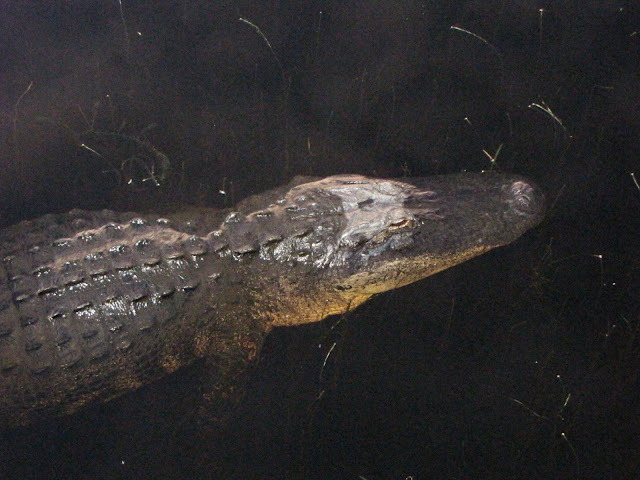
They say that the distance in inches between an alligator's eyes and its nostrils is equal to the length of the whole animal in feet. This behemoth hangs out by the fishing dock in Loxahatchee National Wildlife Refuge feeding on discarded bait fish and who knows what else. My best guess is 14 inches nose to eyes, which would make it not unheard-of big but certainly exciting-to-canoe-past big.

It is amazing to think such an invulnerable top predator (at least within the refuge) started out nearby as a scared little snack for herons like this:

Authorship code

I'm writing a paper with two of my students. Well, I'm writing it with one of them and another one did a lot of work on the statistics. But today we had to straighten out the order that the authors would be listed in on the paper. This can be a contentious issue, and I know of cases in which papers did not getting written at all because the authors couldn't agree on who got to be listed first. Some big multi-author papers simply list everyone in alphabetical order to avoid the fuss, but then Dr. Aardvark always gets to be first author. Some journals have a little section where each author's contribution is described, but they usually end up saying something uninformative and false like "all authors contributed equally."

I came up with most of the ideas in the current paper, put things together, decided who would do what, etc. My student did much of the lab work and is doing much of the actual writing. Given this, most biologists would propose what I did, and what my student objected to: She (as the person doing the writing) should come first, I (as the senior person on the paper) should come last, and everyone else (in this case meaning the statistics student) gets sandwiched in between. This was very counterintuitive for my student; she thought I was trying to minimize my own role by putting myself last. In fact, it is a step up for me to be writing papers in which I am in that last position. I remember this being counterintuitive for me the first time it was explained to me. I was a college student, and a boss said that he'd make me second author on a paper. I said something to the effect that I'd be glad to be even last author, which I thought was being humble, but he took it as me saying the paper had been my idea. We straightened out the miscommunication but I didn't end up being listed as author on the paper. That the last author spot (at least in biology) signifies the senior author is a code biologists internalize, and I had to think back a long way to figure out why my student objected to me being last author. I explained, she reluctantly believed, and now it is settled.

Tuesday, January 03, 2012

Oh give me a home, where the apple-snails roam

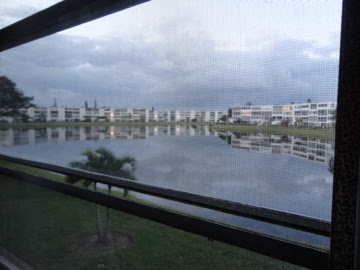
Retirement communities are, by design, fairly sterile places. Much of south Florida is covered in huge gated spreads of nearly identical buildings with neatly trimmed lawns leading down to pleasingly curving shallow canals so that every apartment can have water views. It is uniform, controlled, boring. But all those networks of shallow canals catching lawn fertilizer and Florida sun provide habitat and highways for rapidly growing aquatic plants, which feed aquatic invertebrates and fish. With relatively few retirement community residents catching their own fish, this leaves the fish to grow as big as want.

Or at least it used to. When I was a kid visiting my grandparents in Century Village, I rarely saw any wildlife around the wide place in the canal (referred to as a lagoon because it increases resale values) behind their apartment.


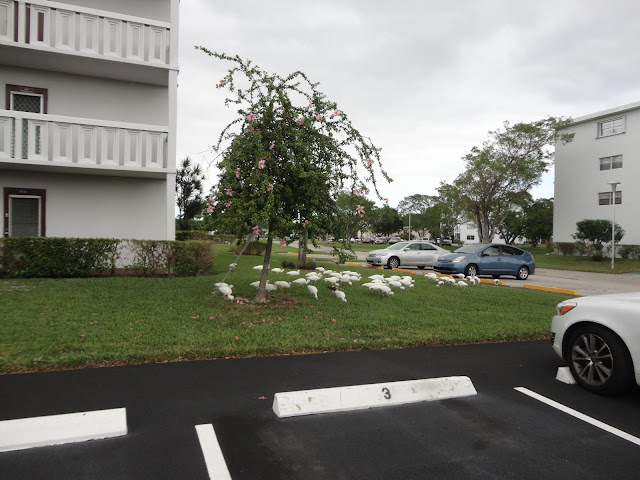
When I was a teenager and my grandmother was widowed, the lawn by the water was occupied by a flock of Muscovi Ducks (plant eaters), Cattle Egrets (which eat mostly insects picked from lawns) and the very occasional Great Blue Heron, which eat only small to medium fish. My aunt inherited the same apartment, and my wife and I brought our baby daughter to visit her this winter. Our first morning there, jetlag woke us early. Standing by the lagoon was a flock of Wood Storks. Walking past them in the water's edge was a flock of White Ibis, trailed by a Tricolor Heron.


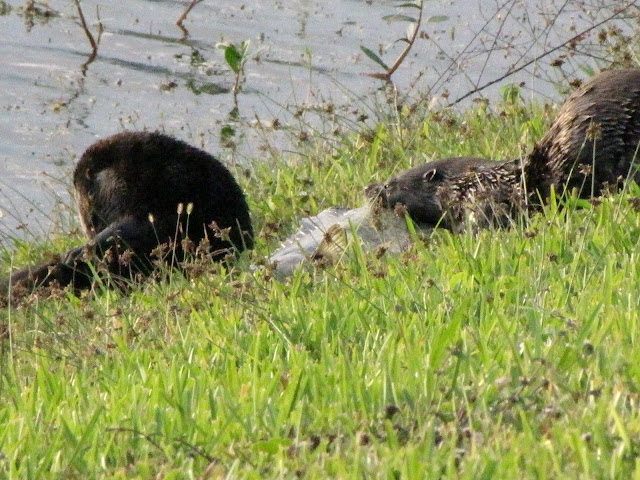
On the far bank an Anhinga spread its black wings to the sun. A few feet away lay a huge dead fish, heavily built and probably 80cm long, partly eaten by something. What could kill a fish that big, drag it up on the bank and eat only part of it? Walking the banks we found the shells of numerous Apple Snails, so named because they are as large as the fruit. Apple snails don't come up on land by themselves, so something must have carried them up, presumably to eat them. In back of the next building over, beyond the Great Egret and Little Blue Heron, I could just see something moving on the bank. I thought it might be a dog (not allowed in Century Village) but then I could see it was two long low animals chasing and wrestling with each other. They jumped in the water and swam as no dog could. River otters! A pair of very large river otters chased each other, making circles in the reflected condos. The remains of several large fish, each only partly eaten, attested to the successful hunting they had been having in the canal.


Four Turkey Vultures sat around one such plate of sushi as others circled and swooped, their wing tips almost brushing the screening of enclosed patios. We cajoled my aunt, her bad ankle throbbing, to come out onto the lawn with us for a closer look at the otters. We crept closer to them and the fish they were snacking on until they raised their heads and hissed at me, at which point we backed off.

All this wildlife, carrion, birds and their poo on cars, giant snails, etc. are pretty clearly not what the designers of Century Village, and south Florida's thousands of other retirement communities had in mind. Nevertheless, I think most of the residents are probably happy to have so much nature on their lawns. I doubt all those telescopes and binoculars sitting in the screened patios were for spying on the other retirees.

Is this all good for the wildlife populations? Clearly they would have been better off if the wetlands had not been made into retirement communities, but given that they were, I'd guess that learning to exploit those communities is to their advantage. The water in these canals surely has all sorts of runoff from lawns and parking lots, but if the birds feeding in it can still breed consistently, they are likely to have a feeding habitat that no one will drain, pave or burn. If things get too rough in the nearby Everglades, they will have a retirement home ready.

Sunday, December 18, 2011

The end is neigh!

When I start working on a project, it is always interesting and exciting, otherwise I wouldn't start working on it. Developing ideas is fun, narrowing down the question to just the core issue is challenging, building an apparatus or simulation or whatever feels productive and creative. But I also have to actually write a paper which frame the whole thing in a useful way, which means reviewing and summarizing the relevant literature, which is boring unless I actually have something novel to say about that literature, other than what my new experiment or analysis or whatever shows. And I have to make my paper, which is always interdisciplinary in some way, fit into a particular journal, most of which are tightly disciplinary. So I'm much better at starting papers than finishing them, and I have a tremendous backlog of papers to get out. It is therefore a great relief to have just sent out what was originally (three years ago) a response to another paper in which I saw some methodological shortcomings, that turned into a broad comparative analysis of human and primate demography, and ended up as a review article submitted yesterday to an anthropology journal. One of my co-authors is a bone fide anthropologist, so I feel confident that we at least refer to most of the right papers. I'm also confident that our points are valid and important and the paper generally well written. But mostly I just feel happy that if all goes well I will soon no longer have to work on this paper.

Wednesday, October 26, 2011

Undermining the Wall of Death

Different fields of science often don't talk to each other, even when coming at the same problem from different angles. A stark example of this can be found in the literature on aging. I'm in the field of evolutionary demography, and aging is one of our central focuses. We ask why and how it happens by studying the demographic patterns of different species under different circumstances. The evolutionary demographic theory of aging is built around the idea that there are alleles that have effects at different ages and natural selection acts on these genes to sculpt the age-specific mortality at different ages. Because dying young (before you've had a chance to reproduce) is more disadvantageous than dying old (after you've already passed on some genes) natural selection acts more strongly to minimize mortality in early adulthood than later adulthood, resulting in a chance of dying that increases in age. There are decades of theory built up around this idea, and the idea is not without merit, but it does assume these age-specific gene effects, generally without bothering to say what the actual genes are or how they influence mortality.

Another field within biology that focuses heavily on understanding aging is biogerontology. Biogerontology focuses on understanding the mechanistic basis of aging at the cellular and molecular level. They describe aging as a process of narrowing of the homeodynamic space, often due to accumulation of damage. Homeodynamic space is a concept related to homeostasis (the tendency of organisms to push their physiological state back to some optimum), but with the recognition that the goal that the individual is pushing towards, and its options for pushing, change over time. For example, as the cells in an organism accumulate mutations, it becomes more dangerous to allow them to continue replicating, because this could spawn a cancer. So the cells are forced to turn down expression of genes that allow for cell replication. But if your cells are replicating less, then you should be more reluctant to allow apoptosis, programmed cell death, because cells that die can't as easily be replaced. But if you've down-regulated the genes involved in apoptosis, this means infected cells will be less likely to kill themselves, so you need to have a stronger inflammation response, so that white blood cells will be brought to areas of infection and kill the infected cells from the outside. But increased inflammation has all sorts of nasty side effects, which themselves need to be compensated for. Note that I am just making this chain up as an example. The point being that the organism, in order to deal with the accumulation of damage, has to adjust various aspects of its physiology, which can cause damage or challenges to the system, which requires further adjustments. The organism gradually loses wiggle room, paints itself into a corner as it were. When this homeodynamic space gets too small, the organism can't respond to whatever insults (internal or external) come along and gets killed.

Reading papers in biogerontology, I am struck by two things. The first is how naive and outdated their evolutionary assumptions tend to be. For example, they still will state that aging is not observed in the wild because no individual lives long enough to grow old in the wild, an opinion that evolutionary biologists began to reject in the 1960s and have now disproved with data from numerous species from plankton to humans and birds to aphids. But I am also struck by how naive they would think our assumptions about age-specific genes are. They state as one of the basic principles of biogerontology that are no genes whose roll it is to cause aging, or which act at a particular age to regulate the chance of death. You will remember I said that such age-specific gene effects, from unspecified genes, are at the center of much of the theory behind evolutionary demography. Yet biogerontologists know such genes not to exist. So our assumptions about the mechanisms are as naive and simplistic as their assumptions regarding the demography.

This lack of communication, with each field basing its thinking on ideas the other has long since rejected, is common in science. There are simply too many journals, papers, conferences, etc., too many fields that may produce important information, for anyone to keep a useful fraction of an eye on most of them. So the lack of communication between fields is to some extent inevitable, but it does have significant consequences.

This is obvious when we introduce the gerontological observation that gene expression is not highly age specific (at least not late in life) to the evolutionary literature on post-reproductive lifespan (PRLS). Much of the study of PRLS has been motivated by the idea that PRLS shouldn't exist unless post-reproductive individuals do something useful for their younger kin. This idea arises from the evolutionary demographic theory of aging I described above. If an individual has reached the age where it can no longer reproduce, the genes it is expressing at that age should be genes that selection doesn't care about at all, because whether she dies at that age has no effect on how many offspring she has. So mutations that kill post-reproductive individuals should accumulate rapidly, unopposed by natural selection. W.D. Hamilton, a preeminent evolutionary theorist of the mid-20th century, wrote in 1966 that “In the absence of complications due to parental care or other altruistic contributions due to post-reproductives, the [mortality] curve should be roughly asymptotic to the age of the ending of reproduction.” By this he means that as the individual approaches the end of her reproductive period, her chance of dying at each instant should approach 100%. This has been dubbed "Hamilton's Wall of Death." Hamilton's work is influential enough, and his basic logic sound enough, that many of my colleagues still believe we should find the Wall of Death. But in fact we can find PRLS in a huge range of organisms where there is no parental care or anything comparable, and the Wall of Death is nowhere to be found. Hamilton's prediction fails because his model is built around high age-specificity of gene expression, which we now know not to exist. Genes which are being expressed at and after the age of reproductive cessation are the same genes being expressed prior to that age, doing the same things they did prior to that age (except of course reproduction) and so they can't just suddenly cause all sorts of lethal effects. This represents a major constraint on the ways selection can shape the pattern of mortality over age, and we evolutionary demographers are just starting to come to terms with the ramifications of this. When I have time to write another longish post, I'll explain how this leads to a major question in evolutionary demography that I have been thinking about but don't yet have any plausible answer to.

Monday, October 10, 2011

Constraints

The field of life-history evolution, into which the stuff I do roughly fits, spends a lot of time thinking about optimality. What is the optimal age to start reproducing? What is the optimal amount of time to spend foraging each day? What is the optimal body size for a creature in a particular niche? The factor being optimized here is fitness, usually measured by the rate at which a sub-population with a particular trait would increase in size. The trait value that leads to the fastest increase is the optimum. Quite often when we calculate an optimum value and then measure the actual values in the population, most individuals are fairly close to the optimum. But fairly often this does not happen, and then we start talking about "optimality with constraints." By this we mean that there are certain conditions that must be met, and the optimum we are looking for is the best value that is consistent with those conditions. The most commonly considered constraint in my field is the constraint of limited resources. If you have only 100 calories a day of energy to expend, you can't expend it all on growth and maintenance and all on reproduction, your reproduction is constrained by the need for maintenance, and vice versa. So we can calculate, given a set of biologically informed assumptions, what the optimal investment in reproduction is at each age. This kind of constraint makes sense to people, and yields many useful insights. That said, it is often the only type of constraint considered in situations where many other constraints potentially come into play.

One type of constraint that is particularly hard to build theory around is that natural selection can only favor those traits that exist. That is, a trait may be drastically suboptimal, but if all individuals in the population have that trait, and the genes which determine it cannot easily be altered by mutation such that they allow a higher fitness solution, the population will continue being far from optimal.

A classic example of this type of suboptimality is known as the 'obstetric dilemma.' This is the problem that humans have narrow pelvises and big heads, and the head has to pass through the pelvis during birth. In a (now somewhat out of date but still sound for our purposes) summary of one hypothesis of how humans diverged from our chimply relatives, Kristen Hawkes (the anthropologist behind the Grandmother Hypothesis) described (in 2003) the central role this obstetric dilemma played in human evolution thusly:


* Drying environments in the late Tertiary constricted African forests, making capacities to use alternative foods more advantageous among ancestral apes.
* Bipedalism was then favored because it freed hands for tool use, which
increased success at hunting big animals, and this put a premium
on larger brains.
* But the mechanics of bipedal locomotion limited pelvic width, so brain expansion created an ‘‘obstetrical dilemma’’ requiring most brain growth to be postnatal.
Consequently, children with developing brains were immature longer and were more dependent, for a longer time, on maternal care.
* The care requirements interfered with maternal hunting, so mothers relied on
provisioning from hunting mates. This help from fathers allowed mothers to produce more surviving offspring.
* Thus, parents formed lasting bonds and nuclear families became the fundamental
units of cooperation in which a sexual division of labor served familial goals of production and reproduction.


Now according to this story, variations of which are still supported by the scientific evidence,much of the distinctness of human life-history comes through:
1. The need for large brains and small pelvises
2. Which explains why our babies are so undeveloped
3. Which explains we take so long to mature
4. Which is an important part in explaining why we end up with our social system.
5. Which explains why we live so long.

So the optimality of a narrow pelvis, the optimality of a large brain and the need for
that brain to pass through that pelvis ends up being a central fact of human evolution. And why, we may ask, is it optimal for the baby's skull to pass through the mother's pelvis? The apparent answer is that if there is only one possible trait, that trait is the best of all possible traits.

The pattern of vertebrates expelling their young through their pelvis dates back to
before vertebrates actually had pelvises.


Note that this fish has its gonads above and in front of its pelvic fin. That is a common trait among fish, including the lobe-finned fish from which all terrestiral vertebrates are descended. The lobe-finned fishes had bony feet with which they could support themselves on the sea floor, and the bones in their pelvic fins would eventually be modified by evolution into the legs and pelvis.


Now the first terrestrial vertebrates were amphibians, and like most frogs and salamanders, laid small soft eggs, so it was probably no problem for them to continue having the gonads in front and running a tube through the pelvis to the cloaca. This system only became problematic when the eggs got large and hard, as they are in reptiles like turtles. Turtle people like to talk about "pelvic consraint" when they discuss why turtles don't make bigger eggs.


The only non-fish vertebrates to escape the need to run the babies through the pelvis are those that no longer have ana full pelvis, like whales and most snakes. To my knowledge nobody has managed to invent an alternative outlet, so everybody, including us, has to find one way or another to get through the pelvis. In fact, the only alternative is a human invention, the cesarian section.


This obstetric dillema is a very obvious contraint of the 'no alternative' type. Whenever I get a chance to write another longish post, I'll give an example of a constraint where the lack of alternatives is less obvious because it is genetic rather than anatomical.

Saturday, October 08, 2011

More fun zoo photos

Rostock Zoo, Oct, 2011


I like zoo photography. Click the caiman to see the slideshow.

Sunday, September 25, 2011

Thoughts during a trip to a conference

The Rostock main train station (Hauptbahnhof, Hbf) is an easy walk from our building, even when bedangled with a laptop bag, poster tube and backpack. I was amused to see that three other passengers getting on my same train also had the black plastic tubes which announce that one is going to or from a conference. None of them looked like ecologists, so I figured it wasn't the same conference. I tried to eavesdrop to figure out what topic two of them were discussing, but it was rapid and in French, and so instead I fell asleep as the train pulled out.

It took 34 minutes from the time we arrived at Hamburg Hbf until I was sitting in my gate at the Hamburg airport waiting for my flight to Manchester. This without any running, pushing or hurrying, and the airport is not particularly near the Hbf. A single S-Bahn trip stops directly under the security check, so up two escalators I got on one of the many very short lines, and didn't have to remove my shoes or belt, nor get molested. I like to complain about the fact that you can't get a flight from Rostock's small airport to anywhere, but if door to gate takes only two and half hours, this is still better than many trips to JFK I've made. It is frankly slightly disorienting for an American for a transit system to work this smoothly.

As I sat in the gate, two English gentlemen sitting just behind me recognized each other and began to make small talk. The one is the occasional patient of the other, and has an appointment to see him in late December. They kept up a lively conversation about not much of anything, without a single pause, for about 45 minutes. I have heard the English talent for small talk described before, but I must say this was really impressive. They moved purposefully from one genial topic to the next, always with a smooth transition. Football, Christmas Markets, vacation destinations, and so forth. I felt like congratulating them.

As the bus took us from our gate to the plane, we passed a taxiing airplane from Air Tunis. It wonder if flights to Tunis are cheep these days? I've heard they have trouble filling their hotels since the revolution.

As we pass up then down through layers of clouds, I notice how closely defined their surfaces are. The top of my window can be mostly in the cloud, and the bottom mostly out. I wonder vaguely what sort of fluid dynamics allow for such a sharp transition to be stable.

I hope I have the right ticket for this train.

An hour and a half into wandering around Sheffield looking for my accommodation, I'm standing on a corner with three young guys with tattoos on their massive biceps as one of them looks up Edgecliffe Crescent on his iPhone. The guy resting in front of the closed Pakistani restaurant next door says go to the roundabout, take a right, and straight to the top.

Breakfast in the cafeteria is much what you would expect from breakfast in an English University's dormitory cafeteria. The orange juice and eggs are from concentrate, but the sausage is fresh squeezed. I sit across from a young woman who has never been to a conference before. I briefly consider teasing her about the fact that she is nervous despite not having to do anything but listen to other people's presentations. She gives me good directions to the conference hall.


"You can't really understand anything in ecology without thinking about soil biodiversity," says the plenary speaker. I guess what I do isn't ecology.

A couple of people come up to question me further after my talk. One of them is a guy I once emailed for advice on keeping rotifers. I can't remember what the question was, but thank him for how quickly he responded.

There is no way I am going to stay awake through the whole poster session. I get slightly lost on my way back to my room and end up in an OxFam thrift store. I get lost again carrying some used books. I spot an expidition of ecologists and follow them home.

Waking up cold I pass by the Greek place and have peas panner with garlic nann. I happily chew the hard chunks of spices in the sauce. "I'm a womanizer!" announces the old, obese, bald and drunk puddle of English gentleman at the corner table with the off duty waiters. "Yes, Sir, you are!" one of them reassures him.

I consider rehearsing my poster spiel for tomorrow, but instead prepare by sleeping more.

We are joined at breakfast by a conference of dentists (there may be a better term of venery for dentists, but I don't know it). They are easily distinguished by their unecologist-like formalwear.


Lost of people ask questions about my poster, and most of them tell me that while interesting, it has nothing to do with anything they will ever work on. This interesting but not directly relevant feeling is largely mutual.

Thursday, September 08, 2011

Typical

In Rostock it is entirely unsurprising that the woman who answers the phone at the Fremdsprachendienst (Foreign Language Services company) proudly speaks nothing but German.

Tuesday, September 06, 2011

Dan SMASH!

I've just spent six hours trying to convert a file (a poster I'm presenting at a conference next week) from one standard format to another for printing. After six computers and dozens of programs each of which is supposed to be able to do this conversion instantly, it finally converted, although it looks kind of crappy in its converted format. I've sent it to the printer because I don't care anymore. None of the other things I desperately needed to get done today got done.

I am not generally given to violence, but do currently have the urge to break something.

Monday, September 05, 2011

Irene reaches Europe

The National Hurricane Center was remarkably accurate in predicting the track Hurricane Irene would follow up the East Coast of the US. Tropical Storm Irene made her way over New England pretty much as they said she would. They stopped updating that forecast when Tropical Depression Irene passed the northern boundary of Maine into Canada, and even the Canadian press largely stopped covering Irene once it passed out into the Labrador Sea. But now Post-Tropical Cyclone Irene, is forecast to bring gale-force winds to Wales over the next few days. Given that this storm started as a tropical wave over Africa, I wonder if she is just trying to find her way back home. Or maybe she wants to go around again? The only forecast I have seen on the future path of the remnants actually calls for her to come this way (towards the Baltic), as a fairly ordinary low-pressure wave and storm later this week.