Most of the "congresses" are in China or India and they are all on topics that have are totally unrelated to my work. I think most but not all of these conferences are intended as actual events, but the point of all of them is to collect registration fees.The organizing committee is pleased to announce that the 2nd Annual World Congress of Nano-S&T (Nano S&T-2012), which will be held from October 26 to 28, 2012 in Qingdao, China. The congress will consist of 12 streamlines covering topics including: Nanosciences and Technologies, Nanomaterials, Analytical tools for Nanotech, Nano-electronics, Nano IT, Nanocoating, etc. This conference will bring together over 1000 experts and specialists from all over the world.Based upon your contribution to the field of Nanotechnology, we invite you to give an oral presentation at Section 4-4: Etching Process about your recent work. Certainly, you can look through the program and select a session at your priority. We will be honored if you can deliver a speech during this event. Your involvement in this congress will be invaluable for the development of the program.The full program with speakers’ profile and presentation’s titles will be released at the conference website in a few weeks so that you can know what specific subjects will be covered by the other speakers. You may log on: http://www.bitconferences.com/nano2012/program.asp.I am pleased to send you a conference brochure about Nano-S&T2011 in the attachment.We would be honored if you could attend the Nano S&T-2012 Conference.I will appreciate it if you could forward this invitation letter to the experts who may be interested in us.Sincerely yours,Ms. Selina
Thursday, March 22, 2012
Conference Spam
Friday, March 16, 2012
Wednesday, March 14, 2012
Friendly advice for your first NIH grant application
Notice that its sharp mouth parts are at the end of its huge nose. Cool huh?
Okay, here goes:
Monday, March 12, 2012
Evolutionary biology vs. evolved biology
An example: A couple of years ago I attended a workshop on bioinformatics in aging research. There was a dinner the night before the talks started, and the bioinformaticist organizing the workshop asked me about my training and research. I said, "well I study the evolution of demographic patterns, particularly how constraints on natural selection lead observed demographic patterns to differ from the predictions of evolutionary theory." He replied, "Oh, but you are also trained in biology?" What he meant by this, I discovered, was that I also had some training in the molecular nuts and bolts that to him are biology. Evolution is a process that shapes biology, but in his view, and I think the view of many of the people there, does not in itself count as biology. Asking him if he ever incorporated evolution into his work, he explained that he had, comparing how networks of gene interactions differed between fruit fly and nematode. Fair enough, comparative biology is surely the study of evolution, but his approach to it required no technique or concept from evolutionary theory. He produces good and useful science, and gives no more daily thought to evolution than I give to promoter regions. I am certain that he would not be offended to be described as a good biologist who believes in evolution, but is not an evolutionary biologist.
A definition from wikipedia: "Evolutionary biology is a sub-field of biology concerned with the study of the evolutionary processes that have given rise to the diversity of life." This is somewhat too narrow in my view, but it is close enough given that it is past my bedtime.
This has all come to mind because of the post I wrote yesterday, about weeds evolving resistance to Monsanto's best-selling herbicide, and the failure of Monsanto's biologists to predict this. A good friend of mine, who is deeply knowledgeable about matters environmental and agricultural, responded by asking how Monsanto's biologists could have failed to predict the apparently obvious facts I was pointing out unless they were A, Tools; B, Fools; or C, having their results manipulated by suits. This is a reasonable and interesting question, and I'll venture an answer. My guess is that they were neither A nor B, and that C went on but was not a major factor. Monsanto did have an enormous financial stake in convincing regulators that weeds would not evolve resistance to Roundup, but they also had an enormous stake in having weeds actually not evolve resistance to Roundup. So my guess is they honestly thought it was a highly unlikely outcome.
Why did they think so, despite being smart, honest biologists? Because they weren't trained in, or primarily thinking about, evolution as it occurs in nature. They were plant geneticist and bioengineers, spending many years and countless millions of dollars to unravel the finest details of how Roundup kills plants and how to build a crop that will have resistance to it (without passing that resistance on to its offspring). That was an enormous challenge, and their success was unprecedented. They had achieved what many, even within their own company, must have thought was an impossible SciFi dream.
Surely someone was assigned to think deeply about the problem of whether weeds would evolve resistance, but surely that someone had been involved in the project for years, and was so wrapped up in the grotesque details of the genetic magic they had just achieved that no perspective was possible. In other words, they couldn't see the field for the soybeans. A person highly trained in artificial selection, and used to that way of thinking, will think of the evolution of weed resistance in those terms, despite the fact that natural selection has inherent advantages.
In hindsight, their logical errors are obvious, probably even to them. In foresight, reasonable and well intentioned people frequently fail to think of highly relevant and potentially obvious things. This is particularly likely if those things require a perspective they don't possess, doubly particularly if they are thinking deeply about the problem from a very different perspective. Monsanto had many biologists who knew about evolution, used a particular type of evolution as a tool, and thought about evolution. But my guess is they didn't have any evolutionary biologists.
Sunday, March 11, 2012
Evolution infringes upon Monsanto's patent
The point of the article is that Monsanto falsely rejected the possibility that carpeting the world in Roundup would lead to the evolution of Roundup resistant weeds.
Then the story, written by Daniel Charles, continues like so:
Oops. Since then, resistance to glyphosate has emerged in 20 different weed species.In case the holes in their logic haven't struck you, allow me to provide a quick lesson in how natural selection (or in this case semi-natural selection), as opposed to genetic engineering, works.
I called up several people who were at Monsanto at that time. Why didn't people there think resistance would happen? They all told a similar story.
First, the company had been selling Roundup for years without any problems. Second, and perhaps most important, the company's scientists had just spent more than a decade, and many millions of dollars, trying to create the Roundup-resistant plants that they desperately wanted — soybeans and cotton and corn. It had been incredibly difficult. When I interviewed former Monsanto scientists for my book on biotech crops, one of them called it the company's "Manhattan Project."
Considering how hard it had been to create those crops, "the thinking was, it would be really difficult for weeds to become tolerant" to Roundup, says Rick Cole, who is now responsible for Monsanto's efforts to deal with the problem of resistant weeds.
Engineers at Monsanto were surely aware of natural selection and its proclivity to producing resistant pests, but they considered the idea that there would be even a hint of heritable resistance in the weed populations to be highly unlikely. This is because they failed to consider the following facts:
A. They were testing thousands of highly targeted potential genetic alterations in the lab, on a few crop species, and found that almost none of them conferred significant resistance. They didn't consider that after global distribution of their crops, trillions of genetically distinct (although totally untargetted) genetic modifications (that is, natural mutations) in thousands of weed species would be tested for their resistance. When something potentially useful did pop up, Monsanto was again able to test hundreds or maybe thousands of slight modifications on that, while natural selection could within a few years test millions of potential modifications iteratively over several generations. So they didn't consider that nature's search for solutions would be far more exhaustive than theirs.
B. I'm sure engineers have a term for closely examining one type of failure risk while completely ignoring others. That's what Monsanto did. They were look hard at making plant tissue resistant. From the same story:
Some weeds, Cole says, appear to keep glyphosate from entering the plant at all; others sequester the herbicide in a spot where it can't do much damage. Monsanto's genetically engineered crops use a different technique entirely.So they didn't consider the possibility that some plants would simply shield their vital tissues from the toxin, the way many metal resistant plants do.
C. They assumed that because Roundup had been used broadly for several years already, and there were no known resistant weeds, weed populations simply had no resistance traits available for natural selection to favor. They failed to consider that with the introduction of their crops, and the resulting increase in usage, both the population size of the exposed weeds and the force of selection for resistance would increase dramatically.
The force of selection is a measure biologists use to ask the question, how much difference does a heritable change of a certain size in a trait (for example a 0.1% increase the probability of surviving a spraying with Roundup) make to the fitness of the individuals with that altered trait. So long as most individuals in a weed population were never exposed to Roundup, the force of selection for resistance to it was small. Resistance doesn't help much if you are never exposed. The seeds blowing into farmers fields were coming from unexposed sub-populations, and so were not resistant. When we started blanketing the world in Roundup, the force of selection increased, because most every weed subpopulation over huge areas was exposed. So their experience up to that point led them to underestimated the force of selection for resistance. And if there is one thing that evil empires should know, it is to never underestimate the force.
Friday, March 02, 2012
Google goes stupid
So I used search terms like: “linear regression” “scatter plot” age and figure. And I got back images of babies, mothers breastfeeding, pornographic images of women (not medical or educational or artistic, despite having Safe Search set at strict) mixed with a smattering of scatter plots, almost all from papers about women’s reproductive health, breast- and cervical-cancer and baby nutrition. None of it was useful to me, and a lot had no apparent link to any of my search terms. What was going on?
At the same time at home, my wife was reading a Blogger hosted blog on women’s reproductive health and baby-care. She was using my laptop and was still signed into gmail as me. Blogger is owned by Google. Yesterday was the first day of Google’s new policy of sharing information about users of any of its services with any of its other services to help to personalize search results and the ads it shows. I was looking for figures. My wife was reading about women, their reproductive health, and their babies. I got images of babies, women’s figures and reproductive parts, and scientific figures plotting data on same. If I was interested in scatter plots related to breast-cancer, I would include “breast-cancer” in my search terms. Yesterday, I logged out of my Google account in order to get decent results from Google. This is not helpful for Google or for me.
There has been a big kerfuffle about the lack-of-privacy implications of this new policy. People say that Google is becoming Facebook, a sinister ploy to know more about you than you do. I am sympathetic to those complaints, but not particularly worried about them for my own sake. My main complaint isn’t that the new policy is evil (i.e., Facebookish), but that it is stupid (i.e., Microsoftian), in that it makes Google’s core product, Search, less useful. Google is forgetting what Microsoft has never figured out: Too many functions doing things for you detracts tremendously from the functionality of the software. If I want to sit down at a new computer and use Word, I don’t want to first have to individually turn off all twelve parts of Autocorrect and 75 other things that will change my document for me in undesirable ways. And if I want to search for something, I don’t want terms I haven’t inserted invisibly added to my search. To have the algorithm decide to include terms from a blog that I (or anyone logged into the same account) read in my search takes control away from me, and then I have to fight against the algorithm to find what I want (or, heaven forefend, use Bing). It’s like having a car that tries to drives you to a restaurant of its choice every time anyone in the car, or on the radio, mentions food. You drive because you have to, but after the tenth visit to that terrible restaurant, you wish you could just walk.
The Google–becoming-Facebook complaints are surely in part a reference to Google’s relatively new social network site, Google+. But here again, it feels to me more like Google-becoming-Microsoft. My complaint stems from their push to drive every possible bit of traffic to Google+, even if this makes their other products harder to use. Microsoft similarly tried (before being ordered otherwise by the courts) to so thoroughly integrate Internet Explorer into Windows that you basically couldn’t use one without the other. Google seems to be trying to do the same with all their products and Google+. The‘Photos’ link used to take me to my photos on Picasa. This was helpful. Now it takes me to the recent photos that people in my circles have uploaded to Google+. This is not generally useful, and makes it harder to get to my pictures. On pretty much all their products the Share button (which used to take me directly to the option to email or link to an item) now opens a window asking me to post whatever it is on Google+, making it harder to share whatever it is with the vast majority of people I communicate with through other means. I understand that Google wants me to communicate with all of them only through Google+, but as that is never going to happen, designing a product that assumes it has already happened is stupid. There are quite a few of these small things that don’t make a big difference in and of themselves, but take Google’s products, which have traditionally been beautifully designed and implemented one step closer to things I use because I have to. And once you are into “use because I have to” territory, you are Microsoftian.
Sunday, February 26, 2012
Camels (and alpacas and equids)
Update: 10 camels, 6 alpacas, 4 miniature ponies, 3 donkeys and 9 horses. Only the camels are out grazing, fodder is being brought in and more tents are being set up in the areas already cleared.
Friday, February 24, 2012
National Academy of the Extremely Vigorous
I'm thinking about this at present because I have had a very productive evening. Since coming home from a full day at work I've made dinner, done the dishes, played with my daughter, rocked her to sleep, folded the laundry, done more laundry and folded that also, cleaned the cat's box, organized things around the house, rinsed the drop-cloth we put under the highchair while my daughter learns to eat, cleaned the broccoli and potato bits out of the bathtub, written work emails, taken down the garbage and the recycling, climbed the 18 flights of stairs to come back up and written half a blog post. This is extraordinary for me, especially this time of year. I am almost always either coming down with something or trying to recover from it, or coddling an inflamed joint, or just feeling low energy. I lose a disgusting amount of potential productivity to being sickly. The elite academies members I know, and those who are not yet in those academies but seem likely to be in them some day, are all people who are this energetic all the time. If they do get sick, they seem to almost always be back at in after a day or two. It is rare for me to recover from a cold in less than a week, and not rare for me to be out for two or three weeks at a stretch. This is not to say that many of these people are not also smarter than me in important respects, but the trait that most unifies the really successful academics I know is their extraordinary energy and vigor. My boss, nearing his 70th birthday, and a National Academy member, hardly seems to know what it is to feel tired. He'll attend meetings on four continents in the course of a week, say how exhausted he is, and still spring from his chair to scribble equations on his whiteboard. So my belief is that people of the highest academic attainment live longest not because they are of high attainment, but because they are remarkable in their health and energy, which also allows them to produce the torrent of great science necessary to be elected to one of these societies. Alright, enough writing, I'm exhausted.
Thursday, February 23, 2012
Scandal! Scientists find error in their own results!
Last September, a group of scientists in Italy got some strange results that made headlines around the world. Their results suggested that neutrinos were traveling faster than the speed of light.
I ask you to consider the following excerpt from a BBC article that came out just after their announcement:
"We tried to find all possible explanations for this," the report's author Antonio Ereditato of the Opera collaboration told BBC News on Thursday evening.I now ask you to consider the opening of NPR's article reporting the news that the error has probably been found:
"We wanted to find a mistake - trivial mistakes, more complicated mistakes, or nasty effects - and we didn't.
"When you don't find anything, then you say 'well, now I'm forced to go out and ask the community to scrutinise this'."
Friday's meeting was designed to begin this process, with hopes that other scientists will find inconsistencies in the measurements and, hopefully, repeat the experiment elsewhere.
"Despite the large [statistical] significance of this measurement that you have seen and the stability of the analysis, since it has a potentially great impact on physics, this motivates the continuation of our studies in order to find still-unknown systematic effects," Dr Ereditato told the meeting.
"We look forward to independent measurement from other experiments."
Remember last year, when we reported that Italian scientists claimed to have broken the speed of light?
And this, from a blog post headed "That's Embarrassing" that one of my Facebook friends linked to:
Remember CERN's claim that they found neutrinos traveling faster than the speed of light? Weeeeeell now they want to renege, blaming a faulty fiber-optic cable and timing gear for the erroneous results. Jesus -- and we're supposed to trust these people to NOT tear open a black hole and swallow earth?And this, linked to by another friend
Ridiculous: A Loose Cable Caused Those ‘Faster-Than-Light’ Particles
We know that Einstein always has the last laugh, but this is hilarious: the faster-than-light particles that could have wrecked his relativity theory are no more. It was a mistake in the test results caused by a loose cable.
Didn't anyone from the Genius Bar tell them about the first rule of tech support? Check your cables first! Oh, scientists!
I try not to get to whiny in complaining about the state of American science journalism, as I know it is not going to improve any time soon, but this really quite lamentable. The scientists involved were faced with data that could potentially destroy the theoretical underpinnings of their field. The wrong things to do would have been to ignore the data because they are theoretically heretical, or to make a big deal about their irrefutable and earthshaking discovery. Instead they did exactly what they should have done: They announce the situation to their peers and asked for help in evaluating the situation. They did this with full knowledge that their results would probably be shown to be in error, and that when that happened they would be mocked and insulted. This is an example of science working as it should, despite a dysfunctional press. No one, no matter how well established or well funded (or named Einstein), is the High Priest of science, and everyone's conclusions have to be reexamined and reconsidered. This responsibility to skepticism extends especially to one's own conclusions.
Their results have now been shown, by them, to have probably been an error, and the message the average American is getting is that these goofy Italian so-called-scientists were just too comical to even consider the possibility that Einstein was smarter than they are. NPR's science reporting is actually usually better than most, which is why I read their articles. In this case, they went with the invented scandal.
Tuesday, February 21, 2012
The boundries of personhood
A curmudgeonly old man, who was an environmentalist but hated that he was because he didn't like to be associated with hippies, once opined to me as follows on this topic, only in much more colorful language: We can't start treating whales as though they have the same rights as humans, because if we give those rights to whales, we have to give them to apes too, and if we give them to apes pretty soon we'll be extending them to monkeys, and pretty soon antibiotics will be outlawed because they violate the inalienable rights of infectious bacteria.
I have mixed feelings about slippery slope arguments generally. Letting even minor instances of objectionable predilections (sexism, racism, etc.) slide really does seem to be a problem, on the principle that once people are used to these sentiments going unchallenged, they will feel freer to get more egregious. But we can and frequently do make different rules about the treatment of different categories of animals, and there is little likelihood of the rules that now apply to the study of chimpanzees being extended to include studies of bacteria, let alone infections. My research with live animals legally requires no review by any ethics board because I am working with invertebrates. Back when I studied birds, I needed committee approval just to go out in the woods and watch birds for scientific purposes, and my friends who study humans have sometimes had to get such approval just to reuse preexisting published and publicly available data on long-dead populations.
The fact of the matter is that we can and do make arbitrary decisions, often influenced by scientific knowledge but also influenced by emotional predilections, about who and what deserve what rights and protections. Before the US Civil War, southerners quibbled with the evidence that slaves were fully human, but more fundamentally they didn't admit that this implied that they deserved the same rights as other people. These days, American conservatives tend to want to extend the full rights of personhood to fetuses, embryos and potentially fertilized eggs. American liberals often want to extend these same rights to smart charismatic non-humans. Each side sees the other as both ridiculous and morally bankrupt. The difference underlying these wants are philosophical, moral, ethical and political, sometimes economic, but not generally founded in disagreements on scientific fact. Those factual disagreements usually follow, as each side looks for ways to justify its conclusions. I don't expect cetaceans will ever be granted the same rights as humans, but as we learn more about their mental and emotional lives, I do think it will become harder to treat them little different from large endangered fish. In other words, I think we will go part way down the slope.
Monday, February 20, 2012
Culturing culture
Friday, February 17, 2012
I, flotsam.
Let's review a few facts. First, the US economy is still in the shitter, if slightly less deep in than a few years ago. Lots of people, regardless of their industry, are moving wherever for whatever job they can get. Maybe there is some profession where you can just up and move where you want and be confident of making a living there, but I'm not sure what profession that would be at this point.
Second, even in good times, academics can almost never pick a city and get a job there. For hundreds of years academics have been moving to whatever University has a position for them. I'm reading a book about Alexander von Humboldt, who was one of the greatest scientists of the late 1700s and early 1800s, and even he keeps going from country to country looking for a patron and encountering academics working far from their own countries. There are extraordinarily few academics who can simply contact a University of interest and based on their scientific reputation be confident of getting a job there. Once you've won a Nobel Prize your chances are good. Barring that, good luck.
Third, I have done what most of the academic establishment says scientists should do, but very few fully do, because it makes publishing and job-hunting that much harder. My work is so damn interdisciplinary and specific that I am unlikely to fit the particular job description a small disciplinary department at a college or university is likely to write. I am on an email list for an online bulletin board for evolutionary biologists called EvolDir, and every few days I get an email for some position somewhere in the world that they are trying to fill. Here are a few of the most recent entry-level faculty positions:
•"There are several openings for Bioinformaticians and Software Developers at the University of Glasgow (UK)."
•The City University of New York seeks candidates with expertise "in tropical ecology, biogeography, evolutionary ecology, and conservation biology."
•" Tel Aviv University (ISRAEL) invites ... applicants who apply modern approaches to investigate fundamental problems in the general area of Plant Ecology. "
•UC Riverside "invites applications for a faculty position in plant evolutionary developmental biology."
These are positions I would bother applying for. This is not to say that I won't find anything, but rather that even if Near My Relatives U does decide to advertise for a new professor, they are more likely to be looking for an expert in the genomic analysis of primate fecal samples than they are a developmental evolutionary demographer. When I am ready to apply for positions, the question will not be, "Is that biking distance from my relatives?" but rather, "am I plausibly qualified for that position and is it a place where my wife is willing to live?" If it is, I'll need to apply. It is most likely that positions I do apply for will be among the relatively few broadly defined positions in evolutionary biology, with no further disciplinary restrictions. I very much approve of such broad-net casting, but it tends to lead to many hundreds of applications, as everyone in the field qualifies, so my chances with any one such position are slim.
If the economy were to improve dramatically, I could plausibly limit my search to within 1000 miles of my family. As it is, that limit will be about 12000 miles.
Wednesday, February 15, 2012
How I got stapled to a live turkey, and other fond memories of California
Sunday, February 12, 2012
Spanning the vastness
Saturday, February 11, 2012
Emissions of the aged
My friend and colleague Emilo Zagheni decided we should make the calculus that much more complicated (and informative) by also asking how the aging of the population will influence carbon outputs. A demographer's demographer, which Emilio surely is, is never happy with any calculation that does not include age-structure in one way or another.
This article in the Economist summarizes what he did and what he found. As people get older, they tend to consume more and more, emitting more and more carbon, until 65ish, at which point consumption tends to start declining. See the graph, and the analysis, in the Economist, or the original in the journal Demography (2011) pp 371-399. The punchline for the carbon-watcher is that the changing age-structure will tend to increase carbon emissions until about 2050, after which point such a large portion of the population will be above 65 (I'll be 73) that the age effect will begin to marginally decrease emissions.
I should finish with a quote from Ron Lee, Professor of both Demography and Economics at UC Berkeley, who both Emilio and I studied under. Ron was one of the inventors of the widely used Lee-Carter method* (1992) for forecasting future mortality patterns. Seventeen years later, I asked Ron how well his forecasts for the first 17 years matched what had actually happened in those years. He cocked his head slightly to the left, sighed sagely and said, "Well, demographers are well aware that our projections don't always fair so well in a complex world. But we console ourselves with the knowledge that we do much better than the economists."
* The original article has been cited more than 1000 times in the peer-reviewed literature, and modifications are used by the US Census Bureau, the UN, and so forth.
Friday, February 03, 2012
Suddenly crustaceans
I've now gotten to the point in my career where I am organizing a research group and serving on people's committees, and suddenly and unintentionally, I'm all into crustaceans. I'm supervising a post-doc and a doctoral student and on the committee of another student all working on different Daphnia projects. Daphnia are the model organism for crustaceans. I've got another post-doc working on barnacles (which despite their outward appearance as adults, are very much crustaceans, and go through not one but two amazing metamorphoses before ending up attached to ships, rocks or whales). This particular barnacle, Balanus improvisus was first described by Darwin (1854) in his giant book on barnacles that he wrote to procrastinate publishing On the Origin of Species (1859).
I've still got projects on Neurospora a fungus best known for ruining your bread, on Hydra, and on primates (including humans) going, but most of my time at the moment is crustacean focused. I suppose I will have to learn the basics of carcinology. Yes, that does come from the same root as carcinogen and carcinoma.
11-hour
One of our laws in the U.S. requires that federal paperwork that people have to fill out be a bit longer than necessary in order to inform us that the federal government is mandated by law to reduce unnecessary paperwork, and to provide an estimate of how long it should take to deal with the particular piece of paperwork.
I'm preparing a grant application to the National Institutes of Health, and have spent the last month trying to figure out the rules, regulations and customs. They provide a helpful 264 page guide to filling out the application form, with links to more information online. This guide estimates it should take me 11 hours to prepare my application, not including the part where I design my research. It also advises me that I should read the whole guide, and the various additional information (including a very necessary glossary) before beginning to fill out the forms. A friend of mine, who recently looked at this instruction book and thereupon decided not to apply for NIH funds, suggested that anyone who could read and comprehend all 264+ pages in under 11 hours with enough time left to fill out the forms should probably just be acknowledged as a genius and given whatever money they need for their work.
I certainly don't blame NIH for having a lot of rules, or putting them in a book. They have a huge number of people asking them for money, the responsibility to make sure all the applications are dealt with fairly, and the need to comply with a very large number of laws on many topics. All sorts of special cases and exceptions arise, and they need to have guidance on everything (although I have already come across several places where one just has to know how it is done, generally by asking people who have done it before). So you can't really blame their helpful but understaffed staff. However the 11-hour estimate should probably be reexamined.
Anyway, I'm learning, and the next time I write an NIH application, it may take me only 11 hours to understand the rules, provided they haven't changed them too much. The sad part is that the proportion of applications funded continues to decline, even as the length of the application instructions increases. I'll distract myself from thinking about that by reading the 33 FAQs about the Modular Grant Application Concept.
Wednesday, January 25, 2012
Can anyone think of model organism genera starting with I,J or Q?
Arabadopsis
Bufo
Caenorhabditis
Drosophila
Escherichia
Felis
Gallus
Hydra
I
J
Klebsiella
Loligo
Mus
Neurospora
Oikopleura
Phodopus
Q
Rattus
Saccharomyces
Trichoplax
Ustilago
Vibrio
Wolbachia
Xenopus
Yersinia
Zea
Thursday, January 05, 2012
A, alligators all around
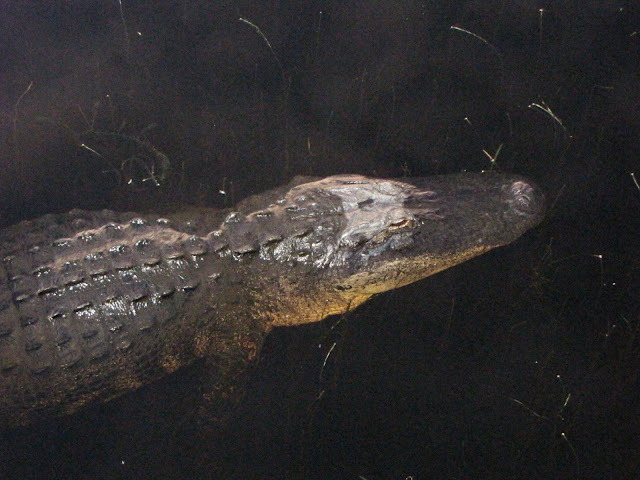
They say that the distance in inches between an alligator's eyes and its nostrils is equal to the length of the whole animal in feet. This behemoth hangs out by the fishing dock in Loxahatchee National Wildlife Refuge feeding on discarded bait fish and who knows what else. My best guess is 14 inches nose to eyes, which would make it not unheard-of big but certainly exciting-to-canoe-past big.
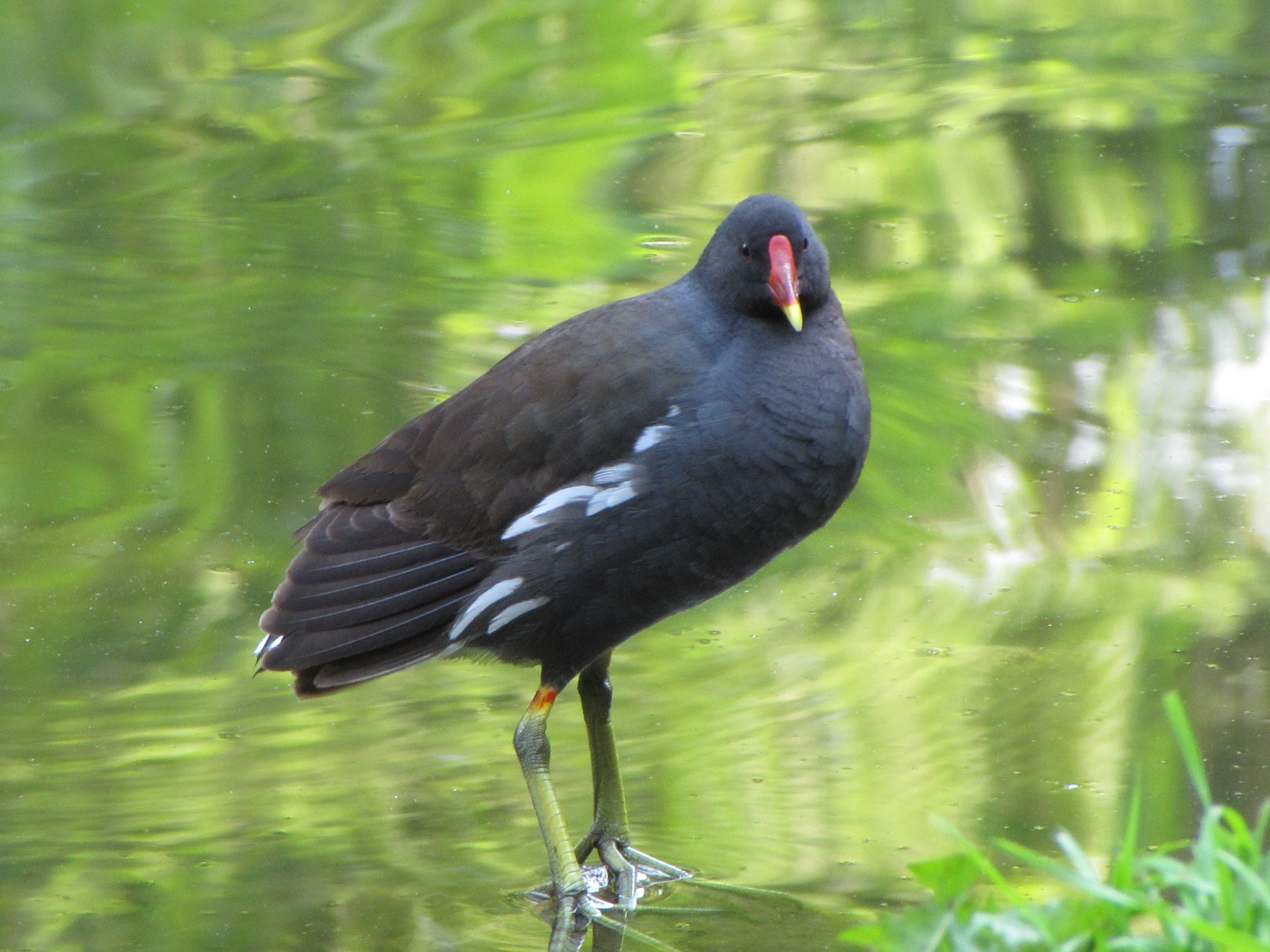
It is amazing to think such an invulnerable top predator (at least within the refuge) started out nearby as a scared little snack for herons like this:
Authorship code
I'm writing a paper with two of my students. Well, I'm writing it with one of them and another one did a lot of work on the statistics. But today we had to straighten out the order that the authors would be listed in on the paper. This can be a contentious issue, and I know of cases in which papers did not getting written at all because the authors couldn't agree on who got to be listed first. Some big multi-author papers simply list everyone in alphabetical order to avoid the fuss, but then Dr. Aardvark always gets to be first author. Some journals have a little section where each author's contribution is described, but they usually end up saying something uninformative and false like "all authors contributed equally."
I came up with most of the ideas in the current paper, put things together, decided who would do what, etc. My student did much of the lab work and is doing much of the actual writing. Given this, most biologists would propose what I did, and what my student objected to: She (as the person doing the writing) should come first, I (as the senior person on the paper) should come last, and everyone else (in this case meaning the statistics student) gets sandwiched in between. This was very counterintuitive for my student; she thought I was trying to minimize my own role by putting myself last. In fact, it is a step up for me to be writing papers in which I am in that last position. I remember this being counterintuitive for me the first time it was explained to me. I was a college student, and a boss said that he'd make me second author on a paper. I said something to the effect that I'd be glad to be even last author, which I thought was being humble, but he took it as me saying the paper had been my idea. We straightened out the miscommunication but I didn't end up being listed as author on the paper. That the last author spot (at least in biology) signifies the senior author is a code biologists internalize, and I had to think back a long way to figure out why my student objected to me being last author. I explained, she reluctantly believed, and now it is settled.