I love Italy. Friendly people, good food, great art, nice weather, etc. But there is something in Italian governance traditions that make me feel okay about not living there. Prime examples are Berlusconi and this, the conviction of six seismologists and a government functionary for failing to predict an earthquake in L'Aquila that killed 309 people in 2009. More exactly, they issued a report that said that it wasn't possible to predict whether or not their would be a major earthquake that year, but estimated the probability as fairly low. The earthquake came, and they are the scapegoats.
Imagine if you will that an Italian man goes to the doctor, and asks if he is going to have a stroke that year. The doctor gives him an exam, some blood tests and a questionnaire, then uses the best available methods to estimate that this man has only a 10% chance of having a heart attack that year. The man goes for a hike, has a heart attack, dies. Should the doctor go to jail for failing to know for sure that the heart attack is coming? Of course not. We don't put people in jail for failing to know things that no one could possibly know. We don't, but apparently the Italian courts do.
Now imagine the Italian government comes to you next week and wants you to produce an expert report on an unpredictable topic for them. Would you be eager to help?
Monday, October 22, 2012


Tuesday, October 16, 2012
Friendly advice for your first grant application, ERC edition
Earlier this year I wrote a fairly long post about the experience and lessons of completing my first NIH grant application (nightmare). While I still haven't heard back if NIH are going to fund me, the good news is that my application has been deemed to at least have the scientific merit for funding (the scientific review board ranked it ahead of almost all of the other applications). Now they have to decide if it makes sense for them administratively to fund it. I should hear some time this month, I hope.
In the mean time I've been applying for more grants (three applications I'm involved in have been submitted in the last three weeks), because what else is there for scientists to do? I've just completed my first grant application to the European Research Council (ERC). I've heard from several people that my NIH post was helpful, so I'm going to offer a few of my thoughts on the ERC process.
Before we start, think about how cool nature is. For example, consider this American Dipper my wife and I saw in Lassen Volcanic National Park a few years ago.
 Now, with that in mind:
1. Don't panic. The ERC process is far less brutal and inhuman than NIH's. Where NIH's instruction booklet is 264 pages and requires numerous supplementary online documents, ERC's is 77 (really only one 40 page section of it was necessary for me, and it is well organized) and requires very little outside information. It took me far less time to complete the ERC Starting grant application than just to figure out how one in theory applies for an NIH grant, despite the fact that I was applying for eight times as much money from ERC, and the funding rate is somewhat better. The whole ERC process, including a lot of reading relevant literature I wasn't previously aware of, took me about three weeks of very hard work. There is a reason so many American academics are in Europe these days. There is no industry of writing ERC grantsmanship advice the way their is for NIH because it just isn't necessary. That said, I'll offer a few bits that may be helpful.
2. The type of grant I applied for, the ERC Starting Grant, is the one most people applying for the first time will apply for. "Starting" in this case means early in your career (at least two and no more than I think seven years since you got your PhD) rather than necessarily your first grant. They also have other grants for people later in their careers. The idea is that a promising early-career scientist applies for money to start a research group at a European university (or other academic host, like a Max Planck Institute). The host is named in the grant and has to provide a letter promising to employ the applicant for at least the duration of the grant (up to 5 years) if that application is funded. It has often been the case that applicants would apply with one host and then upon getting funded used that wad of cash an enticement to get hired somewhere else, but I hear that the ERC is trying to clamp down on that. They retain the right to tell you that you can't take it with you.
2. Try very hard to get a copy of a successful ERC application, the more recent and the closer to your field, the better. While the instructions are pretty clearly written, it is always helpful to look at how a successful application is organized. That said, make sure you follow the latest version of the instruction. A friend of mine who is also applying for an ERC this year thought he was supposed to use the 2012 instructions, because it is 2012. Silly friend! If you write your application in 2012, your application will be reviewed in 2013, so use the 2013 instructions. They don't seem to change too drastically from year to year, but they do change.
3. Be aware that when they say you have to have your PhD for at least 2 years, they mean the date physically written on your diploma has to be at least two years before they publish that year's call for applications. I wasn't eligible to apply last year because while I finished my PhD more than two years before the deadline, the somewhat later date written on my diploma was less than two years before the somewhat earlier date when the call for applications was published. They don't care about your citizenship or residency, but they do care what date is written on your diploma.
4. They review in two rounds. The first time they look at your CV and publications and a five page project description called an 'Extended Synopsis.' (Sort of like an unabridged compact edition). If you make it through the first round, they look instead at a 15 page scientific project description that includes more detail, a methods section and your proposed budget. The five pager really is a compact version of the 15 pager minus the budget, and there is no reason you can't copy and paste almost all of your text from the first into the second.
5. ERC has a list of 25 topic-specific evaluation panels that review these applications. Before you start writing, decide which panel you are aiming it at. When they publish the names of the panel chairs, be sure to look at the recent publications of your panel's chair so you know your audience.
6. You will need the help of an administrator at your proposed host. Find out who that person is and give her at least a month notice that you are applying. Chocolate is not a bad idea.
7. Oh yes, one last thing. The amount of money you can ask for doesn't depend on which country your host is in, but what you can do with that money does. My proposed host is in Denmark, which means I can hire about one third the number of people that I could in Germany with the same budget, and perhaps one tenth as many as in the least expensive EU countries. But apparently they are so focused on the scientific merit of the project and applicant (and to a lesser extent the host) that which country you propose to work in or how relatively expensive it is isn't a big concern for them.
That's about it. The three weeks I gave myself to get this done was clearly too little time, and I'm now exhausted and behind on everything else. My application probably could have used another couple of days of polishing and reading through by friends. But all in all I think the ERC process is quite reasonable.
Good luck and happy grant writing. I'm going to try to remember what papers I was working on before I started writing grants again.
In the mean time I've been applying for more grants (three applications I'm involved in have been submitted in the last three weeks), because what else is there for scientists to do? I've just completed my first grant application to the European Research Council (ERC). I've heard from several people that my NIH post was helpful, so I'm going to offer a few of my thoughts on the ERC process.
Before we start, think about how cool nature is. For example, consider this American Dipper my wife and I saw in Lassen Volcanic National Park a few years ago.

1. Don't panic. The ERC process is far less brutal and inhuman than NIH's. Where NIH's instruction booklet is 264 pages and requires numerous supplementary online documents, ERC's is 77 (really only one 40 page section of it was necessary for me, and it is well organized) and requires very little outside information. It took me far less time to complete the ERC Starting grant application than just to figure out how one in theory applies for an NIH grant, despite the fact that I was applying for eight times as much money from ERC, and the funding rate is somewhat better. The whole ERC process, including a lot of reading relevant literature I wasn't previously aware of, took me about three weeks of very hard work. There is a reason so many American academics are in Europe these days. There is no industry of writing ERC grantsmanship advice the way their is for NIH because it just isn't necessary. That said, I'll offer a few bits that may be helpful.
2. The type of grant I applied for, the ERC Starting Grant, is the one most people applying for the first time will apply for. "Starting" in this case means early in your career (at least two and no more than I think seven years since you got your PhD) rather than necessarily your first grant. They also have other grants for people later in their careers. The idea is that a promising early-career scientist applies for money to start a research group at a European university (or other academic host, like a Max Planck Institute). The host is named in the grant and has to provide a letter promising to employ the applicant for at least the duration of the grant (up to 5 years) if that application is funded. It has often been the case that applicants would apply with one host and then upon getting funded used that wad of cash an enticement to get hired somewhere else, but I hear that the ERC is trying to clamp down on that. They retain the right to tell you that you can't take it with you.
2. Try very hard to get a copy of a successful ERC application, the more recent and the closer to your field, the better. While the instructions are pretty clearly written, it is always helpful to look at how a successful application is organized. That said, make sure you follow the latest version of the instruction. A friend of mine who is also applying for an ERC this year thought he was supposed to use the 2012 instructions, because it is 2012. Silly friend! If you write your application in 2012, your application will be reviewed in 2013, so use the 2013 instructions. They don't seem to change too drastically from year to year, but they do change.
3. Be aware that when they say you have to have your PhD for at least 2 years, they mean the date physically written on your diploma has to be at least two years before they publish that year's call for applications. I wasn't eligible to apply last year because while I finished my PhD more than two years before the deadline, the somewhat later date written on my diploma was less than two years before the somewhat earlier date when the call for applications was published. They don't care about your citizenship or residency, but they do care what date is written on your diploma.
4. They review in two rounds. The first time they look at your CV and publications and a five page project description called an 'Extended Synopsis.' (Sort of like an unabridged compact edition). If you make it through the first round, they look instead at a 15 page scientific project description that includes more detail, a methods section and your proposed budget. The five pager really is a compact version of the 15 pager minus the budget, and there is no reason you can't copy and paste almost all of your text from the first into the second.
5. ERC has a list of 25 topic-specific evaluation panels that review these applications. Before you start writing, decide which panel you are aiming it at. When they publish the names of the panel chairs, be sure to look at the recent publications of your panel's chair so you know your audience.
6. You will need the help of an administrator at your proposed host. Find out who that person is and give her at least a month notice that you are applying. Chocolate is not a bad idea.
7. Oh yes, one last thing. The amount of money you can ask for doesn't depend on which country your host is in, but what you can do with that money does. My proposed host is in Denmark, which means I can hire about one third the number of people that I could in Germany with the same budget, and perhaps one tenth as many as in the least expensive EU countries. But apparently they are so focused on the scientific merit of the project and applicant (and to a lesser extent the host) that which country you propose to work in or how relatively expensive it is isn't a big concern for them.
That's about it. The three weeks I gave myself to get this done was clearly too little time, and I'm now exhausted and behind on everything else. My application probably could have used another couple of days of polishing and reading through by friends. But all in all I think the ERC process is quite reasonable.
Good luck and happy grant writing. I'm going to try to remember what papers I was working on before I started writing grants again.
Monday, October 15, 2012
In which I use some strong words on the topic of a botched editing job
So this big long review article my collaborators and I sent to a very good
scientific journal was sent for one last copy-edit before it was published.
This is normal, most journals have a copy editor look things over right before
typesetting. This particular paper had already been professionally copy edited,
but hey, there is always room for improvement. So we get back the typeset
version from the production editor (who works for the corporate publisher of
the journal and is in charge of turning the accepted paper into a formatted,
typeset publication), and an hour later, we get an email from the scientific
editor (who is a scientist in charge of deciding what gets published and makes
decisions about scientific content) that the copy editor (who works for the production editor and is only supposed
to correct grammar, punctuation and such) is an "aggressive copy
editor" and we should check the paper carefully. So we sit down to read
through the paper and figure out what this means when HOLY SHIT! I notice that
the very first sentence of our paper directly contradict the rest of its
content. And then YOU ARE FUCKING KIDDING ME?! I notice that my coauthor's name
is spelled wrong. Then LET LOOSE THE DOGS OF WAR! I see that the very central
sentence of the paper, the one that defines the really important concept that we
are introducing and talking about, no longer means anything at all. And then,
ARE YOU TRYING TO KILL ME?! I see that a paper written by a very senior
colleague who I've only slightly corresponded with is now attributed to me, as
though I wrote it. To top it off ARE YOU SOME KIND OF IDIOT?! there are now all
sorts of punctuation errors, formatting errors, random characters inserted in
the middles of words. So I think maybe that's the worst of it, and then HOW
HAVE YOU NOT BEEN FIRED YET?! I figure out that the copy editor went through
and sorta tried to rewrite the paper, adding a sentence here, taking out a
clause there, HOW IS THIS POSSIBLE inserting parenthetical phrases with no
closed parenthesis. (I DON'T UNDERSTAND! Oh, and MAKE IT STOP! the names of
the demographic phenomena have been changed to something the copy editor
thought sounded nicer.
So we figure maybe the copy editor was high on crack, and we
write to the production editor, whose job it is to make sure the copy editing
was done right, and we politely explain the problem, and ask that we would like
to make sure that we don't miss any errors that may have been introduced, and
so could we please have the list that he has of the changes that were made, and
he SATAN! SATAN! writes back a one sentence email telling us we just need to
follow the instructions he already sent. Considering I spent more than a year
in total working on this paper, I think I am handling it rather well. DOOM!
DOOM!
I have now written a somewhat less polite email to the
production editor demanding that the pre-vandalized version be used, as we
can't possibly find and mark all of the hundreds of places where the paper was
damaged. My hope is to end up working with a different production editor, one
who is not so BLATTANTLY STUPID unconcerned about the quality of the product.
Wednesday, August 29, 2012
When animals aren't 'animals.'
I know a guy who has fishing licenses in about ten states. He doesn't fish, but he does study salamanders, and according to the fishing regulations in many states, salamanders are fish and you need a fishing license to mess with them. Salamanders are of course not fish, unless you are a hard-core cladist who thinks that all vertebrates are fish. State fishing officials are not generally hard-core cladists, just people who write and enforce regulations and don’t really care if salamanders aren’t fish.
A similar situation arises when it comes to laws governing ethical animal research. If a scientist wants to passively observe a bunch of animals in the wild, she needs to go through all kinds of ethics boards and paper-work to make sure she is complying with these laws. If another scientist wants to slowly dissolve a bunch of live insects in acid, he just needs to buy some acid, because legally, invertebrate animals aren’t ‘animals.’ Animal ethics laws generally don’t apply to them. I say generally because their are particular exceptions. Switzerland and Norway consider lobsters and their relatives to be animals, so you can’t just drop them in boiling water (at least not in a scientific context), you have to kill them humanely. England extends animal protection laws to the Common Octopus, but apparently not to other less common octopuses, so it pays to be common.
For a researcher like myself, who studies invertebrates in the lab, this is a very convenient absurdity. It means that when I want to feed live brine-shrimp to my hydra, I don’t have to ask any committees to review whether the feeding is humane to the brine-shrimp or the hydra. I don’t need to get official approval for the size of container I keep barnacles in.
I approve of laws, regulations, forms and committees that require the ethical treatment of animals in research, and I try hard to follow the principles they are intended to enforce. I am also very glad I don’t personally have to deal with the red tape.
A similar situation arises when it comes to laws governing ethical animal research. If a scientist wants to passively observe a bunch of animals in the wild, she needs to go through all kinds of ethics boards and paper-work to make sure she is complying with these laws. If another scientist wants to slowly dissolve a bunch of live insects in acid, he just needs to buy some acid, because legally, invertebrate animals aren’t ‘animals.’ Animal ethics laws generally don’t apply to them. I say generally because their are particular exceptions. Switzerland and Norway consider lobsters and their relatives to be animals, so you can’t just drop them in boiling water (at least not in a scientific context), you have to kill them humanely. England extends animal protection laws to the Common Octopus, but apparently not to other less common octopuses, so it pays to be common.
For a researcher like myself, who studies invertebrates in the lab, this is a very convenient absurdity. It means that when I want to feed live brine-shrimp to my hydra, I don’t have to ask any committees to review whether the feeding is humane to the brine-shrimp or the hydra. I don’t need to get official approval for the size of container I keep barnacles in.
I approve of laws, regulations, forms and committees that require the ethical treatment of animals in research, and I try hard to follow the principles they are intended to enforce. I am also very glad I don’t personally have to deal with the red tape.
Tuesday, August 21, 2012
Letter to the Committee on Science
Dear Committee on Science, Space and Technology,
I would like to offer you my perspective as an American
scientist currently working oversees. I work with scientists from all over the
world, and frequently encounter the stereotype that Americans are willfully
ignorant and prone to rejecting established scientific facts. Efforts to argue
against this view are made nearly impossible by the frequent counter-factual
statements made by America's political leaders, including those whose jobs
specifically call for some understanding of science, such as those on science
committees. While Rep. Akin has shown himself to be a particularly questionable
choice, his membership demonstrates that no particular knowledge or
understanding of science is expected of committee members. Indeed, it would
appear that a significant number of committee members have repeatedly
demonstrated a strong antipathy towards science.
This is an embarrassment for our great nation, and tarnishes
the reputation of American science and education. I would like to suggest that
our political leaders in general, but members of science-focused committees in
specific, harm the USA when intentionally ignoring, misunderstanding or
inventing scientific facts. This is because good policy can't be based on false
knowledge, but also because our country is made to look like a bunch of fools.
As such, I would suggest that some knowledge of science should be a
prerequisite for membership in a science committee. The dim view that many in
America and around the world currently take of your committee could perhaps be
improved by removing one of your most glaringly ignorant members.
Sincerely,
Dan Levitis
Friday, June 22, 2012
See no seagull
One advantage to living in the tallest building in town is that we
can see who's sneaking around on the roofs of other buildings. That is
in fact part of why our building was built so tall. Back when this was
the German Democratic Republic (East Germany), this building was
occupied mostly by the Stasi (secret police) whose job
it was to keep an eye on everyone all the time and their families.
The building next to ours was the Stasi office building for the state. It has not only been taken over for university use, but there are Herring Gulls nesting on its roof. I spotted two big chicks wandering around yesterday. It is a great place for nesting: high up, with a rim so the chicks won't jump out, and fitted with the finest 1970's surveillance equipment. The roof is even roughly chick-colored, which is probably why until now I have seen no seagull.


The building next to ours was the Stasi office building for the state. It has not only been taken over for university use, but there are Herring Gulls nesting on its roof. I spotted two big chicks wandering around yesterday. It is a great place for nesting: high up, with a rim so the chicks won't jump out, and fitted with the finest 1970's surveillance equipment. The roof is even roughly chick-colored, which is probably why until now I have seen no seagull.


Thursday, June 21, 2012
Acclimatized
15C (59F) is quite cool for summer in New York and a normal summer day in Rostock.
25C (77F) is a normal summer day in New York, and a really hot day in Rostock.
35C (95F) is a really hot day in New York, and hotter than it has ever been measured in Rostock.
45C (113F) is hotter than it has ever been measured in New York and would kill half of Rostock.
As I pack for a trip, I am forced to wonder not only what the weather will be like in New York, but if 35C in New York means the same thing to me now that I have been living in Rostock.
25C (77F) is a normal summer day in New York, and a really hot day in Rostock.
35C (95F) is a really hot day in New York, and hotter than it has ever been measured in Rostock.
45C (113F) is hotter than it has ever been measured in New York and would kill half of Rostock.
As I pack for a trip, I am forced to wonder not only what the weather will be like in New York, but if 35C in New York means the same thing to me now that I have been living in Rostock.
Tuesday, June 19, 2012
Field specific meanings
In demography, the phrase "historical demography" means studying the population processes of human populations of which we have historical records. In population genetics and other subfields of biology, it means trying to estimate past changes in population sizes based on the genetic patterns of current populations.
In demography, fecundity means capacity to produce babies and fertility means realized production of babies. In biology, these meanings are reversed.
In demography, EPC means European Population Conference, the largest yearly demography meeting in Europe. In biology, EPC means Extra-Pair Copulation.
In demography, fecundity means capacity to produce babies and fertility means realized production of babies. In biology, these meanings are reversed.
In demography, EPC means European Population Conference, the largest yearly demography meeting in Europe. In biology, EPC means Extra-Pair Copulation.
Friday, June 15, 2012
Some people
So I was kvetching to a friend the other day, pointing out that I could make far more money and work fewer houes with less training and more job security in a country and state of my choice as a high-school biology teacher, when she was so rude as to ask me why I didn't do so. As though that was a realistic option!
Wednesday, June 13, 2012
Brusca and Brusca
My family is genetically Jewish and exercise the occasional fancy that we are in some important way culturally Jewish as well. We like bagels and go to relatives' houses for Matzo Ball Soup on Passover. We didn't have bar and bat mitzvohs or learn any Hebrew, but we learned enough Yiddish to insult each other and had large 13th birthday parties. When my 13th birthday party was approaching, people started asking my parents what they should get me, and my parents started asking me. I already had most every material object I wanted, and so I told them I wanted books about animals. I had decided several years earlier that I was going to be a zoologist, and I thought it would be nice to have some grown-up books about zoology. Well little did I know that I was going to get books like this:

Invertebrates, but Brusca and Brusca. And not the Second Edition (2003) with the nice color photos. Oh no, this was line drawings and black and white plates of everything from ciliates and amoebae to sea-squirts and squid. This was lists of the sub-classes within the classes within the sub-phyla within each Phylum. This was extended discussion of the bauplan concept, and pre-molecular phylogenetics. This was 1990.
I was simultaneously thrilled and offended. Why would anyone give a book like this to a 13 year old? Ridiculous! How could tardigrades possibly survive exposure to raw vacuum? Ridiculous!
Someone (I'm sure it came with a card, but I have no memory of who gave it to me.) had spent a fair chunk of money to give me a book that is really intended as a reference for invertebrate zoologists.
Now, let's skip forward 22 years and a few weeks, and we find me at my desk reading the Brusca and Brusca chapter on Phylum Porifera (sponges) as I prepare to write the outlines of a research proposal focusing on this group that I have no knowledge of. Of course the taxonomy has been changed 22 times since then as more and more molecular data have become available, but mostly it has changed back and forth, so Brusca and Brusca are still pretty much right. Most of the rest of the detail they give is still approximately true, and despite being a formulaic listing of facts, the writing is not too painful. Really very useful.
So whoever gave me the book, you probably never got a thank you card, and you probably don't read my blog, but thank you. This is turning out to be one of the most useful presents I've ever gotten.
Invertebrates, but Brusca and Brusca. And not the Second Edition (2003) with the nice color photos. Oh no, this was line drawings and black and white plates of everything from ciliates and amoebae to sea-squirts and squid. This was lists of the sub-classes within the classes within the sub-phyla within each Phylum. This was extended discussion of the bauplan concept, and pre-molecular phylogenetics. This was 1990.
I was simultaneously thrilled and offended. Why would anyone give a book like this to a 13 year old? Ridiculous! How could tardigrades possibly survive exposure to raw vacuum? Ridiculous!
Someone (I'm sure it came with a card, but I have no memory of who gave it to me.) had spent a fair chunk of money to give me a book that is really intended as a reference for invertebrate zoologists.
Now, let's skip forward 22 years and a few weeks, and we find me at my desk reading the Brusca and Brusca chapter on Phylum Porifera (sponges) as I prepare to write the outlines of a research proposal focusing on this group that I have no knowledge of. Of course the taxonomy has been changed 22 times since then as more and more molecular data have become available, but mostly it has changed back and forth, so Brusca and Brusca are still pretty much right. Most of the rest of the detail they give is still approximately true, and despite being a formulaic listing of facts, the writing is not too painful. Really very useful.
So whoever gave me the book, you probably never got a thank you card, and you probably don't read my blog, but thank you. This is turning out to be one of the most useful presents I've ever gotten.
Monday, June 11, 2012
Brave=Denotation(Foolish)-Connotation(Foolish)*2
When colleagues started telling me that what I was doing was brave, I knew I was in trouble. People tell you are brave as you march off to war, or volunteer to babysit multiple toddlers around bedtime, or (it seems), when you undertake the organizing of a new scientific society. They mean, "Man, you're going to end up unemployed, but I'm sure glad you are doing it instead of me."
I waited until they had a few drinks in them and had mostly finished going back for seconds on the salmon, then commandeered one of the cocktail tables as a podium. I proposed the formation of an society and then opened the floor for discussion.
The good news is that we now have about 50 members including many of the big names in the field. The bad news is that everyone seems to think I have an actual plan. How will we fund the first meeting? What kind of official and financial structure should we have? Will we take over that other, mostly defunct but somewhat related society for the benefit of their infrastructure and their resources, or will we start fresh? Do we need to incorporate? I don't know any of these things.
So here is what I am doing. I'm organizing the election of a board, and I'm making sure there are people who know what they are doing standing for election. I'm communicating with the people who will organize the first meeting next year. I want the society to exist, and I'm happy to help, but I certainly don't plan to run the thing by myself. That would be a little bit too brave.
I waited until they had a few drinks in them and had mostly finished going back for seconds on the salmon, then commandeered one of the cocktail tables as a podium. I proposed the formation of an society and then opened the floor for discussion.
The good news is that we now have about 50 members including many of the big names in the field. The bad news is that everyone seems to think I have an actual plan. How will we fund the first meeting? What kind of official and financial structure should we have? Will we take over that other, mostly defunct but somewhat related society for the benefit of their infrastructure and their resources, or will we start fresh? Do we need to incorporate? I don't know any of these things.
So here is what I am doing. I'm organizing the election of a board, and I'm making sure there are people who know what they are doing standing for election. I'm communicating with the people who will organize the first meeting next year. I want the society to exist, and I'm happy to help, but I certainly don't plan to run the thing by myself. That would be a little bit too brave.
Sleeze of sponges
The term of venery for sponges: a sleeze.
Example: The vessel must have rested there many years, as it was more than half covered in a sleeze of the most enormous sponges.
Example: The vessel must have rested there many years, as it was more than half covered in a sleeze of the most enormous sponges.
The dangers of autocorrect
I sat down to write a quick email at a computer I don't usually use. Autocorrect was not turned off because I don't usually use that computer. In an email to a senior colleague I tried to write, "I completely understand" but got out "I completely undrestand." Autocorrect changed it to, "I am completely undressed." I am happy that I proofread my emails.
Thursday, April 19, 2012
Egg-maculate conception
I've long said that if I was a benevolent deity the first thing I would do was give penguins the ability to produce live offspring at sea, the way whales and otters do. My opinion has been that all birds lay eggs that need to be kept warm and be exposed to air, and no bird can give live birth, and therefore it would require the intercession of a god to produce a bird that could develop its eggs either internally or under (cold) water.
Well, that may still be true, but consider the following from the BBC today:
Now before all you penguins trade in your carefully maintained rock scrapes and hole-nests for shrines to the fertility god, keep in mind the following:
1. The mother died, probably quite painfully, and therefore is not around to feed the chick.
2. It would be hard for a trait like that to spread through a population, as each mother could produce only one offspring, and sexually reproducing mothers need to produce at least two adult offspring to reach replacement.
3. It probably isn't true anyway.
Still, it is an interesting story. If a group of birds could for some other reason first evolve to have un-calcified eggs, then it seems more likely that live birth would have a chance of evolving.
Well, that may still be true, but consider the following from the BBC today:
Let's assume for a moment that this is true, and neither a prank nor a misunderstanding. What seems to have happened is that the egg was retained inside the mother's reproductive tract. This (technically called dystocia) happens occasionally, especially to older hens. The egg just gets stuck, and usually eventually breaks and comes out in pieces, which can often kill the mother, and which also smells terrible, as the egg is usually quite rotten. But in this case it appears that the retained egg developed successfully, and the mother wasn't killed until the chick was viable. So assuming this is true, it is the first example of live birth in a bird I can find.'Eggless' chick laid by hen in Sri Lanka
Instead of passing out of the hen's body and being incubated outside, the egg was incubated in the hen for 21 days and then hatched inside the hen.
The chick is fully formed and healthy, although the mother has died.
Now before all you penguins trade in your carefully maintained rock scrapes and hole-nests for shrines to the fertility god, keep in mind the following:
1. The mother died, probably quite painfully, and therefore is not around to feed the chick.
2. It would be hard for a trait like that to spread through a population, as each mother could produce only one offspring, and sexually reproducing mothers need to produce at least two adult offspring to reach replacement.
3. It probably isn't true anyway.
Still, it is an interesting story. If a group of birds could for some other reason first evolve to have un-calcified eggs, then it seems more likely that live birth would have a chance of evolving.
Tuesday, April 03, 2012
Accepted, but...
We have set ourselves a difficult task. Some months ago, my friends and I submitted a review article, clarifying some common (within the scientific literature) misconceptions, to a very good anthropology journal. Today we heard back from them. The editor explained that it took longer than usual because he had sent it out to "several" reviewers, and then "several more" and was waiting to get comments from all of them.
The good news is that all the reviewers seemed to like it, and the editor knows which issue of the journal he wants to put it in, which we take as the paper being accepted. The bad news (or at least time-consuming news) is that all of the several and several reviewers made long lists of things they would like to see changed, added, clarified or reorganized. I have not yet finished reading all these comments, but I don't see a lot of repetition, meaning that we have hundreds of distinct comments and criticisms to deal with. In the months we were waiting, we also showed the draft to a couple of colleagues, who gave us still different but also very useful comments. The good news is that the editor has given us permission to go well beyond the usual page limit for this journal in order to deal with all the reviewer comments. The bad news is that we now can't use space limitations as an excuse for not dealing with relevant points or citing relevant literature. So we have a great deal of rewriting to do.
Part of the problem with writing an article pointing out places where other people's thinking or language has been unclear is that one has to live up to very high standards for clarity in one's thinking and language. We've already extensively rewritten this paper a few times, and each time it has gotten clearer. Nevertheless, a large portion of the reviewers' comments are right on, and further clarification is needed. By the time this thing comes out it will either be brilliant or a total muddle. I'm not clear which.
The good news is that all the reviewers seemed to like it, and the editor knows which issue of the journal he wants to put it in, which we take as the paper being accepted. The bad news (or at least time-consuming news) is that all of the several and several reviewers made long lists of things they would like to see changed, added, clarified or reorganized. I have not yet finished reading all these comments, but I don't see a lot of repetition, meaning that we have hundreds of distinct comments and criticisms to deal with. In the months we were waiting, we also showed the draft to a couple of colleagues, who gave us still different but also very useful comments. The good news is that the editor has given us permission to go well beyond the usual page limit for this journal in order to deal with all the reviewer comments. The bad news is that we now can't use space limitations as an excuse for not dealing with relevant points or citing relevant literature. So we have a great deal of rewriting to do.
Part of the problem with writing an article pointing out places where other people's thinking or language has been unclear is that one has to live up to very high standards for clarity in one's thinking and language. We've already extensively rewritten this paper a few times, and each time it has gotten clearer. Nevertheless, a large portion of the reviewers' comments are right on, and further clarification is needed. By the time this thing comes out it will either be brilliant or a total muddle. I'm not clear which.
Thursday, March 22, 2012
Conference Spam
I get several emails a week like this:
Most of the "congresses" are in China or India and they are all on topics that have are totally unrelated to my work. I think most but not all of these conferences are intended as actual events, but the point of all of them is to collect registration fees.The organizing committee is pleased to announce that the 2nd Annual World Congress of Nano-S&T (Nano S&T-2012), which will be held from October 26 to 28, 2012 in Qingdao, China. The congress will consist of 12 streamlines covering topics including: Nanosciences and Technologies, Nanomaterials, Analytical tools for Nanotech, Nano-electronics, Nano IT, Nanocoating, etc. This conference will bring together over 1000 experts and specialists from all over the world.Based upon your contribution to the field of Nanotechnology, we invite you to give an oral presentation at Section 4-4: Etching Process about your recent work. Certainly, you can look through the program and select a session at your priority. We will be honored if you can deliver a speech during this event. Your involvement in this congress will be invaluable for the development of the program.The full program with speakers’ profile and presentation’s titles will be released at the conference website in a few weeks so that you can know what specific subjects will be covered by the other speakers. You may log on: http://www.bitconferences.com/nano2012/program.asp.I am pleased to send you a conference brochure about Nano-S&T2011 in the attachment.We would be honored if you could attend the Nano S&T-2012 Conference.I will appreciate it if you could forward this invitation letter to the experts who may be interested in us.Sincerely yours,Ms. Selina
Friday, March 16, 2012
Wednesday, March 14, 2012
Friendly advice for your first NIH grant application
I've just submitted my first National Institutes of Health
grant application (or rather administrators at my collaborator's university
have submitted an application that I wrote most of). In preparing to write it,
I read a lot of online advice ranging from the general 'how to write an NIH
grant' to the specific 'the clause-structure I use while writing my cover
letter for maximizing the chances that it will be sent to my preferred review
committee.' People who regularly apply for NIH money refer to NIH funded
research as an industry, and like any industry, there is a lot to know to
compete successfully. NIH pays or invites some people to write advice on 'good
grantsmanship' and many others, for a variety of reasons (perhaps on their blogs)
write advice essays. Most of this advice starts with a paragraph or two along
the lines of, "I've been conducting NIH funded research since 1982, and am
currently involved in seven NIH funded projects, four as PI (Primary
Investigator). I've served on 12 review panels and helped to amend the rules on permissible administrative expenditures on research grants in 2002 and again in 2006." And so on. The
message is, "I am an expert on NIH funding applications and therefore
qualified to advise you." While these people certainly are qualified and
anyone planning to apply should read as much of their advice as
bearable, there are two points I would like to make about this that they may
not have considered. The first is that the way they write their advice,
including the way they lay out their qualifications, reads very much like an
NIH application. It makes me wonder if becoming expert in these applications
makes it hard to write a love letter that isn't in the form of a funding
application."Specific Aim 2: Produce a rapid natural release of endorphins, aiding current pleasure, speeding forgetfulness of discomfort and fomenting pair-bonding."
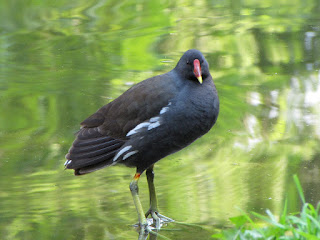 Can you see how long its toes are? Fricken' long. Imagine soaking your extra-long toes in a nice summer pond.
Second, and more seriously, I have the impression that none
of these people nor the people writing the instruction books or the FAQs on the
NIH websites have any memory of what it is like to not already know how to
apply for NIH funding. The instruction book is full of rules that are explained
not in terms of what you have to do, but in terms of how what you have to do is
different than what it was before the changes to regulation #SF5326BB777. They
use all sorts of words that are normal English words but don't mean what they
normally mean, without explaining, because however NIH usually uses a word is
its normal meaning to them. (This, by the way, is very close to the technical definition of jargon).
So I'd like to offer a few pieces of advice to people
considering applying for their first NIH grant. I am not an expert, have never
served on (or been invited to serve on) a review panel and may or may not ever
have any NIH funding, but when I was a kid my dad worked just a few blocks from
NIH headquarters, and I once spilled an incredibly powerful neurotoxin on
myself inside an NIH laboratory. Before I start, consider this unrelated photo (of a 2.5 inch long weevil I once found in my hair) that helps to break up the text:
 Notice that its sharp mouth parts are at the end of its huge nose. Cool huh?
Okay, here goes:

Okay, here goes:
1. Before doing anything else, ask yourself if you can spare
the two or three hundred working hours your first NIH application is likely to take
you. If you can't, don't. Subsequent applications may take an order of
magnitude less time, but this is going to be a slog.
2. Before doing anything second else, find colleagues who
know all about applying for NIH grants and buy them beer, chocolate, whatever
it takes. Wash their cars, baby-sit their kids, fix their refrigerators, do
their laundry. This will save you so much time. If you are very lucky your
department/institute/whatever may even have someone whose job includes guiding
you through the process. If so, flowers and a gift-certificate to a nearby spa are in order. If you can by any means
obtain copies of past successful grants to use as Rosetta Stones in figuring
out what the instructions mean, then you have some chance of retaining your
sanity.
3. Next, find out who is your SO (Signing Officer, an administrator
officially authorized to sign legal documents on behalf of your organization). You don't submit the grant, the SO does. She also has to do various other registration tasks, meaning that
they need to know that you will apply several weeks before you actually do. If you just found out that the deadline is in three weeks, relax. There will be another deadline some months in the future, and by then you may have found some other way to fund your work. The SO
will need all the forms you are to prepare at least a week before the official
due date, as there are a whole bunch of other forms they have to fill out seperately.
4. Don't panic. Download the 264 page instruction book
(a.k.a. "SF424 (R&R)
Application Guide for NIH and Other PHS Agencies").
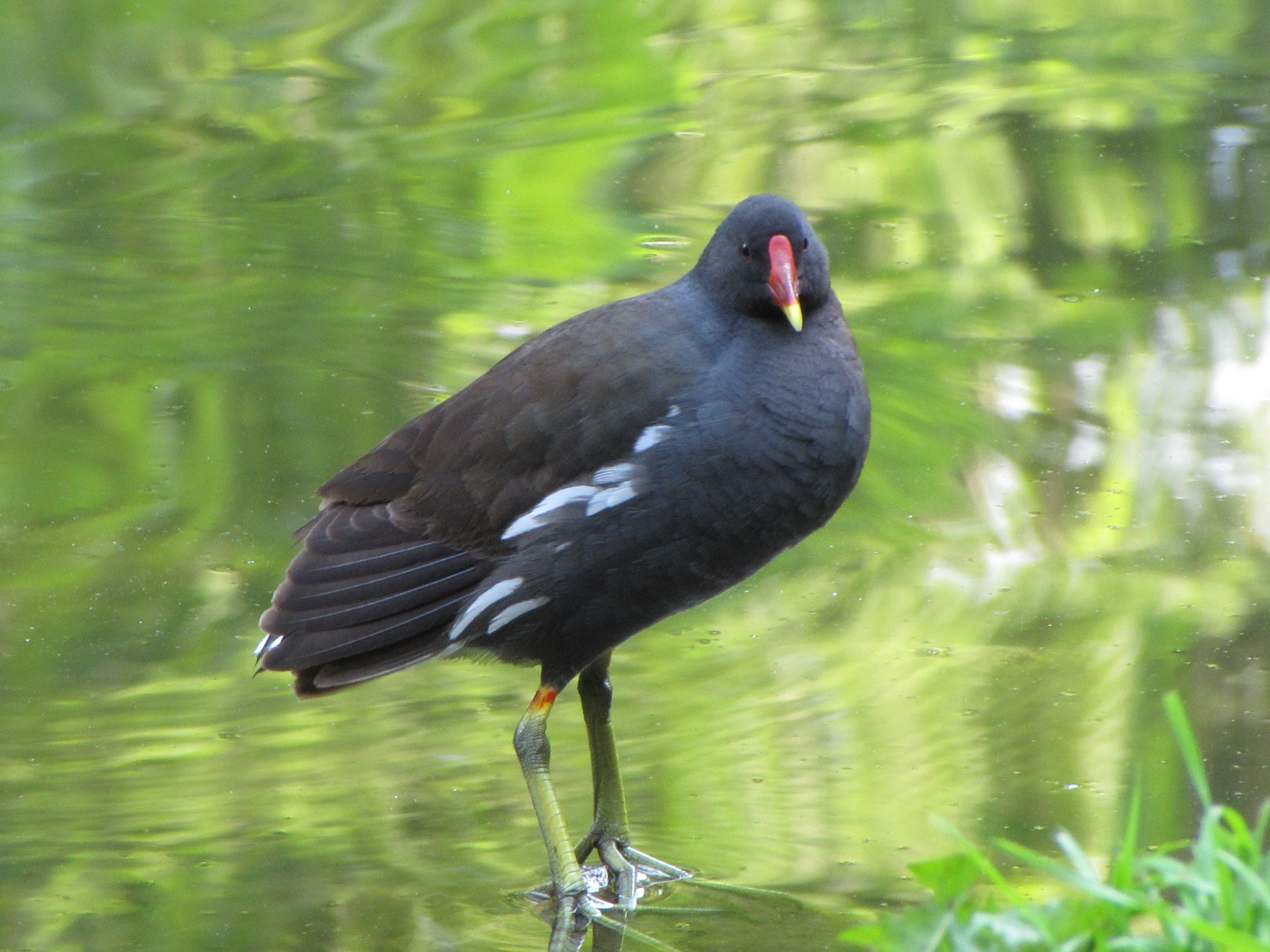
Here is a picture of a moorhen to help you not panic as you download:
5. Do not print out the instruction book. It is 264 pages. You
will need to constantly jump from section to section to hunt down the clues and riddles needed to fill out each of the approximately 30 forms
you will complete. Keep it digital so you can search for relevant terms.
6. Do print out this glossary of NIH terms. Then read it. Then read it again to
see if you understand it any better. Keep in mind that while necessary, this
glossary is wildly incomplete, because NIH people can't guess what terms non-NIH
people won't understand. Also keep in mind that when they use a term to define
itself, they mean well.
7. The National Institutes of Health are called
"Institutes" because they have quite a few different topic-specific
Institutes, plus a bunch of Centers and several Divisions. You are supposed to
know which of these is most likely to be interested in funding your work,
contact the appropriate PO (program officer) and pitch it to them before then
writing in your cover letter than you contacted that PO and she encouraged you
to apply to that Institute, Center or Division. There are very detailed
guidelines you should follow in writing to that PO. You are
supposed to already know which PO within the appropriate branch is the
appropriate PO. The only way I found of finding this out was to spend
countless hours on the NIH web pages learning about
the structure of NIH, then countless more hours reading those pages before
making a wild (and wrong) guess. Luckily the person I wrote to (who wasn't even
at the Institute I thought she was at) directed me to another person, who told
me that I was heading the wrong way. Eventually I made a decision.
8. Go through the instruction book and make a list of all
the forms and attachments you will need. Depending on the specifics, there
could be anywhere from 15 to infinity of them. On your list, make notes as to
the purpose of each form and what is an attachment to which extension to which
sub-form. Also note which parts you have to do and which parts the SO has to do, and then confirm this with the SO. Then look at these pieces in the pile of example applications you've
gathered.
9. Don't plan any vacations for before the due date. Plan a
vacation for after the due date.
10. You may notice that I have not yet mentioned anything
about science. At least once a week, think about the scientific goal of your
application. It is very easy to lose track of the fact that there is some reason you are putting yourself through this.
Monday, March 12, 2012
Evolutionary biology vs. evolved biology
Once, during a medical exam, the doctor asked me what I did. I said I was an evolutionary biologist, to which he replied, "oh, so not a creation biologist?" His tone of voice made it clear he thought it was funny that I had to specify evolutionary, as though a biologist in Berkeley could possibly not believe in evolution. Considering where his hands were at the time, I didn't stop to explain to him what the term "evolutionary biologist" means. Every biologist knows, or should, that Theodosius Dobzhansky wrote, "Nothing in biology makes sense except in the light of evolution." The vast majority of biologists, of all disciplines not only know about evolution, but accept it as a necessary part of any complete explanation for the things they study. But a large portion of biologists don't regularly think about evolution; it is not the part of the explanation they are interested in. A large (and I think increasing) proportion of biologists study the interactions of atoms, molecules, organelles, genes, cells, etc. And while they may connect their work to evolution in some way, they are not basically asking questions about evolution, but about the details of the proximate mechanisms which make organisms work. That these mechanisms are the result of evolution is often not particularly relevant to the present question.
An example: A couple of years ago I attended a workshop on bioinformatics in aging research. There was a dinner the night before the talks started, and the bioinformaticist organizing the workshop asked me about my training and research. I said, "well I study the evolution of demographic patterns, particularly how constraints on natural selection lead observed demographic patterns to differ from the predictions of evolutionary theory." He replied, "Oh, but you are also trained in biology?" What he meant by this, I discovered, was that I also had some training in the molecular nuts and bolts that to him are biology. Evolution is a process that shapes biology, but in his view, and I think the view of many of the people there, does not in itself count as biology. Asking him if he ever incorporated evolution into his work, he explained that he had, comparing how networks of gene interactions differed between fruit fly and nematode. Fair enough, comparative biology is surely the study of evolution, but his approach to it required no technique or concept from evolutionary theory. He produces good and useful science, and gives no more daily thought to evolution than I give to promoter regions. I am certain that he would not be offended to be described as a good biologist who believes in evolution, but is not an evolutionary biologist.
A definition from wikipedia: "Evolutionary biology is a sub-field of biology concerned with the study of the evolutionary processes that have given rise to the diversity of life." This is somewhat too narrow in my view, but it is close enough given that it is past my bedtime.
This has all come to mind because of the post I wrote yesterday, about weeds evolving resistance to Monsanto's best-selling herbicide, and the failure of Monsanto's biologists to predict this. A good friend of mine, who is deeply knowledgeable about matters environmental and agricultural, responded by asking how Monsanto's biologists could have failed to predict the apparently obvious facts I was pointing out unless they were A, Tools; B, Fools; or C, having their results manipulated by suits. This is a reasonable and interesting question, and I'll venture an answer. My guess is that they were neither A nor B, and that C went on but was not a major factor. Monsanto did have an enormous financial stake in convincing regulators that weeds would not evolve resistance to Roundup, but they also had an enormous stake in having weeds actually not evolve resistance to Roundup. So my guess is they honestly thought it was a highly unlikely outcome.
Why did they think so, despite being smart, honest biologists? Because they weren't trained in, or primarily thinking about, evolution as it occurs in nature. They were plant geneticist and bioengineers, spending many years and countless millions of dollars to unravel the finest details of how Roundup kills plants and how to build a crop that will have resistance to it (without passing that resistance on to its offspring). That was an enormous challenge, and their success was unprecedented. They had achieved what many, even within their own company, must have thought was an impossible SciFi dream.
Surely someone was assigned to think deeply about the problem of whether weeds would evolve resistance, but surely that someone had been involved in the project for years, and was so wrapped up in the grotesque details of the genetic magic they had just achieved that no perspective was possible. In other words, they couldn't see the field for the soybeans. A person highly trained in artificial selection, and used to that way of thinking, will think of the evolution of weed resistance in those terms, despite the fact that natural selection has inherent advantages.
In hindsight, their logical errors are obvious, probably even to them. In foresight, reasonable and well intentioned people frequently fail to think of highly relevant and potentially obvious things. This is particularly likely if those things require a perspective they don't possess, doubly particularly if they are thinking deeply about the problem from a very different perspective. Monsanto had many biologists who knew about evolution, used a particular type of evolution as a tool, and thought about evolution. But my guess is they didn't have any evolutionary biologists.
An example: A couple of years ago I attended a workshop on bioinformatics in aging research. There was a dinner the night before the talks started, and the bioinformaticist organizing the workshop asked me about my training and research. I said, "well I study the evolution of demographic patterns, particularly how constraints on natural selection lead observed demographic patterns to differ from the predictions of evolutionary theory." He replied, "Oh, but you are also trained in biology?" What he meant by this, I discovered, was that I also had some training in the molecular nuts and bolts that to him are biology. Evolution is a process that shapes biology, but in his view, and I think the view of many of the people there, does not in itself count as biology. Asking him if he ever incorporated evolution into his work, he explained that he had, comparing how networks of gene interactions differed between fruit fly and nematode. Fair enough, comparative biology is surely the study of evolution, but his approach to it required no technique or concept from evolutionary theory. He produces good and useful science, and gives no more daily thought to evolution than I give to promoter regions. I am certain that he would not be offended to be described as a good biologist who believes in evolution, but is not an evolutionary biologist.
A definition from wikipedia: "Evolutionary biology is a sub-field of biology concerned with the study of the evolutionary processes that have given rise to the diversity of life." This is somewhat too narrow in my view, but it is close enough given that it is past my bedtime.
This has all come to mind because of the post I wrote yesterday, about weeds evolving resistance to Monsanto's best-selling herbicide, and the failure of Monsanto's biologists to predict this. A good friend of mine, who is deeply knowledgeable about matters environmental and agricultural, responded by asking how Monsanto's biologists could have failed to predict the apparently obvious facts I was pointing out unless they were A, Tools; B, Fools; or C, having their results manipulated by suits. This is a reasonable and interesting question, and I'll venture an answer. My guess is that they were neither A nor B, and that C went on but was not a major factor. Monsanto did have an enormous financial stake in convincing regulators that weeds would not evolve resistance to Roundup, but they also had an enormous stake in having weeds actually not evolve resistance to Roundup. So my guess is they honestly thought it was a highly unlikely outcome.
Why did they think so, despite being smart, honest biologists? Because they weren't trained in, or primarily thinking about, evolution as it occurs in nature. They were plant geneticist and bioengineers, spending many years and countless millions of dollars to unravel the finest details of how Roundup kills plants and how to build a crop that will have resistance to it (without passing that resistance on to its offspring). That was an enormous challenge, and their success was unprecedented. They had achieved what many, even within their own company, must have thought was an impossible SciFi dream.
Surely someone was assigned to think deeply about the problem of whether weeds would evolve resistance, but surely that someone had been involved in the project for years, and was so wrapped up in the grotesque details of the genetic magic they had just achieved that no perspective was possible. In other words, they couldn't see the field for the soybeans. A person highly trained in artificial selection, and used to that way of thinking, will think of the evolution of weed resistance in those terms, despite the fact that natural selection has inherent advantages.
In hindsight, their logical errors are obvious, probably even to them. In foresight, reasonable and well intentioned people frequently fail to think of highly relevant and potentially obvious things. This is particularly likely if those things require a perspective they don't possess, doubly particularly if they are thinking deeply about the problem from a very different perspective. Monsanto had many biologists who knew about evolution, used a particular type of evolution as a tool, and thought about evolution. But my guess is they didn't have any evolutionary biologists.
Sunday, March 11, 2012
Evolution infringes upon Monsanto's patent
NPR has a useful story today by a guy who interviewed people who were involved in Monsanto's application for release, in 1993, of "Roundup Ready" crops, that is crops that are genetically engineered to be resistant to Monsanto's best selling herbicide, glyphosate, sold as Roundup. The idea, which has made Monsanto many billions of dollars, is that if the crops are immune to the herbicide, and weeds are not, fields can be sprayed liberally. Farmers don't have to do mechanical weeding, and Monsanto gets to sell them both the patented herbicide and the patented resistant seed. This set of facts, along with Monsanto acting like the faceless corporate giant that it is in defending its patents, has made it probably the most despised company among the organic farming crowd, vilified far more than competitors like ADM or DuPont.
The point of the article is that Monsanto falsely rejected the possibility that carpeting the world in Roundup would lead to the evolution of Roundup resistant weeds.
Then the story, written by Daniel Charles, continues like so:
Engineers at Monsanto were surely aware of natural selection and its proclivity to producing resistant pests, but they considered the idea that there would be even a hint of heritable resistance in the weed populations to be highly unlikely. This is because they failed to consider the following facts:
A. They were testing thousands of highly targeted potential genetic alterations in the lab, on a few crop species, and found that almost none of them conferred significant resistance. They didn't consider that after global distribution of their crops, trillions of genetically distinct (although totally untargetted) genetic modifications (that is, natural mutations) in thousands of weed species would be tested for their resistance. When something potentially useful did pop up, Monsanto was again able to test hundreds or maybe thousands of slight modifications on that, while natural selection could within a few years test millions of potential modifications iteratively over several generations. So they didn't consider that nature's search for solutions would be far more exhaustive than theirs.
B. I'm sure engineers have a term for closely examining one type of failure risk while completely ignoring others. That's what Monsanto did. They were look hard at making plant tissue resistant. From the same story:
C. They assumed that because Roundup had been used broadly for several years already, and there were no known resistant weeds, weed populations simply had no resistance traits available for natural selection to favor. They failed to consider that with the introduction of their crops, and the resulting increase in usage, both the population size of the exposed weeds and the force of selection for resistance would increase dramatically.
The force of selection is a measure biologists use to ask the question, how much difference does a heritable change of a certain size in a trait (for example a 0.1% increase the probability of surviving a spraying with Roundup) make to the fitness of the individuals with that altered trait. So long as most individuals in a weed population were never exposed to Roundup, the force of selection for resistance to it was small. Resistance doesn't help much if you are never exposed. The seeds blowing into farmers fields were coming from unexposed sub-populations, and so were not resistant. When we started blanketing the world in Roundup, the force of selection increased, because most every weed subpopulation over huge areas was exposed. So their experience up to that point led them to underestimated the force of selection for resistance. And if there is one thing that evil empires should know, it is to never underestimate the force.
The point of the article is that Monsanto falsely rejected the possibility that carpeting the world in Roundup would lead to the evolution of Roundup resistant weeds.
Then the story, written by Daniel Charles, continues like so:
Oops. Since then, resistance to glyphosate has emerged in 20 different weed species.In case the holes in their logic haven't struck you, allow me to provide a quick lesson in how natural selection (or in this case semi-natural selection), as opposed to genetic engineering, works.
I called up several people who were at Monsanto at that time. Why didn't people there think resistance would happen? They all told a similar story.
First, the company had been selling Roundup for years without any problems. Second, and perhaps most important, the company's scientists had just spent more than a decade, and many millions of dollars, trying to create the Roundup-resistant plants that they desperately wanted — soybeans and cotton and corn. It had been incredibly difficult. When I interviewed former Monsanto scientists for my book on biotech crops, one of them called it the company's "Manhattan Project."
Considering how hard it had been to create those crops, "the thinking was, it would be really difficult for weeds to become tolerant" to Roundup, says Rick Cole, who is now responsible for Monsanto's efforts to deal with the problem of resistant weeds.
Engineers at Monsanto were surely aware of natural selection and its proclivity to producing resistant pests, but they considered the idea that there would be even a hint of heritable resistance in the weed populations to be highly unlikely. This is because they failed to consider the following facts:
A. They were testing thousands of highly targeted potential genetic alterations in the lab, on a few crop species, and found that almost none of them conferred significant resistance. They didn't consider that after global distribution of their crops, trillions of genetically distinct (although totally untargetted) genetic modifications (that is, natural mutations) in thousands of weed species would be tested for their resistance. When something potentially useful did pop up, Monsanto was again able to test hundreds or maybe thousands of slight modifications on that, while natural selection could within a few years test millions of potential modifications iteratively over several generations. So they didn't consider that nature's search for solutions would be far more exhaustive than theirs.
B. I'm sure engineers have a term for closely examining one type of failure risk while completely ignoring others. That's what Monsanto did. They were look hard at making plant tissue resistant. From the same story:
Some weeds, Cole says, appear to keep glyphosate from entering the plant at all; others sequester the herbicide in a spot where it can't do much damage. Monsanto's genetically engineered crops use a different technique entirely.So they didn't consider the possibility that some plants would simply shield their vital tissues from the toxin, the way many metal resistant plants do.
C. They assumed that because Roundup had been used broadly for several years already, and there were no known resistant weeds, weed populations simply had no resistance traits available for natural selection to favor. They failed to consider that with the introduction of their crops, and the resulting increase in usage, both the population size of the exposed weeds and the force of selection for resistance would increase dramatically.
The force of selection is a measure biologists use to ask the question, how much difference does a heritable change of a certain size in a trait (for example a 0.1% increase the probability of surviving a spraying with Roundup) make to the fitness of the individuals with that altered trait. So long as most individuals in a weed population were never exposed to Roundup, the force of selection for resistance to it was small. Resistance doesn't help much if you are never exposed. The seeds blowing into farmers fields were coming from unexposed sub-populations, and so were not resistant. When we started blanketing the world in Roundup, the force of selection increased, because most every weed subpopulation over huge areas was exposed. So their experience up to that point led them to underestimated the force of selection for resistance. And if there is one thing that evil empires should know, it is to never underestimate the force.
Subscribe to:
Posts (Atom)
