Hungry buzz heralds spring
Watchful grin, floating.
Smack
Bloody bugs
Showing posts with label Rostock. Show all posts
Showing posts with label Rostock. Show all posts
Friday, March 16, 2012


Sunday, February 26, 2012
Camels (and alpacas and equids)
There are camels, at least seven of them, in one of the
vacant lots adjacent to the Institute. These (the lots, not the camels) are generally
dominated by garbage-bespangled weeds and scrubby little trees. Today there is
a circus truck, a tent with camel stalls, and a bunch of camels happily chomping
the weeds down to the ground. I've seen goats, sheep and even cows used to clear brush, but the camels seem to be eating through the weeds faster than any of these could. The garbage has been removed (hopefully before the camels were let in), and there is a man
who looks more like a circus worker than a government worker cutting and
hauling away the woody stuff the camels pass by (actually just throwing it into another one of the vacant lots). It seems like by tomorrow evening they will have to move them to another lot, or bring in fodder. I wonder if the circus is paying for, or being paid for, the use of the lot. Seems like a good deal for both parties.
It
is 6C (43F) and sunny, which means that Rostockers think it is summer, and are
walking around, admiring the camels. Some college kids have carried their couch
onto the waterfront and are setting up a barbeque. The ice on the harbor has all melted, and the
gulls and mallards are looking for handouts.
Given all this, you might rightly ask why I am in the lab on
a Sunday, instead of showing my daughter the camels, or walking with my wife, considering that I have excellent
student assistants who are doing all of the actual lab work. The answer is that
student assistants are not allowed to be in the lab by themselves, regardless
of how mature or well trained they might be, or how routine or undangerous the
work. So if the animals need to be checked every day, someone has to be here
every day to baby-sit whichever student is in that day. This situation has
actually gotten somewhat better. For 18 months that someone always had to be
me, and I worked 7 days a week unless I was too sick and had to ask a colleague
to cover for me. Now I am working with two wonderful post-docs, and only need
to be in the lab every third weekend. Soon another graduate student will join
us, and it will be every fourth weekend. Of course, the more experiments there
are going on, the longer we have to be in the lab each day, and we are at about
6 hours now, and this will increase. So while those 7 day work weeks I was working included two pretty short days, the occasional work weekend will soon mean working almost full time.
This is honestly not so bad, but I’d rather be out watching
the camels eat up that vacant lot.
Update: 10 camels, 6 alpacas, 4 miniature ponies, 3 donkeys and 9 horses. Only the camels are out grazing, fodder is being brought in and more tents are being set up in the areas already cleared.
Update: 10 camels, 6 alpacas, 4 miniature ponies, 3 donkeys and 9 horses. Only the camels are out grazing, fodder is being brought in and more tents are being set up in the areas already cleared.
Saturday, February 11, 2012
Emissions of the aged
Projections of future carbon-dioxide emissions are complicated. How will energy consumption habits change as societies get richer or more urban? What mix of sources will we be getting our energy from?
My friend and colleague Emilo Zagheni decided we should make the calculus that much more complicated (and informative) by also asking how the aging of the population will influence carbon outputs. A demographer's demographer, which Emilio surely is, is never happy with any calculation that does not include age-structure in one way or another.
This article in the Economist summarizes what he did and what he found. As people get older, they tend to consume more and more, emitting more and more carbon, until 65ish, at which point consumption tends to start declining. See the graph, and the analysis, in the Economist, or the original in the journal Demography (2011) pp 371-399. The punchline for the carbon-watcher is that the changing age-structure will tend to increase carbon emissions until about 2050, after which point such a large portion of the population will be above 65 (I'll be 73) that the age effect will begin to marginally decrease emissions.
I should finish with a quote from Ron Lee, Professor of both Demography and Economics at UC Berkeley, who both Emilio and I studied under. Ron was one of the inventors of the widely used Lee-Carter method* (1992) for forecasting future mortality patterns. Seventeen years later, I asked Ron how well his forecasts for the first 17 years matched what had actually happened in those years. He cocked his head slightly to the left, sighed sagely and said, "Well, demographers are well aware that our projections don't always fair so well in a complex world. But we console ourselves with the knowledge that we do much better than the economists."
* The original article has been cited more than 1000 times in the peer-reviewed literature, and modifications are used by the US Census Bureau, the UN, and so forth.
My friend and colleague Emilo Zagheni decided we should make the calculus that much more complicated (and informative) by also asking how the aging of the population will influence carbon outputs. A demographer's demographer, which Emilio surely is, is never happy with any calculation that does not include age-structure in one way or another.
This article in the Economist summarizes what he did and what he found. As people get older, they tend to consume more and more, emitting more and more carbon, until 65ish, at which point consumption tends to start declining. See the graph, and the analysis, in the Economist, or the original in the journal Demography (2011) pp 371-399. The punchline for the carbon-watcher is that the changing age-structure will tend to increase carbon emissions until about 2050, after which point such a large portion of the population will be above 65 (I'll be 73) that the age effect will begin to marginally decrease emissions.
I should finish with a quote from Ron Lee, Professor of both Demography and Economics at UC Berkeley, who both Emilio and I studied under. Ron was one of the inventors of the widely used Lee-Carter method* (1992) for forecasting future mortality patterns. Seventeen years later, I asked Ron how well his forecasts for the first 17 years matched what had actually happened in those years. He cocked his head slightly to the left, sighed sagely and said, "Well, demographers are well aware that our projections don't always fair so well in a complex world. But we console ourselves with the knowledge that we do much better than the economists."
* The original article has been cited more than 1000 times in the peer-reviewed literature, and modifications are used by the US Census Bureau, the UN, and so forth.
Saturday, October 08, 2011

Thursday, September 08, 2011
Typical
In Rostock it is entirely unsurprising that the woman who answers the phone at the Fremdsprachendienst (Foreign Language Services company) proudly speaks nothing but German.
Thursday, June 23, 2011
Decreasing population, increasing density
The Institute where I work is built on land that used to be part of huge East German ship building facility. The facility folded shortly after the German Democratic Republic did. The buildings were, for the most part, left derelict. One of the former factory buildings has been converted into an indoor shopping center. Each store is its own single story box built into the bottom of the cavernous factory building, with walkways and cranes still hanging overhead. Most of the other buildings have been torn down, and ~15 waterfront apartment buildings have been built (or are being built) on the land, most just within the two years I have been here. Apartments in these new buildings are on the expensive side for Rostock, but are filling up fast. One or two huge windowless cement monstrosities (one holds a dance club called The Bunker) remain, as well as a couple of older brick warehouses that have been refurbished. One is being used as a temporary home for the Rostock Volkstheater (community theater) while their main hall is closed for fire-code violations. It feels as though a new, fairly fancy, neighborhood is simply sprouting from the root-system of the old shipyards, among the remaining shells, foundations and train tracks to nowhere.
The demand for housing that fuels all this building is a story of migration. Rostock is Mecklenberg-Vorpomern, the least densely populated state in Germany, and a state that has steadily lost population since reunification. Many of the outylying villages are dominated by abandoned buildings. Apartment complexes on the outer edges of Rostock, plunked down in the middle of fields by the communist planners, now offer multiple months of free rent to anyone who will move in and still are emptying out. Rostock is full of college students, who don’t want to be on the outskirts in half empty buildings, and an aging population of long-term residents, who don’t either. The more abandoned the outskirts get, the strong the incentive to move toward the city center. So the center of Rostock is becoming denser even as the state loses population.
The demand for housing that fuels all this building is a story of migration. Rostock is Mecklenberg-Vorpomern, the least densely populated state in Germany, and a state that has steadily lost population since reunification. Many of the outylying villages are dominated by abandoned buildings. Apartment complexes on the outer edges of Rostock, plunked down in the middle of fields by the communist planners, now offer multiple months of free rent to anyone who will move in and still are emptying out. Rostock is full of college students, who don’t want to be on the outskirts in half empty buildings, and an aging population of long-term residents, who don’t either. The more abandoned the outskirts get, the strong the incentive to move toward the city center. So the center of Rostock is becoming denser even as the state loses population.
Tuesday, May 17, 2011
Walking desk
I'm one of those people who have trouble sitting still and working for any great period of time. I frequently find excuses to get up and walk to the other side of the building to talk to someone or check on something. I've occasionally seen articles like this one on NPR touting the health and productivity benefits of treadmill desks.
When I was in grad school I read such an article, then saw a treadmill for sale in a thrift store near campus. I stopped by the office of the acting director of the museum where my office was and asked if I could install myself a treadmill desk. She looked confused and busy but said yes. The next day maybe half an hour after I had moved the mill in, as I was just figuring out how to build a desk over it, she apologetically called me to her office and asked me to remove it from the museum. My wife kindly let me keep the machine in our tiny tiny Berkeley studio apartment until we sold it to a friend.
Now that I have a real job and we have a decent sized apartment, we are reorganizing that apartment to fit a baby and all the stuff that goes with modern babyhood. And it just so happens that I have both another used treadmill and a broken desk. Below are pictures of the result. It is not the world's prettiest construction (built while recovering from a tooth extraction using only materials I had in the room and without taking any measurements) but now I can walk and type at the same time. It will take a little bit of getting used to typing while rocking from foot to foot, but I think I am going to like this, and maybe it will help me remember to use the treadmill.
Here is my wife's shot of me typing this post:

And here's a view from the treadmill. We are in the tallest building in the state, so I have a nice view of Rostock from my desk.

List of materials:
Treadmill from thrift store
Broken desk
Various screws and bolts I had around the house
An old curtain rod
Total cost €90 spent last year
When I was in grad school I read such an article, then saw a treadmill for sale in a thrift store near campus. I stopped by the office of the acting director of the museum where my office was and asked if I could install myself a treadmill desk. She looked confused and busy but said yes. The next day maybe half an hour after I had moved the mill in, as I was just figuring out how to build a desk over it, she apologetically called me to her office and asked me to remove it from the museum. My wife kindly let me keep the machine in our tiny tiny Berkeley studio apartment until we sold it to a friend.
Now that I have a real job and we have a decent sized apartment, we are reorganizing that apartment to fit a baby and all the stuff that goes with modern babyhood. And it just so happens that I have both another used treadmill and a broken desk. Below are pictures of the result. It is not the world's prettiest construction (built while recovering from a tooth extraction using only materials I had in the room and without taking any measurements) but now I can walk and type at the same time. It will take a little bit of getting used to typing while rocking from foot to foot, but I think I am going to like this, and maybe it will help me remember to use the treadmill.
Here is my wife's shot of me typing this post:

And here's a view from the treadmill. We are in the tallest building in the state, so I have a nice view of Rostock from my desk.

List of materials:
Treadmill from thrift store
Broken desk
Various screws and bolts I had around the house
An old curtain rod
Total cost €90 spent last year
Thursday, May 12, 2011
Spring is the season of interviews
Spring has sprung and is sprinting toward summer here in Rostock. The horse-chestnut trees that line many of the parks and roads are covered in big spikes of flowers. There are fledglings all over the place, running around on the ground until their wings are developed enough to let them fly. (Many of them don’t make it and the curious eye will spot the occasional bit of carnage under a bush). In the shallow western end of the old city moat, newts are breeding among the sunken leaves and floating catkins. From one day to the next, the skies above the city have filled with squadrons of swifts, whistling incessantly as they outmaneuver any insect that dares take flight.
The days are rapidly getting longer. The sun might officially go down at 9:02 today, but the twilight stretches to well after 10 as the sun skims just below the northwestern horizon. Early this morning there was light streaming in our north-facing kitchen window.
The spring here brings more than just a physical thaw. Come to Rostock in the winter and you will think the population generally has forgotten how to smile. You will see few people on the streets, and often the only parts of them that are visible are scowling. Now the streets are full of summer dresses and shorts, and their occupants are reveling in sunshine.
This, frankly, is the perfect time to be bringing post-doc candidates to Rostock. Flowers, birds, smiling faces, warm breezes, so much sun. These interviews are as much about convincing people they want to come here as they are deciding which people we want to hire. Having the place at its best certainly helps in that regard. We won’t do any interviewing in February.
The days are rapidly getting longer. The sun might officially go down at 9:02 today, but the twilight stretches to well after 10 as the sun skims just below the northwestern horizon. Early this morning there was light streaming in our north-facing kitchen window.
The spring here brings more than just a physical thaw. Come to Rostock in the winter and you will think the population generally has forgotten how to smile. You will see few people on the streets, and often the only parts of them that are visible are scowling. Now the streets are full of summer dresses and shorts, and their occupants are reveling in sunshine.
This, frankly, is the perfect time to be bringing post-doc candidates to Rostock. Flowers, birds, smiling faces, warm breezes, so much sun. These interviews are as much about convincing people they want to come here as they are deciding which people we want to hire. Having the place at its best certainly helps in that regard. We won’t do any interviewing in February.
Friday, November 12, 2010
Winter
This morning as Iris and I sat and ate breakfast, we watched a mixture of leaves, rain and snow swirl upwards past our 18th floor (19th by American counting) window. If the winters here were only as windy as Chicago, or cold as New York, or dark as southern Alaska, or damp as Seattle, or foggier than San Francisco, I wouldn’t mind so much. But they are all of these things. The wind howls through everything, bringing cold and wet to each cranny.
I have found that the best strategy for keeping my bad hip from minding the weather is to make sure I am absurdly over-dressed. This morning I walked to work, in temperatures above freezing, wearing high insulated shoes, long-underwear, lined pants, a heavy over-shirt, a down parka and thick gloves, hat and scarf. I was sweating the whole time, but my hip felt fine.
All of this does not endear the city to my heart, and yet I hope I will be here another five years. The grant application that is taking most of my time is to establish a research group of my own, funded by the Max Planck Society for five years. There are three responses they could make to my application. They could say no, they could say yes and let me form the research group here, or they could say yes but tell me to form it at a different Max Planck Institute, in a different city (i.e., Cologne).
I indicate in my application that my first choice is to stay here (at MPIDR), not out of love for the climate, but because of MPIDR’s, “strength in evolutionary demography would be a great benefit to me. I have ongoing collaborations with several MPIDR researchers, including members of the Research Groups on Lifecourse Dynamics and Demographic Change, and Modeling the Evolution of Aging, and of the Laboratories of Statistical Demography, Survival and Longevity, and Evolutionary Biodemography. As my project draws on evolutionary and demographic theory, on MPIDR's Human Mortality Database and Biodemographic Database, on laboratory experiments and survey data, MPIDR’s mixture of social science and biology is the ideal environment for me.”
Add to that that we have good friends, Iris enjoys teaching at the University here, we like our colleagues, we have a great apartment, and moving (which we have done far to much of) is a pain in the rear, and I am very much hoping to stay here. That said, if they offer me a group in Cologne, we will certainly go, in the spring.
I have found that the best strategy for keeping my bad hip from minding the weather is to make sure I am absurdly over-dressed. This morning I walked to work, in temperatures above freezing, wearing high insulated shoes, long-underwear, lined pants, a heavy over-shirt, a down parka and thick gloves, hat and scarf. I was sweating the whole time, but my hip felt fine.
All of this does not endear the city to my heart, and yet I hope I will be here another five years. The grant application that is taking most of my time is to establish a research group of my own, funded by the Max Planck Society for five years. There are three responses they could make to my application. They could say no, they could say yes and let me form the research group here, or they could say yes but tell me to form it at a different Max Planck Institute, in a different city (i.e., Cologne).
I indicate in my application that my first choice is to stay here (at MPIDR), not out of love for the climate, but because of MPIDR’s, “strength in evolutionary demography would be a great benefit to me. I have ongoing collaborations with several MPIDR researchers, including members of the Research Groups on Lifecourse Dynamics and Demographic Change, and Modeling the Evolution of Aging, and of the Laboratories of Statistical Demography, Survival and Longevity, and Evolutionary Biodemography. As my project draws on evolutionary and demographic theory, on MPIDR's Human Mortality Database and Biodemographic Database, on laboratory experiments and survey data, MPIDR’s mixture of social science and biology is the ideal environment for me.”
Add to that that we have good friends, Iris enjoys teaching at the University here, we like our colleagues, we have a great apartment, and moving (which we have done far to much of) is a pain in the rear, and I am very much hoping to stay here. That said, if they offer me a group in Cologne, we will certainly go, in the spring.
Sunday, April 18, 2010
Planeless sky
The unpronounceable Icelandic volcano has left my place of work quite empty. This last week was the largest demography conference of the year, and a large portion of my colleagues flew to Dallas for it. They have not been able to return.

This map (from the NYTimes) shows which European airports are currently closed. Rostock is right in the middle of the gray area, half way between Berlin and Copenhagen. The closest operating airports right now are Madrid (2500km), Rome (1700 km including crossing the Alps) or St. Petersburg (2 days by ferry), and they are all booked up. So I may not have many coworkers around until this dust blows over.
The sunsets have been colorful the last couple of days, and the horizon looks hazier than usual, but other than that and the lack of airplanes flying over, I can see no smoke. Also, the grocery stores are out of bananas.
The airlines are starting to question the science behind the flight ban. I am doubtful myself. The concentration of particles (which hasn't actually been measured in most places) must be pretty minute, as the emissions from a small eruption are dispersed over perhaps 100,000,000 cubic kilometers.
I come to that rough estimate because the effected area is about 5000km east to west, 5000km north to south and the cloud is about 4 km top to bottom. I've not seen an estimate for how many tons of ash are up there, or what concentration is dangerous, but I'm guessing the concentration of particulate matter up there is no higher than that over LA or Houston in the summer.

This map (from the NYTimes) shows which European airports are currently closed. Rostock is right in the middle of the gray area, half way between Berlin and Copenhagen. The closest operating airports right now are Madrid (2500km), Rome (1700 km including crossing the Alps) or St. Petersburg (2 days by ferry), and they are all booked up. So I may not have many coworkers around until this dust blows over.
The sunsets have been colorful the last couple of days, and the horizon looks hazier than usual, but other than that and the lack of airplanes flying over, I can see no smoke. Also, the grocery stores are out of bananas.
The airlines are starting to question the science behind the flight ban. I am doubtful myself. The concentration of particles (which hasn't actually been measured in most places) must be pretty minute, as the emissions from a small eruption are dispersed over perhaps 100,000,000 cubic kilometers.
I come to that rough estimate because the effected area is about 5000km east to west, 5000km north to south and the cloud is about 4 km top to bottom. I've not seen an estimate for how many tons of ash are up there, or what concentration is dangerous, but I'm guessing the concentration of particulate matter up there is no higher than that over LA or Houston in the summer.
Wednesday, April 14, 2010
Die Fledermaus
It was only the second warm evening of the year and a Friday no less, so I came home at 5. Iris, having also noticed the weather, was up at Warnemunde, strolling the beach line of the still frigid Baltic with a couple friends, so I decided to go for a walk myself. The riverfront in town, which as been transformed from port to shops and restaurants, had been surrendered all winter to the ice and wind. The brick walkways and cement steps along the riverfront were still strewn with New Year's Eve firecrackers and beer bottles. The ice that had covered the Unterwarnow was gone, and the only remaining snow was nubbins of the huge piles the city had dumped in a parking lot. I strolled along the waterfront, enjoying the presence of other people in a place that for six months had been abandoned, and watching the grebes bring up small wriggling bits of silver from the river. The Institute is on the waterfront and I came to it as the sun went down. I thought about going inside to see if any colleagues wanted to stroll with me, but decided instead to wander through the unoccupied lot next door. That whole section had been a major port and while much of it has been built over, much, including the peace next to the Institute has gone to grass and the occasional tree. A two-story heap of dirt and rocks, dug up to make space for some building's foundation, is all that distinguishes the lot from a small unmaintained park. As I gazed up at this heap in the fading light, something fluttered over and around it. The silhouette of a tiny bat flitted and floated, gliding and diving after nothing I could see. I tried and failed to detect any insects it could be after. yet it repeatedly visited the same spots, just under those exposed tree roots, just over the top of the dirt pile, just past that lighted window of the Institute. closing my eyes and concentrating, I could just barely hear its wings and a rapid ticking at the upper end of audibility, the lowest notes in its echolocation. I could hear no insects flying, calling or crawling. Watching the lightest part of the sky, I spotted a single midge flying a few feet from my head. Moments later it had disappeared into the hunting bat. This qualified me to be added to its circuit; on each subsequent round of the lot, it would make a small circle around me, perhaps a meter way, checking what other insects I may have attracted. I watched it past when I could see anything, and will return on subsequent dusks.
Wednesday, February 03, 2010
A month of snow
A cubic meter of fluffy freshly fallen snow weighs about 80kg, while a cubic meter of water weighs a metric ton, 1000kg. This implies that a meter of fresh snow will melt into a paltry 8cm deep layer of water. Enough to make the ground very soggy, but not nearly as impressive as a meter of snow. As ice is slightly less dense than water (about 92% as dense) a meter of snow will squish down into a slightly thicker layer of ice, almost 9cm. A third possibility is to catch a plane to someplace warmer, where the snow never fell at all.
Wednesday, January 27, 2010
The flapper in winter
It was -10C this morning, and fresh snow on ice made an unbroken expanse of flat whiteness where the harbor usually is. The small ferry constantly crossing back and forth kept one thin line open, and the water birds congregated around that oasis; compared to sub-freezing air, freezing water is relatively warm. A few birds seemed not to have gotten the memo and instead made lumps in the snow at random points on the ice. One large lump the color of dirty ice seemed bird shaped, and I looked at it on and off seeing if it moved. It was the right size and about the right shape and color to be a juvenile swan, but it could also be a pit of trash or a chunk of refrozen slush someone slid out onto the ice.
My colleague, who also watches birds came into my office to ask if I had noticed it, and if so what I thought it was. He said there were footsteps in the fresh snow near it. He was right. Through my binoculars I could see swan prints leading to where it sat. And that lump on top might be a bit of neck leading to a head tucked entirely under a wing. But it must be dead I thought, why else would it sit so still for so long in such a windy spot on the ice?
I glanced at it occasionally though the morning, and it didn't move. Then some people walking their dog passed by, and the dog made like it was going to run out onto the ice to get the swan. A long gray neck snaked out from under the wing and looked straight back at the dog. The dog must have realized the ice was too thin to hold it. As soon as the dog was gone, the head disappeared under the wing again, and there it stayed.
In the early afternoon a fire department rescue truck pulled down the road to the harbor near the swan. Two guys, one holding binoculars, got out and looked at the swan for a while. I wondered if they thought it was a child. They drove away and came back with a third guy, who threw snowballs near the swan and yelled at it until it got up and walked a few steps. They left again, and the swan sat back in its usual spot, head under wing. The snow got heavier and started to pile up on the windward side of the swan, but it stuck to its spot, and still was there when the sun went down.
My colleague, who also watches birds came into my office to ask if I had noticed it, and if so what I thought it was. He said there were footsteps in the fresh snow near it. He was right. Through my binoculars I could see swan prints leading to where it sat. And that lump on top might be a bit of neck leading to a head tucked entirely under a wing. But it must be dead I thought, why else would it sit so still for so long in such a windy spot on the ice?
I glanced at it occasionally though the morning, and it didn't move. Then some people walking their dog passed by, and the dog made like it was going to run out onto the ice to get the swan. A long gray neck snaked out from under the wing and looked straight back at the dog. The dog must have realized the ice was too thin to hold it. As soon as the dog was gone, the head disappeared under the wing again, and there it stayed.
In the early afternoon a fire department rescue truck pulled down the road to the harbor near the swan. Two guys, one holding binoculars, got out and looked at the swan for a while. I wondered if they thought it was a child. They drove away and came back with a third guy, who threw snowballs near the swan and yelled at it until it got up and walked a few steps. They left again, and the swan sat back in its usual spot, head under wing. The snow got heavier and started to pile up on the windward side of the swan, but it stuck to its spot, and still was there when the sun went down.
Monday, January 11, 2010
Lovers in the snow
The UnterWarnow is frozen, and snow is building up on the ice. Sunset will come 7 hours and 45 minutes after sunrise today. The crows and blackbirds are digging in the snow looking for food, and the birds that usually haunt the harbor all winter are gone, perhaps to the south, perhaps out to the Baltic where the water isn’t solid.
But in the tree in front of my office window, two magpies are carrying fresh twigs into a crook between three branches. There is only one reason I know of why they would be doing this: they are building a nest. Most birds, including magpies, only build nests to lay eggs in, and now is not the time to lay eggs. It is too cold for the eggs to develop (even with mom sitting on them), and if they did hatch , there would be nothing to feed them. Any nest built now isn’t even likely to still be in good enough shape to use come spring. The spot where they are putting the twigs is near the top of the tree, on the branch closest to the river, and shakes whenever the wind blows, which it does frequently.
This raises the question of why? When other birds in the neighborhood are struggling just to keep from freezing or starving, why are the magpies wasting their time and exposing themselves to the cold building a nest they can’t use? Perhaps the cold has driven them mad? Maybe they are pulling food out of the dumpster of the near by grocery store, and having plenty of food, think it is time to breed? A genetic disorder?
There may be some perfectly good reason for this (pair-bonding activity?) but I’m not sure I buy that.
When my colleagues and I were writing a paper on the definition of behavior, many of previously published definitions we came across specified that behavior is adaptive, that it will tend to increase the fitness of the individual performing the behavior. We omitted this from our definition, because there are so many behaviors whose adaptive significance is uncertain, or which seem maladaptive. It is certainly true that most behaviors are adaptive, some, like building a nest in a snow storm, probably are not.
Wednesday, January 06, 2010
Rostock ten day forecast
Snow
Snow
Mostly Cloudy
Snow
Snow
Snow
Snow
Snow
Snow
Snow
I must really love science, as I don't know what else would keep me in this sun-forsaken place.
Snow
Mostly Cloudy
Snow
Snow
Snow
Snow
Snow
Snow
Snow
I must really love science, as I don't know what else would keep me in this sun-forsaken place.
Sunday, October 18, 2009
Nuts with no squirrels
At my parent's home in New York State, the acorns don't last long. The deer, squirrels, chipmunks and turkeys quickly gobble up, hoard or bury the best nuts, leaving only the small and wormy nuts for the insects and mice. A forest ecologist I once worked for told me that oaks are reproducing poorly in the northeastern US, in part because the unnaturally high deer populations consume so many acorns.
Walking through the woods around Rostock is a stark contrast, despite the similar mix of trees. Here, it is nearly impossible to avoid stepping on piles of big, healthy nuts. Acorns, chestnuts, beechnuts, walnuts. All the trees seem to be dropping fantastic numbers of nuts, and nothing but insects and a few birds seems to be eating them. Here neither deer nor squirrels seem to be common in urban parks as they are in the US. In fact the only wild mammals we have seen around Rostock are Fledermäuse (bats) flying around at dusk and a jackrabbit or two. The ground in the parks is also full of mole tunnels (must be moles, as there are no gophers or other rodent tunnelers here). There are of course some mice and rats, but we haven't seen them and their numbers don't seem up to the task of disposing of all those nuts.
In North America, deer and gray squirrels have increased their numbers and expanded their ranges as humans have removed predators and made food available year-round. In western Europe, where the native animals have a far longer history of being persecuted by humans, where large wilderness areas are rare, and where there seem to be fewer native mammal species anyway (perhaps because of extinctions?) there just doesn't seem to be anyone to fill that urban nut-eater niche. There aren't even any turkeys or other birds big enough to eat nuts whole. Under such circumstances, I wonder if the nut trees do well because their nuts aren't all eaten, or do poorly because their nuts don't get buried, passed though germination-inducing digestive systems and dispersed.
Walking through the woods around Rostock is a stark contrast, despite the similar mix of trees. Here, it is nearly impossible to avoid stepping on piles of big, healthy nuts. Acorns, chestnuts, beechnuts, walnuts. All the trees seem to be dropping fantastic numbers of nuts, and nothing but insects and a few birds seems to be eating them. Here neither deer nor squirrels seem to be common in urban parks as they are in the US. In fact the only wild mammals we have seen around Rostock are Fledermäuse (bats) flying around at dusk and a jackrabbit or two. The ground in the parks is also full of mole tunnels (must be moles, as there are no gophers or other rodent tunnelers here). There are of course some mice and rats, but we haven't seen them and their numbers don't seem up to the task of disposing of all those nuts.
In North America, deer and gray squirrels have increased their numbers and expanded their ranges as humans have removed predators and made food available year-round. In western Europe, where the native animals have a far longer history of being persecuted by humans, where large wilderness areas are rare, and where there seem to be fewer native mammal species anyway (perhaps because of extinctions?) there just doesn't seem to be anyone to fill that urban nut-eater niche. There aren't even any turkeys or other birds big enough to eat nuts whole. Under such circumstances, I wonder if the nut trees do well because their nuts aren't all eaten, or do poorly because their nuts don't get buried, passed though germination-inducing digestive systems and dispersed.
Saturday, October 17, 2009
Rostock Zoo
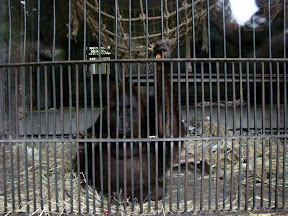
We wanted to go for a longish walk today, and the Rostock Zoo is walking distance from our house, so we headed on over. We walked through only a few city blocks and then a large city park with oak/maple/chestnut/beech forest and playing fields. The zoo was blissfully uncrowded due to the cold and wet weather. Unfortunately, this also meant that many of the animals were inside or inactive. Walking into this zoo the differences in funding and history from the Copenhagen Zoo we so recently admired were painfully obvious. It is of course an unfair comparison, given the differences between the two cities, and the weather when we visited, but still striking. Many of the animals simply stood in small, relatively featureless enclosures. Iris commented that the people who designed some of the enclosures were following in the style of Soviet apartment blocks. The animals, with some notable exceptions, looked bored, and sat waiting to be fed. A couple of the fish tanks had dead fish at the bottoms. The lone elephant walked in a small circle, always clockwise. The orangutan clutched the bars of her cage.
Many of the animals were tremendously obese. We saw almost no zoo employees except at the cafe, the entrances and the store. There was a lot of the feeling of bad old zoo here.
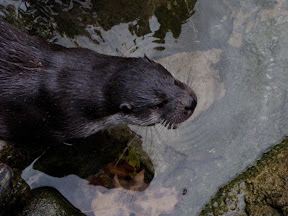
At the same time, like much of Rostock, it was obvious that the Rostock Zoo is very actively trying to replace the run-down vestiges of GDR with new, modern and elegant. The otter habitat, clearly recently built, had the otter racing every which way through trees, ponds and tunnels searching for cleverly hidden bits of food. We watched from a small bridge over the enclosure or from a sunken room below water level, aquarium style. The otter's enclosure was beautifully thought through and built.
The depressing concrete and iron boxes that house the great apes have been retrofitted with glass fronts for warmth as well as branches and nets for climbing on, and big signs requesting donations to build a new ape house. I emptied my coins into the collection box. A large counter showed that they had raised most of the million Euros in donations they need for the new ape house. The old-world monkeys were in a new (although still somewhat cramped) exhibition hall that doubles as a gallery of large prints of the winners of a wildlife photography contest.
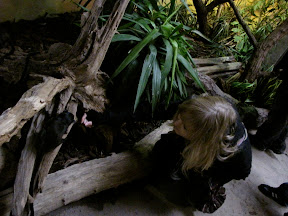
The most striking (and to me most disturbing) enclosure is the crocodile house. About the size of a two car garage, it has a couple of small crocs, some large soft-shelled turtles, brightly colored freshwater fish (all the fish at the zoo are freshwater, presumably because they lack the facilities for salt-water aquaria) and four free-roaming Black-mantled Tamarins. These little South American monkeys had the complete run of the place. They jumped over the crocodile tank, ran between the zoo visitors' feet, jumped on the visitors and scurried up and down the walls. They showed no fear of people, and while we were there were fed by hand by more than one young guest. One young lady took turns with a tamarin licking her ice cream.
All this with no zoo employee or volunteer in the building, and both doors to the house frequently open. It was thrilling to see these tiny (~1Lb) primates up so close, have them jump onto my shoulder, stick their noses against my camera lens to see what was inside, etc. But it also struck me as really quite irresponsible. It may be that the zoo simply has no other warm space to keep the tamarins, but my mind was filled with all the things that could go wrong here. Someone could step on a tamarin. One of the teenagers attempting to grab a tamarin's tail could succeed and get a nasty bite, or injure the animal. People could transmit diseases to our fellow primates. The monkeys could transmit diseases to people. Someone could stuff a tamarin in a backpack and take it home (this sort of thing has happened at other zoos). The tamarins could run out the door and wander into the nearby lion enclosure, or just die of cold. The crocs could get them. Petting zoos are supervised, and never contain primates or species of conservation concern. This broke every rule, and I can only hope it is a very temporary arrangement. That said, the tamarins were probably the most memorable and exciting part of the visit.
One other thing that struck me about this zoo is how much space they have for expansion. Many of their newer exhibits, and large fields for the ungulates, are in an area across a road from the main zoo, accessible through a separate entrance or via an underpass. Most of that added-on section is still just woods, waiting to be made into wooded homes for animals. They also have lots of old cages that are simply empty, ripe for replacement or creative reuse. What they seem to lack is not the will to improve, or the space, but funding. With the exception of the tamarins (which I think should be moved at once, even if it has to be to somewhere the public can't see them, or to another zoo) all of the animals are situated as well as they can be given the current enclosures available. If asked, I would probably advise replacing or significantly modifying 75% of the enclosures. I suspect the people who work there feel the same way. I very much hope that they find the funding and the will to make the type of transformation they need.
Due to poor weather and bad batteries I only took 150 pictures today. 20 of the better or more relevant ones are here.
 |
| From Rostock Zoo 10/17/09 |
Many of the animals were tremendously obese. We saw almost no zoo employees except at the cafe, the entrances and the store. There was a lot of the feeling of bad old zoo here.
At the same time, like much of Rostock, it was obvious that the Rostock Zoo is very actively trying to replace the run-down vestiges of GDR with new, modern and elegant. The otter habitat, clearly recently built, had the otter racing every which way through trees, ponds and tunnels searching for cleverly hidden bits of food. We watched from a small bridge over the enclosure or from a sunken room below water level, aquarium style. The otter's enclosure was beautifully thought through and built.
 |
| From Rostock Zoo 10/17/09 |
The depressing concrete and iron boxes that house the great apes have been retrofitted with glass fronts for warmth as well as branches and nets for climbing on, and big signs requesting donations to build a new ape house. I emptied my coins into the collection box. A large counter showed that they had raised most of the million Euros in donations they need for the new ape house. The old-world monkeys were in a new (although still somewhat cramped) exhibition hall that doubles as a gallery of large prints of the winners of a wildlife photography contest.
The most striking (and to me most disturbing) enclosure is the crocodile house. About the size of a two car garage, it has a couple of small crocs, some large soft-shelled turtles, brightly colored freshwater fish (all the fish at the zoo are freshwater, presumably because they lack the facilities for salt-water aquaria) and four free-roaming Black-mantled Tamarins. These little South American monkeys had the complete run of the place. They jumped over the crocodile tank, ran between the zoo visitors' feet, jumped on the visitors and scurried up and down the walls. They showed no fear of people, and while we were there were fed by hand by more than one young guest. One young lady took turns with a tamarin licking her ice cream.
 |
| From Rostock Zoo 10/17/09 |
All this with no zoo employee or volunteer in the building, and both doors to the house frequently open. It was thrilling to see these tiny (~1Lb) primates up so close, have them jump onto my shoulder, stick their noses against my camera lens to see what was inside, etc. But it also struck me as really quite irresponsible. It may be that the zoo simply has no other warm space to keep the tamarins, but my mind was filled with all the things that could go wrong here. Someone could step on a tamarin. One of the teenagers attempting to grab a tamarin's tail could succeed and get a nasty bite, or injure the animal. People could transmit diseases to our fellow primates. The monkeys could transmit diseases to people. Someone could stuff a tamarin in a backpack and take it home (this sort of thing has happened at other zoos). The tamarins could run out the door and wander into the nearby lion enclosure, or just die of cold. The crocs could get them. Petting zoos are supervised, and never contain primates or species of conservation concern. This broke every rule, and I can only hope it is a very temporary arrangement. That said, the tamarins were probably the most memorable and exciting part of the visit.
One other thing that struck me about this zoo is how much space they have for expansion. Many of their newer exhibits, and large fields for the ungulates, are in an area across a road from the main zoo, accessible through a separate entrance or via an underpass. Most of that added-on section is still just woods, waiting to be made into wooded homes for animals. They also have lots of old cages that are simply empty, ripe for replacement or creative reuse. What they seem to lack is not the will to improve, or the space, but funding. With the exception of the tamarins (which I think should be moved at once, even if it has to be to somewhere the public can't see them, or to another zoo) all of the animals are situated as well as they can be given the current enclosures available. If asked, I would probably advise replacing or significantly modifying 75% of the enclosures. I suspect the people who work there feel the same way. I very much hope that they find the funding and the will to make the type of transformation they need.
Due to poor weather and bad batteries I only took 150 pictures today. 20 of the better or more relevant ones are here.
 |
| Rostock Zoo 10/17/09 |
Subscribe to:
Posts (Atom)
