 |
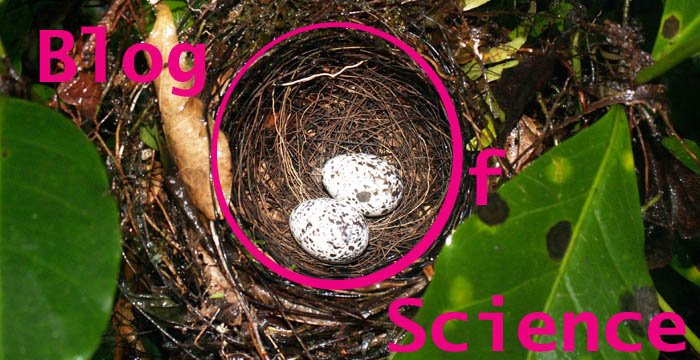
| Students mark a live beetle for release. Photo by Kim Lundgreen. |
Showing posts with label Natural History. Show all posts
Showing posts with label Natural History. Show all posts
Friday, November 21, 2014
Teaching mark-recapture with dor beetles
The key step in the planning of any good field course is to spend some time at the field site observing and asking questions. What is the habitat like, what lives there, what are the facilities, what are potential challenges or dangers to working there, etc? When I first went to do this at Svanninge Bjerge, the location of my zoology field course, I immediately started seeing big blue dung beetles all over the place. Bikuben Foundation, who operate the place, run cattle there. There is no lack of dung. These big plodding dor beetles (Geotrupidae) were all over the place, and it didn't take me long to decide I wanted to work them into the course. I wanted to introduce mark-recapture methods, and these seemed like perfect subjects. Mark-recapture methods involve catching animals, marking them in some way that would allow them to be recognized if re-sighted, letting them go, and then trying to recapture them. Such methods have a huge range of applications from tracking individual movements and estimating population sizes to monitoring growth and survival and studying behavior and sociality. To teach this in a field course, I wanted an invertebrate animal that wasn't too likely to leave the study area, that is easy to capture, mark and handle without damage, and that has enough charisma to capture students' attention. Dor beetles have all this. They are big and slow, and so easy to find and catch by hand. They don't bite or sting. They will collect in large numbers in pitfall traps baited with cow dung. They have big hard upper wings (elytra) that can be marked in any number or ways without harming them (we used this system with nail polish, but I've now got a battery-powered cautery). They are extremely numerous. They are shiny and blue. They can fly, but don't often do so.
They make such an ideal intro to mark-recapture that I almost worry that I've given the student a false sense that this is easy, where in fact such studies are often very hard work. Still, if you want an efficient system for teaching mark-recapture methods and have beetles like this at your location, I strongly recommend them to you.


Thursday, September 18, 2014
Picture show (in Danish)

It makes me all happy and proud and sad-that-it-is-over to look through these and remember what amazing fun that course was.
Friday, August 15, 2014
Toddler naturalist
 It was only 45 minutes until dinner and my girl was antsy. We decided to head out into the woods and see what we could see. We got on a bike brought along an almond and raisin snack, a water bottle, a doll, and stuffed orangutan. Five minutes later we were standing in the woods outside of town looking at this piece of wood. "This is a perfect cover object," I told Tigerlily. It was flat or even slightly concave underneath, it was on the soil but not in the soil, it was broad, and it was in the sunlight. "I want to look under it," she said. We lifted it up and found this shiny black toad.
We talked about toad poison and washing hands before eating. She hadn't finished her raisin and almond snack so only I held the toad.
Next we went for a little walk in the woods. She said she wanted to find insects. Instead, we found blackberries.
Or rather, she stumbled into them and I recognized what they were. I tried one just to make sure they were good, and they were. I didn't use my hands. Toad poison.

Now it was dinner time and we walked straight back to our bike. My girl was tired and hungry but learning about the woods and was ready to come home.
Friday, October 01, 2010
Fall
Sunrise splashes across autumn-spangled tree tips. A hooded crow, black and gray and flapping methodically, meanders between the swaying, glowing, multicolored peaks. Wingtip sweep up, flashing into horizontal sunlight, and down, into shadow and raucous foliage.
Friday, October 02, 2009
Wadden Sea
Imagine if you will a big flat muddy seabed. Various rivers and ocean currents deposit mud, silt, and sand onto it for ages. Currents may dig a slightly deeper part here, cause a raised area to form there, but basically its flat. Next, suppose global sea level drops. The top of the water is about equal with the top of the accumulated sediment at the bottom of our flat sea. Where the sediment is piled high, it might stick a meter or two above the water. Where the sediment is low water will remain, but not be very deep. And everywhere there will be mud.
Something very much like this has, over the eons, repeatedly occurred in what is currently the Wadden Sea area. Wadden Sea is the Anglicization of the Danish 'Vadehavet' which means mud-flat sea. In southwestern Jutland (the part of Denmark on mainland Europe), down through northwestern Germany and west across the northern Netherlands, simple daily tides still move the shoreline in and out by some miles. In between are extensive mudflats. As was done in Holland, the people of southwest Denmark gradually, over centuries, drained much of this tidal area with dikes, building walls over which the tide cannot climb (except during large storm floods, which throughout the middle ages would occasionally overcome the dikes and drown thousands of people). Despite the dikes, and the normally small tides of ~1.5m, the inter-tidal zone is many km wide in this area.
Iris and I spent a day on Mandø, an island in the Wadden Sea. The Danes long ago surrounded the island, which is only a few kilometers across, with dikes, and most of the interior is grazing land for cows and sheep. There is also a village of about 50 people, and an environmental education center/hotel, where we stayed. Outside the dikes, which are basically just 3-5m high slope-sides earthen walls grazed by sheep, there are wetlands surrounded by huge areas which daily alternate between being land and sea. At low tide one can drive to Mandø, or go for long walks on the mud-flats. At high tide it is water on every side for miles.
100m or so outside the dikes most of Mandø's shoreline (if it can be called that when it is often miles from the water) is ringed by fences that are about knee high. Each fence is made of two rows of sticks driven vertically into the mud, with thinner sticks, bits of brush and whatever else tied into bundles and wedged into the space between the two lines. Iris and I were mystified as to what function this short fence could perform, other than giving homes to billions of barnacles and perches to the preening shorebirds. It turns out these funny little fences, over generations, wrest land from the sea. At high tide water with sand and mud in it pours through, over and around the fence. As the tide recedes, much of its sediment gets caught in the bundled brush, like krill in the baleen of a whale. The area within the fence eventually fills with soil up to the top of the fence, and another fence is built further out. Repeat for 1000 years and add sheep.
Danish policy, now that they finally have the technology to seize the entire mud flats in years rather than centuries, is to let the boundary stand where it is. Let the shellfish, the shorebirds, the mud worms and the crabs keep what they have, and let the farmers keep their hard-won dry land. This summer Nationalpark Vadehavet became the largest national park in Demark. (Germany has also made large portions of its piece of the Wadden Sea into national parks.) It is bizarre, mysterious and wonderful to visit, and a glorious piece of wildness on the edge of all too tamed northern Europe. Global climate change may well doom the Wadden Sea to return to just being a flat seabed, so I suggest a visit sooner rather than later.
Here are a few photos:


Something very much like this has, over the eons, repeatedly occurred in what is currently the Wadden Sea area. Wadden Sea is the Anglicization of the Danish 'Vadehavet' which means mud-flat sea. In southwestern Jutland (the part of Denmark on mainland Europe), down through northwestern Germany and west across the northern Netherlands, simple daily tides still move the shoreline in and out by some miles. In between are extensive mudflats. As was done in Holland, the people of southwest Denmark gradually, over centuries, drained much of this tidal area with dikes, building walls over which the tide cannot climb (except during large storm floods, which throughout the middle ages would occasionally overcome the dikes and drown thousands of people). Despite the dikes, and the normally small tides of ~1.5m, the inter-tidal zone is many km wide in this area.
Iris and I spent a day on Mandø, an island in the Wadden Sea. The Danes long ago surrounded the island, which is only a few kilometers across, with dikes, and most of the interior is grazing land for cows and sheep. There is also a village of about 50 people, and an environmental education center/hotel, where we stayed. Outside the dikes, which are basically just 3-5m high slope-sides earthen walls grazed by sheep, there are wetlands surrounded by huge areas which daily alternate between being land and sea. At low tide one can drive to Mandø, or go for long walks on the mud-flats. At high tide it is water on every side for miles.
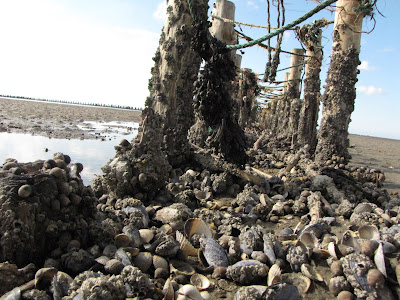
100m or so outside the dikes most of Mandø's shoreline (if it can be called that when it is often miles from the water) is ringed by fences that are about knee high. Each fence is made of two rows of sticks driven vertically into the mud, with thinner sticks, bits of brush and whatever else tied into bundles and wedged into the space between the two lines. Iris and I were mystified as to what function this short fence could perform, other than giving homes to billions of barnacles and perches to the preening shorebirds. It turns out these funny little fences, over generations, wrest land from the sea. At high tide water with sand and mud in it pours through, over and around the fence. As the tide recedes, much of its sediment gets caught in the bundled brush, like krill in the baleen of a whale. The area within the fence eventually fills with soil up to the top of the fence, and another fence is built further out. Repeat for 1000 years and add sheep.
Danish policy, now that they finally have the technology to seize the entire mud flats in years rather than centuries, is to let the boundary stand where it is. Let the shellfish, the shorebirds, the mud worms and the crabs keep what they have, and let the farmers keep their hard-won dry land. This summer Nationalpark Vadehavet became the largest national park in Demark. (Germany has also made large portions of its piece of the Wadden Sea into national parks.) It is bizarre, mysterious and wonderful to visit, and a glorious piece of wildness on the edge of all too tamed northern Europe. Global climate change may well doom the Wadden Sea to return to just being a flat seabed, so I suggest a visit sooner rather than later.
Here are a few photos:
Iris on the mud flats

Disintegrating coastal fence encrusted by shellfish

Oystercatchers like this one are extremely numerous in the Wadden Sea. Their long stout bills are perfect for wrestling invertebrates out of the mud.

Friday, July 31, 2009
Like most places in the northeastern US, Vermont has been having a very wet summer. It rains most days, and the ground rarely has time to dry out before the next rain. This is just how the slugs like it. They seem to be everywhere, doing all their usual sluggy things: eating leaves, devouring mushrooms, sitting on wet rocks, getting squished on the sidewalk. What else is there for slugs to do? This afternoon I saw a group of slugs doing something I've never seen slugs do, or even heard of them doing.
Yesterday, a couple of blocks from home, I passed a freshly roadkilled squirrel. By today, most of the carcass was gone, with only bits and chunks scattered on the shoulder. And on each little morsel sat a garden variety slug, chowing down. The bigger chunks had two or three slugs, each about an inch long, actively feeding (or at least that's what it looked like, it was hard to know for sure, as their mouthparts are underneath). There were a few slugs that had been run over as they fed, and others had come in to finish the job, and eat there recently departed kin.
I've watched slugs eat hundred of times, and it has always been on plant matter or fungi. It never occurred to me that they might eat meat. So of course I checked what Wikipedia had to say on the subject:
Yesterday, a couple of blocks from home, I passed a freshly roadkilled squirrel. By today, most of the carcass was gone, with only bits and chunks scattered on the shoulder. And on each little morsel sat a garden variety slug, chowing down. The bigger chunks had two or three slugs, each about an inch long, actively feeding (or at least that's what it looked like, it was hard to know for sure, as their mouthparts are underneath). There were a few slugs that had been run over as they fed, and others had come in to finish the job, and eat there recently departed kin.
I've watched slugs eat hundred of times, and it has always been on plant matter or fungi. It never occurred to me that they might eat meat. So of course I checked what Wikipedia had to say on the subject:
"Many species of slugs play an important role in ecosystems by eating dead leaves, fungus, and decaying vegetable material. Other species eat parts of living plants.Which makes me wonder if there was ever a B movie about giant radioactive predatory slugs.
Some slugs are predators, eating other slugs and snails, or earthworms.
Most slugs will on occasion also eat carrion, including dead of their own kind."
Wednesday, July 16, 2008
Snake self defence
Iris and I were on our way up Blake St from the BART station to our house.
At the corner of Walnut St, I exclaimed, "Oh!"
"What! What!? What?" Iris responded.
"A garter snake!"
The sleek black ribbon, two feet long and no more than half an inch wide, with a bright yellow strip up its back, was frantically trying to wriggle out of the street and onto the curb. That corner has no curb-cut, and its movements were too disorganized to allow it to climb the 6-inch curb.
Three facts jumped to mind:
1. It was clearly overheated by being on the black pavement in the sun, and would cook to death or get run-over unless we rescued it.
2. Garter snakes are not poisonous, but can bite.
3. It probably came from El Cerrito Hillside Natural Area, 200m up the street.
So I handed my cane and groceries to Iris and grabbed the snake with both hands. But I had forgotten that the hotter a snake is, the faster it can move. Before I could get a finger on it, my thumb was bleeding from multiple tiny punctures. I grabbed the little snot anyway and held firmly, but without squeezing, on the back of its skull. Then it hit me with a garter-snake's last line of defense: musk. A garter snake's musk glands are in its vent (a.k.a. cloaca, a.k.a. butt) and can rapidly discharge a surprising quantity of a fluid that smells somewhere between a port-a-potty and old gym-socks.
With one hand bleeding and the other clamped on a snake and stinking, I looked up at Iris. She handed me my cane and retreated up the street.
Thamnophis elegans - Western Terrestrial Gartersnake


At the corner of Walnut St, I exclaimed, "Oh!"
"What! What!? What?" Iris responded.
"A garter snake!"
The sleek black ribbon, two feet long and no more than half an inch wide, with a bright yellow strip up its back, was frantically trying to wriggle out of the street and onto the curb. That corner has no curb-cut, and its movements were too disorganized to allow it to climb the 6-inch curb.
Three facts jumped to mind:
1. It was clearly overheated by being on the black pavement in the sun, and would cook to death or get run-over unless we rescued it.
2. Garter snakes are not poisonous, but can bite.
3. It probably came from El Cerrito Hillside Natural Area, 200m up the street.
So I handed my cane and groceries to Iris and grabbed the snake with both hands. But I had forgotten that the hotter a snake is, the faster it can move. Before I could get a finger on it, my thumb was bleeding from multiple tiny punctures. I grabbed the little snot anyway and held firmly, but without squeezing, on the back of its skull. Then it hit me with a garter-snake's last line of defense: musk. A garter snake's musk glands are in its vent (a.k.a. cloaca, a.k.a. butt) and can rapidly discharge a surprising quantity of a fluid that smells somewhere between a port-a-potty and old gym-socks.
With one hand bleeding and the other clamped on a snake and stinking, I looked up at Iris. She handed me my cane and retreated up the street.
Thamnophis elegans - Western Terrestrial Gartersnake


Wednesday, June 04, 2008
Of listing and sex
Among many bird-watchers, there is an obsession with listing. Species one has seen anywhere, species one has seen in Ontario, species one has seen in Ontario in October, species one has seen through a particular window while sitting on the toilet and so on. I once had a colleague point his binoculars up at the sky for a few seconds, and say, "Awesome, I've never seen a Red-Throated Loon on the southward migration over Lake Eire before. Another tic for my list."
I keep a few place specific lists, "birds I've seen in the El Cerrito Hillside Natural Area," or, "birds of Mahopac, NY," and used to keep a life list (e.g. all the wild birds I've ever seen anywhere) but I've never really gotten into listing for listing's sake. Hard-core listers (commonly referred to as twitchers for their inability to hold still if someone suggests a bird they don't yet have on a particular list is nearby) are often far more interested in adding birds to lists than in actually looking at the birds, and will often travel long distances to find a bird, look at it for just long enough to confidently add it to their list, then begin the long journey home. Those of us who are not twitchers, but know people who are, enjoy the game of making up new types of lists and mentioning them to twitchers so that they will feel compelled to rush out and start building a bigger, longer more impressive list with more rare species. So, in that spirit, I have started to compile a copulation list, of all the bird species I have ever observed copulating. This list is necessarily incomplete, as I am only including those species which I know a particular time and place when I witnessed a copulation in the wild, but excluding all the other species that I forget where or when. This list was inspired by the activity of two house-sparrows this fine June morning.
In no particular order:
House Sparrow
California Condor
Turkey Vulture
Fairy Bluebird
Florida Scrub-Jay
Western Scrub-Jay
Steller's Jay
Common Raven
American Crow
Bald Eagle
House Finch
European Starling
Canada Goose
Mallard
Muskovi Duck
Great Egret
American Robin
Dark-Eyed Junco
California Towhee
Red-Tailed Hawk
Red-Shouldered Hawk
Willie Wagtail
I keep a few place specific lists, "birds I've seen in the El Cerrito Hillside Natural Area," or, "birds of Mahopac, NY," and used to keep a life list (e.g. all the wild birds I've ever seen anywhere) but I've never really gotten into listing for listing's sake. Hard-core listers (commonly referred to as twitchers for their inability to hold still if someone suggests a bird they don't yet have on a particular list is nearby) are often far more interested in adding birds to lists than in actually looking at the birds, and will often travel long distances to find a bird, look at it for just long enough to confidently add it to their list, then begin the long journey home. Those of us who are not twitchers, but know people who are, enjoy the game of making up new types of lists and mentioning them to twitchers so that they will feel compelled to rush out and start building a bigger, longer more impressive list with more rare species. So, in that spirit, I have started to compile a copulation list, of all the bird species I have ever observed copulating. This list is necessarily incomplete, as I am only including those species which I know a particular time and place when I witnessed a copulation in the wild, but excluding all the other species that I forget where or when. This list was inspired by the activity of two house-sparrows this fine June morning.
In no particular order:
House Sparrow
California Condor
Turkey Vulture
Fairy Bluebird
Florida Scrub-Jay
Western Scrub-Jay
Steller's Jay
Common Raven
American Crow
Bald Eagle
House Finch
European Starling
Canada Goose
Mallard
Muskovi Duck
Great Egret
American Robin
Dark-Eyed Junco
California Towhee
Red-Tailed Hawk
Red-Shouldered Hawk
Willie Wagtail
Sunday, June 01, 2008
Three Birds, Two Cats and a primate
It was an awful lot of croaking for a Friday afternoon. I went out on the patio to investigate. The Ravens were in an uproar about something. My first thought was that one of their nestlings had fledged and was hiding in our yard. They were flying back and forth, low over the top of the apple tree, scolding and creaking and booming. I decided their fledgling must be in the top of the tree, and they must be trying to tell it that this was not a safe place. My eyes scanning the trees for a fledgling, I was impressed and intimidated to see these two birds, each the size of a large hawk, diving and screaming just over my head. And just as I was starting to think they might really be screaming directly at me, I heard something moving only a couple of yards from my feet. Looking down, I saw this:

A turkey right in our garden, and clearly the focus of the Ravens' ire. They were responding to it as they would any large animal (except humans and deer, which they seem to be used to ) getting too close to their nest tree: by screaming and scolding, "you better git the hell off our land if you know what's good fer ya!" The turkey had apparently responded by hunkering down by Betty's compost bin.

I pulled out my cell phone and started to take pictures. After a couple of minutes the ravens went off to scream at something else and the turkey and I were left to talk amongst ourselves. I went for my better camera, but finding the batteries dead, knocked on Betty's door and said, "Hi Betty, sorry to bother you, but there is a turkey in the backyard. You should bring your camera please."
It was a very tame turkey. I taking photos with my cellphone and Betty with her big digital SLR each stood about 10 feet from it. "People have been feeding it." I said as it watched us hopefully and I resisted the urge to feed it. It rooted around in the garden.

FeLion wandered out onto the patio and saw the turkey. Her response seemed perfectly split between, "That is the biggest bird I have ever seen, I'm gonna eat it." and "that is the bigest bird I have ever seen, I hope it doesn't try to eat me." She was frozen with indecision.

Betty's cat Sophie, on the other hand, was not at all reluctant to charge a bird twice her weight. She burst out of the bushes and sprinted toward the turkey, who turned tail and ran up the step to the very top of our yard.

When I caught up, the turkey was defending a position on top of the garden gate arch, and Sophie was attempting to storm the battlements.

Eventually she succeeded, and the Turkey took to the air, at which point the Ravens resumed their harrying. The turkey, pursued from above an below. stopped in a tangle of low Eucalyptus branches. Betty and I snapped a few more shots and then took the cats inside.


A turkey right in our garden, and clearly the focus of the Ravens' ire. They were responding to it as they would any large animal (except humans and deer, which they seem to be used to ) getting too close to their nest tree: by screaming and scolding, "you better git the hell off our land if you know what's good fer ya!" The turkey had apparently responded by hunkering down by Betty's compost bin.

I pulled out my cell phone and started to take pictures. After a couple of minutes the ravens went off to scream at something else and the turkey and I were left to talk amongst ourselves. I went for my better camera, but finding the batteries dead, knocked on Betty's door and said, "Hi Betty, sorry to bother you, but there is a turkey in the backyard. You should bring your camera please."
It was a very tame turkey. I taking photos with my cellphone and Betty with her big digital SLR each stood about 10 feet from it. "People have been feeding it." I said as it watched us hopefully and I resisted the urge to feed it. It rooted around in the garden.

FeLion wandered out onto the patio and saw the turkey. Her response seemed perfectly split between, "That is the biggest bird I have ever seen, I'm gonna eat it." and "that is the bigest bird I have ever seen, I hope it doesn't try to eat me." She was frozen with indecision.

Betty's cat Sophie, on the other hand, was not at all reluctant to charge a bird twice her weight. She burst out of the bushes and sprinted toward the turkey, who turned tail and ran up the step to the very top of our yard.

When I caught up, the turkey was defending a position on top of the garden gate arch, and Sophie was attempting to storm the battlements.

Eventually she succeeded, and the Turkey took to the air, at which point the Ravens resumed their harrying. The turkey, pursued from above an below. stopped in a tangle of low Eucalyptus branches. Betty and I snapped a few more shots and then took the cats inside.

Thursday, March 20, 2008
Residual life
Most of us take for granted that we will live for a long time after we stop having kids (for those of us who will have kids). The standard picture for Americans these days is to stop at 40 or so, hope to live to twice that age. And this doesn't seem unrealistic. But when viewed evolutionarily, it seems a bit bizarre. Most organisms do not have a post-reproductive lifespan, human females very clearly do. I've previously written about the most common hypothesis to explain this fact, is the "Grandmother Hypothesis."
On Tuesday I was giving a talk on my research to Berkeley's Primate Research Group, including my experimental examination of the Grandmother Hypothesis. After the talk, I got a lot of good feedback, including an interesting question. How certain are we that females of other species of primates wouldn't live as long post-menopause as humans if they lived as cushy lives as we do?
The only answer I could give them is that I haven't seen any data suggesting otherwise. But then, on my way home, it occurred to me that I already have probably the world's best data set for answering exactly that question.
Primates in well run zoos tend to greatly outlive their wild cousins. Medical care, reliable food supplies, no predators and few pathogens. Not to say the life of a captive primate is perfect, or that there isn't significant variation in the quality of care, but for many species maximum longevity in captivity is much greater than in the wild. And it just so happens that I have life tables, including age specific reproductive rates and mortality rates, for 120 species of primates. These come from ISIS data, meaning data from relatively well run zoos, and I will need permission from ISIS to use them in this way, but I doubt they will have any major objections.
The idea of writing a paper based on data I already have is exciting to me. Usually I spend years between having an idea and having assembled the data to address it. I have almost all the data I need to address this question safely on several computers. I'll get the hang of this science thing yet.
On Tuesday I was giving a talk on my research to Berkeley's Primate Research Group, including my experimental examination of the Grandmother Hypothesis. After the talk, I got a lot of good feedback, including an interesting question. How certain are we that females of other species of primates wouldn't live as long post-menopause as humans if they lived as cushy lives as we do?
The only answer I could give them is that I haven't seen any data suggesting otherwise. But then, on my way home, it occurred to me that I already have probably the world's best data set for answering exactly that question.
Primates in well run zoos tend to greatly outlive their wild cousins. Medical care, reliable food supplies, no predators and few pathogens. Not to say the life of a captive primate is perfect, or that there isn't significant variation in the quality of care, but for many species maximum longevity in captivity is much greater than in the wild. And it just so happens that I have life tables, including age specific reproductive rates and mortality rates, for 120 species of primates. These come from ISIS data, meaning data from relatively well run zoos, and I will need permission from ISIS to use them in this way, but I doubt they will have any major objections.
The idea of writing a paper based on data I already have is exciting to me. Usually I spend years between having an idea and having assembled the data to address it. I have almost all the data I need to address this question safely on several computers. I'll get the hang of this science thing yet.
Saturday, February 23, 2008
Field Notes
FEB. 23 2008
D. Levitis
Hillside Natural Area (North Unit) El Cerrito, Contra Costa County, CA
Sijie Mao, Nichole Winters and I went out from 1300 to 1530. It was quite windy with very strong gusts, temp in the lower 50s and varying between slight drizzle and significant rain. Our fist stop was the detritus field around the storm drain at the lowest point in the park, just behind my house, under the Eucalyptus. A lot of good cover items, but nothing under there. From there we went just up the hill to the small pile of shipping pallets on the grass. Under the first one I lifted was an Aneides lugubris (Arboreal Salamander)! The first I'd seen here. We took this as a sign of good salamandering to come.
We followed a route approximated by that marked on this map, but with many side excursions to check under log, rocks and other cover objects:

Much of this part of the Nature Area has many of the cover objects removed for yearly mowing, so much of the available cover is in piles of cut log pieces or small rocks piled at the base of trees and in gullies.
Sijie and Nichole are extremely contentious about putting every cover item back exactly as it was, and are energetic and enthusiastic herpers. We found almost nothing under rocks, but the logs were very productive today. We checked under approximately 400 wood bits and 100 rocks/cement bits and found 71 Batrachoseps attenuatus (California Slender Salamanders) 3 Aneides and one Elgaria multicarinata (Southern Alligator Lizard).
The Aneides were all near oaks, as Dave Wake told me to expect, while the Batrachoseps were under logs and a few rocks in every habitat we checked. The Elgaria was under a pine log in grassy habitat.
In addition to the herps, invertebrates were extremely numerous under cover objects, including Jerusalem crickets, cave crickets, ants, termites, ground beetles, several kinds of spiders including a couple of Black Widows, copious pill-bugs, snails, slugs, worms and sundry.
Many fresh gopher diggings were evident in the soft wet earth, and many of the logs and rocks we lifted had smaller rodent tunnels, quite possibly vole. Deer prints and fox scat were in abundance.
One bird species to add to my list for the nature area, Wild Turkey. One was seen at the northwest corner of our route, just north of Snowdon Ave. and another was heard responding to its calls. Nichole took pictures of the turkey, which was tame enough to allow her to approach to within 6 meters.
Our explorations revealed no standing water in which frogs could breed, which may explain their absence from our observations.
Birding today wasn't great, due to wind and rain, but saw/heard following birds today:
Western Scrub-Jay (2)
American Crow (10)
Northern Raven (2)
Black Phoebe (1)
Yellow-rumped Warbler (25)
Chestnut-backed Chickadee (4)
House Sparrow (15)
Ruby-Crowned Kinglet (2)
American Robin (40)
California Towhee (3)
Dark-eyed Junco (4)
Wild Turkey (2)
Red-shouldered Hawk (1)
Anna's Hummingbird (3)
Mourning Dove (6)
Mammals:
Eastern Fox Squirrel (Sciurus niger) (2)
Mule Dear (Odocoileus hemionus) (tracks)
Voles (Microtus californicus? runways and burrows)
Pocket Gophers (burrows)
Fox (Grey fox? scat)
Herps:
Southern Alligator Lizard (Elgaria multicarinata) (1)
California Slender Salamander (Batrachoseps attenuatus) (71)
Arboreal Salamander (Aneides lugubris) (3)
D. Levitis
Hillside Natural Area (North Unit) El Cerrito, Contra Costa County, CA
Sijie Mao, Nichole Winters and I went out from 1300 to 1530. It was quite windy with very strong gusts, temp in the lower 50s and varying between slight drizzle and significant rain. Our fist stop was the detritus field around the storm drain at the lowest point in the park, just behind my house, under the Eucalyptus. A lot of good cover items, but nothing under there. From there we went just up the hill to the small pile of shipping pallets on the grass. Under the first one I lifted was an Aneides lugubris (Arboreal Salamander)! The first I'd seen here. We took this as a sign of good salamandering to come.
We followed a route approximated by that marked on this map, but with many side excursions to check under log, rocks and other cover objects:

Much of this part of the Nature Area has many of the cover objects removed for yearly mowing, so much of the available cover is in piles of cut log pieces or small rocks piled at the base of trees and in gullies.
Sijie and Nichole are extremely contentious about putting every cover item back exactly as it was, and are energetic and enthusiastic herpers. We found almost nothing under rocks, but the logs were very productive today. We checked under approximately 400 wood bits and 100 rocks/cement bits and found 71 Batrachoseps attenuatus (California Slender Salamanders) 3 Aneides and one Elgaria multicarinata (Southern Alligator Lizard).
The Aneides were all near oaks, as Dave Wake told me to expect, while the Batrachoseps were under logs and a few rocks in every habitat we checked. The Elgaria was under a pine log in grassy habitat.
In addition to the herps, invertebrates were extremely numerous under cover objects, including Jerusalem crickets, cave crickets, ants, termites, ground beetles, several kinds of spiders including a couple of Black Widows, copious pill-bugs, snails, slugs, worms and sundry.
Many fresh gopher diggings were evident in the soft wet earth, and many of the logs and rocks we lifted had smaller rodent tunnels, quite possibly vole. Deer prints and fox scat were in abundance.
One bird species to add to my list for the nature area, Wild Turkey. One was seen at the northwest corner of our route, just north of Snowdon Ave. and another was heard responding to its calls. Nichole took pictures of the turkey, which was tame enough to allow her to approach to within 6 meters.
Our explorations revealed no standing water in which frogs could breed, which may explain their absence from our observations.
Birding today wasn't great, due to wind and rain, but saw/heard following birds today:
Western Scrub-Jay (2)
American Crow (10)
Northern Raven (2)
Black Phoebe (1)
Yellow-rumped Warbler (25)
Chestnut-backed Chickadee (4)
House Sparrow (15)
Ruby-Crowned Kinglet (2)
American Robin (40)
California Towhee (3)
Dark-eyed Junco (4)
Wild Turkey (2)
Red-shouldered Hawk (1)
Anna's Hummingbird (3)
Mourning Dove (6)
Mammals:
Eastern Fox Squirrel (Sciurus niger) (2)
Mule Dear (Odocoileus hemionus) (tracks)
Voles (Microtus californicus? runways and burrows)
Pocket Gophers (burrows)
Fox (Grey fox? scat)
Herps:
Southern Alligator Lizard (Elgaria multicarinata) (1)
California Slender Salamander (Batrachoseps attenuatus) (71)
Arboreal Salamander (Aneides lugubris) (3)
Saturday, February 16, 2008
Brown Creeper
There are certain birds that, based on experience, I can place a very high prior probability on finding in any patch of trees around here. Anna's Hummingbird. American Robin, California Towhee, Ruby-Crowned Kinglet and so on. They're there, I can find them quickly. Most of these species made my bird list for El Cerrito Hillside Natural Area within the first day or two. But there is one bird I have high confidence is in all these patches, but not high confidence in finding. And that is the Brown Creeper, Certhia americana. The Brown Creeper, as its name suggests, is not a flashy bird. Small, brown, spotted for camo, the only American representative of the family Certhidae moves like its old world relatives; it creeps, foot over foot, up surfaces (in this case the trunks of trees) probing cracks and crevasses with its wrenish bill, looking for arthropods. It doesn't make a lot of noise, it doesn't make sudden movements, it is an extremely common bird that most people will never see unless they look for it. I have seen people walk past Brown Creepers that are at head height, five feet from their eyes and in full view, and never know the bird is there.
So I have had my eyes and ears open for the little sneakers ever since we moved to El Cerrito, and been continuously thwarted. Occasionally I will see a flash as something shoots past, flapping like a creeper flaps, but been unable to get a good enough look to confirm the identity. I have heard what I thought was creepers but couldn't be sure. But this morning, Iris and I went for a short walk under the oaks just outside our back yard, and a flash of bitty wings caught my eyes. My brain said "Creeper!" I swung around, unwilling to take my eyes off it as it flitted this way and that through the branches, and then dropped, coming to rest on a tree trunk ten meters from us, fully visible only because my brain knew it was there. Iris and I both raised our binoculars. Sure enough, a Brown Creeper, trickling up the trunk. That swaying foot over foot climbing makes the bird move more like a wavering shadow than a living thing, and the speckles on the bird's back looked like little bits of every kind of bark in the forest. Being reminded of this, I felt a little bit of pride at having spotted this very common backyard bird. I'm sure there are hundreds of them back there.
So I have had my eyes and ears open for the little sneakers ever since we moved to El Cerrito, and been continuously thwarted. Occasionally I will see a flash as something shoots past, flapping like a creeper flaps, but been unable to get a good enough look to confirm the identity. I have heard what I thought was creepers but couldn't be sure. But this morning, Iris and I went for a short walk under the oaks just outside our back yard, and a flash of bitty wings caught my eyes. My brain said "Creeper!" I swung around, unwilling to take my eyes off it as it flitted this way and that through the branches, and then dropped, coming to rest on a tree trunk ten meters from us, fully visible only because my brain knew it was there. Iris and I both raised our binoculars. Sure enough, a Brown Creeper, trickling up the trunk. That swaying foot over foot climbing makes the bird move more like a wavering shadow than a living thing, and the speckles on the bird's back looked like little bits of every kind of bark in the forest. Being reminded of this, I felt a little bit of pride at having spotted this very common backyard bird. I'm sure there are hundreds of them back there.
Friday, February 08, 2008
Citizen science, and the limits thereof
One of my neighbors sent me a copy of a list that she was given by the people who sold her her house. They told her they saw all these species in El Cerrito Hillside Natural Area. At first was excited to see this list, and the first several species on there are quite reasonable, but a more careful look significantly lowered my level of confidence in these observations. This is a perfect example of why "citizen science" projects that rely on non-experts to gather natural history data require great care. Below I have pasted in the list, with some comments.
chestnut-backed chickadee
common bushtit
turkey vulture
cooper's hawk
american kestrel
red-tailed hawk
common crow
common raven
great-horned owl
ruby-crowned kinglet
woodthrush (Does not occur in CA, probably Hermit Thrush)
red-shafted flicker
winter wren
hairy woodpecker
downy woodpecker
robin
brown towee (Californa Towhee)
rufous-sided towee (Spotted Towhee)
oregon junco (Dark-Eyed Junco)
purple finch
house finch
pine siskin
wilson's warbler
tennessee warbler (does not occur in CA, Orange-Crowned Warbler)
american goldfinch
lesser goldfinch
lawrence's goldfinch
mockingbird
plain titmouse (Oak Titmouse)
scrub jay
steller's jay
mexican jay (Does not occur in CA, probably juv. scrub-jay)
cedar waxwing
western wood pewee
mourning dove
bead-tailed pigeon (Band-tailed Pigeon)
fox sparrow
savannah sparrow
harris's sparrow (Does not occur in CA, probably House Sparrow)
golden-crowned sparrow
starling
anna's hummingbird
allen's hummingbird
black phoebe
wrentit
marsh hawk (Same as Northern Harrier, listed below)
swainsons's thrush (possible)
mississippi kite (Does not occur in CA, probably Northern Harrier)
rufous hummingbird (nearly impossible to tell from Allen's except in hand)
canada goose
brown pelican (in park or flying in distance over bay?)
slate-colored junco (same as junco listed above)
warbling vireo
lazuli bunting (possible)
western tanager
bluegray gnatcatcher
empidonax flycatcher
bewick's wren
yellow-rumped warbler
townsend's warbler
hermit thrush
myrtle warbler (same as Yellow-rumped arbler)
osprey
beardless flycatcher (not found in CA)
red-breasted nuthatch
white warbler (not a real species, no idea)
chestnut-backed chickadee
common bushtit
turkey vulture
cooper's hawk
american kestrel
red-tailed hawk
common crow
common raven
great-horned owl
ruby-crowned kinglet
woodthrush (Does not occur in CA, probably Hermit Thrush)
red-shafted flicker
winter wren
hairy woodpecker
downy woodpecker
robin
brown towee (Californa Towhee)
rufous-sided towee (Spotted Towhee)
oregon junco (Dark-Eyed Junco)
purple finch
house finch
pine siskin
wilson's warbler
tennessee warbler (does not occur in CA, Orange-Crowned Warbler)
american goldfinch
lesser goldfinch
lawrence's goldfinch
mockingbird
plain titmouse (Oak Titmouse)
scrub jay
steller's jay
mexican jay (Does not occur in CA, probably juv. scrub-jay)
cedar waxwing
western wood pewee
mourning dove
bead-tailed pigeon (Band-tailed Pigeon)
fox sparrow
savannah sparrow
harris's sparrow (Does not occur in CA, probably House Sparrow)
golden-crowned sparrow
starling
anna's hummingbird
allen's hummingbird
black phoebe
wrentit
marsh hawk (Same as Northern Harrier, listed below)
swainsons's thrush (possible)
mississippi kite (Does not occur in CA, probably Northern Harrier)
rufous hummingbird (nearly impossible to tell from Allen's except in hand)
canada goose
brown pelican (in park or flying in distance over bay?)
slate-colored junco (same as junco listed above)
warbling vireo
lazuli bunting (possible)
western tanager
bluegray gnatcatcher
empidonax flycatcher
bewick's wren
yellow-rumped warbler
townsend's warbler
hermit thrush
myrtle warbler (same as Yellow-rumped arbler)
osprey
beardless flycatcher (not found in CA)
red-breasted nuthatch
white warbler (not a real species, no idea)
El Cerrito Hillside Natural Area, February list
Here is the February list. 53 species are listed at present.
Birds:
Western Scrub-Jay
Stellar's Jay
American Crow
Northern Raven
Hutton's Vireo
Black Phoebe
Yellow-rumped Warblers
Townsend's Warbler
Brown Creeper
Bewick's Wren
Chestnut-backed Chickadee
Oak Titmouse
House Sparrow
Ruby-Crowned Kinglet
Golden-Crowned Kinglet
American Robin
Bush Tit
Hermit Thrush
Northern Mockingbird
White-crowned Sparrow
Golden-crowned Sparrow
Song Sparrow
Spotted Towhee
California Towhee
Dark-eyed Junco
Cedar Waxwing
American Goldfinch
Lesser Goldfinch
Pine Siskin
House Finch
Wild Turkey
Cooper's Hawk
Red-tailed Hawk
Red-shouldered Hawk
American Kestrel
Great Horned Owl
Red-breasted Nuthatch
Downy Woodpecker
Red-shafted Flicker
Red-breasted Sapsucker
Nuttall's Woodpecker
Anna's Hummingbird
Selasphorus Hummingbird (Either Allen's or Rufous, two nearly indistinguishable)
Turkey Vulture
American Coot
Double-crested Cormorant
Ring-Billed Gull
Rock Pigeon
Mourning Dove
Mammals:
Eastern Fox Squirrel (Sciurus niger)
Mule Dear (Odocoileus hemionus)
Voles (Microtus californicus? runways and burrows)
Pocket Gophers (burrows)
Fox (Grey fox? scat)
Skunk (smelled, species?)
Herps:
Southern Alligator Lizard (Elgaria multicarinata)
California Slender Salamander (Batrachoseps attenuatus)
Arboreal Salamander (Aneides lugubris)
Birds:
Western Scrub-Jay
Stellar's Jay
American Crow
Northern Raven
Hutton's Vireo
Black Phoebe
Yellow-rumped Warblers
Townsend's Warbler
Brown Creeper
Bewick's Wren
Chestnut-backed Chickadee
Oak Titmouse
House Sparrow
Ruby-Crowned Kinglet
Golden-Crowned Kinglet
American Robin
Bush Tit
Hermit Thrush
Northern Mockingbird
White-crowned Sparrow
Golden-crowned Sparrow
Song Sparrow
Spotted Towhee
California Towhee
Dark-eyed Junco
Cedar Waxwing
American Goldfinch
Lesser Goldfinch
Pine Siskin
House Finch
Wild Turkey
Cooper's Hawk
Red-tailed Hawk
Red-shouldered Hawk
American Kestrel
Great Horned Owl
Red-breasted Nuthatch
Downy Woodpecker
Red-shafted Flicker
Red-breasted Sapsucker
Nuttall's Woodpecker
Anna's Hummingbird
Selasphorus Hummingbird (Either Allen's or Rufous, two nearly indistinguishable)
Turkey Vulture
American Coot
Double-crested Cormorant
Ring-Billed Gull
Rock Pigeon
Mourning Dove
Mammals:
Eastern Fox Squirrel (Sciurus niger)
Mule Dear (Odocoileus hemionus)
Voles (Microtus californicus? runways and burrows)
Pocket Gophers (burrows)
Fox (Grey fox? scat)
Skunk (smelled, species?)
Herps:
Southern Alligator Lizard (Elgaria multicarinata)
California Slender Salamander (Batrachoseps attenuatus)
Arboreal Salamander (Aneides lugubris)
Sunday, February 03, 2008
Mixed-Species Flock
I've been seeing a lot of cedar waxwings and robins recently, and I'm used to seeing them together, but Saturday in our backyard was the biggest mixed flock of these two species Ive ever seen. Forty birds shooting this way and fifty coming back that way, a clamor of robin whinnies and waxwing whistles from ever tree and bush. The robins numbered in the hundreds and waxwings outnumbered them, but in the whirling bickering flock, I couldn't really tell how many hundreds there were. There were American and Lesser Goldfinches, Chestnut-backed Chickadees, Oak Titmice and at least one Bewick's Wren feeding with the flock. Anything with berries on it was covered in birds, coming, filling their bellies and quickly being replaced by the next wave. I took the opportunity to take a couple of hundred photos, although most of them ended up with streaks as other birds flew into, out of, or through the frame. Some of the best shots are in this album.
I also took the opportunity to teach Iris how to identify these species. She asked the excellent question of why all there birds were moving around together, when it seemed like they were all squabbling over the same food. This is actually a questions several scientists have looked into, and the answer seems to be that like most things, one has to consider the costs and benefits. When the costs of participating in the flock (competition for food, time lost arguing) are outweighed by the benefits (protection in numbers from predators, more guides looking for food) then the birds flock. In the case of waxwings and robins, they are looking for a very patchy resource. While a bush is making berries, it is hard for even a huge flock to use up all the food, but the good berry bushes may be rare. So the cost of competition is low, because there is so much food on each bush, but the benefit is high, because by following the flock one doesn't have to waste time finding the food. Go where the flock is loudest and there is sure to be a bush covered in berries. And with so many eyes around, no predator could possibly sneak up. I saw one scrub-jay (which will occasionally kill and eat smaller birds) being chased by about 40 waxwings and a couple of chickadees. Once the jay was well away, they all went back to feeding.
 |
| ECHNA Birds |
Wednesday, January 09, 2008
El Cerrito Hillside Natural Area, January list
I've decided to have one post per month for this list, and add things to the existing list as I see them. Here is the January list. 44 species are listed at present.
Birds:
Western Scrub-Jay
Stellar's Jay
American Crow
Northern Raven
added Jan 15th: Hutton's Vireo
Black Phoebe
Yellow-rumped Warblers
added Jan 15th: Townsend's Warbler
Bewick's Wren
Chestnut-backed Chickadee
added Jan 22nd: Oak Titmouse
House Sparrow
Ruby-Crowned Kinglet
Golden-Crowned Kinglet
American Robin
Bush Tit
Hermit Thrush
Northern Mockingbird
White-crowned Sparrow
Golden-crowned Sparrow
added Jan 15th: Song Sparrow
Spotted Towhee
California Towhee
Dark-eyed Junco
Cedar Waxwing
American Goldfinch
added Jan 14th: Lesser Goldfinch
House Finch
Cooper's Hawk
Red Tailed Hawk
American Kestrel
Great Horned Owl
Red-breasted Nuthatch
Downy Woodpecker
Red-shafted Flicker
Red-breasted Sapsucker
added Jan 15th: Nuttall's Woodpecker
Anna's Hummingbird
Turkey Vulture
American Coot
added Jan. 27th Double-crested Cormorant
Rock Pigeon
Mourning Dove
Mammals:
Eastern Fox Squirrel (Sciurus niger)
Mule Dear (Odocoileus hemionus)
Voles (Microtus californicus? runways and burrows)
Pocket Gophers (burrows)
Fox (Grey fox? scat)
Skunk (smelled, species?)
Herps:
Southern Alligator Lizard (Elgaria multicarinata)
California Slender Salamander (Batrachoseps attenuatus)
Birds:
Western Scrub-Jay
Stellar's Jay
American Crow
Northern Raven
added Jan 15th: Hutton's Vireo
Black Phoebe
Yellow-rumped Warblers
added Jan 15th: Townsend's Warbler
Bewick's Wren
Chestnut-backed Chickadee
added Jan 22nd: Oak Titmouse
House Sparrow
Ruby-Crowned Kinglet
Golden-Crowned Kinglet
American Robin
Bush Tit
Hermit Thrush
Northern Mockingbird
White-crowned Sparrow
Golden-crowned Sparrow
added Jan 15th: Song Sparrow
Spotted Towhee
California Towhee
Dark-eyed Junco
Cedar Waxwing
American Goldfinch
added Jan 14th: Lesser Goldfinch
House Finch
Cooper's Hawk
Red Tailed Hawk
American Kestrel
Great Horned Owl
Red-breasted Nuthatch
Downy Woodpecker
Red-shafted Flicker
Red-breasted Sapsucker
added Jan 15th: Nuttall's Woodpecker
Anna's Hummingbird
Turkey Vulture
American Coot
added Jan. 27th Double-crested Cormorant
Rock Pigeon
Mourning Dove
Mammals:
Eastern Fox Squirrel (Sciurus niger)
Mule Dear (Odocoileus hemionus)
Voles (Microtus californicus? runways and burrows)
Pocket Gophers (burrows)
Fox (Grey fox? scat)
Skunk (smelled, species?)
Herps:
Southern Alligator Lizard (Elgaria multicarinata)
California Slender Salamander (Batrachoseps attenuatus)
Sunday, December 16, 2007
El Cerrito Hillside Natural Area
Add:
American Coot
Sharp-shinned Hawk
Southern Alligator Lizard (Elgaria multicarinata)
Northern Mockingbird
Iris and I went for a very nice walk this morning. Iris found a couple of pellets (she thinks they are from an owl, I suspect they were regurgitated by a hawk) which contained the full skeleton of a pocket gopher and quite a lot of fur. We also found the partial skeleton, including the skull, of a dear. The highlight was when we came around a corner and a Red-Tailed Hawk Came running out from the bushes. It took off but circled low over us such that it was clear it did not want to leave the spot. I checked the bush it had come out from under and found a freshly killed and partly dismembered American Coot. Continuing a little way along the path we came to a swampy area and a free flowing creek that could easily be coot habitat. We left the coot for the hawk to finish off.
Iris is getting good at using binoculars, and we spent a while sitting and looking at Scrub-Jays, Spotted Towhees and hummingbirds to give her practice. Found a small (~10cm) Southern Alligator Lizard under a chunk of wood in a field. When I let it go it ran down a gopher hole. On our way back to the house, we passed a Northern Mockingbird on the edge of the park and I heard a Sharp-shinned Hawk calling.
American Coot
Sharp-shinned Hawk
Southern Alligator Lizard (Elgaria multicarinata)
Northern Mockingbird
Iris and I went for a very nice walk this morning. Iris found a couple of pellets (she thinks they are from an owl, I suspect they were regurgitated by a hawk) which contained the full skeleton of a pocket gopher and quite a lot of fur. We also found the partial skeleton, including the skull, of a dear. The highlight was when we came around a corner and a Red-Tailed Hawk Came running out from the bushes. It took off but circled low over us such that it was clear it did not want to leave the spot. I checked the bush it had come out from under and found a freshly killed and partly dismembered American Coot. Continuing a little way along the path we came to a swampy area and a free flowing creek that could easily be coot habitat. We left the coot for the hawk to finish off.
Iris is getting good at using binoculars, and we spent a while sitting and looking at Scrub-Jays, Spotted Towhees and hummingbirds to give her practice. Found a small (~10cm) Southern Alligator Lizard under a chunk of wood in a field. When I let it go it ran down a gopher hole. On our way back to the house, we passed a Northern Mockingbird on the edge of the park and I heard a Sharp-shinned Hawk calling.
Friday, December 14, 2007
Wednesday, December 12, 2007
Sunday, December 09, 2007
More Birds for the Hillside Natural Area
Iris and I went out for a walk in the EC Hillside Natural Area from 9-9:30AM. I forgot to bring my binoculars, so was mostly birding by ear. I can add the following birds to the list for the park:
Red-shafted Flicker
Red-breasted Sap-Sucker
American Robin
Black Towhee
Bush Tit
Mourning Dove
Red-shafted Flicker
Red-breasted Sap-Sucker
American Robin
Black Towhee
Bush Tit
Mourning Dove
Subscribe to:
Posts (Atom)
