The hills will look lifeless when you return, the char infinitely deep,
like death on a cracker but the cracker has burned and so has the plate.
But before the ravens, getting soot on their jet, remove the last body
of evidence of life that was, the hills' funerary garb will be sullied,
pimpled, with brown. The refugees are returning from the underworld.
Gophers, their digging fanatical, already are turning the ash down into
the soil that insulated them, churning the living earth
to the surface, and making withdrawals from the seed bank. All the
dungeon dwellers of their domain, moles and voles, snakes and
salamanders, beetles and bugs, are filing out of Hades' unguarded gates,
hunting water, and each other. Plants whose ancestors have persisted
through every fire for ages are doing it again, resurrecting themselves
according to each family's tradition. Deer who fled to the valley are
hoofing it back to the unburned patches, nibbling everything that isn't
too crispy, and trying to catch the scent of mountain lion through the
dissipating olfactory roar of fire. Seeds will ride up the hill on
pelts, and wind, and in cheek-pouches and colons, joining the feast of
uncontested soil and light. Ashen mountain mourning garb will give way
to a new morning's green and the united kingdom of death to rebellious,
fractious life. As surely as the gophers make the soil boil in slow
motion, the forest will return, and forget, and repeat its mistakes.
Showing posts with label ecology. Show all posts
Showing posts with label ecology. Show all posts
Friday, October 20, 2017


Friday, January 13, 2017
Adventitious knowledge
Joseph Grinnell, eminent ecologist and zoologist of the early 20th century, and founding Director of the Museum of Vertebrate Zoology, where I was a graduate student, wrote some hilarious stuff. Google Scholar lists 376 publications in his name, most of which are actually by him, including foundational papers in niche ecology, bio-geography, museum science, and so forth. He took so many thousands of pages of detailed, elegant, highly legible, informative, rigorous, lyrical, systematic field notes that if I told you how many, I'd have to look it up again, and it is getting late here. And he is rightly revered as a founder and role model in the MVZ. But perhaps my favorite thing of all about Joseph Grinnell is his nearly forgotten, mildly disturbing, profoundly droll paper, "A Striking Case of Adventitious Coloration." I have no memory of how I first encountered this paper, other than that it was in my former life as an ornithologist at the MVZ. I have never come across another paper that cited it, and Google Scholar lists none. It is, at core, a mystery.
The whole story is available here. The first two sentences:
Which brings me to that wonderful word in Grinnell's title, "adventitious." It means something on the order of "acquired by chance" which is how those titmice presumably got their yellow, and how I came to the knowledge that in a drawer in Berkeley two spore laden titmice waited. What did I intend to do with this knowledge? Keep it in a drawer, until, perhaps after one hundred years, it proved valuable.
Now, I unexpectedly find myself with colleagues interested in spore dispersal ecology, and somebody mentioned spore dispersal via bird feathers. Which started me rummaging around in my dusty rusty musty gusty fusty drawers of ornithology, hunting for memory of birds with spores on them. All I remembered clearly was Willard undertaking to exercise the shotgun, but eventually (this morning) I found first memory, then paper, and shared both. And by afternoon my new mycology colleagues had requested access to Nos. 40,391 and 40,392 from my old ornithology colleagues at the MVZ, so that we can collect some of the long faded yellow dust. A little bit of molecular genetics wizardry (our lab is set up for sequencing DNA from dried fungal museum specimens) and we may finally be able to discover what made Grinnell's birds so yellow. If it is a new species of anything, we must surely name it after Willard.
The whole story is available here. The first two sentences:
On February 8, 1920, I spent the afternoon with my family at a point in Moraga Valley, Contra Costa County, California, some five miles, airline, northeast of Berkeley. My son Willard undertook to exercise the shotgun for the purpose of securing some specimens of local birds such as happened to be needed at the Museum.So ornately informal, so precisely vague, so informatively not-to-the-point, I am in love with this opening. No reputable journal would publish it these days, and that is a shame. He's storytelling, and quite well. The story strides on: Willard blasts a mated pair of Oak Titmice, both of whom have bright yellow breasts. Why bright yellow? Oak Titmice are grey, never yellow. Grinnell rushes the five airline miles back to Berkeley, marches into the botany department with his dead birds, and tells them to figure out what kind of yellow pollen these birds have got on them. Not pollen, say the botanists. Grinnell marches into a mycology lab and tells them to figure out what kind of yellow spores his birds have on their breasts. Maybe slime molds, hard to tell, say the mycologists. Grinnell concludes that possibly bird feathers could be an important means of dispersal in slime molds! He finishes by pointedly mentioning that if anyone is interested, these two birds "and their loads of spores, constitute Nos. 40,391 and 40,392 in the bird collection of the Museum of Vertebrate Zoology." He publishes the whole thing in The Auk, and that is the end of that, for almost a century. A century, by the way, is how long Grinnell said some of the MVZ's specimens might have to wait before they would be put to some as yet un-imagined use. It has been 97 years.
Which brings me to that wonderful word in Grinnell's title, "adventitious." It means something on the order of "acquired by chance" which is how those titmice presumably got their yellow, and how I came to the knowledge that in a drawer in Berkeley two spore laden titmice waited. What did I intend to do with this knowledge? Keep it in a drawer, until, perhaps after one hundred years, it proved valuable.
Now, I unexpectedly find myself with colleagues interested in spore dispersal ecology, and somebody mentioned spore dispersal via bird feathers. Which started me rummaging around in my dusty rusty musty gusty fusty drawers of ornithology, hunting for memory of birds with spores on them. All I remembered clearly was Willard undertaking to exercise the shotgun, but eventually (this morning) I found first memory, then paper, and shared both. And by afternoon my new mycology colleagues had requested access to Nos. 40,391 and 40,392 from my old ornithology colleagues at the MVZ, so that we can collect some of the long faded yellow dust. A little bit of molecular genetics wizardry (our lab is set up for sequencing DNA from dried fungal museum specimens) and we may finally be able to discover what made Grinnell's birds so yellow. If it is a new species of anything, we must surely name it after Willard.
Thursday, May 19, 2011
Bedside ecosystem

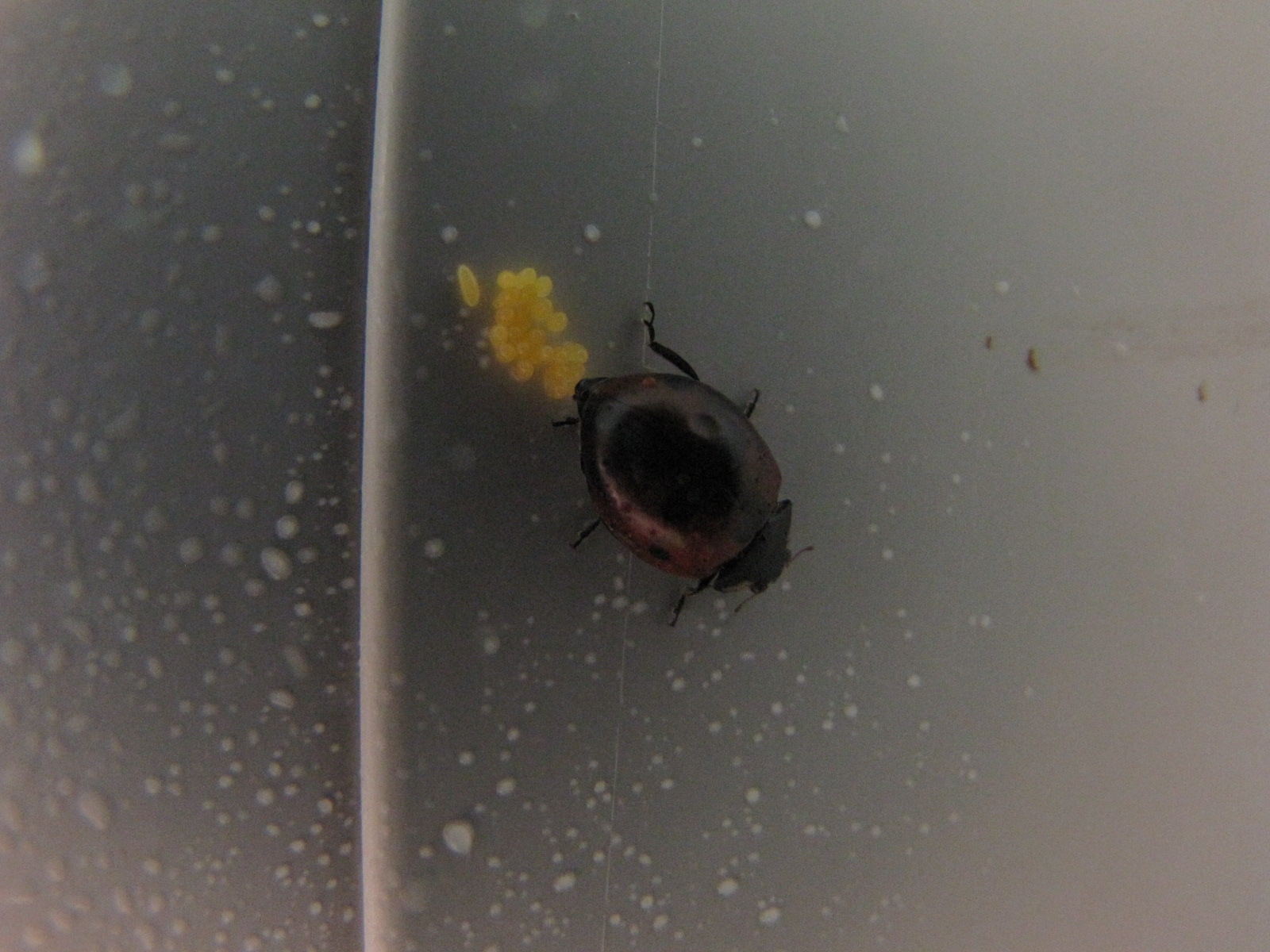
Most mornings I spritz the chocolate peppermint plant on our bedroom windowsill from a spray bottle of water. It loves to be damp. It is growing so well these days, is so juicy and luscious, that the aphids are maintaining a healthy population on it despite my best efforts to squish them and the depredations of the ladybugs. This of course leads the ladybugs to congregate on the mint, as the aphids, thrips and whiteflies have been picked clean off our other plants. And you know what happens when beetles congregate in the spring. This morning as I was spraying, I noticed one of the ladybugs laying eggs on the window frame!
There are about 30 eggs so far and she is still laying. The great thing about this is that labybug larvae are wonderful aphid predators, and don't fly away the way the adults do. So I'm going to transfer the eggs onto a leaf and hope they hatch.
Sunday, October 18, 2009
Nuts with no squirrels
At my parent's home in New York State, the acorns don't last long. The deer, squirrels, chipmunks and turkeys quickly gobble up, hoard or bury the best nuts, leaving only the small and wormy nuts for the insects and mice. A forest ecologist I once worked for told me that oaks are reproducing poorly in the northeastern US, in part because the unnaturally high deer populations consume so many acorns.
Walking through the woods around Rostock is a stark contrast, despite the similar mix of trees. Here, it is nearly impossible to avoid stepping on piles of big, healthy nuts. Acorns, chestnuts, beechnuts, walnuts. All the trees seem to be dropping fantastic numbers of nuts, and nothing but insects and a few birds seems to be eating them. Here neither deer nor squirrels seem to be common in urban parks as they are in the US. In fact the only wild mammals we have seen around Rostock are Fledermäuse (bats) flying around at dusk and a jackrabbit or two. The ground in the parks is also full of mole tunnels (must be moles, as there are no gophers or other rodent tunnelers here). There are of course some mice and rats, but we haven't seen them and their numbers don't seem up to the task of disposing of all those nuts.
In North America, deer and gray squirrels have increased their numbers and expanded their ranges as humans have removed predators and made food available year-round. In western Europe, where the native animals have a far longer history of being persecuted by humans, where large wilderness areas are rare, and where there seem to be fewer native mammal species anyway (perhaps because of extinctions?) there just doesn't seem to be anyone to fill that urban nut-eater niche. There aren't even any turkeys or other birds big enough to eat nuts whole. Under such circumstances, I wonder if the nut trees do well because their nuts aren't all eaten, or do poorly because their nuts don't get buried, passed though germination-inducing digestive systems and dispersed.
Walking through the woods around Rostock is a stark contrast, despite the similar mix of trees. Here, it is nearly impossible to avoid stepping on piles of big, healthy nuts. Acorns, chestnuts, beechnuts, walnuts. All the trees seem to be dropping fantastic numbers of nuts, and nothing but insects and a few birds seems to be eating them. Here neither deer nor squirrels seem to be common in urban parks as they are in the US. In fact the only wild mammals we have seen around Rostock are Fledermäuse (bats) flying around at dusk and a jackrabbit or two. The ground in the parks is also full of mole tunnels (must be moles, as there are no gophers or other rodent tunnelers here). There are of course some mice and rats, but we haven't seen them and their numbers don't seem up to the task of disposing of all those nuts.
In North America, deer and gray squirrels have increased their numbers and expanded their ranges as humans have removed predators and made food available year-round. In western Europe, where the native animals have a far longer history of being persecuted by humans, where large wilderness areas are rare, and where there seem to be fewer native mammal species anyway (perhaps because of extinctions?) there just doesn't seem to be anyone to fill that urban nut-eater niche. There aren't even any turkeys or other birds big enough to eat nuts whole. Under such circumstances, I wonder if the nut trees do well because their nuts aren't all eaten, or do poorly because their nuts don't get buried, passed though germination-inducing digestive systems and dispersed.
Friday, July 31, 2009
Like most places in the northeastern US, Vermont has been having a very wet summer. It rains most days, and the ground rarely has time to dry out before the next rain. This is just how the slugs like it. They seem to be everywhere, doing all their usual sluggy things: eating leaves, devouring mushrooms, sitting on wet rocks, getting squished on the sidewalk. What else is there for slugs to do? This afternoon I saw a group of slugs doing something I've never seen slugs do, or even heard of them doing.
Yesterday, a couple of blocks from home, I passed a freshly roadkilled squirrel. By today, most of the carcass was gone, with only bits and chunks scattered on the shoulder. And on each little morsel sat a garden variety slug, chowing down. The bigger chunks had two or three slugs, each about an inch long, actively feeding (or at least that's what it looked like, it was hard to know for sure, as their mouthparts are underneath). There were a few slugs that had been run over as they fed, and others had come in to finish the job, and eat there recently departed kin.
I've watched slugs eat hundred of times, and it has always been on plant matter or fungi. It never occurred to me that they might eat meat. So of course I checked what Wikipedia had to say on the subject:
Yesterday, a couple of blocks from home, I passed a freshly roadkilled squirrel. By today, most of the carcass was gone, with only bits and chunks scattered on the shoulder. And on each little morsel sat a garden variety slug, chowing down. The bigger chunks had two or three slugs, each about an inch long, actively feeding (or at least that's what it looked like, it was hard to know for sure, as their mouthparts are underneath). There were a few slugs that had been run over as they fed, and others had come in to finish the job, and eat there recently departed kin.
I've watched slugs eat hundred of times, and it has always been on plant matter or fungi. It never occurred to me that they might eat meat. So of course I checked what Wikipedia had to say on the subject:
"Many species of slugs play an important role in ecosystems by eating dead leaves, fungus, and decaying vegetable material. Other species eat parts of living plants.Which makes me wonder if there was ever a B movie about giant radioactive predatory slugs.
Some slugs are predators, eating other slugs and snails, or earthworms.
Most slugs will on occasion also eat carrion, including dead of their own kind."
Friday, February 06, 2009
Carnival of Science!
The lead story on the BBC New's Science and Environment page is on the research of one of the post-doctoral researchers in my professor's lab. The idea is rather simple, the process was complex.
We know that climate changes over time, and that where one can find a particular type of habitat changes with the climate. Recently, using a wide range of data sources, scientists have been constructing both a detailed history of how climate has changed over time and what climate parameters limit the extent of particular habitats, such as South America's Atlantic Rainforest. My lab-mate, Ana Carnival (along with several collaborators) combined the climate history data with the climate requirement data to make maps of how the extent of the Atlantic forest has changed over the last 20,000 years. She found that there were a few relatively small areas that had been rainforest the whole time, even when climate shifts caused the rest of it to change to other habitat types, such as grassland. She identified these as 'rainforest refugia,' areas where rainforest species could survive through the millenia when the climate was inhospitable elsewhere. She then predicted that these refugia should be the centers from which genetic diversity spread to the rest of the forest once its borders once again grew. To test these predictions, she gathered genetic samples from three species of frogs which can survive only in the rainforest. Sure enough, the frog's DNA told the story she had predicted, confirming the refugia she had identified based on climate models. This is not only cool science, it has significant conservation implications. These refugia should house a large portion of the diversity found in the rainforest, because at some points in the last 20K years, all the rainforest species lived there. This suggests that if we are forced to make choices about which land to preserve (which we are) we might do well to preserve these refugia. And both the methods and the conclusions are potentially generalizable to other thretened habitats around the world.
One final thought: This is very cool work, and very much in line with what most people in my adviser's lab study, but it is so far from my own work that I barely understand the details. This may be why I don't notice any glaring errors in the BBC article, or maybe the UK press are not as bad at writing about science as the American press.
We know that climate changes over time, and that where one can find a particular type of habitat changes with the climate. Recently, using a wide range of data sources, scientists have been constructing both a detailed history of how climate has changed over time and what climate parameters limit the extent of particular habitats, such as South America's Atlantic Rainforest. My lab-mate, Ana Carnival (along with several collaborators) combined the climate history data with the climate requirement data to make maps of how the extent of the Atlantic forest has changed over the last 20,000 years. She found that there were a few relatively small areas that had been rainforest the whole time, even when climate shifts caused the rest of it to change to other habitat types, such as grassland. She identified these as 'rainforest refugia,' areas where rainforest species could survive through the millenia when the climate was inhospitable elsewhere. She then predicted that these refugia should be the centers from which genetic diversity spread to the rest of the forest once its borders once again grew. To test these predictions, she gathered genetic samples from three species of frogs which can survive only in the rainforest. Sure enough, the frog's DNA told the story she had predicted, confirming the refugia she had identified based on climate models. This is not only cool science, it has significant conservation implications. These refugia should house a large portion of the diversity found in the rainforest, because at some points in the last 20K years, all the rainforest species lived there. This suggests that if we are forced to make choices about which land to preserve (which we are) we might do well to preserve these refugia. And both the methods and the conclusions are potentially generalizable to other thretened habitats around the world.
One final thought: This is very cool work, and very much in line with what most people in my adviser's lab study, but it is so far from my own work that I barely understand the details. This may be why I don't notice any glaring errors in the BBC article, or maybe the UK press are not as bad at writing about science as the American press.
Wednesday, January 14, 2009
Can't live with'em can't live without 'em.
Biologists and Ecologists have (mostly) learned to give at least some forethought to the consequences of introducing non-native species. The problems invasive species cause are often most sever on islands, where the native species often have limited evolutionary experience dealing with the relative of the invaders. For example, many island endemic bird species were flightless, as there were no land based predators to need to fly away from, so why bother building all that expensive escape equipment when there is nobody to escape from. Other island nesting birds, like those on Macquarie Island can fly (except the penguins) but don't seem to have the right tricks in their behavioral repertoires to escape from introduced predators.
A recent attempt to help these birds is making ecologists aware that one has to be very careful not only about introducing invasive species, but also about removing them. A commentary in Nature describes the story:
The Australian authorities who run Macquarie Island are now trying to figure out how to exterminate the rabbits, rats and mice without harming other native populations, such as the seals and sea lions that breed on the island. They estimate it will take tens of millions of dollars, and that may be optimistic. Few efforts to irradicate rodents from any land mass of decent size have succeeded. Macquarie Island, at 128 km², offers a lot of hiding places big enough for a rat. Miss one pregnant rat and in just few years you are back to square one. And who knows what effect the rats would have without rabbits around harboring disease and eating potential cover? Rats eat bird eggs, and have been known to finish off large bird colonies in just a few years.
The lesson learned is that just because introducing species is generally bad, removing those introduced species from an ecosystem that has started to adjust to their input isn't always good. At least it has to be done very carefuly.
A recent attempt to help these birds is making ecologists aware that one has to be very careful not only about introducing invasive species, but also about removing them. A commentary in Nature describes the story:
So the island has cats, rabbits, rabbit fleas, rabbit viruses as well as rats and mice, all introduced. The cats were bad for the birds because they ate them. The rabbits were introduced and were bad for the birds because they destroyed the vegetation, but good in that they distracted the cats. And the cats were at least partly good for the birds, because they ate the rabbits. Some kind of unstable plateau was reached. And then disease was introduced to reduce the rabbit population, leaving a whole bunch of hungry cats, which were bad for the birds. But then the cats were killed off, which was bad for the birds and everything else (except the rabbits, rats and mice) because for the first time there were rabbits without cats on the island. The rabbits, unchecked, ate through most of the island's plants. And this, of course, is a vast over simplification.Cats were introduced to the Macquarie Island in 1818; sealers introduced rabbits 60 years later.
The rabbits tore through the island's vegetation. In 1968, the rabbit flea was introduced. Once that had established the lethal myxomatosis virus — which the flea spreads — was introduced in 1978.
Rabbit numbers crashed, but then the cats, which had previously eaten rabbits, switched their attentions to the island's birds.
But once the cats were gone, the few hardy rabbits that had survived both the cats and the myxomatosis emerged and began doing what rabbits do best — breeding and eating.
The Australian authorities who run Macquarie Island are now trying to figure out how to exterminate the rabbits, rats and mice without harming other native populations, such as the seals and sea lions that breed on the island. They estimate it will take tens of millions of dollars, and that may be optimistic. Few efforts to irradicate rodents from any land mass of decent size have succeeded. Macquarie Island, at 128 km², offers a lot of hiding places big enough for a rat. Miss one pregnant rat and in just few years you are back to square one. And who knows what effect the rats would have without rabbits around harboring disease and eating potential cover? Rats eat bird eggs, and have been known to finish off large bird colonies in just a few years.
The lesson learned is that just because introducing species is generally bad, removing those introduced species from an ecosystem that has started to adjust to their input isn't always good. At least it has to be done very carefuly.
Monday, February 25, 2008
Biofuels won't fix it.
Pretty much every issue of Trends in Ecology and Evolution has a paper or two worth the reading. I thought this one was worth drawing your attention to:
Christopher B. Field, J. Elliott Campbell and David B. Lobell. 2008. Biomass energy: the scale of the potential resource. Trends in Ecology & Evolution. Volume 23, Issue 2, Pages 65-72
Abstract:
Increased production of biomass for energy has the potential to offset substantial use of fossil fuels, but it also has the potential to threaten conservation areas, pollute water resources and decrease food security. The net effect of biomass energy agriculture on climate could be either cooling or warming, depending on the crop, the technology for converting biomass into useable energy, and the difference in carbon stocks and reflectance of solar radiation between the biomass crop and the pre-existing vegetation. The area with the greatest potential for yielding biomass energy that reduces net warming and avoids competition with food production is land that was previously used for agriculture or pasture but that has been abandoned and not converted to forest or urban areas. At the global scale, potential above-ground plant growth on these abandoned lands has an energy content representing ~5% of world primary energy consumption in 2006. The global potential for biomass energy production is large in absolute terms, but it is not enough to replace more than a few percent of current fossil fuel usage. Increasing biomass energy production beyond this level would probably reduce food security and exacerbate forcing of climate change.
Christopher B. Field, J. Elliott Campbell and David B. Lobell. 2008. Biomass energy: the scale of the potential resource. Trends in Ecology & Evolution. Volume 23, Issue 2, Pages 65-72
Abstract:
Increased production of biomass for energy has the potential to offset substantial use of fossil fuels, but it also has the potential to threaten conservation areas, pollute water resources and decrease food security. The net effect of biomass energy agriculture on climate could be either cooling or warming, depending on the crop, the technology for converting biomass into useable energy, and the difference in carbon stocks and reflectance of solar radiation between the biomass crop and the pre-existing vegetation. The area with the greatest potential for yielding biomass energy that reduces net warming and avoids competition with food production is land that was previously used for agriculture or pasture but that has been abandoned and not converted to forest or urban areas. At the global scale, potential above-ground plant growth on these abandoned lands has an energy content representing ~5% of world primary energy consumption in 2006. The global potential for biomass energy production is large in absolute terms, but it is not enough to replace more than a few percent of current fossil fuel usage. Increasing biomass energy production beyond this level would probably reduce food security and exacerbate forcing of climate change.
Saturday, February 16, 2008
Deer Populations and Ecological Illiteracy
The New York Times this week has an article about deer overpopulation in New Jersey (although the problem is just as bad throughout the forested northeast) and efforts to control it through culls.
The problem, and reactions to it, demonstrate the deep ecological illiteracy informing both sides of the debate. Groups that value the deer see them as a natural and beautiful part of the landscape. They are beautiful, and individually they are natural, but their populations are much higher than they would ever have been naturally. This is partially because of removal of predators (deer evolved to breed faster than the wolves and mountain lions could eat them) and partially because we have created so much high quality feeding habitat for them. Deer find the easiest and best food at forest edges, and because of human land use there is so much more forest edge than there has ever been before. Somebody or other, maybe Audubon, said that a squirrel could travel from Maine to Louisiana without ever having to come down from the trees. These were big trees with their leaves way up where deer can't reach, and very few breaks. The forests of the east are now young and fragmented; basically an all you can eat for the deer. And we can no longer rely on long snowy winters to cull deer populations every year. As a result, the effects that deer are having on the forest is very far from natural.
Experiments with deer exclosures (basically large fenced areas, chosen randomly in the forest to see what happens without deer) are fairly unambiguous. I've seen these experiments first hand in the old growth forest of upper Michigan. Working for ecologist Dr. Kerry Woods the summer after I graduated from college, one of my tasks was to revisit exclosures he'd built three years earlier. Outside the exclosures, where the deer can get, extremely few seedlings make it. The forest has an open, park like feeling, no understory. The deer population is so dense everything gets mowed. Inside the exclosures, dense hedges of rapidly growing saplings compete for light, but any branch that reaches outside the enclosure is quickly nipped off. This forest that had never been cut by humans was being kept from replacing itself by the deer overpopulation. The same pattern is being found all over the north-east.
But if the people who see the deer as wonderful parts of nature are ignoring ecology, they are not alone. Those who see deer overpopulation as a problem generally ignore the same ecological facts. Governments organize huge one time culls in limited areas, and are then surprised when deer from next door are attracted by the unexploited greenery. Deer populations with plenty of food and few predators can double every two years or so. Shoot 1500 out of 2000 deer in your county and four years later you are back where you started, even if you don't have deer moving in from adjoining counties.
Basic arithmetic tells us that until White Tailed Deer mortality rates exceed birth rates throughout the northeast, the regional population will not decline. Birthrates are unlikely to decline, unless the structure of the current forest changes so much that the deer are nutritionally limited. Not likely. And plans to control the wild regional population through some sort of sterilization program strike me as ludicrously expensive and incredibly unlikely to work.
So what causes mortality? Disease, winter, cars, predators, hunters. Disease we don't want to encourage, especially considering that many diseases that affect deer can also fell horses, sheep, cows and such. Winters are tending weaker. Sever storms are increasing, but to really knock back the deer population, one needs a winter that is very cold and snowy for months over a large area. Not likely. Few would advocate increased car-deer collisions. Hunters are limited in where they can hunt by the danger of bullets carrying to nearby houses, roads and such. And hunting seasons are limited, in part to make forests safe for other uses the rest of the year. There is also mounting evidence that deer hunters regularly dose themselves and their families with lead when they bring the carcass home. Natural predators are few and far between in the northeast, although coyotes are becoming both more common and larger, making it easier for them to bring deer down. The traditional predators, wolves and mountain lions, are unlikely to be restored to populations in the northeast sufficient to keep the deer in check.
So if reducing deer populations is important and none of our current strategies seem promising, what do I suggest? Integrated pest management. Look at the problem on a broad geographic scale, understand the demography in as much detail as we can, and figure out what the vulnerable point in the demographic cycle is. As an example, hunting seasons were traditionally in the fall and winter, exactly because hunting then reduces the deer herd the least. Fewer winter deaths, no pregnant does, few dependant young. If we really want to keep deer populations down, hunting should be done in the spring. Hunters have traditionally hoped for a buck. But killing a buck does basically nothing to reduce the population in the long term. Some other buck will be happy to inseminate all the does. One buck and a hundred does will produce just as many fawns as one hundred bucks and one hundred does. If our goal is to bring the population down, we need to target does, and let hunters take as many as they please, perhaps requiring the donation of excess meat to charitable food pantries. And we should do it with non-lead ammunition, so we don't poisoning ourselves in the process. And we should be honest enough to admit that we are going to have to do this every year in perpetuity, until the ecology of the northeast changes enough that deer populations are regulated naturally.
The problem, and reactions to it, demonstrate the deep ecological illiteracy informing both sides of the debate. Groups that value the deer see them as a natural and beautiful part of the landscape. They are beautiful, and individually they are natural, but their populations are much higher than they would ever have been naturally. This is partially because of removal of predators (deer evolved to breed faster than the wolves and mountain lions could eat them) and partially because we have created so much high quality feeding habitat for them. Deer find the easiest and best food at forest edges, and because of human land use there is so much more forest edge than there has ever been before. Somebody or other, maybe Audubon, said that a squirrel could travel from Maine to Louisiana without ever having to come down from the trees. These were big trees with their leaves way up where deer can't reach, and very few breaks. The forests of the east are now young and fragmented; basically an all you can eat for the deer. And we can no longer rely on long snowy winters to cull deer populations every year. As a result, the effects that deer are having on the forest is very far from natural.
Experiments with deer exclosures (basically large fenced areas, chosen randomly in the forest to see what happens without deer) are fairly unambiguous. I've seen these experiments first hand in the old growth forest of upper Michigan. Working for ecologist Dr. Kerry Woods the summer after I graduated from college, one of my tasks was to revisit exclosures he'd built three years earlier. Outside the exclosures, where the deer can get, extremely few seedlings make it. The forest has an open, park like feeling, no understory. The deer population is so dense everything gets mowed. Inside the exclosures, dense hedges of rapidly growing saplings compete for light, but any branch that reaches outside the enclosure is quickly nipped off. This forest that had never been cut by humans was being kept from replacing itself by the deer overpopulation. The same pattern is being found all over the north-east.
But if the people who see the deer as wonderful parts of nature are ignoring ecology, they are not alone. Those who see deer overpopulation as a problem generally ignore the same ecological facts. Governments organize huge one time culls in limited areas, and are then surprised when deer from next door are attracted by the unexploited greenery. Deer populations with plenty of food and few predators can double every two years or so. Shoot 1500 out of 2000 deer in your county and four years later you are back where you started, even if you don't have deer moving in from adjoining counties.
Basic arithmetic tells us that until White Tailed Deer mortality rates exceed birth rates throughout the northeast, the regional population will not decline. Birthrates are unlikely to decline, unless the structure of the current forest changes so much that the deer are nutritionally limited. Not likely. And plans to control the wild regional population through some sort of sterilization program strike me as ludicrously expensive and incredibly unlikely to work.
So what causes mortality? Disease, winter, cars, predators, hunters. Disease we don't want to encourage, especially considering that many diseases that affect deer can also fell horses, sheep, cows and such. Winters are tending weaker. Sever storms are increasing, but to really knock back the deer population, one needs a winter that is very cold and snowy for months over a large area. Not likely. Few would advocate increased car-deer collisions. Hunters are limited in where they can hunt by the danger of bullets carrying to nearby houses, roads and such. And hunting seasons are limited, in part to make forests safe for other uses the rest of the year. There is also mounting evidence that deer hunters regularly dose themselves and their families with lead when they bring the carcass home. Natural predators are few and far between in the northeast, although coyotes are becoming both more common and larger, making it easier for them to bring deer down. The traditional predators, wolves and mountain lions, are unlikely to be restored to populations in the northeast sufficient to keep the deer in check.
So if reducing deer populations is important and none of our current strategies seem promising, what do I suggest? Integrated pest management. Look at the problem on a broad geographic scale, understand the demography in as much detail as we can, and figure out what the vulnerable point in the demographic cycle is. As an example, hunting seasons were traditionally in the fall and winter, exactly because hunting then reduces the deer herd the least. Fewer winter deaths, no pregnant does, few dependant young. If we really want to keep deer populations down, hunting should be done in the spring. Hunters have traditionally hoped for a buck. But killing a buck does basically nothing to reduce the population in the long term. Some other buck will be happy to inseminate all the does. One buck and a hundred does will produce just as many fawns as one hundred bucks and one hundred does. If our goal is to bring the population down, we need to target does, and let hunters take as many as they please, perhaps requiring the donation of excess meat to charitable food pantries. And we should do it with non-lead ammunition, so we don't poisoning ourselves in the process. And we should be honest enough to admit that we are going to have to do this every year in perpetuity, until the ecology of the northeast changes enough that deer populations are regulated naturally.
Tuesday, October 23, 2007
Ecological causes and effects of SoCal fires: Initial thoughts
There are numerous wildfires currently blackening southern California. The short term response has to be to the fire itself. Save the people, save the pets, save the homes and the businesses. But what should be the response when the fires are out? Ruibiuld everything exactly as is was? That is the most likely outcome. After a disaster, people want to rebuild, regardless of how likely it is that disaster will happen again. But how likely is it these fires will return? What ecological factors played into this disaster, what ecological effects can be expected and what lessons should we draw from all of this?
I feel it is important to raise these issues before everyones attention moves on and we fail to learn from previous mistakes. I'll appreciate your input and comments.
With no further ado:
Ecological Causes:
1. Obviously the big'un is the Santa Ana Wind, the hot dry wind that blow-dries out of the Great Basin and over southern California every year. The topography and climate of coastal southern California, combined with the Santa Anas make for fires pretty much every year. It is being reported that the Santa Ana's are stronger and more persistent than usual this year. It is not yet known, so far as I know, if the Santa Ana's are expected to be stronger every year now that the Great Basin's climate is turning much hotter and drier.
2. California has had an unusually dry year this year. Unusual meaning "in comparison to the last 150 years." This year may turn out to be unusually wet as compared to the next 150 years, because, as mentioned, the climate of the southwest is drying.
3. A lot of these areas have many times the natural fuel-load. The last 150 years are important, because that is how long we have been suppressing fires in southern California. This unusually wet period allowed for a lot of biomass to build up, and not burn off, because we would not let it burn.
The natural time between fires in most of these areas is a few decades. Fires would pass through, burn off much of the fuels without destroying the local ecology because in most cases, the previous fire was recent enough to keep this fire from getting too hot. By putting out every fire we could for so long, we allowed the fuel load to build up to the point that the fires now get incredibly hot and spread incredibly fast. Some of the areas currently burning have burned recently, but the mean time since the last fire is much higher than what is natural.
4. We tend to build our settlements and structures without regard to the fact that we are building in a fire maintained ecology, and another fire will come. By failing to take that into account, we make things that much harder for firefighters and those who need to evacuate. It is like building in a floodplain and expecting your house to not get washed away every once in a while.
5. The climate is changing and the southwest is becoming more of a desert. When wet areas dry out, the vegetation eventually burns off.
Ecological Effects:
1. California is a world center of biodiversity, and quite a few of our species are found nowhere else. Many of the native plants and animals are already endangered by habitat loss, invasive species, pollution and climate change. Most of our natural areas are fragmented by human edifices. The native populations could deal with the comparatively mild natural wildfires of the past. Smaller, more fragmented and already declining native species with small ranges may well have trouble keeping a foothold in areas burning as hot and wide as the current fires.
I have a colleague who studies a species of native mouse found primarily in San Diego County. This year he could find almost none of his mice because their habitat is turning to desert. He did find them in a few places. In the last two days some of those places have gone up in smoke.
2. Fuel loads in the areas currently burning will be reduced, which is both good and bad. Good in that future fires will have less fuel. Bad in that all that fuel load was sequestered carbon, which is now in the atmosphere, and because the drier southwest won't have as much vegetation, that carbon is not going to be taken back out by the same land. My guess is, without having seen any numbers, that total carbon output from these fires will actually be quite minuscule on a global scale, and we are better off without all that tinder lying around.
3. If the rains in SoCal do get started in a month or two, we can expect some serious erosion from all the areas that have been stripped of their vegetation.
Lessons, not just for SoCal, but for the country:
1. Don't just let fuel build up until it explodes. Areas like this need to have some plan for how to get rid of fuel. My personal preference is controlled burns at times of year when the fire is easier to keep in hand. We can't keep pretending we can keep fire based ecologies from burning forever.
2. Notice that climate change is a serious problem now. Stop making the problem worse.
3. Take fire risk into consideration when deciding where and when to build. Developers should be legally responsible for planning their developments such that they are not putting residents and firefighters at risk. Planners should disallow building in areas that cannot be defended from fires.
I feel it is important to raise these issues before everyones attention moves on and we fail to learn from previous mistakes. I'll appreciate your input and comments.
With no further ado:
Ecological Causes:
1. Obviously the big'un is the Santa Ana Wind, the hot dry wind that blow-dries out of the Great Basin and over southern California every year. The topography and climate of coastal southern California, combined with the Santa Anas make for fires pretty much every year. It is being reported that the Santa Ana's are stronger and more persistent than usual this year. It is not yet known, so far as I know, if the Santa Ana's are expected to be stronger every year now that the Great Basin's climate is turning much hotter and drier.
2. California has had an unusually dry year this year. Unusual meaning "in comparison to the last 150 years." This year may turn out to be unusually wet as compared to the next 150 years, because, as mentioned, the climate of the southwest is drying.
3. A lot of these areas have many times the natural fuel-load. The last 150 years are important, because that is how long we have been suppressing fires in southern California. This unusually wet period allowed for a lot of biomass to build up, and not burn off, because we would not let it burn.
The natural time between fires in most of these areas is a few decades. Fires would pass through, burn off much of the fuels without destroying the local ecology because in most cases, the previous fire was recent enough to keep this fire from getting too hot. By putting out every fire we could for so long, we allowed the fuel load to build up to the point that the fires now get incredibly hot and spread incredibly fast. Some of the areas currently burning have burned recently, but the mean time since the last fire is much higher than what is natural.
4. We tend to build our settlements and structures without regard to the fact that we are building in a fire maintained ecology, and another fire will come. By failing to take that into account, we make things that much harder for firefighters and those who need to evacuate. It is like building in a floodplain and expecting your house to not get washed away every once in a while.
5. The climate is changing and the southwest is becoming more of a desert. When wet areas dry out, the vegetation eventually burns off.
Ecological Effects:
1. California is a world center of biodiversity, and quite a few of our species are found nowhere else. Many of the native plants and animals are already endangered by habitat loss, invasive species, pollution and climate change. Most of our natural areas are fragmented by human edifices. The native populations could deal with the comparatively mild natural wildfires of the past. Smaller, more fragmented and already declining native species with small ranges may well have trouble keeping a foothold in areas burning as hot and wide as the current fires.
I have a colleague who studies a species of native mouse found primarily in San Diego County. This year he could find almost none of his mice because their habitat is turning to desert. He did find them in a few places. In the last two days some of those places have gone up in smoke.
2. Fuel loads in the areas currently burning will be reduced, which is both good and bad. Good in that future fires will have less fuel. Bad in that all that fuel load was sequestered carbon, which is now in the atmosphere, and because the drier southwest won't have as much vegetation, that carbon is not going to be taken back out by the same land. My guess is, without having seen any numbers, that total carbon output from these fires will actually be quite minuscule on a global scale, and we are better off without all that tinder lying around.
3. If the rains in SoCal do get started in a month or two, we can expect some serious erosion from all the areas that have been stripped of their vegetation.
Lessons, not just for SoCal, but for the country:
1. Don't just let fuel build up until it explodes. Areas like this need to have some plan for how to get rid of fuel. My personal preference is controlled burns at times of year when the fire is easier to keep in hand. We can't keep pretending we can keep fire based ecologies from burning forever.
2. Notice that climate change is a serious problem now. Stop making the problem worse.
3. Take fire risk into consideration when deciding where and when to build. Developers should be legally responsible for planning their developments such that they are not putting residents and firefighters at risk. Planners should disallow building in areas that cannot be defended from fires.
Subscribe to:
Posts (Atom)
