Showing posts with label science photos. Show all posts

Thursday, February 02, 2017

Friendly Advice for Your First NSF Pre-proposal

It is going to be okay. Very okay.

Let's start with the important information that until last month I, like anyone who needs to read this post, had never applied for, let alone received, US National Science Foundation research funding. Having been out of the US for most of my time since earning my Ph.D., and other extenuating circumstances, kept me from applying to this extremely important source of funds. As with my posts on applying for NIH and ERC funding (which I didn't get), I'm writing this not as an expert, but because most people who write advice on applying for NSF funding are to varying degrees experts, and have been doing it for so long that they have no idea what us newbies might not know. I've never been on an NSF panel, I've never been to NSF, and all my attempts to talk to NSF employees have been unsuccessful. I am, like you, an outsider. So I learned a lot along the way, much of it later than I should have, and I'd like to share some key points. Before we begin, let's take a moment to contemplate this bodacious caterpillar I found in the University of Wisconsin Arboretum last summer:

Wow!

Alright, now that you remember that you love science, and brim with important and exciting questions about the world, let's delve.

1. NSF, we can agree, does not have the funds to support more than a small fraction of the grant applications they receive. Other huge governmental funders of science, like NIH, are in a similar situation. (I am assuming here, perhaps in vain, that the US government under El Presidentisimo continues to invest in funding basic research at some meaningful level.) This is a problem not only in terms of almost-everybody-doesn't-get-funded, but in terms of the phenomenal amount of time that scientists squander writing unsuccessful grant applications. In many cases, months of each year are spent applying for funding that is not available. On the flip side, NSF has to harness huge amounts of scientists' time to serve on committees, wading through the reams of applications finding reasons to reject as many of them as possible.

NSF has attempted a partial solution to this problem: the preliminary application. Basically, one starts by writing a short (four pages of text, plus many ancillary documents, including a one page Project Summary) version that has to be approved by a committee before one is invited to submit a full application. Most applicants (about 75%, in the program I'm applying to) only have to write the short version before being rejected, and the committees mostly have to read piles of short applications, with relatively few longer ones coming after that.

2. Writing the preliminary application was honestly not that bad. Several reasons: No budget is required, and many of the ancillary documents that NSF needs before they can fund anyone don't get submitted until your preliminary proposal is approved. More importantly, I have good collaborators, who are in practice writing these things. There is a huge amount to know about NSF specific 'grantsmanship.' When the committee gets to our application, after having already scanned scores of others, they will be both eager to find something really interesting that keeps them awake, and eager to find some reason that the thing can be rejected, so that they can get it over with. They will be looking for key phrases that everyone should have, and possible pitfalls indicated by things only people who have served on these committees (or maybe only that particular committee) know about. In short, it would be tremendously surprising if someone who just had phenomenal scientific ideas but no insider guidance as to the evaluation process ever got funding. I am lucky to have had that guidance; while it means I did a lot of rewriting to try to conform to a culture I've never encountered, it also, hopefully, means we have some chance of being invited to submit a full proposal. If so, that's what I'll be doing this summer, again with about a 20-25% chance of success.

3. As with any funding application, reading past successful applications to the same program is important. Notice not only the language used, the level of methodological detail given, and the structure of the proposal, but also the scope and scale of the proposed science.

4. Write, and revise, the one page Project Summary, and make sure everyone in the project agrees on it, before bothering with the longer Project Description. I made the mistake of drafting the Project Summary, receiving only minimal feedback on it from one of my collaborators, then writing the rest of the grant. By the time I got more extensive feedback from this collaborator, I had only a few days to reconsider the scope of the work being proposed and extensively rewrite. The proposal ended up much better for it, but I could have gotten a lot more sleep if I'd pushed for more feedback after writing just the summary.

5. The whole thing really isn't that much writing. Given that one knows what one is doing, and has good communication with collaborators, a good draft can be banged out in a couple of solid days.

6. In most cases, the one page Summary has to be uploaded as unformatted text, and it takes up more space the way NSF automatically formats it than it would if you or I formatted it according to their rules. I, and a few people I've talked to, ended up hacking down the one page summary very shortly before the deadline when we figured this out.

7. In order to apply, you need an "NSF ID." Looking on the NSF web page, you will find lots of information on retrieving your NSF ID, what to do if you have two NSF IDs, whether NSF ID is the same thing as various other identifiers NSF has used in the past, and so on. You will not find any information about how to get an NSF ID if you don't already have one. If you call NSF to ask how to get one, they will be so confused by you that they won't be able to help you, as if you had called to ask how to breath in before speaking. You just do it, and you must already know how. So I will tell you the secret: somewhere in your university or other approved research organization, there is some individual with the official power to communicate with NSF to get you your very own NSF ID. You will have to find out who that person is and request the NSF ID several days before the application deadline. My collaborator at another university didn't get a reply to his request until a few hours before we submitted, and we were actively discussing what would happen if we had to leave him off the PI list. Don't let that happen to you.

8. Which reminds me of another important point. I was advised to contact the NSF Program Officer for my application when I had a nearly final Project Summary worked up. As mentioned above, that didn't happen until less than a week before the grant deadline, at which point the Project Officers were all swamped by others trying to meet the same deadline. I emailed the Program Officer, and got back a very short email, but never got to talk with her. Finishing your Project Summary early will allow you to get input from your Project Officer.

9. Be smart, work very hard, and have extremely good luck.

Thursday, September 18, 2014

Picture show (in Danish)

This spring I taught a field course in terrestrial zoology at Svanninge Bjerge, a nature area owned and operated by the Bikuben Foundation. The foundation had Casper Tybjerg, a well known Danish photographer, join us and take photos. Bikubenfonden has featured the course on the Svanninge Bjerge website, including posting many of his photos (including the above). If you start here, and click to the right, most of the next several dozen photos are from our course, and all are beautiful. The accompany text is in Danish.

It makes me all happy and proud and sad-that-it-is-over to look through these and remember what amazing fun that course was.

Friday, June 22, 2012

See no seagull

One advantage to living in the tallest building in town is that we can see who's sneaking around on the roofs of other buildings. That is in fact part of why our building was built so tall. Back when this was the German Democratic Republic (East Germany), this building was occupied mostly by the  Stasi (secret police) whose job it was to keep an eye on everyone all the time and their families. 

The building next to ours was the Stasi office building for the state. It has not only been taken over for university use, but there are Herring Gulls nesting on its roof. I spotted two big chicks wandering around yesterday. It is a great place for nesting: high up, with a rim so the chicks won't jump out, and fitted with the finest 1970's surveillance equipment. The roof is even roughly chick-colored, which is probably why until now I have seen no seagull.

Wednesday, March 14, 2012

Friendly advice for your first NIH grant application

I've just submitted my first National Institutes of Health grant application (or rather administrators at my collaborator's university have submitted an application that I wrote most of). In preparing to write it, I read a lot of online advice ranging from the general 'how to write an NIH grant' to the specific 'the clause-structure I use while writing my cover letter for maximizing the chances that it will be sent to my preferred review committee.' People who regularly apply for NIH money refer to NIH funded research as an industry, and like any industry, there is a lot to know to compete successfully. NIH pays or invites some people to write advice on 'good grantsmanship' and many others, for a variety of reasons (perhaps on their blogs) write advice essays. Most of this advice starts with a paragraph or two along the lines of, "I've been conducting NIH funded research since 1982, and am currently involved in seven NIH funded projects, four as PI (Primary Investigator). I've served on 12 review panels and helped to amend the rules on permissible administrative expenditures on research grants in 2002 and again in 2006." And so on. The message is, "I am an expert on NIH funding applications and therefore qualified to advise you." While these people certainly are qualified and anyone planning to apply should read as much of their advice as bearable, there are two points I would like to make about this that they may not have considered. The first is that the way they write their advice, including the way they lay out their qualifications, reads very much like an NIH application. It makes me wonder if becoming expert in these applications makes it hard to write a love letter that isn't in the form of a funding application."Specific Aim 2: Produce a rapid natural release of endorphins, aiding current pleasure, speeding forgetfulness of discomfort and fomenting pair-bonding."

Second, and more seriously, I have the impression that none of these people nor the people writing the instruction books or the FAQs on the NIH websites have any memory of what it is like to not already know how to apply for NIH funding. The instruction book is full of rules that are explained not in terms of what you have to do, but in terms of how what you have to do is different than what it was before the changes to regulation #SF5326BB777. They use all sorts of words that are normal English words but don't mean what they normally mean, without explaining, because however NIH usually uses a word is its normal meaning to them. (This, by the way, is very close to the technical definition of jargon).

So I'd like to offer a few pieces of advice to people considering applying for their first NIH grant. I am not an expert, have never served on (or been invited to serve on) a review panel and may or may not ever have any NIH funding, but when I was a kid my dad worked just a few blocks from NIH headquarters, and I once spilled an incredibly powerful neurotoxin on myself inside an NIH laboratory. Before I start, consider this unrelated photo (of a 2.5 inch long weevil I once found in my hair) that helps to break up the text:

Notice that its sharp mouth parts are at the end of its huge nose. Cool huh?

Okay, here goes:

1. Before doing anything else, ask yourself if you can spare the two or three hundred working hours your first NIH application is likely to take you. If you can't, don't. Subsequent applications may take an order of magnitude less time, but this is going to be a slog.

2. Before doing anything second else, find colleagues who know all about applying for NIH grants and buy them beer, chocolate, whatever it takes. Wash their cars, baby-sit their kids, fix their refrigerators, do their laundry. This will save you so much time. If you are very lucky your department/institute/whatever may even have someone whose job includes guiding you through the process. If so, flowers and a gift-certificate to a nearby spa are in order. If you can by any means obtain copies of past successful grants to use as Rosetta Stones in figuring out what the instructions mean, then you have some chance of retaining your sanity.

3. Next, find out who is your SO (Signing Officer, an administrator officially authorized to sign legal documents on behalf of your organization). You don't submit the grant, the SO does. She also has to do various other registration tasks, meaning that they need to know that you will apply several weeks before you actually do. If you just found out that the deadline is in three weeks, relax. There will be another deadline some months in the future, and by then you may have found some other way to fund your work. The SO will need all the forms you are to prepare at least a week before the official due date, as there are a whole bunch of other forms they have to fill out seperately.

4. Don't panic. Download the 264 page instruction book (a.k.a. "SF424 (R&R)
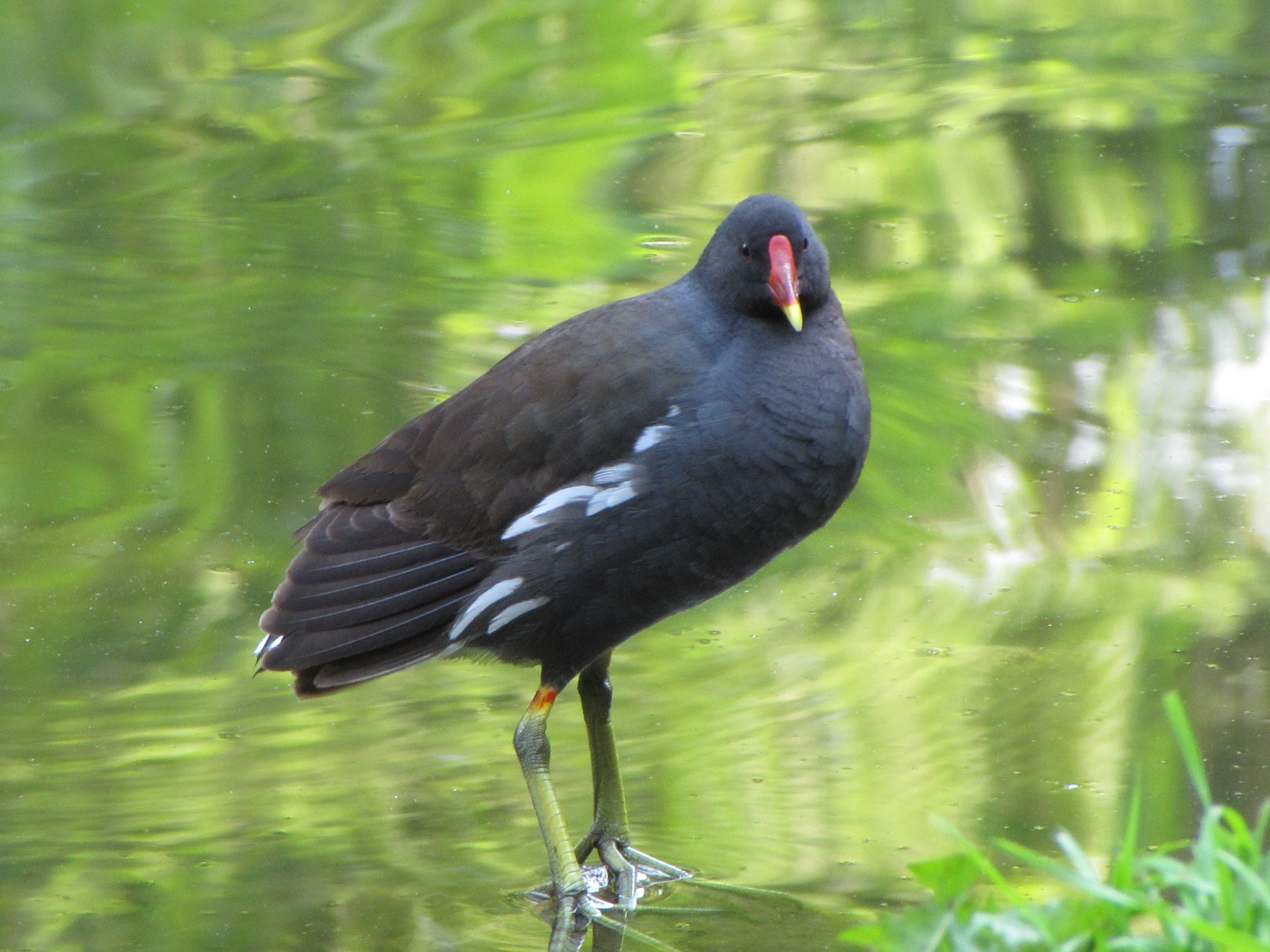
Application Guide for NIH and Other PHS Agencies"). Here is a picture of a moorhen to help you not panic as you download:

Can you see how long its toes are? Fricken' long. Imagine soaking your extra-long toes in a nice summer pond.

5. Do not print out the instruction book. It is 264 pages. You will need to constantly jump from section to section to hunt down the clues and riddles needed to fill out each of the approximately 30 forms you will complete. Keep it digital so you can search for relevant terms.

6. Do print out this glossary of NIH terms. Then read it. Then read it again to see if you understand it any better. Keep in mind that while necessary, this glossary is wildly incomplete, because NIH people can't guess what terms non-NIH people won't understand. Also keep in mind that when they use a term to define itself, they mean well.

7. The National Institutes of Health are called "Institutes" because they have quite a few different topic-specific Institutes, plus a bunch of Centers and several Divisions. You are supposed to know which of these is most likely to be interested in funding your work, contact the appropriate PO (program officer) and pitch it to them before then writing in your cover letter than you contacted that PO and she encouraged you to apply to that Institute, Center or Division. There are very detailed guidelines you should follow in writing to that PO. You are supposed to already know which PO within the appropriate branch is the appropriate PO. The only way I found of finding this out was to spend countless hours on the NIH web pages learning about the structure of NIH, then countless more hours reading those pages before making a wild (and wrong) guess. Luckily the person I wrote to (who wasn't even at the Institute I thought she was at) directed me to another person, who told me that I was heading the wrong way. Eventually I made a decision.

8. Go through the instruction book and make a list of all the forms and attachments you will need. Depending on the specifics, there could be anywhere from 15 to infinity of them. On your list, make notes as to the purpose of each form and what is an attachment to which extension to which sub-form. Also note which parts you have to do and which parts the SO has to do, and then confirm this with the SO. Then look at these pieces in the pile of example applications you've gathered.

9. Don't plan any vacations for before the due date. Plan a vacation for after the due date.

10. You may notice that I have not yet mentioned anything about science. At least once a week, think about the scientific goal of your application. It is very easy to lose track of the fact that there is some reason you are putting yourself through this.

Thursday, January 05, 2012

A, alligators all around


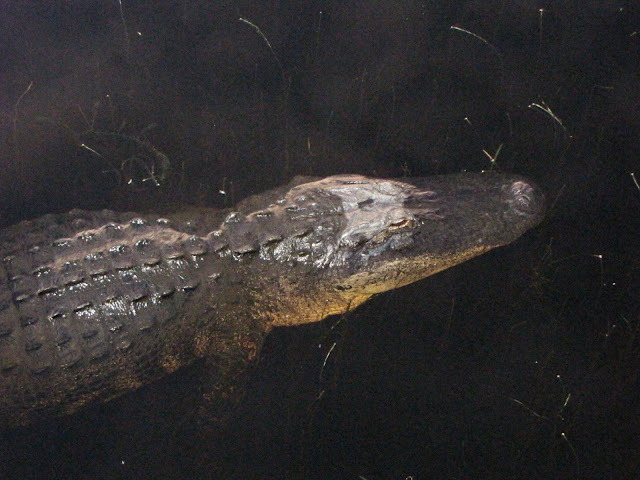
They say that the distance in inches between an alligator's eyes and its nostrils is equal to the length of the whole animal in feet. This behemoth hangs out by the fishing dock in Loxahatchee National Wildlife Refuge feeding on discarded bait fish and who knows what else. My best guess is 14 inches nose to eyes, which would make it not unheard-of big but certainly exciting-to-canoe-past big.

It is amazing to think such an invulnerable top predator (at least within the refuge) started out nearby as a scared little snack for herons like this:

Saturday, October 08, 2011

More fun zoo photos

Rostock Zoo, Oct, 2011


I like zoo photography. Click the caiman to see the slideshow.

Thursday, January 27, 2011

Hydra bud


To reproduce asexually, hydra bud. A bump grows on the lower stem of the adult, elongates, grows tenticles, develops a seperated body cavity, and finally releases from the mother to be a perfect little clone. This particular bud needs another few days of growing before it can detach, but its tenticles are already armed with poison stingers, and it can catch prey, or eat plankton passed to it by the tenticles of the mother. I've only seen this food-passing a couple of time, and it could even be coincidental, but it is nice to think that even cnidarians get tasty treats from their mommies.

Monday, January 24, 2011

Science picture of the month: Hydra hatchling


I've talked her before about hydra and their reproduction, so I thought I should post a few out of the thousands of pictures I have of them. I particularly like this one, and have a copy o up on the wall in the lab. It is a hydra hatchling, right out of the shell. The three bumps at the lower end of the picture are it's stubby little baby tentacles. The diameter of that shell is a bit under half a millimeter.

Thursday, November 18, 2010

Tardigrades!

If one were to rate animals on two scales, how well known they are, and how well liked they are by those who know of them, tardigrades would be near the bottom of the first scale and near the top of the second. Very few non-biologists know what a tardegrade is, but people who know about them almost universally describe them as cool, cute and amazing. There is a very silly tardigrade song that makes the rounds of laboratory email lists. I count myself amoung those who have trouble not grinning when tardigrades are mentioned.

What is so cool about tardigrades? They can survive total dehydration, exposure to vacuum, radiation, freezing, extreme heat, conservative radio personalities, you name it. They can persist for a decade dried out with no signs of life, then just add water and they reanimate themselves. They are rolly and round and shaped kind of like six-legged teddy bears with two more legs growing out of their tails. This appearance has earned them the nickname ‘water bears.’

This afternoon I wanted to see if the hydra I am keeping in the lab would eat rotifers, because the Artemia I am giving them now are a bit too big for them, and rotifers a tiny. I found some in a puddle outside the institute, and in the same puddle, I found tardigrades. I had never knowingly seen a live tardigrade before, so I took a good long look at them under the microscope. These ones were well under a millimeter long, but I tried to get pictures.

They are small enough that really good photos would require a different microscope, but here are two.

This is a tardigrade from above. You can't really see how cute they are from above.


This is the shed skin of a tardigrade.

Just as snakes have to shed their stiff skins occasionally, many animals with exoskeletons molt that shell occasionally. All the arthropods (insects, spiders, crustaceans, crabs etc) will shed their skins, and so will tardigrades. Tardigrades are not arthropods, but are their closest realtive except for the velvet worms. This skin is head-end down. You can clearly see the six legs on the left side, and the two-legged tail at the top-left. I will try to get better pictures of a live critter tomorrow.

Friday, October 02, 2009

Wadden Sea

Imagine if you will a big flat muddy seabed. Various rivers and ocean currents deposit mud, silt, and sand onto it for ages. Currents may dig a slightly deeper part here, cause a raised area to form there, but basically its flat. Next, suppose global sea level drops. The top of the water is about equal with the top of the accumulated sediment at the bottom of our flat sea. Where the sediment is piled high, it might stick a meter or two above the water. Where the sediment is low water will remain, but not be very deep. And everywhere there will be mud.

Something very much like this has, over the eons, repeatedly occurred in what is currently the Wadden Sea area. Wadden Sea is the Anglicization of the Danish 'Vadehavet' which means mud-flat sea. In southwestern Jutland (the part of Denmark on mainland Europe), down through northwestern Germany and west across the northern Netherlands, simple daily tides still move the shoreline in and out by some miles. In between are extensive mudflats. As was done in Holland, the people of southwest Denmark gradually, over centuries, drained much of this tidal area with dikes, building walls over which the tide cannot climb (except during large storm floods, which throughout the middle ages would occasionally overcome the dikes and drown thousands of people). Despite the dikes, and the normally small tides of ~1.5m, the inter-tidal zone is many km wide in this area.

Iris and I spent a day on Mandø, an island in the Wadden Sea. The Danes long ago surrounded the island, which is only a few kilometers across, with dikes, and most of the interior is grazing land for cows and sheep. There is also a village of about 50 people, and an environmental education center/hotel, where we stayed. Outside the dikes, which are basically just 3-5m high slope-sides earthen walls grazed by sheep, there are wetlands surrounded by huge areas which daily alternate between being land and sea. At low tide one can drive to Mandø, or go for long walks on the mud-flats. At high tide it is water on every side for miles.

100m or so outside the dikes most of Mandø's shoreline (if it can be called that when it is often miles from the water) is ringed by fences that are about knee high. Each fence is made of two rows of sticks driven vertically into the mud, with thinner sticks, bits of brush and whatever else tied into bundles and wedged into the space between the two lines. Iris and I were mystified as to what function this short fence could perform, other than giving homes to billions of barnacles and perches to the preening shorebirds. It turns out these funny little fences, over generations, wrest land from the sea. At high tide water with sand and mud in it pours through, over and around the fence. As the tide recedes, much of its sediment gets caught in the bundled brush, like krill in the baleen of a whale. The area within the fence eventually fills with soil up to the top of the fence, and another fence is built further out. Repeat for 1000 years and add sheep.

Danish policy, now that they finally have the technology to seize the entire mud flats in years rather than centuries, is to let the boundary stand where it is. Let the shellfish, the shorebirds, the mud worms and the crabs keep what they have, and let the farmers keep their hard-won dry land. This summer Nationalpark Vadehavet became the largest national park in Demark. (Germany has also made large portions of its piece of the Wadden Sea into national parks.) It is bizarre, mysterious and wonderful to visit, and a glorious piece of wildness on the edge of all too tamed northern Europe. Global climate change may well doom the Wadden Sea to return to just being a flat seabed, so I suggest a visit sooner rather than later.

Here are a few photos:
Iris on the mud flats


Disintegrating coastal fence encrusted by shellfish

Oystercatchers like this one are extremely numerous in the Wadden Sea. Their long stout bills are perfect for wrestling invertebrates out of the mud.

Tuesday, April 21, 2009

The Free Encyclopedia and 'Hairless' Apes

Without having done extensive checking, I would guess that Wikipedia is the only encyclopedia in the world in which the section on primate taxonomy includes nude photos of male and female humans with all their body-hair removed.

I suppose one could argue that body hair would obscure some portion of our typically primate anatomy, or make the photos appear less clinical. That said, none of the other primates pictured are shaven, so why the humans? And honestly, human's body hair doesn't hide that much anyway. As humans are naturally the least hairy of any primate, the clean shaven models seem to me to unduly exaggerate our distinctness from other primates. I don't approve.

On further consideration of the nature of Wikipedia, the inclusion of these photos could be intended purely to annoy social conservatives who object on religious grounds to the placement of humans among the primates. In that case the hairlessness would presumably be intended to emphasize the nudity of the models.

Monday, November 10, 2008

Team of Science

We attempted to get me and my entire team of undergraduate rotifer wranglers into our tiny lab space all at once. Two people couldn't make it, but 12 of us plus a photographer jammed in. The room is 12m^2 but about half of space that is occupied with counters, furniture and large equipment. Hopefully at my next job I will have a larger lab space, a smaller team, or both.

Friday, August 29, 2008

Picture of Science! Steller's Jay


Many birds in the jay, crow and magpie family, the corvidae, are well known for successfully utilizing human provided resources in the form of handouts, garbage or unguarded food. This Steller's Jay, who followed us around a picnic area at Lassen National Park, is no exception.

Wednesday, August 27, 2008

Picture of Science! Spider Hatchlings


One of the wonderful things about gardening is the opportunity to meet the creatures in my yard. I was very pleased this spring to find an empty nursery pot brimming with newly hatched spiders.
I have no idea what species they are. Within two days they had all dispersed to eat up garden pests.

Tuesday, August 26, 2008

Picture of Science! Tiger Salamander Larvae

My wife and I were walking up to Cecret Lake, at 10,000 ft. in Little Cottonwood Canyon, above Salt Lake City. When we got there, I said, "Oh fish!" Iris pointed out that they had too many dangley bits, and I took a closer look. "Tadpoles!" I said, but then I remembered that tadpoles don't have external gills along the back of the head like that. So I eventually figured out they must be salamander larvae. But what salamader has 6 inch long larvae? The tiger salamander, Ambystoma tigrinum.
This struck us as particularly fortuitous, as we only a month ago named a kitten Tigrinum, in honor of this species. Quite a resemblance, wouldn't you say?


Tiger salamanders often breed in mountain lakes and streams, and their populations often die out when fish are introduced to their previously fishless breeding grounds. Those big slow larvae are easy prey for predatory fish.

Picture of Science! American Dipper

I have far too many good nature/animal photos with no particular outlet, so I'm starting a new series here, which I call "Picture of Science!" even though most are pictures of nature, and not of science. Our first photo in the series is of an American Dipper.

Click photo for larger image.

I took this this past weekend at Manzanita Lake in Lassen Volcanic National Park. The wind and the overhanging trees made fantastic patterns on the water. The dipper was kind enough to stand in front of a relatively smooth spot where it's reflection would come through.

Dippers dip in two ways. First, they frequently bob from front to back to front to back, dipping their tail and belly feathers in the water as they do. Second, and more surprising, they will go completely underwater, walk along the bottom of a mountain stream or pond, and pick insect larvae as they go. They have clear nictitating membranes that act as dive goggles, and they have special movable scales that keep water out of their nostrils. Their numerous other adaptations for walking on the bottom of water bodies make them truely remarkable birds. They are sensitvie to degridation in water quality and have become rare through much of their range.

Tuesday, June 03, 2008

Rotifer Photos

I have a couple of students working with me this summer on an ethogram of my rotifers. An ethogram is a list of behaviors exhibited by a species, with a description of each one. One of the students, Laura is particularly interested in invertebrate behavior, and the other, Harmony, wants to get experience in scientific illustration. Harmony will make the illustrations of that go with the descriptions of each behavior.

In order to help her with this, I am figuring out how to get good photos of the rotifers through a compound scope. Here are some of the prototypes:


A juvenile female rotifer feeding on bright green algal cells.

This very small female (on the right) dwarfs the normal sized male on the left. Male rotifers are tiny, fast and anatomically simple. He has no digestive system, a very rudimentary foot, and no defensive spines. The very dark area in the middle of the female is her trophi (aka teeth). The male has none. His penis is at the base (caudal end) of his foot, and he is attempting to inject sperm into the female.


This juvenile female has retracted her head and foot into her shell (lorica) in a defensive posture, because I poked her with my pipette.


This is a high magnification shot of a dried out male rotifer. The males never hold still and are very hard to get photographs of in life. I dried this male onto a microscope slide with a lamp. On the left you can see his shaggy 'mane' of cillia, which propel him through the water. The males are very small compared to their cillia, which may help to explain why they are so damn fast.

Sunday, June 01, 2008

Three Birds, Two Cats and a primate

It was an awful lot of croaking for a Friday afternoon. I went out on the patio to investigate. The Ravens were in an uproar about something. My first thought was that one of their nestlings had fledged and was hiding in our yard. They were flying back and forth, low over the top of the apple tree, scolding and creaking and booming. I decided their fledgling must be in the top of the tree, and they must be trying to tell it that this was not a safe place. My eyes scanning the trees for a fledgling, I was impressed and intimidated to see these two birds, each the size of a large hawk, diving and screaming just over my head. And just as I was starting to think they might really be screaming directly at me, I heard something moving only a couple of yards from my feet. Looking down, I saw this:

A turkey right in our garden, and clearly the focus of the Ravens' ire. They were responding to it as they would any large animal (except humans and deer, which they seem to be used to ) getting too close to their nest tree: by screaming and scolding, "you better git the hell off our land if you know what's good fer ya!" The turkey had apparently responded by hunkering down by Betty's compost bin.


I pulled out my cell phone and started to take pictures. After a couple of minutes the ravens went off to scream at something else and the turkey and I were left to talk amongst ourselves. I went for my better camera, but finding the batteries dead, knocked on Betty's door and said, "Hi Betty, sorry to bother you, but there is a turkey in the backyard. You should bring your camera please."

It was a very tame turkey. I taking photos with my cellphone and Betty with her big digital SLR each stood about 10 feet from it. "People have been feeding it." I said as it watched us hopefully and I resisted the urge to feed it. It rooted around in the garden.

FeLion wandered out onto the patio and saw the turkey. Her response seemed perfectly split between, "That is the biggest bird I have ever seen, I'm gonna eat it." and "that is the bigest bird I have ever seen, I hope it doesn't try to eat me." She was frozen with indecision.


Betty's cat Sophie, on the other hand, was not at all reluctant to charge a bird twice her weight. She burst out of the bushes and sprinted toward the turkey, who turned tail and ran up the step to the very top of our yard.


When I caught up, the turkey was defending a position on top of the garden gate arch, and Sophie was attempting to storm the battlements.

Eventually she succeeded, and the Turkey took to the air, at which point the Ravens resumed their harrying. The turkey, pursued from above an below. stopped in a tangle of low Eucalyptus branches. Betty and I snapped a few more shots and then took the cats inside.