Showing posts with label advice. Show all posts

Monday, October 24, 2016

Why we cosleep with our infant and you (perhaps) should too

The feeling of a soft little one gradually melting into my arms is lovely, and I wouldn't soon give up rocking my baby to sleep. That said, shifting from foot to foot in the dark several hundred times night after night can get repetitive. So tonight, as I was rocking little Peregrine, I set myself an intellectual challenge. I was going to simultaneously count how many times I shifted from foot to foot and plan out this blog post. It turned out that after only 564 rocks he woke up and demanded to be nursed, but I will write what I planned anyway.

Peregrine is now almost two months old, and we've slept with him in our bed with us from the very beginning, as we did with both his older sisters. I can hear the million voices crying out in horror, but hold on and let me explain why. The benefits, I hope are obvious (snuggles, not needing to wake up to nurse the baby, baby sleeping better, family bonding, etc.) but most people (in the US anyway) don't sleep in the same bed as their baby, don't feel allowed to, because the public health advice is that it can cause the infant to strangle or suffocate.
Zero day old Peregrine cosleeping (don't tell the nurses)
Our three children were born in Germany, Denmark and Wisconsin, respectively, and we have learned to be quite skeptical of official advice and cultural mandates that vary wildly from place to place. Advice regarding infant suffocation risk certainly depends on where one lives. When we told our Japanese friends how strongly Americans are cautioned against cosleeping, they were surprised and amused. In Japan, apparently, the official advice and common practice is for the baby to sleep between the mother and father, like Lancelot's sword (misplaced cultural reference, I know.) Our German friend warned us strongly against letting our cat near our baby, as a smothering would surely ensue.
Tigerlily and Flopper, dressed for Halloween
As an American scientist with a professional interest in early mortality, and with kids, I of course looked up the science upon which the American advice is based. The most common reference regarding the risks of cosleeping is:
Blair et al. (1999). Babies sleeping with parents: case-control study of factors influencing the risk of the sudden infant death syndrome. British Medical Journal. 319, 1457-1462.
There are more recent papers on this conducted in several countries, and as far as I can see none of them have basically contradicted Blair et al.'s clearly stated "Key messsages" (sic):

Key messsages

  • Cosleeping with an infant on a sofa was associated with a particularly high risk of sudden infant death syndrome
  • Sharing a room with the parents was associated with a lower risk
  • There was no increased risk associated with bed sharing when the infant was placed back in his or her cot
  • Among parents who do not smoke or infants older than 14 weeks there was no association between infants being found in the parental bed and an increased risk of sudden infant death syndrome
  • The risk linked with bed sharing among younger infants seems to be associated with recent parental consumption of alcohol, overcrowded housing conditions, extreme parental tiredness, and the infant being under a duvet
Now, my wife and I do not smoke, do not drink, are not sleeping on a sofa, do not put the baby under a duvet, do not have overcrowded housing conditions and are merely very, rather than extremely, tired. As this 2016 study makes clear, cosleeping is often associated with overcrowding because people in poverty don't have the money for an extra room or an extra bed. Poverty increases the risk of almost all causes of death, especially infant deaths, and much of the risk from cosleeping may actually be risk from poverty. Our baby is under 14 weeks, but according to Blair et al.'s findings, without these other risk factors (particularly smoking), there is no increased risk associated with cosleeping, even for neonates.

Not child endangerment (with Tigerlily)
Other studies have added parental obesity and extreme youth as risk factors. I am certainly overweight by the standard definition, but not obese. We are not particularly young parents. But still, if there is any risk at all of rolling over onto the baby, wouldn't it be safer to have him in a crib in another room? Emphatically, disastrously, not. Blair et al. write, "There was an increased risk for ... infants who slept in a separate room from their parents." Their estimate, that having the baby sleep in another room increases risk by about ten times, has been revised by more recent research to increasing risk by about half. Long story short, having the baby in a separate room is dangerous, while having him in our bed with us presents no documented risk compared to a good modern crib.

This presents two obvious questions: How should parents who aren't trained in interpreting regression tables make this decision? And, why is the official US advice (which resembles that in several other countries) what it is?
My interpretation, based on Blair et al., and the studies that have followed from their work: Always sleep in the same room as the baby. (Shockingly, this has only now become the advice from the American Academy of Pediatrics)  Never sleep on the couch with the baby (they tend to roll into the cracks, and this is truly dangerous). Don't cosleep with a baby under 14 weeks old if you are a smoker, are under the influence, are obese, are overcrowded (which is associated with poverty and all its ills), or are otherwise difficult to wake. If those risk factors don't apply to you, there are hundreds of hours of baby snuggling available to you, and you can decide to take them or leave the baby in a proper crib in your room. Quitting smoking is astoundingly good for your children's survival, even if you don't smoke inside the home.

Now why is the official advice a simple, "Never cosleep," or starker versions thereof? Because official advice has to be short and simple to be effective. My paragraph of advice, above, is 150 words. "Never cosleep" is two. "Don't live in poverty," would be great, if people were given the opportunity of escaping. People are, on the whole, really bad at following complex advice, and really good at finding reasons why things don't apply to them. Have my wife and I really never used a duvet with a baby? Questionable. Am I really overweight rather than obese? I haven't weighed myself in over a year. How tired is "extremely?" Have I ever fallen asleep on the couch with a baby? Certainly. You see, it gets messy, and it is easier for officialdom to just say, "No."
Baby Kestrel sleeping on the couch with Big Sister. Closely supervised.
So my message to you, should you be in the position of choosing where to sleep your baby is to make an informed decision. Good slogans are rarely good advice, and extensive snuggles are one of the things babies need most.
This baby (Kestrel) is not asleep. A desk drawer is not a proper crib.


Friday, November 02, 2012

Friendly advice for writing your first grant application, actually first edition

As a first year graduate student studying birds in a university natural history museum, I largely failed to learn how to make a decent specimen out of a dead bird. While there are many reasons for my failure, including a lack of aptitude and a lack of effort, at the time it felt impossible in part because the ornithology curator who was teaching a group of us how to do it was just too good at it. She would hold up the dead bird, make a tiny incision in its belly, and then her hands would spin around it and the entire carcass of the bird would be outside of its now inverted skin, which she would hold up to show us. Then she’d grab some bits of wood and cotton, and again her hands would whirl around the bird for a few seconds, after which the bird would be right-side out and restored to a life-like shape, its feathers unruffled, its head turned to the side just so and toes overlapping, as though it was patiently listening for something. I would try to repeat this process on my assigned dead bird, would screw it up somehow, and she would come over, sigh, take the bird for a few seconds and hand it back to me, several steps ahead from where I was. Then she would say, “See?”

I never did learn, or make it in ornithology. From this I learned that of the great challenges of good teaching is that you have to know the topic well, be interested in it and have a strong aptitude for it, but you also have to be able remember what it was like to not know it at all empathize with those with less inherent aptitude.

At the time, I was also learning to write grant applications. I wrote several that first year in grad school, none of which were funded. This was partly because the ideas behind the proposal weren’t well worked out, but partly because I didn’t really know what I was doing as a grant-writer. I have now written a lot of different grant applications, lets guess 40, almost every one to a different funding source. I don’t know that I can claim to know the topic well enough to teach it, or to have a particularly strong aptitude, but I can well remember what it feels like to not know where to begin, which is a very good place to start. So with that in mind, I’m going to offer some thoughts for those trying to write their first research grant applications. I’ve recently written what I learned about applying for grants from NIH and ERC. This is going to be a lot more basic.

First, consider this picture of the time my wife turned into a giant and flattened part of southern Denmark. Pretty cool, huh? Not even Photoshopped.


Okay, now down to business.

1. Don't panic. There is a good chance it seems to you at this point like you are somehow supposed to know how grant-writing is done, and that everyone around you magically knows how to do it, but there is a good chance that no one has ever provided you with any guidance on the subject. Or at least that is where I was at when I was in your shoes. Ask for help and advice frequently. Several times during the process, have people read what you are doing so they can point out your mistakes. There is a whole culture that you haven't been initiated to, and you need a guide. The basic formula for a grant application goes like this: there is a fundamentally important question that we don't know enough about. Here is what the question is and why it is so important. Here is the piece of that question I can address, how I would address it, why that is the right way to do it, why it is feasible and why it won't fail to answer the question. Here is why I am the right person to do it. I need these resources for this part of the plan, and can't do the work without them. Reiterate the importance of the question and your future results.

2. The place to start with a grant application is to have a question you need money to answer. While that may seem horrendously obvious, I have known a fair number of graduate students who were told to apply for a certain grant, or many grants, but didn’t have a clear conception of what they needed the money for. Either the question was ill-defined (as was mine that first year) or it wasn’t really clear what the money was needed for.

3. Writing grants is a pain in the ass, and there are very few academics who wouldn’t rather be spending their time on research. We do it because we need to. That said, writing grant applications is tremendously useful to your research planning, because it gives you a hard-deadline and strict format in which you have to clearly state your research plans in a succinct and clear way. My research plans have often improved dramatically through the process of writing them into an application. Some universities require graduate students to submit a detailed research proposal before starting work on their theses. This serves the same purpose.

4. The two most common types of funding you may be applying for are for research costs and for your own stipend or salary. Small grants available to students usually focus on research costs, fellowships usually fund only stipend or salary and related costs, although some do both or are for funding travel to conferences or other specific costs. Every granting agency has rules for what each grant can or can’t be used for, and so what you apply for depends on what you need to fund.

5. There are an effectively infinite number of organizations that at least occasionally give research grants, but the chance that any one of them is the one you need to apply for is almost infinitely small. This makes finding the grants you should be applying for very difficult. The way to go about this is to avoid doing what I did. I wasted a huge amount of time online looking at listing of things I could apply for, examining the websites of various foundations, etc. Instead, ask people at your university what other students have applied for successfully. Ask faculty, other students, and the administrative staff. Most every university has people whose job it is to shepherd grant applications.

6. Whenever possible, get a copy of someone's successful grant application. Get several if you can. The instructions for every grant are different, so it is best if the application you are reading is for the same grant you are applying for. That said, there is a certain grant-like style that you will find in most applications.

7. Know your audience. Most research grants are evaluated by a small group of very busy researchers who have to get through a big pile of applications and find just a few to fund. Find out as much as you can about who these people are, and design your grant to grab their interest, and tailor it to (or slightly below) their level of knowledge of your field.

8. You need to convince them that your ideas are compelling and sound, your goals achievable and the whole thing in line with the purpose for which the grant is given. You also need to convince them that you are the person to do it. Doing all of this is harder in less space than in more. When you only have a page or two, as is often the case with the grants available to students, you can't get bogged down in the details. Your writing needs to be crisp and to the point. I often write much more than I need and then edit it down repeatedly. No matter how much time you put into writing a section, if you find it isn't necessary, cut it.

9. Beware of giving too much methodological detail. The committee reviewing the grants generally won't care what concentration your solution will be at, where you will order the food pellets or what software package you will use to analyze your data. That said, if one of those details is key to understanding what you plan to do, of course you need to include it.

10. Try to write it long enough in advance that you can set it aside and come back to it a few days later, perhaps more than once. Once you've worked it over more than a few times, you need some time away from it before you can really see it again. Very good writers can produce very bad writing when they've lost their ability to take a step back and just read.

That's my ten cents (inflation). I'm sure there are things I've missed, but those are the main lessons that I can remember learning. Good luck. Now quit browsing the internet and get back to writing.

Tuesday, October 16, 2012

Friendly advice for your first grant application, ERC edition

Earlier this year I wrote a fairly long post about the experience and lessons of completing my first NIH grant application (nightmare). While I still haven't heard back if NIH are going to fund me, the good news is that my application has been deemed to at least have the scientific merit for funding (the scientific review board ranked it ahead of almost all of the other applications). Now they have to decide if it makes sense for them administratively to fund it. I should hear some time this month, I hope.

In the mean time I've been applying for more grants (three applications I'm involved in have been submitted in the last three weeks), because what else is there for scientists to do? I've just completed my first grant application to the European Research Council (ERC). I've heard from several people that my NIH post was helpful, so I'm going to offer a few of my thoughts on the ERC process.

Before we start, think about how cool nature is. For example, consider this American Dipper my wife and I saw in Lassen Volcanic National Park a few years ago.
Now, with that in mind:

1. Don't panic.  The ERC process is far less brutal and inhuman than NIH's. Where NIH's instruction booklet is 264 pages and requires numerous supplementary online documents, ERC's is 77 (really only one 40 page section of it was necessary for me, and it is well organized) and requires very little outside information. It took me far less time to complete the ERC Starting grant application than just to figure out how one in theory applies for an NIH grant, despite the fact that I was applying for eight times as much money from ERC, and the funding rate is somewhat better. The whole ERC process, including a lot of reading relevant literature I wasn't previously aware of, took me about three weeks of very hard work. There is a reason so many American academics are in Europe these days. There is no industry of writing ERC grantsmanship advice the way their is for NIH because it just isn't necessary. That said, I'll offer a few bits that may be helpful.

2. The type of grant I applied for, the ERC Starting Grant, is the one most people applying for the first time will apply for. "Starting" in this case means early in your career (at least two and no more than I think seven years since you got your PhD) rather than necessarily your first grant. They also have other grants for people later in their careers. The idea is that a promising early-career scientist applies for money to start a research group at a European university (or other academic host, like a Max Planck Institute). The host is named in the grant and has to provide a letter promising to employ the applicant for at least the duration of the grant (up to 5 years) if that application is funded. It has often been the case that applicants would apply with one host and then upon getting funded used that wad of cash an enticement to get hired somewhere else, but I hear that the ERC is trying to clamp down on that. They retain the right to tell you that you can't take it with you.

2. Try very hard to get a copy of a successful ERC application, the more recent and the closer to your field, the better. While the instructions are pretty clearly written, it is always helpful to look at how a successful application is organized. That said, make sure you follow the latest version of the instruction. A friend of mine who is also applying for an ERC this year thought he was supposed to use the 2012 instructions, because it is 2012. Silly friend! If you write your application in 2012, your application will be reviewed in 2013, so use the 2013 instructions. They don't seem to change too drastically from year to year, but they do change.

3. Be aware that when they say you have to have your PhD for at least 2 years, they mean the date physically written on your diploma has to be at least two years before they publish that year's call for applications. I wasn't eligible to apply last year because while I finished my PhD more than two years before the deadline, the somewhat later date written on my diploma was less than two years before the somewhat earlier date when the call for applications was published. They don't care about your citizenship or residency, but they do care what date is written on your diploma.

4. They review in two rounds. The first time they look at your CV and publications and a five page project description called an 'Extended Synopsis.' (Sort of like an unabridged compact edition). If you make it through the first round, they look instead at a 15 page scientific project description that includes more detail, a methods section and your proposed budget. The five pager really is a compact version of the 15 pager minus the budget, and there is no reason you can't copy and paste almost all of your text from the first into the second.

5. ERC has a list of 25 topic-specific evaluation panels that review these applications. Before you start writing, decide which panel you are aiming it at. When they publish the names of the panel chairs, be sure to look at the recent publications of your panel's chair so you know your audience.

6. You will need the help of an administrator at your proposed host. Find out who that person is and give her at least a month notice that you are applying. Chocolate is not a bad idea.

7. Oh yes, one last thing. The amount of money you can ask for doesn't depend on which country your host is in, but what you can do with that money does. My proposed host is in Denmark, which means I can hire about one third the number of people that I could in Germany with the same budget, and perhaps one tenth as many as in the least expensive EU countries. But apparently they are so focused on the scientific merit of the project and applicant (and to a lesser extent the host) that which country you propose to work in or how relatively expensive it is isn't a big concern for them.

That's about it. The three weeks I gave myself to get this done was clearly too little time, and I'm now exhausted and behind on everything else. My application probably could have used another couple of days of polishing and reading through by friends. But all in all I think the ERC process is quite reasonable.

Good luck and happy grant writing. I'm going to try to remember what papers I was working on before I started writing grants again.

Wednesday, March 14, 2012

Friendly advice for your first NIH grant application

I've just submitted my first National Institutes of Health grant application (or rather administrators at my collaborator's university have submitted an application that I wrote most of). In preparing to write it, I read a lot of online advice ranging from the general 'how to write an NIH grant' to the specific 'the clause-structure I use while writing my cover letter for maximizing the chances that it will be sent to my preferred review committee.' People who regularly apply for NIH money refer to NIH funded research as an industry, and like any industry, there is a lot to know to compete successfully. NIH pays or invites some people to write advice on 'good grantsmanship' and many others, for a variety of reasons (perhaps on their blogs) write advice essays. Most of this advice starts with a paragraph or two along the lines of, "I've been conducting NIH funded research since 1982, and am currently involved in seven NIH funded projects, four as PI (Primary Investigator). I've served on 12 review panels and helped to amend the rules on permissible administrative expenditures on research grants in 2002 and again in 2006." And so on. The message is, "I am an expert on NIH funding applications and therefore qualified to advise you." While these people certainly are qualified and anyone planning to apply should read as much of their advice as bearable, there are two points I would like to make about this that they may not have considered. The first is that the way they write their advice, including the way they lay out their qualifications, reads very much like an NIH application. It makes me wonder if becoming expert in these applications makes it hard to write a love letter that isn't in the form of a funding application."Specific Aim 2: Produce a rapid natural release of endorphins, aiding current pleasure, speeding forgetfulness of discomfort and fomenting pair-bonding."

Second, and more seriously, I have the impression that none of these people nor the people writing the instruction books or the FAQs on the NIH websites have any memory of what it is like to not already know how to apply for NIH funding. The instruction book is full of rules that are explained not in terms of what you have to do, but in terms of how what you have to do is different than what it was before the changes to regulation #SF5326BB777. They use all sorts of words that are normal English words but don't mean what they normally mean, without explaining, because however NIH usually uses a word is its normal meaning to them. (This, by the way, is very close to the technical definition of jargon).

So I'd like to offer a few pieces of advice to people considering applying for their first NIH grant. I am not an expert, have never served on (or been invited to serve on) a review panel and may or may not ever have any NIH funding, but when I was a kid my dad worked just a few blocks from NIH headquarters, and I once spilled an incredibly powerful neurotoxin on myself inside an NIH laboratory. Before I start, consider this unrelated photo (of a 2.5 inch long weevil I once found in my hair) that helps to break up the text:

Notice that its sharp mouth parts are at the end of its huge nose. Cool huh?

Okay, here goes:

1. Before doing anything else, ask yourself if you can spare the two or three hundred working hours your first NIH application is likely to take you. If you can't, don't. Subsequent applications may take an order of magnitude less time, but this is going to be a slog.

2. Before doing anything second else, find colleagues who know all about applying for NIH grants and buy them beer, chocolate, whatever it takes. Wash their cars, baby-sit their kids, fix their refrigerators, do their laundry. This will save you so much time. If you are very lucky your department/institute/whatever may even have someone whose job includes guiding you through the process. If so, flowers and a gift-certificate to a nearby spa are in order. If you can by any means obtain copies of past successful grants to use as Rosetta Stones in figuring out what the instructions mean, then you have some chance of retaining your sanity.

3. Next, find out who is your SO (Signing Officer, an administrator officially authorized to sign legal documents on behalf of your organization). You don't submit the grant, the SO does. She also has to do various other registration tasks, meaning that they need to know that you will apply several weeks before you actually do. If you just found out that the deadline is in three weeks, relax. There will be another deadline some months in the future, and by then you may have found some other way to fund your work. The SO will need all the forms you are to prepare at least a week before the official due date, as there are a whole bunch of other forms they have to fill out seperately.

4. Don't panic. Download the 264 page instruction book (a.k.a. "SF424 (R&R)
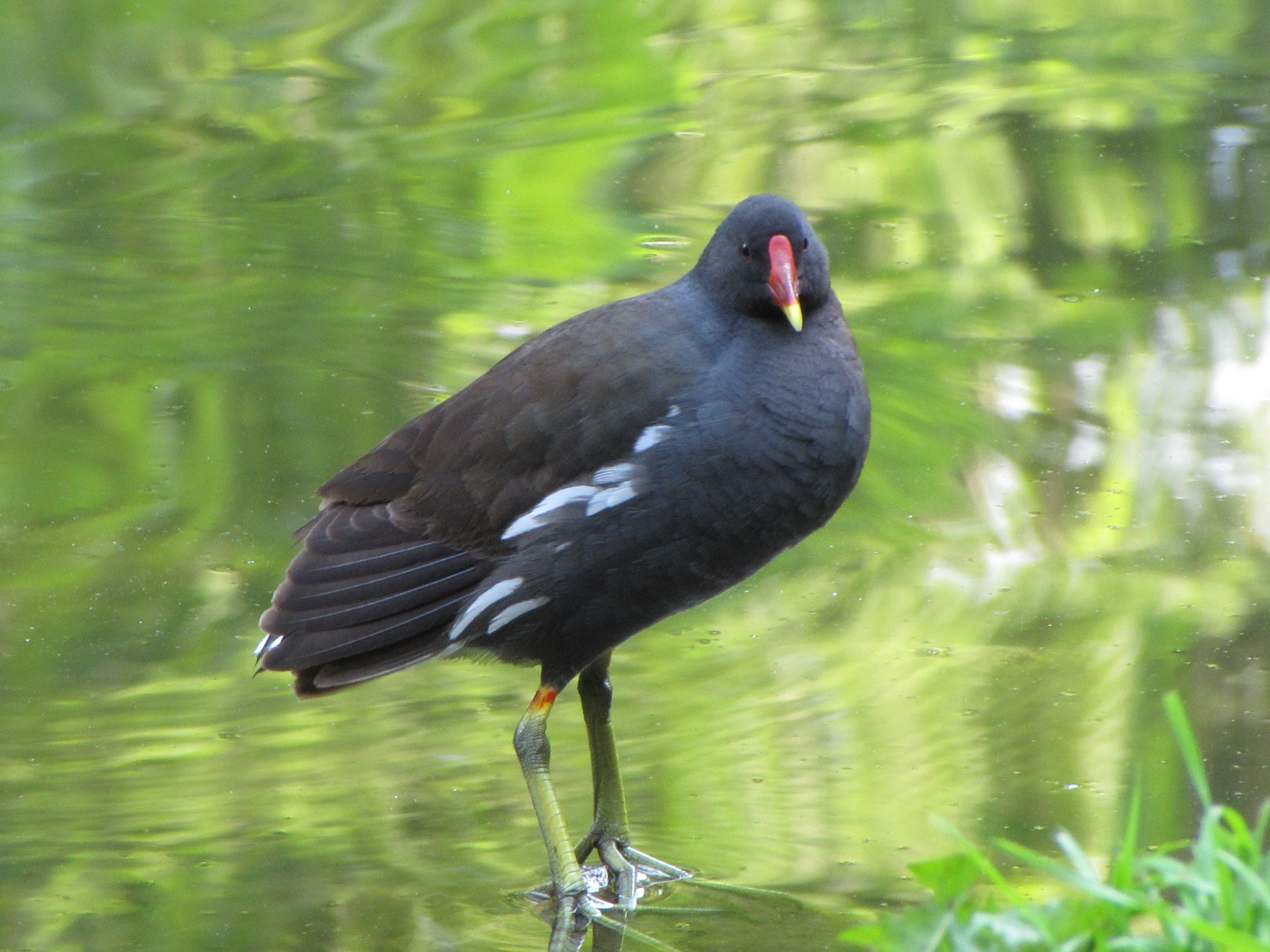
Application Guide for NIH and Other PHS Agencies"). Here is a picture of a moorhen to help you not panic as you download:

Can you see how long its toes are? Fricken' long. Imagine soaking your extra-long toes in a nice summer pond.

5. Do not print out the instruction book. It is 264 pages. You will need to constantly jump from section to section to hunt down the clues and riddles needed to fill out each of the approximately 30 forms you will complete. Keep it digital so you can search for relevant terms.

6. Do print out this glossary of NIH terms. Then read it. Then read it again to see if you understand it any better. Keep in mind that while necessary, this glossary is wildly incomplete, because NIH people can't guess what terms non-NIH people won't understand. Also keep in mind that when they use a term to define itself, they mean well.

7. The National Institutes of Health are called "Institutes" because they have quite a few different topic-specific Institutes, plus a bunch of Centers and several Divisions. You are supposed to know which of these is most likely to be interested in funding your work, contact the appropriate PO (program officer) and pitch it to them before then writing in your cover letter than you contacted that PO and she encouraged you to apply to that Institute, Center or Division. There are very detailed guidelines you should follow in writing to that PO. You are supposed to already know which PO within the appropriate branch is the appropriate PO. The only way I found of finding this out was to spend countless hours on the NIH web pages learning about the structure of NIH, then countless more hours reading those pages before making a wild (and wrong) guess. Luckily the person I wrote to (who wasn't even at the Institute I thought she was at) directed me to another person, who told me that I was heading the wrong way. Eventually I made a decision.

8. Go through the instruction book and make a list of all the forms and attachments you will need. Depending on the specifics, there could be anywhere from 15 to infinity of them. On your list, make notes as to the purpose of each form and what is an attachment to which extension to which sub-form. Also note which parts you have to do and which parts the SO has to do, and then confirm this with the SO. Then look at these pieces in the pile of example applications you've gathered.

9. Don't plan any vacations for before the due date. Plan a vacation for after the due date.

10. You may notice that I have not yet mentioned anything about science. At least once a week, think about the scientific goal of your application. It is very easy to lose track of the fact that there is some reason you are putting yourself through this.