
Showing posts with label urban wildlife. Show all posts
Showing posts with label urban wildlife. Show all posts
Monday, July 07, 2014
Nightly visitor


Tuesday, January 03, 2012
Oh give me a home, where the apple-snails roam
Retirement communities are, by design, fairly sterile places. Much of south Florida is covered in huge gated spreads of nearly identical buildings with neatly trimmed lawns leading down to pleasingly curving shallow canals so that every apartment can have water views. It is uniform, controlled, boring. But all those networks of shallow canals catching lawn fertilizer and Florida sun provide habitat and highways for rapidly growing aquatic plants, which feed aquatic invertebrates and fish. With relatively few retirement community residents catching their own fish, this leaves the fish to grow as big as want.
Or at least it used to. When I was a kid visiting my grandparents in Century Village, I rarely saw any wildlife around the wide place in the canal (referred to as a lagoon because it increases resale values) behind their apartment.
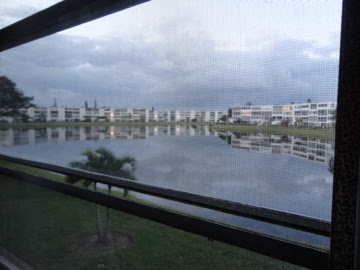
When I was a teenager and my grandmother was widowed, the lawn by the water was occupied by a flock of Muscovi Ducks (plant eaters), Cattle Egrets (which eat mostly insects picked from lawns) and the very occasional Great Blue Heron, which eat only small to medium fish. My aunt inherited the same apartment, and my wife and I brought our baby daughter to visit her this winter. Our first morning there, jetlag woke us early. Standing by the lagoon was a flock of Wood Storks. Walking past them in the water's edge was a flock of White Ibis, trailed by a Tricolor Heron.
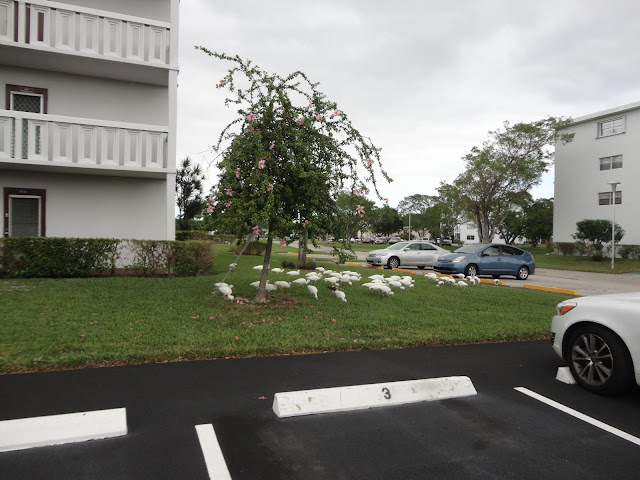
On the far bank an Anhinga spread its black wings to the sun. A few feet away lay a huge dead fish, heavily built and probably 80cm long, partly eaten by something. What could kill a fish that big, drag it up on the bank and eat only part of it? Walking the banks we found the shells of numerous Apple Snails, so named because they are as large as the fruit. Apple snails don't come up on land by themselves, so something must have carried them up, presumably to eat them. In back of the next building over, beyond the Great Egret and Little Blue Heron, I could just see something moving on the bank. I thought it might be a dog (not allowed in Century Village) but then I could see it was two long low animals chasing and wrestling with each other. They jumped in the water and swam as no dog could. River otters! A pair of very large river otters chased each other, making circles in the reflected condos. The remains of several large fish, each only partly eaten, attested to the successful hunting they had been having in the canal.
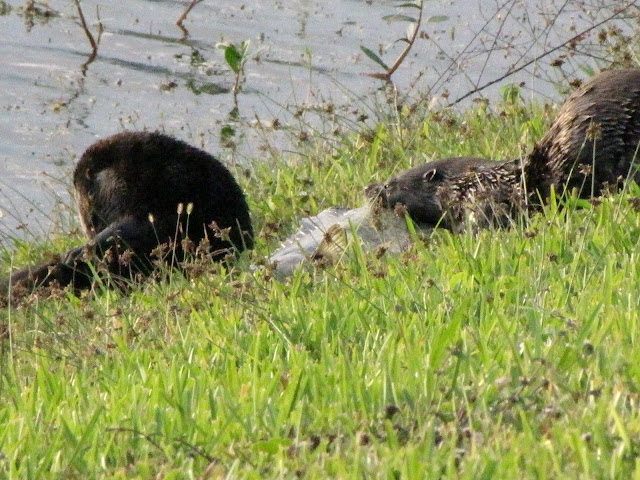
Four Turkey Vultures sat around one such plate of sushi as others circled and swooped, their wing tips almost brushing the screening of enclosed patios. We cajoled my aunt, her bad ankle throbbing, to come out onto the lawn with us for a closer look at the otters. We crept closer to them and the fish they were snacking on until they raised their heads and hissed at me, at which point we backed off.
All this wildlife, carrion, birds and their poo on cars, giant snails, etc. are pretty clearly not what the designers of Century Village, and south Florida's thousands of other retirement communities had in mind. Nevertheless, I think most of the residents are probably happy to have so much nature on their lawns. I doubt all those telescopes and binoculars sitting in the screened patios were for spying on the other retirees.
Is this all good for the wildlife populations? Clearly they would have been better off if the wetlands had not been made into retirement communities, but given that they were, I'd guess that learning to exploit those communities is to their advantage. The water in these canals surely has all sorts of runoff from lawns and parking lots, but if the birds feeding in it can still breed consistently, they are likely to have a feeding habitat that no one will drain, pave or burn. If things get too rough in the nearby Everglades, they will have a retirement home ready.
Thursday, October 08, 2009
Crazy like a crow

I've seen a lot of birds doing a lot of bizarre things. But I couldn't figure out what the heck this crow was doing. Yesterday afternoon, as I was leaving work, I saw a hooded crow (one of the common urban birds hereabouts) flying in the most bizarre bouncy way. Flap hard to climb, drop sharply, pull up, flap upward, attempt to hover, sliding from side to side, drop sharply and repeat. It weaved and bobbed 30 meters above a road full of moving cars. All I could think was that it was playing (which was surprising because crows usually play when there are other crows around to impress, and this was the only one in my line of sight). Then I noticed it had something in its beak. A small ball on a string, or something such. It repeatedly, and obviously intentionally dropped it, only to dive downward and catch it again, then regain altitude for another drop. Several times I thought the what-ever-it-was would fall on one of the moving cars, but the crow always caught it before it could fall that far. After a couple of minutes of this, the crow changed position, flying high over the broad and mostly empty sidewalk on which I stood. After a couple of false starts it dropped its cargo, which plummeted to crash in the middle of the sidewalk, in a clear area with little leaf debris and no people within 20m . As the crow came in to land, I ran over to see what the thing was. It watched me, keeping maybe 5m back, but obviously not ready to take off. The something it had carried, dropped and broken was a large chestnut, now cleanly cracked in half, with the meat easily accessible through the shattered shell.
I backed off and let the crow enjoy its well-earned meal.
Monday, October 05, 2009
The Jellyfish of Copenhagen

Unlike French toast, Danish pastry is actually a specialty of the country it is named for. So while visiting friends in Copenhagen, we had little choice but to make frequent visits to the "Lagkagehuset," pronounced "La-Kay-Who-set" and meaning "The Layer Cake House." Our friend Nisha assured us that this was the best bakery in Copenhagen, and judging by their pastry this seems likely. (Broader sampling may be necessary at some point.) Lagkagehuset is next to one of the many canals that crisscross Copenhagen, and one morning as we sat eating our pastry, I noticed something floating by, maybe a plastic bag. The way it moved caught my eye because it didn't seem entirely passive. I went to take a closer look, but it was gone, moving quickly downward in the water. Too quickly to be a plastic bag, unless there was a sudden and sharp down current. Watching for a moment more, another floated into view, and it was a jellyfish! A big one, as big around as a dinner plate, but with tentacles only a hand long. As we stood and watched dozens more gradually floated by, apparently feeding on the numerous small silver fish moving in schools through the canals. I was surprised to find so much active, apparently healthy sea life in the middle of a major metropolis. Over the next few days every time I glanced into the canals there were jellyfish. Copenhagen's water seems to support lots of little fish, and the jellyfish seem to be their main predators. I've heard that in at least some cases (e.g. where the Mississippi's nutrients spill into the Gulf of Mexico) jellyfish thrive in polluted waters. The water in the canals of Copenhagen look pretty clear, but it is a major metropolis, so I'm not sure if the jellyfish in this case indicate dirty water or a healthy ecosystem. Either way, it is cool to see them floating by.

Wednesday, July 16, 2008
Snake self defence
Iris and I were on our way up Blake St from the BART station to our house.
At the corner of Walnut St, I exclaimed, "Oh!"
"What! What!? What?" Iris responded.
"A garter snake!"
The sleek black ribbon, two feet long and no more than half an inch wide, with a bright yellow strip up its back, was frantically trying to wriggle out of the street and onto the curb. That corner has no curb-cut, and its movements were too disorganized to allow it to climb the 6-inch curb.
Three facts jumped to mind:
1. It was clearly overheated by being on the black pavement in the sun, and would cook to death or get run-over unless we rescued it.
2. Garter snakes are not poisonous, but can bite.
3. It probably came from El Cerrito Hillside Natural Area, 200m up the street.
So I handed my cane and groceries to Iris and grabbed the snake with both hands. But I had forgotten that the hotter a snake is, the faster it can move. Before I could get a finger on it, my thumb was bleeding from multiple tiny punctures. I grabbed the little snot anyway and held firmly, but without squeezing, on the back of its skull. Then it hit me with a garter-snake's last line of defense: musk. A garter snake's musk glands are in its vent (a.k.a. cloaca, a.k.a. butt) and can rapidly discharge a surprising quantity of a fluid that smells somewhere between a port-a-potty and old gym-socks.
With one hand bleeding and the other clamped on a snake and stinking, I looked up at Iris. She handed me my cane and retreated up the street.
Thamnophis elegans - Western Terrestrial Gartersnake


At the corner of Walnut St, I exclaimed, "Oh!"
"What! What!? What?" Iris responded.
"A garter snake!"
The sleek black ribbon, two feet long and no more than half an inch wide, with a bright yellow strip up its back, was frantically trying to wriggle out of the street and onto the curb. That corner has no curb-cut, and its movements were too disorganized to allow it to climb the 6-inch curb.
Three facts jumped to mind:
1. It was clearly overheated by being on the black pavement in the sun, and would cook to death or get run-over unless we rescued it.
2. Garter snakes are not poisonous, but can bite.
3. It probably came from El Cerrito Hillside Natural Area, 200m up the street.
So I handed my cane and groceries to Iris and grabbed the snake with both hands. But I had forgotten that the hotter a snake is, the faster it can move. Before I could get a finger on it, my thumb was bleeding from multiple tiny punctures. I grabbed the little snot anyway and held firmly, but without squeezing, on the back of its skull. Then it hit me with a garter-snake's last line of defense: musk. A garter snake's musk glands are in its vent (a.k.a. cloaca, a.k.a. butt) and can rapidly discharge a surprising quantity of a fluid that smells somewhere between a port-a-potty and old gym-socks.
With one hand bleeding and the other clamped on a snake and stinking, I looked up at Iris. She handed me my cane and retreated up the street.
Thamnophis elegans - Western Terrestrial Gartersnake


Sunday, June 01, 2008
Three Birds, Two Cats and a primate
It was an awful lot of croaking for a Friday afternoon. I went out on the patio to investigate. The Ravens were in an uproar about something. My first thought was that one of their nestlings had fledged and was hiding in our yard. They were flying back and forth, low over the top of the apple tree, scolding and creaking and booming. I decided their fledgling must be in the top of the tree, and they must be trying to tell it that this was not a safe place. My eyes scanning the trees for a fledgling, I was impressed and intimidated to see these two birds, each the size of a large hawk, diving and screaming just over my head. And just as I was starting to think they might really be screaming directly at me, I heard something moving only a couple of yards from my feet. Looking down, I saw this:

A turkey right in our garden, and clearly the focus of the Ravens' ire. They were responding to it as they would any large animal (except humans and deer, which they seem to be used to ) getting too close to their nest tree: by screaming and scolding, "you better git the hell off our land if you know what's good fer ya!" The turkey had apparently responded by hunkering down by Betty's compost bin.

I pulled out my cell phone and started to take pictures. After a couple of minutes the ravens went off to scream at something else and the turkey and I were left to talk amongst ourselves. I went for my better camera, but finding the batteries dead, knocked on Betty's door and said, "Hi Betty, sorry to bother you, but there is a turkey in the backyard. You should bring your camera please."
It was a very tame turkey. I taking photos with my cellphone and Betty with her big digital SLR each stood about 10 feet from it. "People have been feeding it." I said as it watched us hopefully and I resisted the urge to feed it. It rooted around in the garden.

FeLion wandered out onto the patio and saw the turkey. Her response seemed perfectly split between, "That is the biggest bird I have ever seen, I'm gonna eat it." and "that is the bigest bird I have ever seen, I hope it doesn't try to eat me." She was frozen with indecision.

Betty's cat Sophie, on the other hand, was not at all reluctant to charge a bird twice her weight. She burst out of the bushes and sprinted toward the turkey, who turned tail and ran up the step to the very top of our yard.

When I caught up, the turkey was defending a position on top of the garden gate arch, and Sophie was attempting to storm the battlements.

Eventually she succeeded, and the Turkey took to the air, at which point the Ravens resumed their harrying. The turkey, pursued from above an below. stopped in a tangle of low Eucalyptus branches. Betty and I snapped a few more shots and then took the cats inside.


A turkey right in our garden, and clearly the focus of the Ravens' ire. They were responding to it as they would any large animal (except humans and deer, which they seem to be used to ) getting too close to their nest tree: by screaming and scolding, "you better git the hell off our land if you know what's good fer ya!" The turkey had apparently responded by hunkering down by Betty's compost bin.

I pulled out my cell phone and started to take pictures. After a couple of minutes the ravens went off to scream at something else and the turkey and I were left to talk amongst ourselves. I went for my better camera, but finding the batteries dead, knocked on Betty's door and said, "Hi Betty, sorry to bother you, but there is a turkey in the backyard. You should bring your camera please."
It was a very tame turkey. I taking photos with my cellphone and Betty with her big digital SLR each stood about 10 feet from it. "People have been feeding it." I said as it watched us hopefully and I resisted the urge to feed it. It rooted around in the garden.

FeLion wandered out onto the patio and saw the turkey. Her response seemed perfectly split between, "That is the biggest bird I have ever seen, I'm gonna eat it." and "that is the bigest bird I have ever seen, I hope it doesn't try to eat me." She was frozen with indecision.

Betty's cat Sophie, on the other hand, was not at all reluctant to charge a bird twice her weight. She burst out of the bushes and sprinted toward the turkey, who turned tail and ran up the step to the very top of our yard.

When I caught up, the turkey was defending a position on top of the garden gate arch, and Sophie was attempting to storm the battlements.

Eventually she succeeded, and the Turkey took to the air, at which point the Ravens resumed their harrying. The turkey, pursued from above an below. stopped in a tangle of low Eucalyptus branches. Betty and I snapped a few more shots and then took the cats inside.

Friday, May 30, 2008
Garden of Science!
Most anyone in the Northern Hemisphere who has put out a bird feeder has had the problem of dealing with squirrels raiding their feeder, spilling the seed and chasing off the birds. There are a huge range of products designed to deter, exclude or punish the offending rodents, many of which work only marginally. I am currently using a product which is highly effective and nearly free: chili-pepper seed mixed into the bird seed. As any mammal who has bit into a chili-pepper knows, chilies make mammalian mucous membranes burn. What most mammals don't know is that to birds, the active compounds in chilies, capsaicin, does not cause pain to birds. In fact, to them is is an analgesic, meaning a pain killer.
Wild chilies make their seeds and fruits to propagate themselves. But chili seeds eaten by mammals tend to be chewed up, and even if they are not, they don't germinate successfully after passing through our digestive systems, and even if they did, mammals don't tend to transport seeds as far as birds would. So it is well worth their while to produce a compound that dissuades mammalian seed predators and simultaneously encourages avian seed dispersers. Chili seeds pass though the guts of most seed eating birds perfectly primed to germinate, and get a ride far from their parent plant.
But in my bird feeder, the seeds are an enticement to the birds I want to attract, and a strong discouragement to the squirrels. And because it is whole seed, it won't wash away as chili powder would, and pouring whole seed it does not induce as much coughing.
I bought a very cheep bag of over-ripe Thai chilies from my local grocery store, dried them in the sun and then banged them around in the food processor until all the seeds had come loose and settled to the bottom. I then mixed them with commercial bird seed before filling the feeder. The squirrel, to my knowledge, visited the feeder only once.
Thursday, February 21, 2008
"Science" "Journalism"
Even taking into account how poor the state of science journalism is in this country, and what a sorry rag the San Fransisco Chronicle is, this piece on the danger posed to San Francisco by invasive pythons is well below the curve.
To summarize, there is an introduced population of Burmese pythons in the Everglades, 3100 miles away. A USGS lab used an off the shelf climate model to predict where in the US Burmese Pythons could deal with the climate, and San Francisco (along with pretty much the southern half of the US) showed up as one potential habitat.
The idiot who wrote the article then follows this train of thought to show that pythons will be eating pedestrians on Market Street by 2020:
•One python showed up at Lake Okeechobee, 100 miles north of the Everglades, and in the same direction it would travel if its single-minded goal was to reach Fisherman's Wharf.
•Pythons can travel up to 20 miles a month, and the road to SF is 3000 miles, so it will be here in 150 months, or about 12 years.
•Pythons eat mammals.
•"Human beings - like rodents, beavers and deer - are mammals, government scientists confirmed."
•Giant snakes falling from office buildings and eating you.
•QED
The sad thing is, reading the article, I am not sure if he is joking, but I am sure there are some people who will think this is a real threat.
To summarize, there is an introduced population of Burmese pythons in the Everglades, 3100 miles away. A USGS lab used an off the shelf climate model to predict where in the US Burmese Pythons could deal with the climate, and San Francisco (along with pretty much the southern half of the US) showed up as one potential habitat.
The idiot who wrote the article then follows this train of thought to show that pythons will be eating pedestrians on Market Street by 2020:
•One python showed up at Lake Okeechobee, 100 miles north of the Everglades, and in the same direction it would travel if its single-minded goal was to reach Fisherman's Wharf.
•Pythons can travel up to 20 miles a month, and the road to SF is 3000 miles, so it will be here in 150 months, or about 12 years.
•Pythons eat mammals.
•"Human beings - like rodents, beavers and deer - are mammals, government scientists confirmed."
•Giant snakes falling from office buildings and eating you.
•QED
The sad thing is, reading the article, I am not sure if he is joking, but I am sure there are some people who will think this is a real threat.
Saturday, February 16, 2008
Deer Populations and Ecological Illiteracy
The New York Times this week has an article about deer overpopulation in New Jersey (although the problem is just as bad throughout the forested northeast) and efforts to control it through culls.
The problem, and reactions to it, demonstrate the deep ecological illiteracy informing both sides of the debate. Groups that value the deer see them as a natural and beautiful part of the landscape. They are beautiful, and individually they are natural, but their populations are much higher than they would ever have been naturally. This is partially because of removal of predators (deer evolved to breed faster than the wolves and mountain lions could eat them) and partially because we have created so much high quality feeding habitat for them. Deer find the easiest and best food at forest edges, and because of human land use there is so much more forest edge than there has ever been before. Somebody or other, maybe Audubon, said that a squirrel could travel from Maine to Louisiana without ever having to come down from the trees. These were big trees with their leaves way up where deer can't reach, and very few breaks. The forests of the east are now young and fragmented; basically an all you can eat for the deer. And we can no longer rely on long snowy winters to cull deer populations every year. As a result, the effects that deer are having on the forest is very far from natural.
Experiments with deer exclosures (basically large fenced areas, chosen randomly in the forest to see what happens without deer) are fairly unambiguous. I've seen these experiments first hand in the old growth forest of upper Michigan. Working for ecologist Dr. Kerry Woods the summer after I graduated from college, one of my tasks was to revisit exclosures he'd built three years earlier. Outside the exclosures, where the deer can get, extremely few seedlings make it. The forest has an open, park like feeling, no understory. The deer population is so dense everything gets mowed. Inside the exclosures, dense hedges of rapidly growing saplings compete for light, but any branch that reaches outside the enclosure is quickly nipped off. This forest that had never been cut by humans was being kept from replacing itself by the deer overpopulation. The same pattern is being found all over the north-east.
But if the people who see the deer as wonderful parts of nature are ignoring ecology, they are not alone. Those who see deer overpopulation as a problem generally ignore the same ecological facts. Governments organize huge one time culls in limited areas, and are then surprised when deer from next door are attracted by the unexploited greenery. Deer populations with plenty of food and few predators can double every two years or so. Shoot 1500 out of 2000 deer in your county and four years later you are back where you started, even if you don't have deer moving in from adjoining counties.
Basic arithmetic tells us that until White Tailed Deer mortality rates exceed birth rates throughout the northeast, the regional population will not decline. Birthrates are unlikely to decline, unless the structure of the current forest changes so much that the deer are nutritionally limited. Not likely. And plans to control the wild regional population through some sort of sterilization program strike me as ludicrously expensive and incredibly unlikely to work.
So what causes mortality? Disease, winter, cars, predators, hunters. Disease we don't want to encourage, especially considering that many diseases that affect deer can also fell horses, sheep, cows and such. Winters are tending weaker. Sever storms are increasing, but to really knock back the deer population, one needs a winter that is very cold and snowy for months over a large area. Not likely. Few would advocate increased car-deer collisions. Hunters are limited in where they can hunt by the danger of bullets carrying to nearby houses, roads and such. And hunting seasons are limited, in part to make forests safe for other uses the rest of the year. There is also mounting evidence that deer hunters regularly dose themselves and their families with lead when they bring the carcass home. Natural predators are few and far between in the northeast, although coyotes are becoming both more common and larger, making it easier for them to bring deer down. The traditional predators, wolves and mountain lions, are unlikely to be restored to populations in the northeast sufficient to keep the deer in check.
So if reducing deer populations is important and none of our current strategies seem promising, what do I suggest? Integrated pest management. Look at the problem on a broad geographic scale, understand the demography in as much detail as we can, and figure out what the vulnerable point in the demographic cycle is. As an example, hunting seasons were traditionally in the fall and winter, exactly because hunting then reduces the deer herd the least. Fewer winter deaths, no pregnant does, few dependant young. If we really want to keep deer populations down, hunting should be done in the spring. Hunters have traditionally hoped for a buck. But killing a buck does basically nothing to reduce the population in the long term. Some other buck will be happy to inseminate all the does. One buck and a hundred does will produce just as many fawns as one hundred bucks and one hundred does. If our goal is to bring the population down, we need to target does, and let hunters take as many as they please, perhaps requiring the donation of excess meat to charitable food pantries. And we should do it with non-lead ammunition, so we don't poisoning ourselves in the process. And we should be honest enough to admit that we are going to have to do this every year in perpetuity, until the ecology of the northeast changes enough that deer populations are regulated naturally.
The problem, and reactions to it, demonstrate the deep ecological illiteracy informing both sides of the debate. Groups that value the deer see them as a natural and beautiful part of the landscape. They are beautiful, and individually they are natural, but their populations are much higher than they would ever have been naturally. This is partially because of removal of predators (deer evolved to breed faster than the wolves and mountain lions could eat them) and partially because we have created so much high quality feeding habitat for them. Deer find the easiest and best food at forest edges, and because of human land use there is so much more forest edge than there has ever been before. Somebody or other, maybe Audubon, said that a squirrel could travel from Maine to Louisiana without ever having to come down from the trees. These were big trees with their leaves way up where deer can't reach, and very few breaks. The forests of the east are now young and fragmented; basically an all you can eat for the deer. And we can no longer rely on long snowy winters to cull deer populations every year. As a result, the effects that deer are having on the forest is very far from natural.
Experiments with deer exclosures (basically large fenced areas, chosen randomly in the forest to see what happens without deer) are fairly unambiguous. I've seen these experiments first hand in the old growth forest of upper Michigan. Working for ecologist Dr. Kerry Woods the summer after I graduated from college, one of my tasks was to revisit exclosures he'd built three years earlier. Outside the exclosures, where the deer can get, extremely few seedlings make it. The forest has an open, park like feeling, no understory. The deer population is so dense everything gets mowed. Inside the exclosures, dense hedges of rapidly growing saplings compete for light, but any branch that reaches outside the enclosure is quickly nipped off. This forest that had never been cut by humans was being kept from replacing itself by the deer overpopulation. The same pattern is being found all over the north-east.
But if the people who see the deer as wonderful parts of nature are ignoring ecology, they are not alone. Those who see deer overpopulation as a problem generally ignore the same ecological facts. Governments organize huge one time culls in limited areas, and are then surprised when deer from next door are attracted by the unexploited greenery. Deer populations with plenty of food and few predators can double every two years or so. Shoot 1500 out of 2000 deer in your county and four years later you are back where you started, even if you don't have deer moving in from adjoining counties.
Basic arithmetic tells us that until White Tailed Deer mortality rates exceed birth rates throughout the northeast, the regional population will not decline. Birthrates are unlikely to decline, unless the structure of the current forest changes so much that the deer are nutritionally limited. Not likely. And plans to control the wild regional population through some sort of sterilization program strike me as ludicrously expensive and incredibly unlikely to work.
So what causes mortality? Disease, winter, cars, predators, hunters. Disease we don't want to encourage, especially considering that many diseases that affect deer can also fell horses, sheep, cows and such. Winters are tending weaker. Sever storms are increasing, but to really knock back the deer population, one needs a winter that is very cold and snowy for months over a large area. Not likely. Few would advocate increased car-deer collisions. Hunters are limited in where they can hunt by the danger of bullets carrying to nearby houses, roads and such. And hunting seasons are limited, in part to make forests safe for other uses the rest of the year. There is also mounting evidence that deer hunters regularly dose themselves and their families with lead when they bring the carcass home. Natural predators are few and far between in the northeast, although coyotes are becoming both more common and larger, making it easier for them to bring deer down. The traditional predators, wolves and mountain lions, are unlikely to be restored to populations in the northeast sufficient to keep the deer in check.
So if reducing deer populations is important and none of our current strategies seem promising, what do I suggest? Integrated pest management. Look at the problem on a broad geographic scale, understand the demography in as much detail as we can, and figure out what the vulnerable point in the demographic cycle is. As an example, hunting seasons were traditionally in the fall and winter, exactly because hunting then reduces the deer herd the least. Fewer winter deaths, no pregnant does, few dependant young. If we really want to keep deer populations down, hunting should be done in the spring. Hunters have traditionally hoped for a buck. But killing a buck does basically nothing to reduce the population in the long term. Some other buck will be happy to inseminate all the does. One buck and a hundred does will produce just as many fawns as one hundred bucks and one hundred does. If our goal is to bring the population down, we need to target does, and let hunters take as many as they please, perhaps requiring the donation of excess meat to charitable food pantries. And we should do it with non-lead ammunition, so we don't poisoning ourselves in the process. And we should be honest enough to admit that we are going to have to do this every year in perpetuity, until the ecology of the northeast changes enough that deer populations are regulated naturally.
Brown Creeper
There are certain birds that, based on experience, I can place a very high prior probability on finding in any patch of trees around here. Anna's Hummingbird. American Robin, California Towhee, Ruby-Crowned Kinglet and so on. They're there, I can find them quickly. Most of these species made my bird list for El Cerrito Hillside Natural Area within the first day or two. But there is one bird I have high confidence is in all these patches, but not high confidence in finding. And that is the Brown Creeper, Certhia americana. The Brown Creeper, as its name suggests, is not a flashy bird. Small, brown, spotted for camo, the only American representative of the family Certhidae moves like its old world relatives; it creeps, foot over foot, up surfaces (in this case the trunks of trees) probing cracks and crevasses with its wrenish bill, looking for arthropods. It doesn't make a lot of noise, it doesn't make sudden movements, it is an extremely common bird that most people will never see unless they look for it. I have seen people walk past Brown Creepers that are at head height, five feet from their eyes and in full view, and never know the bird is there.
So I have had my eyes and ears open for the little sneakers ever since we moved to El Cerrito, and been continuously thwarted. Occasionally I will see a flash as something shoots past, flapping like a creeper flaps, but been unable to get a good enough look to confirm the identity. I have heard what I thought was creepers but couldn't be sure. But this morning, Iris and I went for a short walk under the oaks just outside our back yard, and a flash of bitty wings caught my eyes. My brain said "Creeper!" I swung around, unwilling to take my eyes off it as it flitted this way and that through the branches, and then dropped, coming to rest on a tree trunk ten meters from us, fully visible only because my brain knew it was there. Iris and I both raised our binoculars. Sure enough, a Brown Creeper, trickling up the trunk. That swaying foot over foot climbing makes the bird move more like a wavering shadow than a living thing, and the speckles on the bird's back looked like little bits of every kind of bark in the forest. Being reminded of this, I felt a little bit of pride at having spotted this very common backyard bird. I'm sure there are hundreds of them back there.
So I have had my eyes and ears open for the little sneakers ever since we moved to El Cerrito, and been continuously thwarted. Occasionally I will see a flash as something shoots past, flapping like a creeper flaps, but been unable to get a good enough look to confirm the identity. I have heard what I thought was creepers but couldn't be sure. But this morning, Iris and I went for a short walk under the oaks just outside our back yard, and a flash of bitty wings caught my eyes. My brain said "Creeper!" I swung around, unwilling to take my eyes off it as it flitted this way and that through the branches, and then dropped, coming to rest on a tree trunk ten meters from us, fully visible only because my brain knew it was there. Iris and I both raised our binoculars. Sure enough, a Brown Creeper, trickling up the trunk. That swaying foot over foot climbing makes the bird move more like a wavering shadow than a living thing, and the speckles on the bird's back looked like little bits of every kind of bark in the forest. Being reminded of this, I felt a little bit of pride at having spotted this very common backyard bird. I'm sure there are hundreds of them back there.
Thursday, September 27, 2007
Duetting Alone
I attended a seminar yesterday given by a former lab mate of mine, discussing her work to understand the duetting call of the California Towhee.
(An article in the Berkeley Alumni Magazine discusses the work and links to a sound file of the call.)
She described how this squeal-call is almost never given by just one bird, and is almost always a duet by the pairs who mate for life (and cheat on each other like mad).
It has been called the "reunion squeal" because the pair always fly towards each other while duetting, and end the duet side by side.
So this morning I was in my neighbor's backyard and noticed a pile of feathers on the ground. They have four outside cats, so I was not surprised. I bent over to examine the feathers and see who the victim was. Drab brown feathers. The wing and tail feathers were too small for a robin or a jay, but too big for most of the sparrows and finches around here. Then I noticed the clump of orange feathers, just the color of a towhee's undertail coverts. A California Towhee, one of the most common birds in the neighborhood, had bit it.
As I stood up, I heard the squeal. A rather half hearted squeal I thought. Then I looked up to see the towhee, sitting on the fence, squealing. It wasn't a half hearted squeal, it was that this bird was doing its half of the duet alone. It was initiating the reunion squeal, but couldn't reunite, because its mate wouldn't squeal back. It squealed twice more in the next several minutes, far more often than is common among pairs.
The cats sat on their lawn chairs and looked smug.
(An article in the Berkeley Alumni Magazine discusses the work and links to a sound file of the call.)
She described how this squeal-call is almost never given by just one bird, and is almost always a duet by the pairs who mate for life (and cheat on each other like mad).
It has been called the "reunion squeal" because the pair always fly towards each other while duetting, and end the duet side by side.
So this morning I was in my neighbor's backyard and noticed a pile of feathers on the ground. They have four outside cats, so I was not surprised. I bent over to examine the feathers and see who the victim was. Drab brown feathers. The wing and tail feathers were too small for a robin or a jay, but too big for most of the sparrows and finches around here. Then I noticed the clump of orange feathers, just the color of a towhee's undertail coverts. A California Towhee, one of the most common birds in the neighborhood, had bit it.
As I stood up, I heard the squeal. A rather half hearted squeal I thought. Then I looked up to see the towhee, sitting on the fence, squealing. It wasn't a half hearted squeal, it was that this bird was doing its half of the duet alone. It was initiating the reunion squeal, but couldn't reunite, because its mate wouldn't squeal back. It squealed twice more in the next several minutes, far more often than is common among pairs.
The cats sat on their lawn chairs and looked smug.
Tuesday, May 15, 2007
DUDES (Diurnal Urban Detritus Eating Sparrows)

There are at least a dozen outdoor housecats on my block. And, as you might expect, not a whole lot of ground dwelling small wildlife. A few salamanders, the very occasional rat (the only times I've seen these there were at least two cats in purrsuit) and some squirells which can outclimb any of the cats. And there is really only one bird species that spends much time on the gound, a big drab brown sparrow called the California Towhee.
Today I saw two of them fighting. A frantic ball of beaks and feathers twisting crazily through the air. They were so intent on mauling each other, they crashed first into the neighbors' fence, then onto the driveway. The instant they touched down, still rolling and pecking, a cat appeared a few yards from them, coming for them at full speed. The cat pounced, and while it was in the air the towhees joined it, but as it began to come down, they accelerated straight upwards. The cat got nothing but the feathers they had torn from each other.
I've seen birds escape preditors before, but nothing quite that close or sudden. These birds clearly had practice. How could they not, given the feline density around here? But somehow, California Towhees seem to thrive, feeding on the ground, in exactly the kinds of neighborhoods that are full of cats.
Like most species able to exploit human created niches, they've got a bright future ahead of them. The cats could even be good for them, keeping out rodents and other birds that would compete with the Towhees for food.
And that is how we get from natural history observation to testable hypothesis.
Subscribe to:
Posts (Atom)
